Cat Insurance: Cheaper Than Dogs, and the Claims Look Different
Cat insurance costs less than dog cover. The claims that dominate, why indoor cats still need it, and how urinary blockage becomes a four-figure emergency.

Table of contents

Cat owners are consistently under-insured relative to dog owners, and the usual reason given is that cats are lower risk. That is half true, and the half that is wrong is the expensive half.
Why cats cost less to insure
Cat premiums run below dog premiums almost everywhere, and the reasons are structural.
Smaller animals, smaller doses, smaller bills. Drug quantities, anaesthesia and surgical time all scale with size.
No large-breed orthopaedic exposure. Cruciate ligament repair and hip dysplasia surgery, which drive a large share of dog claim value, are rare in cats.
Fewer breed-specific hereditary exclusions, though not none, and pedigree cats have their own list.
Lower trauma frequency, particularly for indoor cats.
What does not change is that pet insurance is rated on local veterinary pricing, so your postcode still sets the number. A cat in the Puget Sound corridor costs more to insure than the same cat in rural Iowa, for exactly the reasons our pet insurance by state guide sets out.
The claim profile is genuinely different
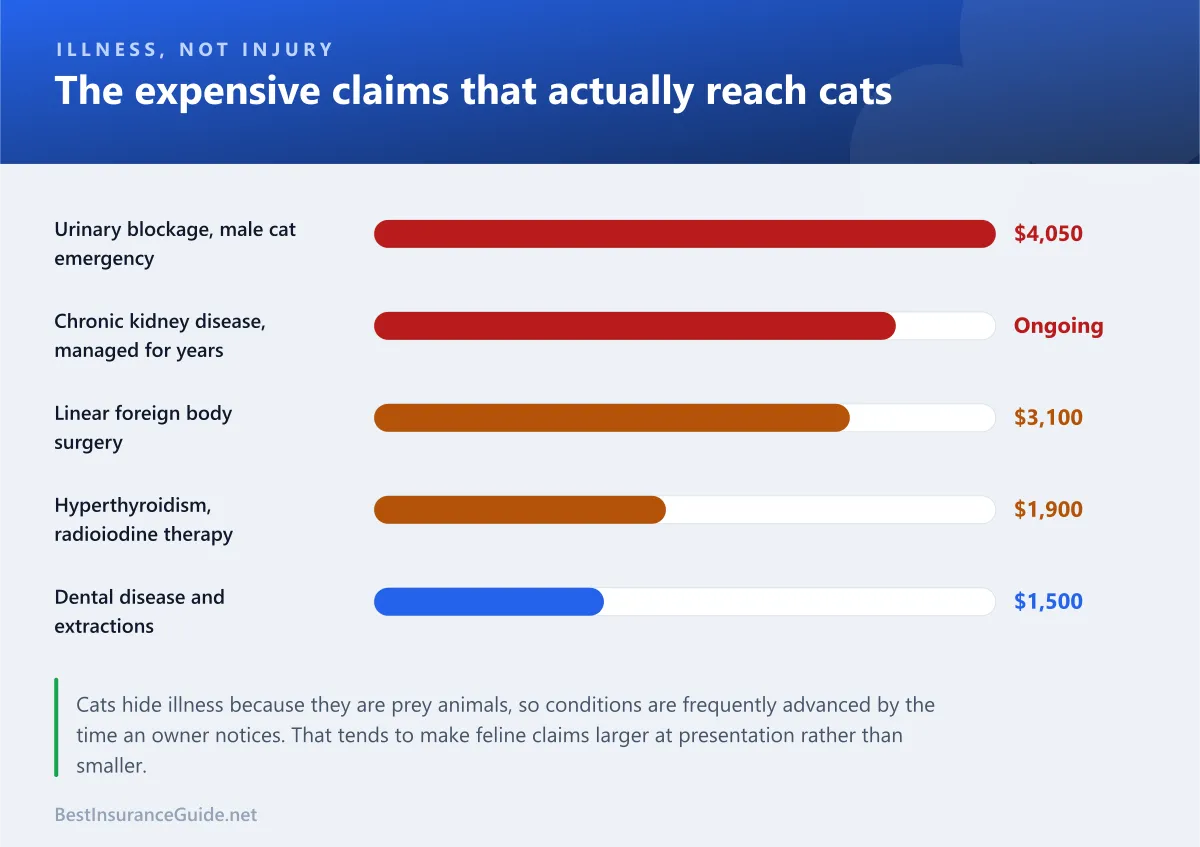
Urinary blockage is the emergency that defines feline insurance. Male cats have a narrow urethra, and crystals, mucus or inflammation can obstruct it completely. The cat cannot urinate, toxins build up, and it becomes life-threatening within a day.
It arrives with no warning, it is a genuine emergency, and treatment means catheterisation, hospitalisation, fluid therapy and monitoring over several days. Recurrent cases sometimes require a surgical procedure to widen the opening permanently.
This one condition is the strongest single argument for insuring any male cat, indoor or otherwise.
Chronic kidney disease is the most common expensive condition in older cats. It is managed rather than cured: prescription diets, fluid therapy, medication and regular monitoring bloods, continuing for years.
Because it is chronic, two policy terms decide whether cover is worth anything. Can a single condition be claimed across multiple policy years? And are prescription diets covered, since therapeutic renal diets are a real recurring cost that many policies exclude as food.
Hyperthyroidism, common in older cats, treatable by medication, surgery or radioiodine therapy, the last of which is effective and expensive.
Diabetes, requiring ongoing insulin, monitoring and sometimes hospitalisation for ketoacidosis.
Dental disease, including tooth resorption which affects a large share of adult cats, and chronic gingivostomatitis which can require full-mouth extraction. Our guide to dog dental insurance covers the coverage rules, which apply equally to cats.
Linear foreign bodies. Cats swallow string, tinsel, hair ties and dental floss, and a linear foreign body can concertina and saw through the intestine. It is a specifically feline surgical emergency and it is expensive.
Cancer, particularly lymphoma.
Worked example: urinary blockage in a four-year-old male cat
Policy: $250 annual deductible, 80% reimbursement, $10,000 annual limit.
| Item | Cost |
|---|---|
| Emergency presentation and stabilisation | $520 |
| Bloodwork, urinalysis and imaging | $610 |
| Urinary catheterisation and unblocking | $780 |
| Hospitalisation with fluids, three days | $1,640 |
| Medication and prescription diet | $290 |
| Follow-up rechecks | $210 |
| Total | $4,050 |
| Less deductible | $250 |
| Reimbursed at 80% | $3,040 |
| Owner pays | $1,010 |
A recurrence, which is not unusual, can lead to a perineal urethrostomy costing a further four figures.
Indoor cats and the misconception
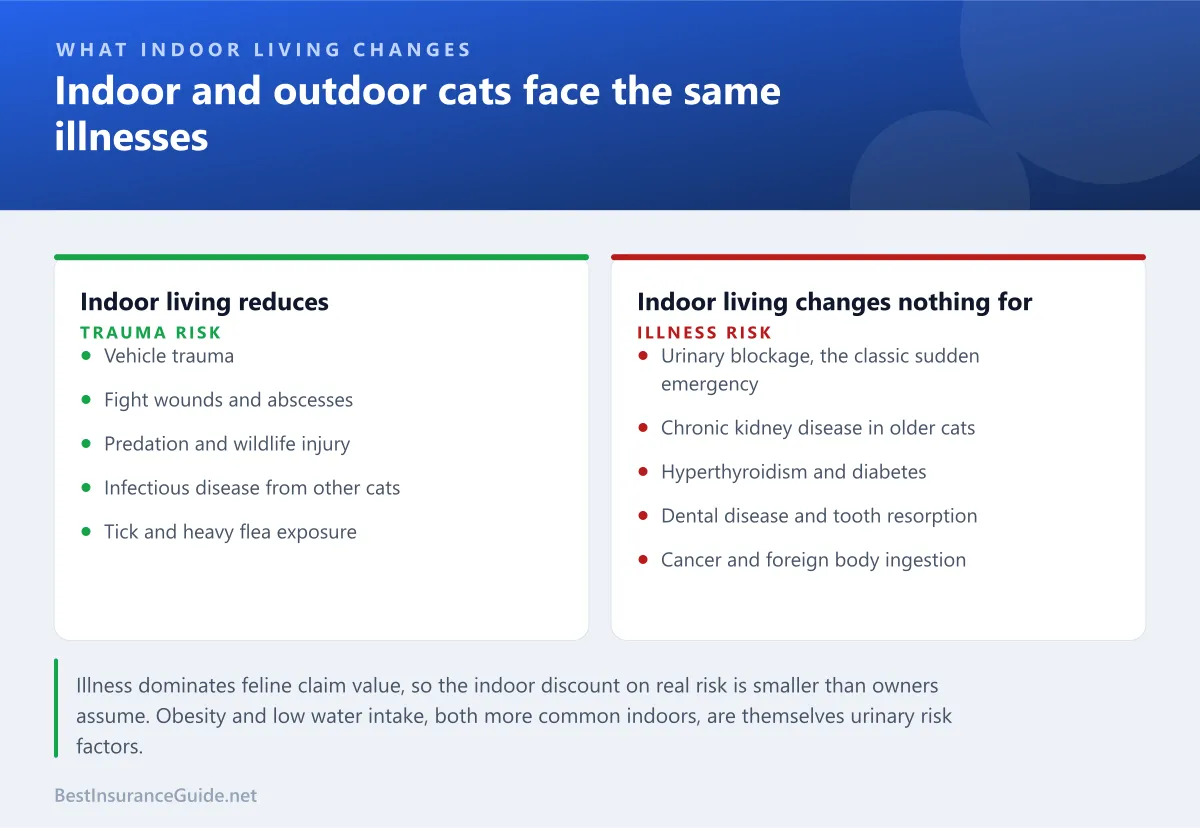
Indoor living meaningfully reduces some risks: vehicle trauma, fight wounds and abscesses, predation, and exposure to infectious disease from other cats.
It reduces none of the following: urinary blockage, chronic kidney disease, hyperthyroidism, diabetes, dental disease, cancer, or foreign body ingestion. Several of those are arguably more common in indoor cats, since obesity and reduced water intake are risk factors for urinary problems.
Since illness dominates feline claim value, the indoor discount on actual risk is smaller than owners assume. Insurers know this, which is why indoor status affects cat premiums far less than people expect it to.
The other complication is that cats hide illness. They are prey animals and they conceal weakness, so conditions are frequently advanced by the time an owner notices. That tends to make feline claims larger at presentation, not smaller.
Buying a cat policy well
The same four fields decide value: the annual limit, the deductible and whether it is annual or per condition, the reimbursement percentage, and the waiting periods.
Four cat-specific priorities on top.
An annual deductible, not per condition. Chronic kidney disease, hyperthyroidism and diabetes are all managed for years, and per-condition designs punish exactly that.
No per-condition lifetime cap. The same reason. A cap will be found by chronic renal management.
Prescription diets covered, if you can get it. Renal and urinary diets are a genuine ongoing cost in the two most common feline chronic conditions, and most policies exclude food. A policy that covers them is worth a premium difference.
Dental illness covered, including tooth resorption, and check whether an annual dental examination is required as a condition of that cover.
Because cat premiums are lower in absolute terms, the cost of buying a higher annual limit is smaller than for a dog. Take the better limit; it costs less here than it does anywhere else.
Insuring an older cat
Cats live long, and a fourteen-year-old cat is common, which makes age limits a live issue.
Most insurers cap new accident and illness policies somewhere between ten and fourteen. Above that, accident-only cover is often still available, though for a cat that is close to useless: indoor cats have low accident exposure and the claims that matter are illnesses. Our guide to accident-only pet insurance sets out when it does and does not make sense.
Read the proposed exclusions before paying. An eleven-year-old cat with recorded early kidney changes will have that excluded, and kidney disease is the condition most likely to cost money.
Enrol young. For cats more than most species, the enrolment date is everything, because the expensive conditions are age-related and appear on routine senior bloodwork.
Prevention that reduces claims
Three habits address the dominant claims directly, and all are cheap.
Increase water intake. Wet food, water fountains and multiple bowls all reduce urinary concentration, which is a direct risk factor for blockage and crystal formation.
Keep weight under control. Obesity is a risk factor for diabetes and urinary problems, and it is the single most common preventable feline health issue.
Remove string-like objects. Hair ties, dental floss, ribbon, tinsel and sewing thread. Linear foreign bodies are among the most serious feline surgical emergencies and they are entirely preventable.
Senior bloodwork from around eight also matters, though note the insurance consequence: it detects early kidney changes, and anything detected before enrolment is excluded. Insure first, then screen.
The short version
Cat insurance costs less than dog insurance because cats generate smaller and less frequent claims, but the claims that do arrive are dominated by illness rather than injury.
Urinary blockage in male cats is sudden, unpredictable and expensive. Chronic kidney disease in older cats is prolonged and expensive. Those two conditions carry the whole argument.
Indoor living reduces trauma and does nothing for illness, so an indoor cat still needs cover.
Buy an annual deductible, avoid per-condition lifetime caps, take a higher annual limit since it is cheap for cats, and ask specifically whether prescription diets and dental illness are covered.
And enrol before senior bloodwork rather than after it.
What a cat policy costs across a life
Cats live long, which changes the arithmetic relative to dogs. A cat insured at twelve weeks may be on the policy for fifteen years or more, and premiums rise with age at every insurer.
| Age band | Indicative monthly premium | Paid in the band |
|---|---|---|
| Years 1 to 3 | $22 | $792 |
| Years 4 to 6 | $29 | $1,044 |
| Years 7 to 9 | $42 | $1,512 |
| Years 10 to 12 | $63 | $2,268 |
| Years 13 to 16 | $91 | $4,368 |
| Total to age sixteen | $9,984 |
Two things fall out of that.
The absolute numbers are far gentler than for dogs, which is why the higher annual limit and better reimbursement percentage are worth buying for a cat. The upgrade costs less here than anywhere.
The late years are where both the premium and the claims concentrate. Chronic kidney disease, hyperthyroidism and dental disease are all conditions of older cats, and they arrive precisely when the premium has tripled and owners are most tempted to cancel.
Cancelling at twelve, after a decade of payments, immediately before the years the policy exists for, is the predictable failure. If the number stops working, raise the deductible or drop the reimbursement percentage at renewal. Both keep the enrolment date.
Multi-cat households
Cats are frequently kept in twos and threes, and a few points apply specifically.
Insure each cat separately and early. Multi-pet discounts run around five to ten per cent per additional animal, which is worth asking for and never worth delaying an enrolment over.
Risk is not shared. Urinary blockage, kidney disease and hyperthyroidism arrive independently. Three cats is three times the exposure, not a pooled one.
Infectious disease is shared, however. Upper respiratory infections, ringworm and parasites move between cats in a household, and an outbreak can produce simultaneous claims. That is covered as illness on each policy, subject to each deductible.
Introduce new cats carefully. Stress is a genuine trigger for feline idiopathic cystitis, which is one of the most common urinary presentations, and a badly managed introduction can produce a claim.
Signs worth acting on
Because cats conceal illness, knowing what actually warrants a same-day visit is worth more than any policy feature.
A male cat straining in the litter tray and producing nothing is an emergency. Not tomorrow. That is urinary blockage until proven otherwise, and it is fatal within a day or two untreated.
Sudden weight loss with a good appetite in an older cat suggests hyperthyroidism or diabetes.
Increased drinking and urinating is the classic early sign of kidney disease or diabetes, and it is easy to miss with a covered litter tray or an outdoor cat.
Not eating for 24 hours is significant in any cat, and in an overweight cat it risks hepatic lipidosis, which is serious.
Hiding, or a change in normal behaviour, is frequently the only sign a cat gives.
Acting a day earlier on any of these reduces both the clinical severity and the size of the claim, which is the one thing that benefits everyone.
A note on scope
Cover terms, exclusions, age limits and pricing vary between insurers, by state and over time, and the figures here are illustrative ranges rather than any particular company’s schedule. Veterinary charges differ substantially by region, and a urinary blockage in a high-cost metro will cost considerably more than the worked example above.
Clinical guidance, including diet, weight management, when to begin senior screening and what any individual symptom means, is for your veterinarian rather than an article. The signs listed here are prompts to seek advice, not a diagnostic tool.
This site is independent and not affiliated with any insurer.
Related reading
Pet insurance for rabbits covers the other non-dog market and how thin the options become outside cats and dogs. Pet insurance that starts immediately covers waiting periods, which matter as much for a cat as for a dog and are the most common source of a declined first claim.
A note on scope
Cover terms, exclusions and pricing vary by insurer, by state and over time, and the figures here are illustrative ranges rather than any particular company’s schedule. Veterinary charges differ substantially by region.
Clinical guidance, including diet, weight management and when to screen, is for your veterinarian. This site is independent and not affiliated with any insurer.