What Does Contingent Beneficiary Mean? The Backup That Prevents Probate
What a contingent beneficiary is, how it differs from a primary beneficiary, why naming one matters, and the designation mistakes that send money to probate.

Table of contents
A contingent beneficiary is the backup, and naming one is among the highest-value two-minute tasks in personal finance. It is also among the most commonly skipped.
The structure
A beneficiary designation has two layers.
The primary beneficiary is first in line. If they are living when the insured dies, they receive the proceeds.
The contingent beneficiary receives the proceeds only if no primary beneficiary can. That happens when the primary died first, cannot be located, or declines the benefit.
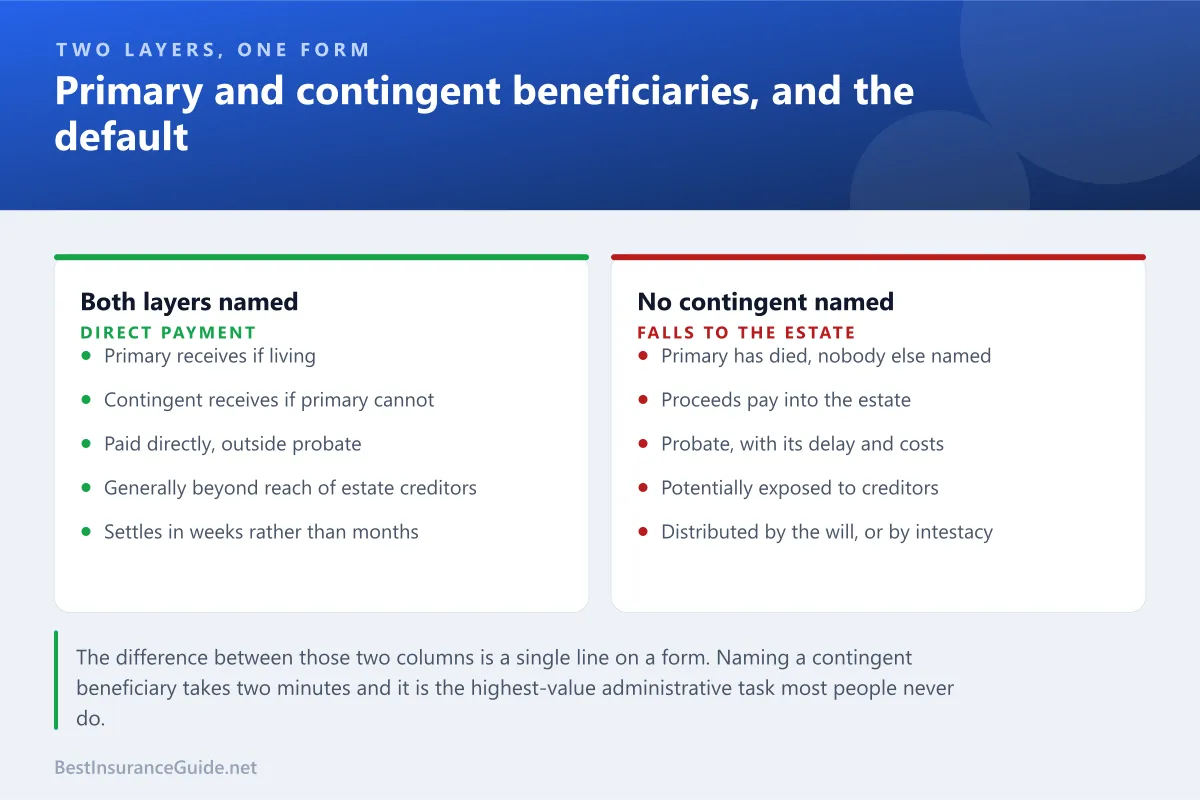
You can name several of each, with percentage shares totalling 100%, and a well-drafted designation names both layers.
Why the backup matters
Without a contingent beneficiary, one specific failure produces a disproportionate consequence.
If the primary beneficiary has died and nobody else is named, the proceeds generally pay into the estate. That is a materially worse outcome than a direct payment for four reasons.
Probate. Estate proceeds go through the probate process, which adds months and sometimes far longer.
Creditors. Money in an estate can be reachable by creditors of the deceased. Money paid directly to a named beneficiary generally is not.
Costs. Probate has administrative and sometimes legal costs, which reduce what reaches the family.
Control. Estate proceeds are distributed according to the will, or according to intestacy rules where there is none, rather than to the person you would have chosen.
Worked example: the same policy, two designations
A $400,000 policy. The primary beneficiary, a spouse, died eighteen months before the insured.
| Contingent named | No contingent | |
|---|---|---|
| Who receives the proceeds | The named contingent, directly | The estate |
| Probate required | No | Yes |
| Typical time to payment | Three to six weeks | Many months |
| Exposed to estate creditors | No | Potentially |
| Distribution follows | Your designation | The will, or intestacy rules |
The policy was identical. The difference is a line on a form.
Designations override wills
This is the point that surprises people most, and it is worth stating without qualification.
A beneficiary designation controls where that money goes, regardless of what a will says.
The practical consequences are severe and common.
An ex-partner named on an old policy receives the proceeds, even where a subsequent will leaves everything to a new spouse. Divorce does not automatically remove a designation in most jurisdictions, though some states have statutes that do, and relying on that is unwise.
A deceased parent still named as primary means the money defaults to the estate if there is no contingent.
A designation made before children were born frequently names a sibling or a parent, and never gets updated.
The same principle applies to retirement accounts, which are usually the other largest asset with a designation attached, and the same neglect applies to them.
Per stirpes, and why it matters
One technical option is worth knowing about because it prevents a specific unfairness.
Per capita, which is the usual default, means a deceased beneficiary’s share is redistributed among the surviving beneficiaries at that level.
Per stirpes means a deceased beneficiary’s share passes down to their own children instead.
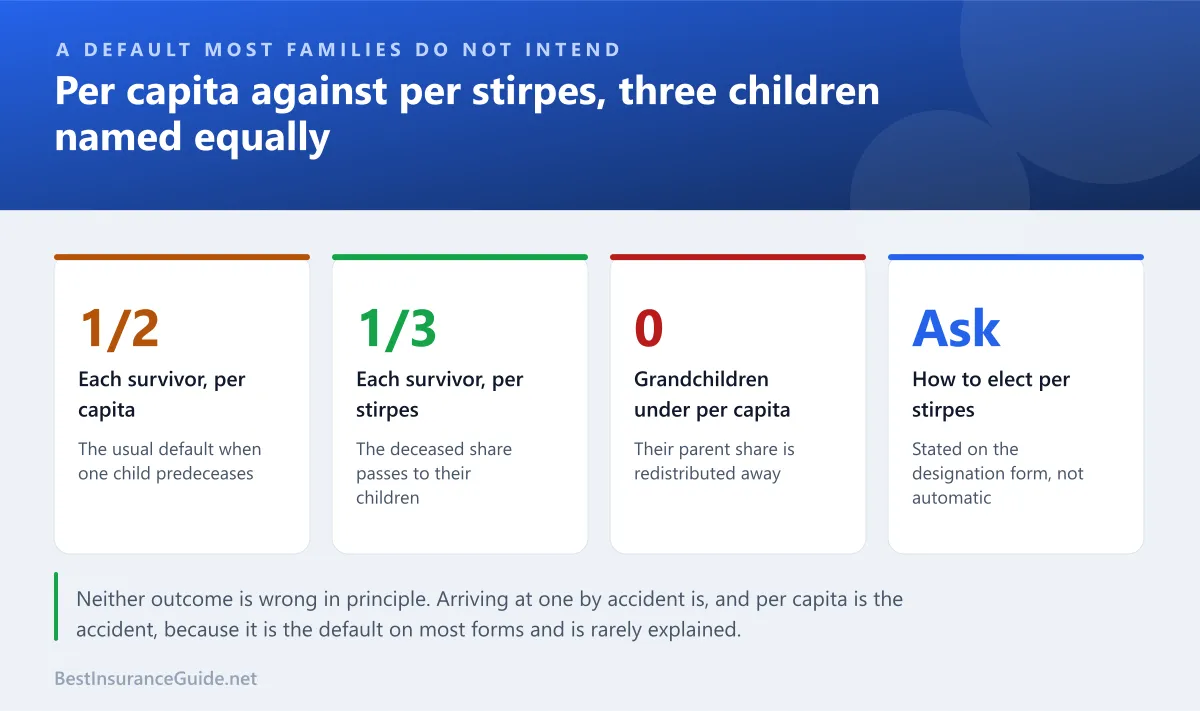
Worked example: three children, one predeceased
A policy naming three children equally. One child dies before the insured, leaving two children of their own.
| Per capita, the default | Per stirpes | |
|---|---|---|
| Surviving child A | One half | One third |
| Surviving child B | One half | One third |
| Grandchildren of deceased child | Nothing | One third, shared |
Neither outcome is wrong in principle. What is wrong is arriving at one of them by accident, and per capita is the accident most families do not intend.
The mistakes that recur
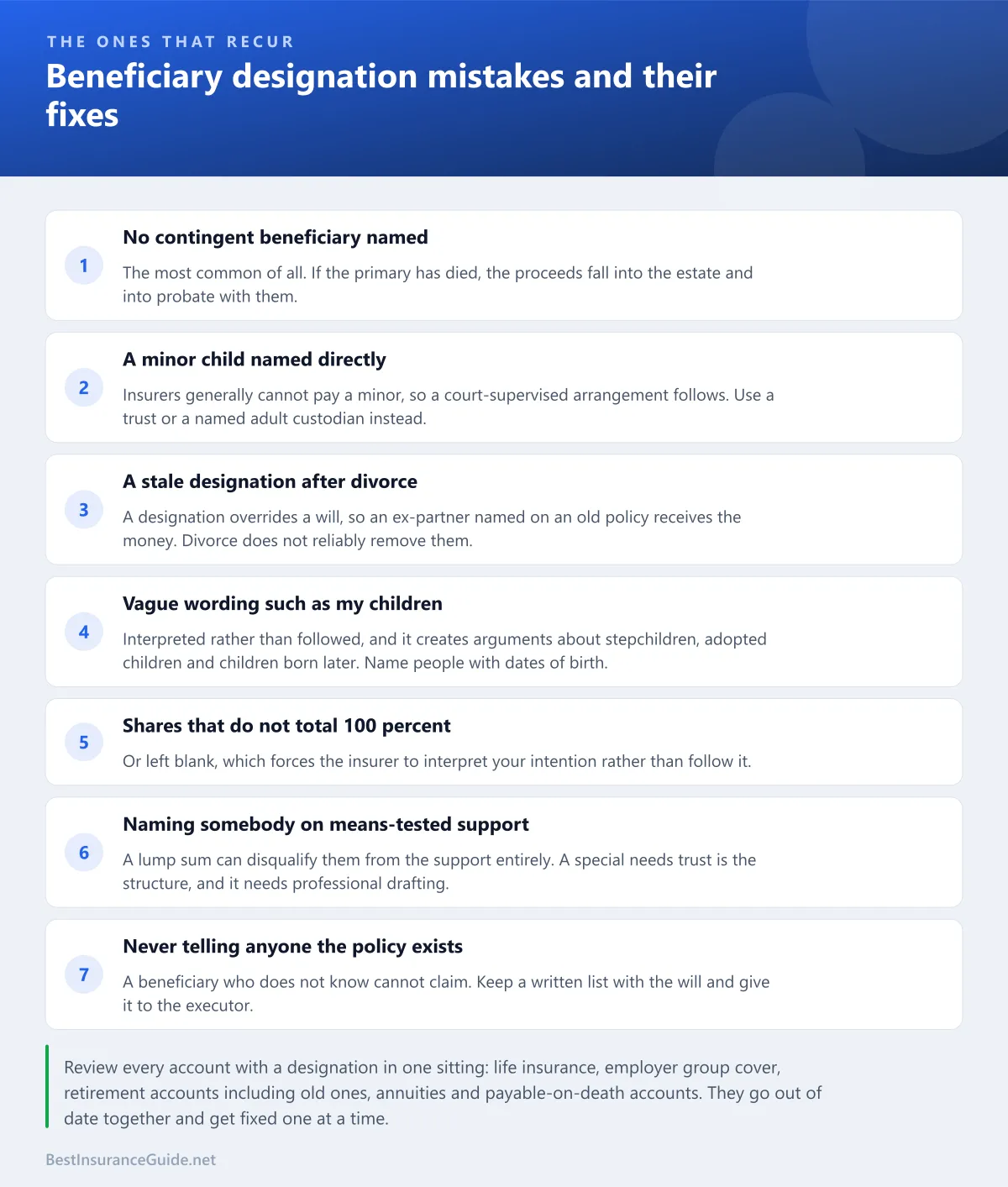
No contingent beneficiary named, which is the subject of this article and the most common of all.
Naming a minor child directly. Insurers generally cannot pay a minor. Proceeds go into a court-supervised guardianship or conservatorship arrangement, which is slow, costs money and hands control to a court rather than to a person you chose. A trust, or a custodian under a uniform transfers to minors arrangement, is the usual answer and is worth advice.
Naming “my estate” deliberately, which some people do believing it is tidy. It is the outcome the direct designation exists to avoid.
Vague designations. “My children” is interpreted rather than followed, and it creates arguments about stepchildren, adopted children and children born later. Name people, with dates of birth.
Shares that do not total 100%, or that are left blank, which forces the insurer to interpret.
Stale designations after divorce, which is the single most consequential category.
Naming a person who receives means-tested benefits, where a lump sum can disqualify them. A special needs trust is the structure for that and it requires professional advice.
Never telling anyone, so nobody claims the policy at all.
Reviewing yours
The habit worth building is simple.
Review after every life event. Marriage, separation, divorce, a birth, a death, a serious diagnosis, a move abroad.
Review everything with a designation at the same time. Life insurance, employer group life, retirement accounts, and any annuity. They drift out of date together and are usually updated one at a time.
Confirm the change was recorded. Submit the form and then ask the insurer to confirm the current designation in writing. Forms go astray, and the time to discover that is now.
Keep a written record of what is designated where, with the will and with the executor.
Do it every few years regardless, because nothing prompts you otherwise.
Our guide to how long life insurance takes to pay out sets out how much of the claim timeline this single document controls.
The short version
A contingent beneficiary is the backup who receives the proceeds if the primary cannot. Without one, the money usually falls into the estate, which means probate, delay, costs and exposure to creditors.
Beneficiary designations override wills. An ex-partner named on an old policy receives the money regardless of what the will says, and divorce does not reliably change that on its own.
Do not name minor children directly, be specific rather than describing a class of people, make the shares total 100%, and consider per stirpes if you want a deceased beneficiary’s share to pass to their children.
Then review it after every life event and confirm in writing that the change was recorded.
For the claim process this document controls, see how long life insurance takes to pay out, and for the fundamentals, life insurance basics.
Where else designations apply
Life insurance is where people first meet the concept, and it is not the only place it matters. The same mechanism, with the same override of a will, applies to several accounts that are frequently larger than the life policy.
Retirement accounts. Workplace plans and individual retirement accounts all carry beneficiary designations, and the tax consequences of who inherits them are significant. A spouse generally has options a non-spouse does not.
Annuities, which carry designations and their own tax treatment.
Payable-on-death and transfer-on-death accounts at banks and brokerages, which pass directly to the named person outside probate.
Health savings accounts, which are treated very differently depending on whether the beneficiary is a spouse.
Employer group life and AD&D, which frequently carry a designation made on the first day of a job and never revisited.
The practical instruction is to review them together, in one session, rather than one at a time as each comes to mind. They drift out of date at the same rate and for the same reasons.
Worked example: an outdated designation
Someone who divorced, remarried, and updated their will but not their designations.
| Asset | Named beneficiary | Who receives it |
|---|---|---|
| Life insurance from a previous employer | Former spouse | Former spouse |
| Retirement account from that job | Former spouse | Former spouse |
| Current employer life insurance | Current spouse | Current spouse |
| House and savings, per the will | Current spouse | Current spouse |
The will was updated. Two of the four assets did not follow it, because a designation is a contract with the provider rather than a term of the estate.
The conversation nobody has
One more practical point. Tell the people involved.
A beneficiary who does not know a policy exists cannot claim it, and a contingent beneficiary who does not know they are named will not step forward when the primary cannot.
The version of this that works is a single sheet listing what exists, with whom, and roughly what it is for, kept with the will and given to the executor. It does not need to state amounts and it does not need to be a formal document. It needs to exist.
Doing it properly, in one sitting
The whole exercise takes under an hour and it does not need a professional unless a trust or a special situation is involved.
List everything with a designation. Life insurance, employer group life and AD&D, retirement accounts including old ones from previous employers, individual retirement accounts, annuities, health savings accounts, and any payable-on-death bank or brokerage account.
Check the current designation on each. Not what you remember naming; what the provider has on file. Ask for it in writing where the online portal does not show it.
Name a primary and a contingent on every one, with percentages totalling 100% at each level.
Use full legal names and dates of birth rather than relationships, since “my son” is interpreted and a name is not.
Decide per stirpes or per capita deliberately where you have named several people at the same level.
Submit each change and confirm receipt in writing. Forms go astray, and an unrecorded change is no change.
Write down what exists and where, and give it to the executor along with the will.
Worked example: what an hour prevents
| Without the review | With it |
|---|---|
| Old employer policy still names an ex-partner | Updated |
| Retirement account has no contingent | Contingent named |
| Two children named, one deceased, per capita default | Per stirpes elected deliberately |
| Family unaware two policies exist | Written record with the executor |
| Payout after months of probate | Payout in weeks, directly |
None of that requires spending money or making a difficult decision. It requires an hour and the knowledge that a designation beats a will.
Two situations that need professional help
Most designations are a form. Two situations are not, and both are worth an hour with an estate planning attorney.
A beneficiary who receives means-tested support. A lump sum paid directly to somebody receiving disability or income-related benefits can disqualify them from that support entirely, which is the opposite of what the designation was intended to achieve. A special needs trust is the structure that avoids it, and it has to be drafted properly and named as the beneficiary.
Minor children as the intended recipients. Naming them directly puts the money into a court-supervised arrangement with a guardian appointed by the court. A trust, or a custodian under a uniform transfers to minors arrangement, keeps the choice with you and is straightforward to set up.
In both cases the cost of getting it right is small relative to the amounts involved and to the difficulty of fixing it afterwards.
Related reading
The designation is what determines how a claim runs, and how long life insurance takes to pay out covers the rest of that process. Where the person being insured is an older relative, life insurance on your parents covers how ownership and beneficiary designation should be structured between siblings.
A note on scope
Nothing here is legal or tax advice. Rules on beneficiary designations, the effect of divorce on existing designations, probate procedure, creditor protection and payments to minors vary by state and change over time.
Your state insurance department publishes consumer guidance on life insurance, and an estate planning attorney is the appropriate source where a trust, a minor beneficiary or a beneficiary receiving means-tested support is involved. Your own policy documents and the designation on file with the insurer are the authoritative statement of who receives what. This site is independent and not affiliated with any insurer.