When Should You Buy Travel Insurance? Sooner Than You Think
Can you buy travel insurance after booking? Yes, but the pre-existing condition waiver and cancel for any reason expire 14 to 21 days after your first deposit.

Table of contents
Almost everyone buys travel insurance at the wrong time, and it costs them the best parts of the policy.
The instinct is to sort it out closer to departure, alongside the currency and the parking. By then the most valuable benefits have quietly expired, and nothing about the price tells you that.
The window nobody mentions
Travel insurance has two tiers of benefit.
Core cover is available whenever you buy: emergency medical, evacuation, baggage, delay, trip interruption. Buy the day before you fly and you get all of it.
Time-sensitive benefits are only available if you buy within a short window after your first trip payment, usually 14 to 21 days depending on the insurer.
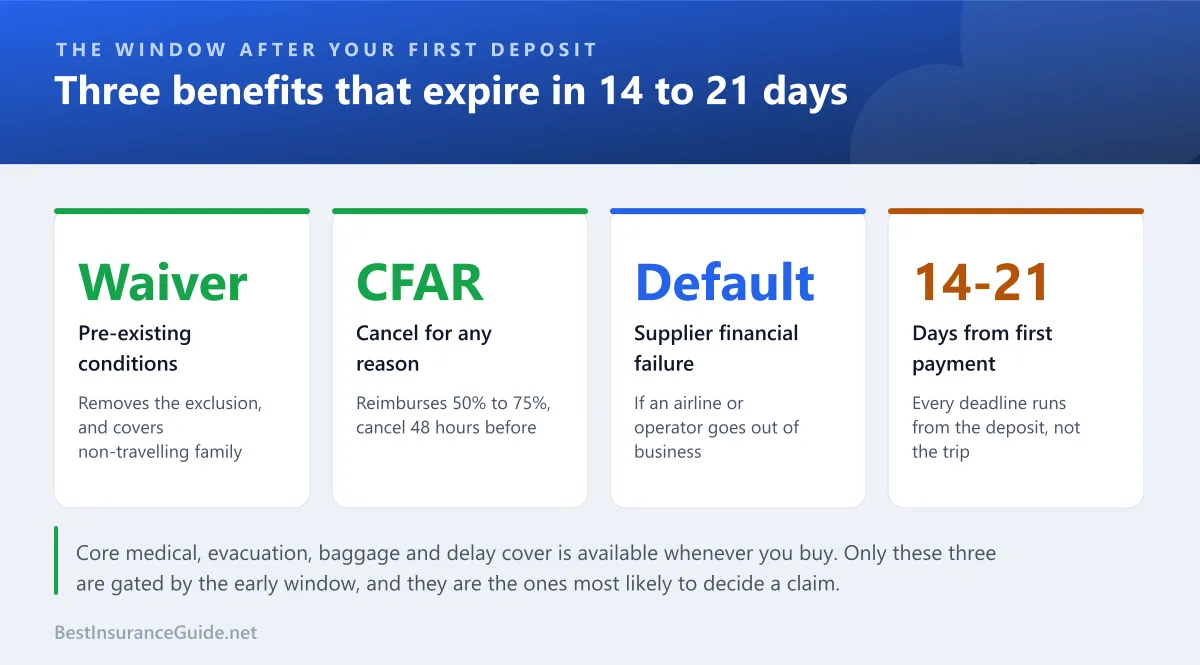
Three benefits sit behind that window, and they are the three most likely to matter.
The pre-existing condition waiver
This is the big one, and it affects far more people than realise.
Standard travel insurance excludes claims arising from a pre-existing medical condition, assessed over a lookback period, commonly 60 to 180 days before purchase. That definition is broader than people expect: a stable, well-controlled condition still counts, and so does a medication dose changed during the lookback.
Buy inside the early window and most insurers waive that exclusion entirely, usually on condition that you insure the full non-refundable trip cost and were medically fit to travel when you bought.
The waiver also covers non-travelling family members. If your trip is cancelled because a parent at home falls ill, whether that claim pays often turns on the waiver, since their condition is assessed the same way.
Cancel for any reason
Standard cancellation cover pays only for listed reasons: illness, injury, death, jury duty, a handful of others. Changing your mind is not on the list. Neither, usually, is anxiety about a situation that has not yet materialised.
Cancel for any reason is an upgrade that removes the list. The typical conditions:
- Bought within 14 to 21 days of the first deposit
- Insure 100% of prepaid non-refundable trip costs
- Cancel at least 48 hours before departure
- Reimburses 50% to 75% of what you lose, not 100%
It costs meaningfully more, often 40% to 60% on top of the base premium. It is worth it for expensive trips far in the future, for anything with a real chance of not happening, and for destinations where conditions can change.
Supplier financial default
If an airline, tour operator or cruise line fails financially, this covers your loss. It is almost always restricted to policies bought early, for an obvious reason: once a company is visibly in trouble, everyone would buy it at once.
So can you buy travel insurance after booking?
Yes, and this is worth stating plainly because the anxiety around it is disproportionate.
You can buy travel insurance after booking a flight, after booking a hotel, after paying a deposit, and in most cases right up to the day before departure. Some insurers will sell up to the departure date itself.
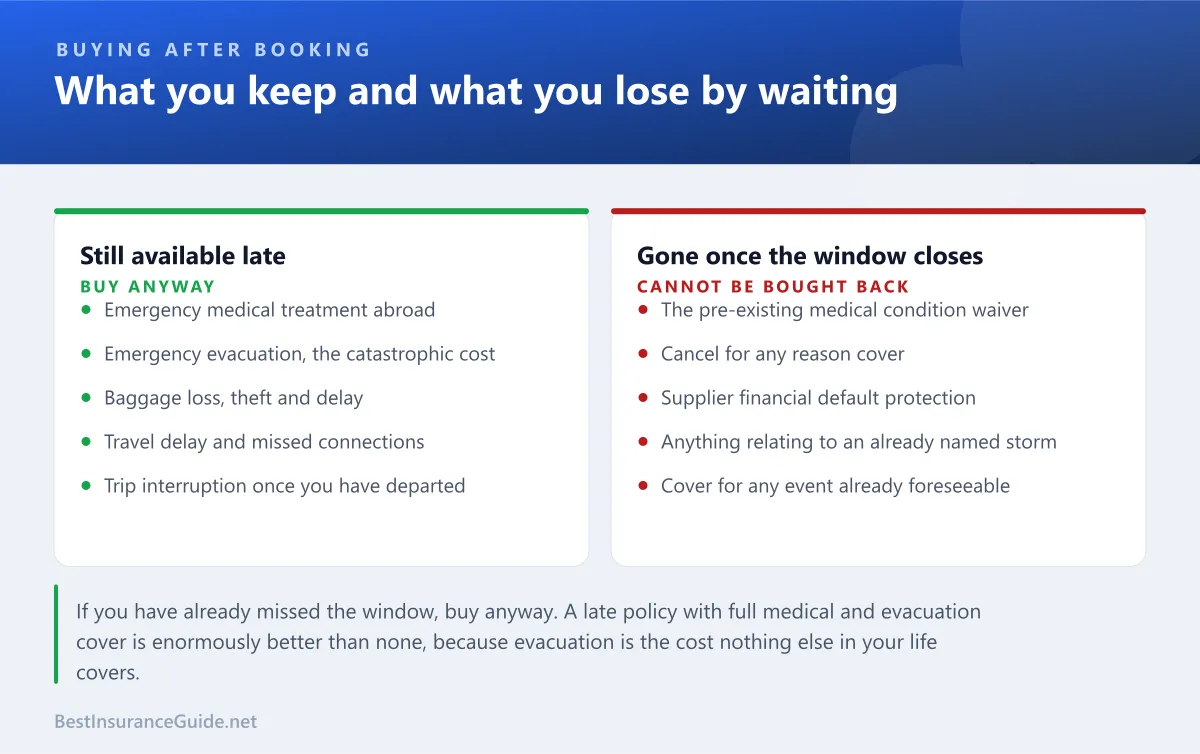
You keep everything that matters for the trip itself. You lose the waiver, cancel for any reason, and financial default cover.
If you have already missed the window, buy anyway. A late policy with full medical and evacuation cover is enormously better than no policy, and evacuation is the genuinely catastrophic cost that nothing else in your life covers. Our guide to whether travel insurance is worth it works through those numbers.
Worked example: two identical trips, bought 3 weeks apart
A $9,400 trip for a couple, one with well-controlled high blood pressure. First deposit paid 12 January.
| Bought 20 January | Bought 10 February | |
|---|---|---|
| Emergency medical | Included | Included |
| Emergency evacuation | Included | Included |
| Baggage and delay | Included | Included |
| Pre-existing condition waiver | Yes | No |
| Cancel for any reason available | Yes | No |
| Supplier default | Yes | No |
| Premium | About $520 | About $470 |
Three weeks later, $50 cheaper, and the blood pressure history is now excluded from every medical and cancellation claim on the trip.
If that condition contributes to a cancellation or a hospital admission abroad, the difference between those two policies is the entire claim.
When it is genuinely too late
Once you have departed. Nearly all policies require purchase before you leave home. A few insurers sell limited post-departure medical cover, at higher cost and with waiting periods.
Once an event is foreseeable. This is the rule that catches people every hurricane season. Insurance covers uncertainty, not known problems.
For storms specifically, the industry uses a named storm cutoff. Once a tropical storm or hurricane is named, any policy bought afterwards excludes claims relating to it. Buy on Monday and the storm is named on Wednesday, you are covered. Buy on Thursday and you are not.
The same principle applies to strikes announced before purchase, civil unrest already under way, and travel advisories already issued.
Does travel insurance cover cancelled flights?
Yes, but its role is narrower than people assume, because the airline owes you things first.
Claim from the airline first. Depending on where you are flying and with whom, airlines owe rebooking, refunds and sometimes cash compensation for cancellations and long delays. Insurance does not duplicate that.
Insurance covers the gap. The unrecoverable costs the airline does not owe: the hotel night you paid for and could not use, the missed tour, the extra accommodation while you wait, the trip abandoned because the delay destroyed the point of it.
Two coverages do the work. Travel delay pays reasonable expenses after a waiting period, typically 6 to 12 hours. Trip interruption covers the unused portion and the cost of getting home early.
Watch the delay threshold when comparing policies. A policy with a 6-hour threshold is materially better than one with 12, and that difference rarely shows up in the headline price.
Is Airbnb or supplier insurance worth it?
Products sold at checkout by an accommodation platform, airline or booking site are usually narrower than a standalone policy.
They typically protect that booking: the accommodation cost, or the flight cost. That is genuinely useful when the stay is the dominant cost of the trip, and it is convenient.
What they often lack is emergency medical and evacuation cover, which is the part of travel insurance that protects against a life-altering bill rather than an annoying one. A cancelled Airbnb costs you a few thousand dollars. A medical evacuation from a remote region costs considerably more, and no accommodation product covers it.
The sensible structure for an international trip is usually a single comprehensive policy covering the whole trip, rather than several narrow products covering individual bookings, each with its own limits and exclusions.
The same test applies to any named provider, including the large established ones. Judge the policy, not the brand: what is the medical limit, what is the evacuation limit, is there a pre-existing condition waiver and what is its window, what is the delay threshold, and what percentage of trip cost are you paying? Compare those five across two or three providers and the choice usually makes itself.
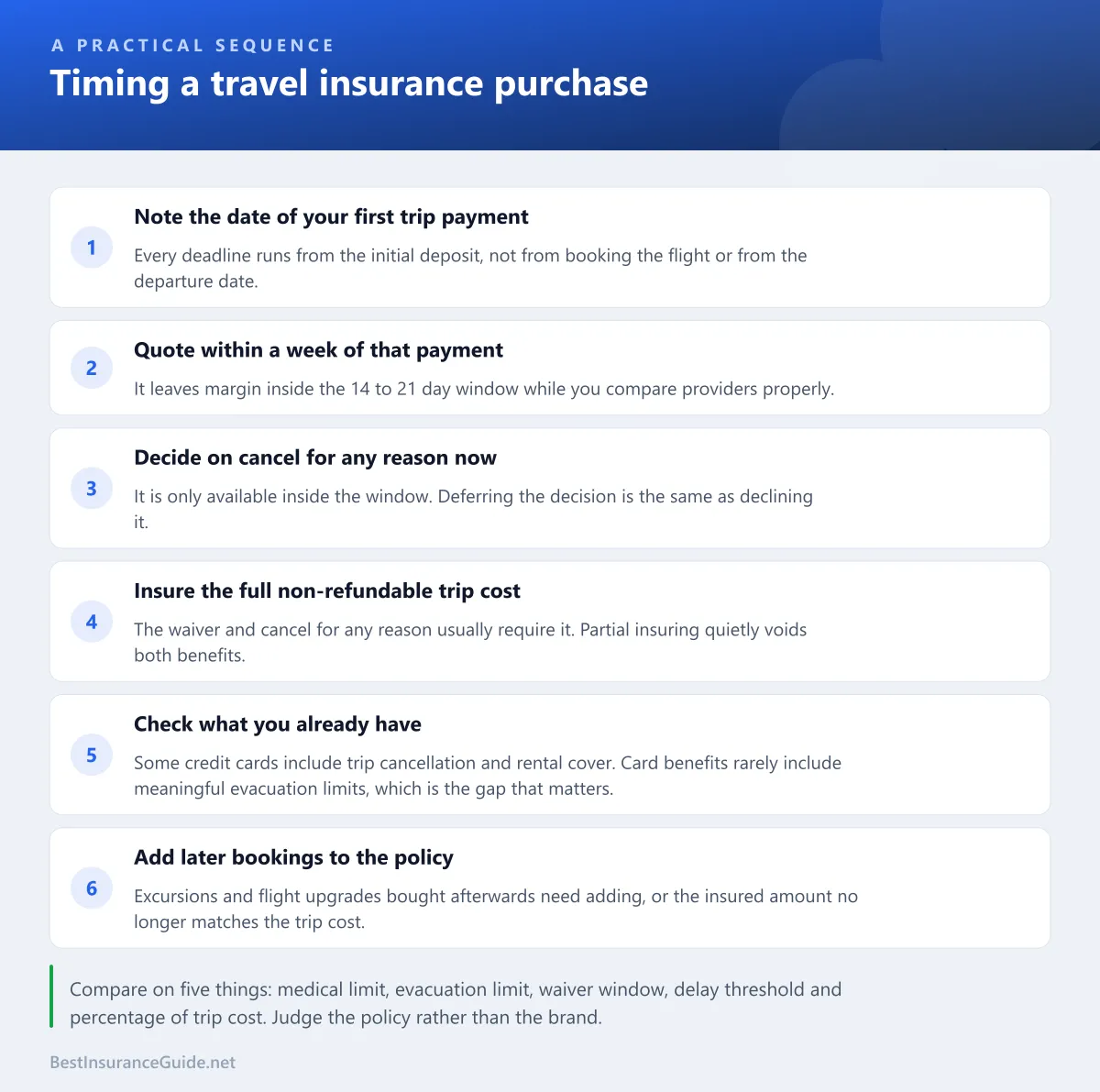
A practical sequence
Book the trip. Note the date of your first payment, because every deadline runs from it.
Quote within a week. That leaves margin inside the 14 to 21 day window while you compare.
Decide on cancel for any reason then, not later, because it is only available now.
Insure the full non-refundable amount. The waiver and cancel for any reason usually require it, and partial insuring quietly voids both.
Check whether you already have cover. Some credit cards provide trip cancellation and rental cover, and a few employer or membership plans include travel medical. Read the benefit guide before buying duplicate cover, though note that card benefits rarely include meaningful evacuation limits.
Add later payments to the policy. If you book excursions or upgrade flights after buying, tell the insurer and increase the insured amount so the full trip cost stays covered.
The short version
Buy travel insurance within about two weeks of your first trip payment. That window is the only time the pre-existing condition waiver, cancel for any reason, and supplier default cover are available, and those are the benefits most likely to decide a real claim.
You can absolutely buy after booking, and you should if you missed the window, because medical and evacuation cover are the reason the product exists. What you cannot do is buy after a storm is named, after an event is foreseeable, or after you have left home.
For whether the policy is worth buying at all, and what evacuation actually costs, see is travel insurance worth it.