Allstate Homeowners Quote: How to Get an Accurate Number
An Allstate homeowners quote takes minutes, but the form guesses your roof age and skips discounts. How to get a number that survives underwriting.

Table of contents

Getting an Allstate homeowners quote is easy. Getting one that still says the same thing after underwriting has looked at your file is a different exercise, and it’s the one worth ten minutes of preparation.
The gap between those two numbers catches people out constantly. You fill in a short form, a figure appears, you mentally file it as “what this costs,” and then the real policy comes back several hundred dollars higher because the form assumed your roof was fifteen years newer than it is. That’s not a bait and switch. It’s what happens when a quote is built from public property records instead of from you.
We’re an independent publisher. We’re not affiliated with Allstate or any insurer, we’re not an agent, and we don’t sell insurance. Everything here comes from publicly available information. Confirm current details with the company or a licensed agent.
Start with the declarations page you already have
If you have any homeowners policy right now, the most useful thing you can do before requesting a new quote is find its declarations page. It’s the summary sheet, usually two pages, listing your coverages and limits.
It matters because a quote only means something against a known set of coverages. A cheaper number that quietly carries a $5,000 wind and hail deductible instead of a $1,000 all-peril one isn’t cheaper. It’s a different product. Without your current dec page you’ve got nothing to hold the new quote against, and comparison collapses into guesswork.
The four lines to copy across exactly:
- Coverage A, dwelling. What it costs to rebuild, not what it would sell for.
- Coverage C, personal property. Often a percentage of Coverage A.
- Coverage E, personal liability. Commonly $100,000 or $300,000.
- Your deductible, including any separate wind, hail or hurricane deductible.
Quote every insurer at those same four numbers and the prices start meaning something.
What to have ready before you open the form
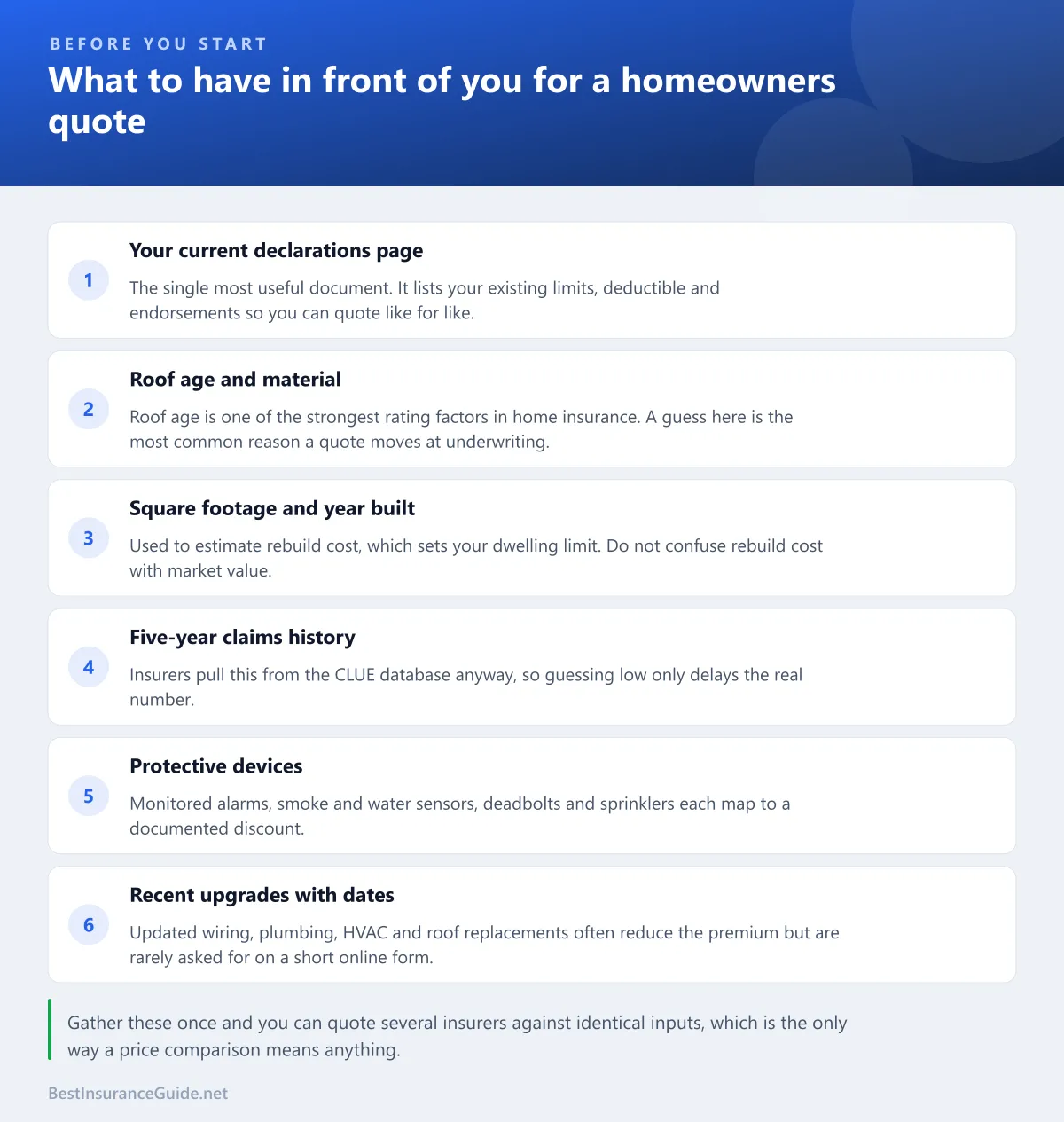
Two of those deserve more explanation, because they’re where quotes move most.
Roof age is the heavyweight. Across the home insurance market, roof age has become one of the strongest single rating factors, and in several states insurers now decline or surcharge older roofs outright. A form estimating your roof from the house’s build year will be wrong for anyone who’s replaced one.
Worked example: what a wrong roof age costs
Same house, same coverage, same everything except what the file says about the roof.
| Roof age on file | Annual premium | Difference |
|---|---|---|
| 5 years (actual, replaced 2021) | $2,140 | — |
| 12 years (form’s guess from a 2014 sale record) | $2,590 | +$450 |
| 26 years (original to the 1998 build) | $3,310 | +$1,170 |
The owner replaced the roof in 2021 and has the invoice in a drawer. The online form assumed the house still had whatever it had at the last recorded sale. Producing one piece of paper is worth $1,170 a year, and nobody asked for it.
Rebuild cost is not market value. This is the most common misunderstanding in home insurance and it runs in both directions. In an expensive metro area, a modest house can have a rebuild cost well below what it would sell for, because land carries much of the price. In a rural area with high construction costs, the reverse. Insuring to market value means either paying for coverage you can’t use or carrying a shortfall you’ll discover at the worst moment. Our guide on what home insurance actually covers works through the coinsurance penalty that follows from getting this wrong.
Where the savings actually come from
Allstate publishes nine homeowners discounts. Availability varies by state and policy form, which is why almost none are quoted as a fixed percentage.
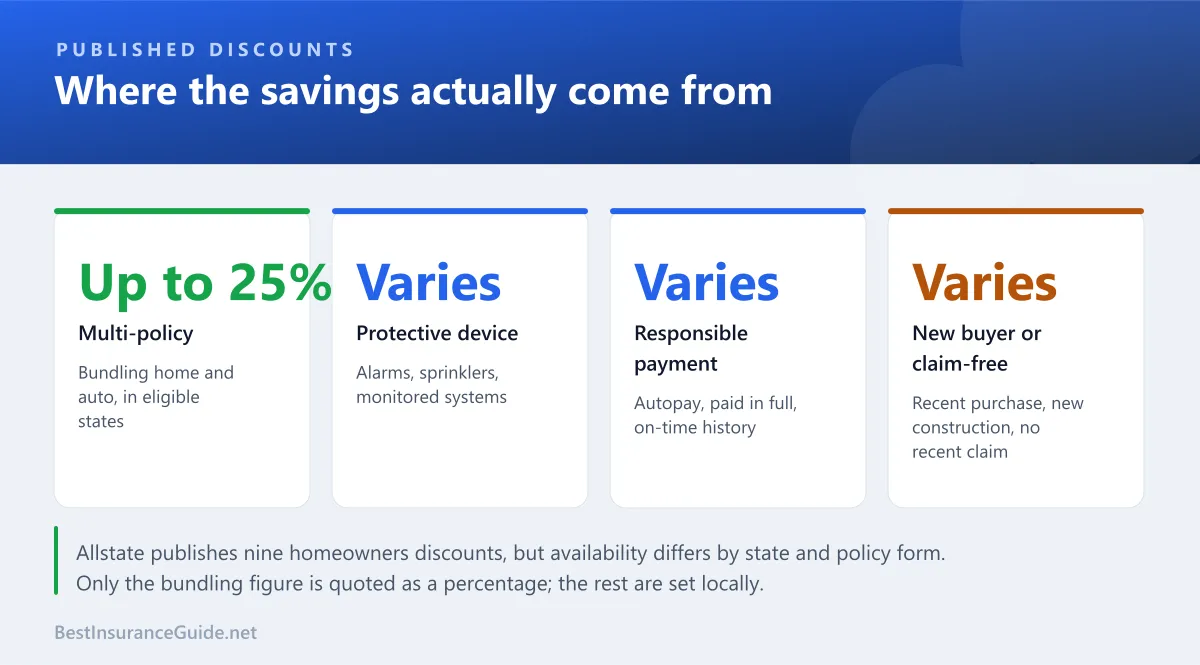
Bundling is the big one, and 25% is a ceiling. The multi-policy discount for combining home and auto is advertised at up to 25% in eligible states. What you receive depends on your state, your vehicles and your profile. It’s still usually the largest single lever, and worth pricing even if you’re happy with your current auto insurer.
Worked example: is bundling actually cheaper?
People assume bundling wins automatically. Sometimes it doesn’t. Here’s the comparison worth running.
| Separate carriers | Bundled at one carrier | |
|---|---|---|
| Home premium | $2,140 (Carrier A) | $2,390 |
| Auto premium | $1,380 (Carrier B) | $1,290 |
| Bundle discount applied | — | −$690 |
| Annual total | $3,520 | $2,990 |
Bundled wins by $530 here, even though the standalone home premium was higher at the bundling carrier. That’s the part people get wrong when they compare only the home policy. The discount lands across both, so both have to be in the comparison.
It doesn’t always land this way. Run both totals rather than assuming.
Protective device discounts reward proof, not intent. A monitored alarm generally earns more than a local siren, because the insurer cares whether anyone gets dispatched. Have the monitoring contract to hand. Water leak sensors have become more valuable to insurers recently, because non-weather water damage is now one of the most frequent homeowners claims.
Payment behaviour is its own discount category. Autopay, paying in full and an on-time history each map to a documented reduction. These are the easiest discounts in the market to claim and the most frequently left sitting there.
Online form or agent call?
Both routes reach the same policy. They differ in what they capture on the way.
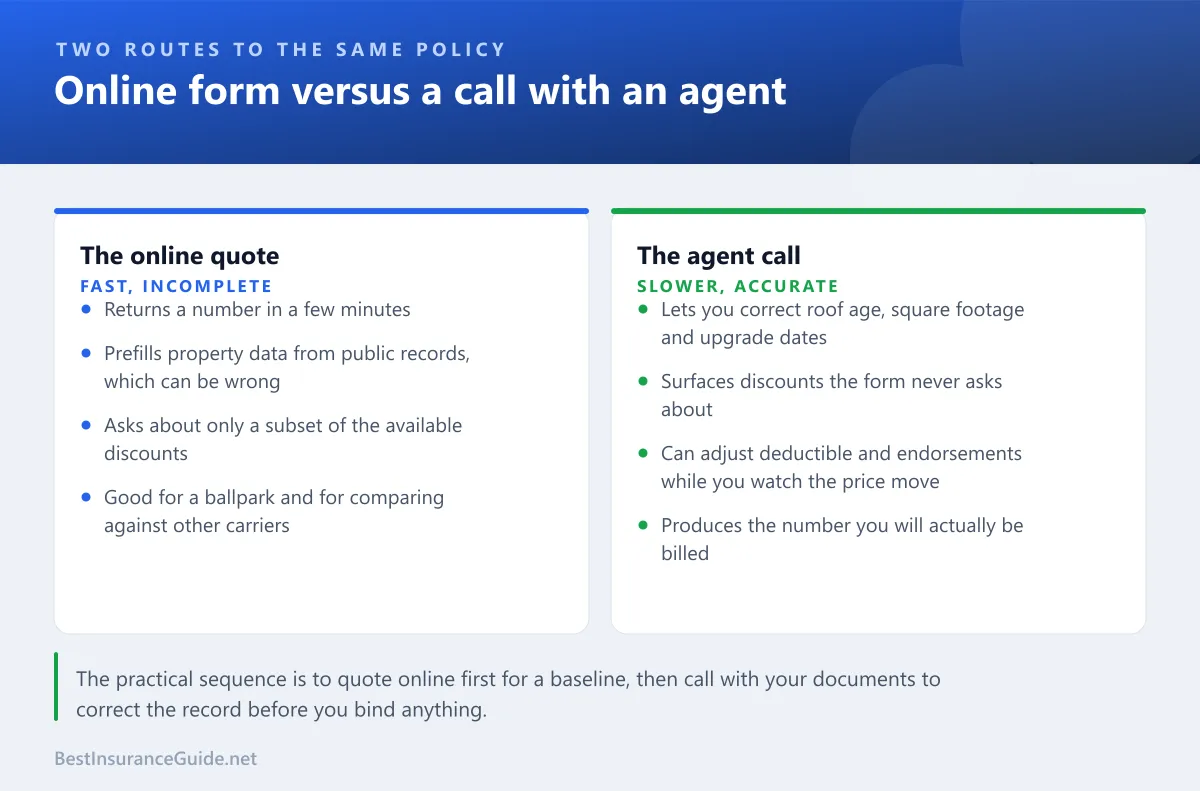
The practical sequence, if you want both speed and accuracy:
- Quote online first for a baseline, and do the same at two or three competitors. Fifteen minutes total.
- Call with your documents and correct the record: roof, square footage, upgrades, protective devices.
- Ask the agent to reprice at a different deductible. Moving from $1,000 to $2,500 often beats any single discount.
- Ask what isn’t included. Water backup, service line and extended replacement cost are commonly excluded by default and commonly wanted.
That last point is where a call earns its keep. An online form sells you what you selected. An agent, asked directly, will tell you what a standard policy leaves out.
Reading the quote you get back
A homeowners quote isn’t one number, and the headline premium is the least interesting part.
Check the dwelling limit against a rebuild estimate. If the quote’s Coverage A differs materially from your current policy’s, one of them is wrong. Ask which construction cost data the estimate uses.
Find the replacement cost wording. Personal property is often written at actual cash value by default, which depreciates your possessions before paying.
Find the wind and hail deductible. In much of the country this is now separate and expressed as a percentage of the dwelling limit.
Worked example: the percentage deductible nobody reads
A quote shows “$1,000 deductible” prominently on the front page. Buried on page three: “Windstorm or Hail Deductible: 2% of Coverage A.”
Coverage A is $420,000. A hailstorm damages the roof and siding, $31,000 of work.
- Assumed deductible: $1,000 → expected payment $30,000
- Actual wind/hail deductible: 2% of $420,000 = $8,400
- Actual payment: $22,600
A $7,400 surprise, on a policy the owner believed had a $1,000 deductible. In hail-prone states this is now standard rather than unusual, and it’s the single most important line to find before you bind anything.
Does requesting a quote affect your credit?
No. In states that permit it, insurers pull a credit-based insurance score using a soft inquiry, and soft inquiries have no effect on your score. Quote as many times as you like.
Worth knowing that a credit-based insurance score isn’t a credit score. It weights the same underlying data differently, aimed at predicting claims rather than default. Several states restrict or prohibit its use in home insurance, and the National Association of Insurance Commissioners tracks where those rules apply.
When the quote comes back higher than you expected
Home premiums have risen sharply almost everywhere, driven by construction cost inflation and severe weather losses. If your renewal has jumped, the cause is often the market rather than anything about you. Our guide to insurance rate trends covers what’s behind it.
Before accepting a large increase, work in this order:
- Verify the property data. Wrong square footage or roof age is the most common cause of an unexplained figure.
- Reprice the deductible. The biggest controllable lever.
- Confirm every discount. Ask them to read the list back rather than asking whether you have them all.
- Price the bundle both directions. Home added to auto, and auto added to home.
- Then compare. Only after your own file is accurate, because otherwise you’re comparing a bad quote against other bad quotes.
Our guide on how to compare insurance quotes covers the mechanics, and what drives your premiums explains which underlying factors you can actually influence.
Ten minutes, then quote
An Allstate homeowners quote is a starting point, not a price. The online form is fast and useful for a baseline. It’s also working from public records that may be years stale, and it doesn’t ask about most of the discounts available to you.
Gather the declarations page, the roof invoice and the upgrade dates first. Quote online, then call to correct the file before you bind. As the roof example above shows, the difference between those two numbers is frequently larger than anything you’d save by switching insurers.
And find every deductible on the policy, not just the one on the front page.