Renters Insurance in Ohio: Costs, Rules and What to Check
Renters insurance in Ohio averages about $14 a month. What it costs, whether it's required, and the Ohio-specific gaps worth closing before you sign.

Table of contents
Renters insurance is the cheapest meaningful insurance most people will ever buy, and it’s the one they’re most likely to skip. In Ohio the numbers make that particularly hard to justify: for roughly the price of two coffees a month, you cover everything you own plus a liability exposure that could otherwise follow you for years.
Here’s what it actually costs here, what the law does and doesn’t require, and the specific coverage decisions that matter in Ohio housing. Two of those get missed by standard policies for a lot of tenants in this state.
What it costs in Ohio
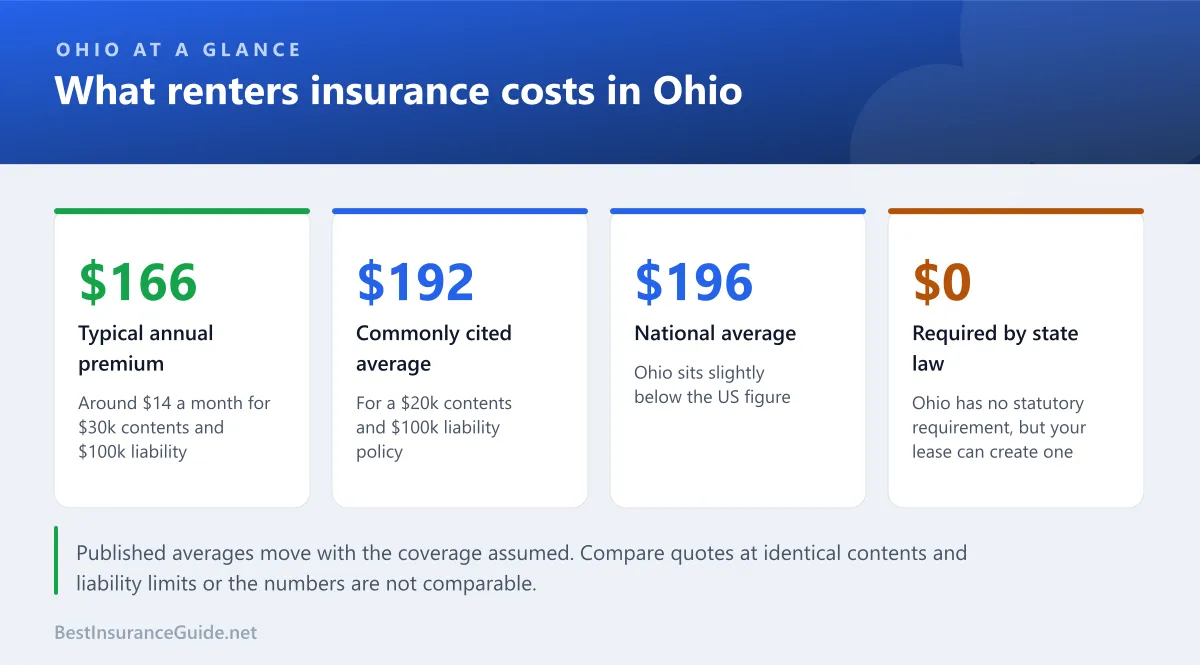
The spread between those figures isn’t disagreement. It’s different assumptions about coverage. A policy with $20,000 of contents costs less than one with $30,000, which costs less than one with $50,000. Whenever you see a renters insurance average quoted anywhere, the first question is always “at what limits.”
Roughly what the tiers look like in practice:
| Contents cover | Liability | Typical annual cost | Monthly |
|---|---|---|---|
| $20,000 | $100,000 | About $190 | $16 |
| $30,000 | $100,000 | $166 to $200 | $14 to $17 |
| $50,000 | $100,000 | About $320 | $27 |
| $250,000 | $300,000 | $1,100+ | $92+ |
Those are market estimates, not quotes. Your own figure moves with your city, building, deductible and claims history. Columbus, Cleveland and Cincinnati price differently from rural counties, largely on theft and weather loss data.
The useful takeaway is that moving from $20,000 to $30,000 costs very little. Most people underestimate what they own, so the cheap tier is usually false economy. Our main renters insurance guide has a worked inventory showing a one-bedroom flat totalling $32,200, against an owner who’d have guessed fifteen.
Is renters insurance required in Ohio?
Not by the state. Ohio has no law requiring tenants to carry it.
Very often by the lease. Most Ohio landlords and property management companies now require it, typically specifying a minimum liability limit, commonly $100,000, and sometimes requiring the landlord be named as an “interested party” so they get notice if the policy lapses.
That distinction matters because a lease requirement is a contractual obligation. Failing to maintain the policy can be a lease violation, and some landlords enforce it by placing you on a forced policy at your expense that protects them and not you.
Worked example: what a forced policy actually buys you
A tenant lets their renters policy lapse. The property manager places landlord-forced coverage and bills it through the rent.
| Tenant’s own policy | Forced placement | |
|---|---|---|
| Monthly cost | $14 | $29 |
| Covers tenant’s belongings | Yes, $30,000 | No |
| Covers tenant’s liability | Yes, $100,000 | Protects landlord only |
| Covers tenant’s living costs | Yes | No |
| Tenant chooses deductible | Yes | No |
Twice the price for something that covers the landlord and nothing of yours. Being named as an interested party, by contrast, gives the landlord no right to your claim payments. It only entitles them to notification, it’s a routine request, and there’s no reason to resist it.
What your landlord’s insurance doesn’t do
This is the misunderstanding that costs Ohio tenants the most money.
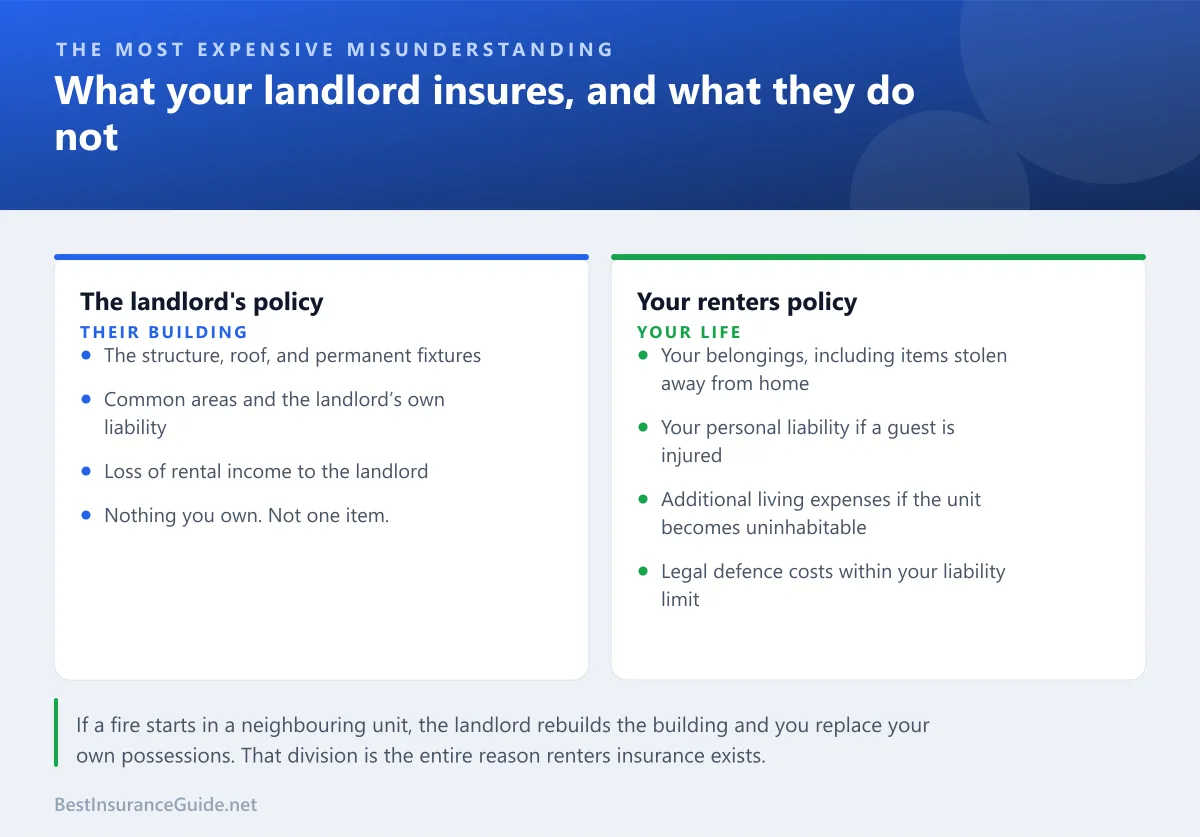
The scenario worth sitting with: a fire starts in the unit above yours, caused by a neighbour, and the building is damaged. The landlord’s policy rebuilds the structure. Your neighbour’s policy, if they have one, covers their liability. Your possessions are covered by your policy and only your policy. Without one, everything you own is a loss you absorb personally, regardless of the fire having nothing to do with you.
The liability side deserves equal attention. A guest injured in your apartment, a dog bite, a tap left running that damages the unit below. Water damage to downstairs neighbours is a genuinely common claim in multi-storey Ohio apartment buildings, and the repair bills reach five figures easily.
The Ohio-specific things to check
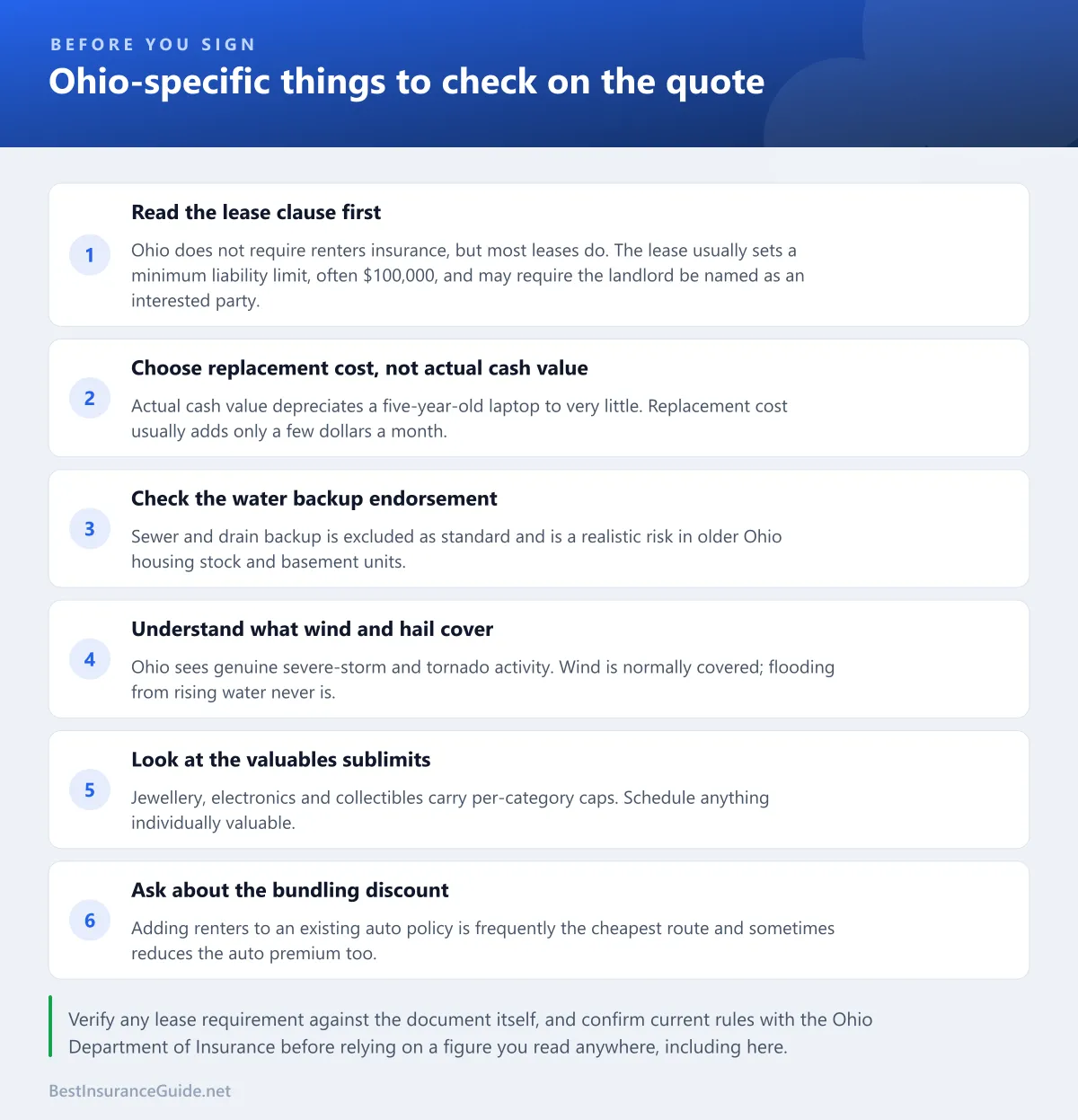
Three of those matter more in Ohio than the generic advice suggests.
Water backup isn’t optional here. Sewer and drain backup is excluded from every standard renters policy and has to be added. It’s usually a few dollars a month. It matters disproportionately in Ohio because of the age of the housing stock in Cleveland, Cincinnati and Dayton, where combined sewer systems and older lateral connections make backups a recurring event in heavy rain. In a basement or garden-level apartment, treat it as essential.
Worked example: a basement apartment backup
Heavy August storm, sewer surcharges, water comes up through the floor drain of a garden-level unit in an older Cleveland building.
| Item | Loss | Without endorsement | With endorsement |
|---|---|---|---|
| Furniture, bed, rugs | $4,800 | $0 | $4,800 |
| Electronics on the floor | $1,900 | $0 | $1,900 |
| Clothing and stored boxes | $3,200 | $0 | $3,200 |
| Additional living expenses, 11 nights | $1,540 | $0 | $1,540 |
| Total | $11,440 | $0 | $11,440 less deductible |
The endorsement costs roughly $45 a year. This is not a rare event in older Ohio housing, and standard policies pay nothing toward it.
Wind and hail are covered; flooding isn’t. Ohio gets genuine severe convective weather including tornadoes, and resulting wind damage is a standard covered peril. Rising water never is, under any renters policy. Near a river or in a low-lying area, flood coverage is a separate purchase through the National Flood Insurance Program or a private flood insurer. Renters can buy NFIP contents-only cover, which many tenants don’t realise exists.
Replacement cost versus actual cash value is the biggest single decision. Actual cash value pays what your possessions were worth after depreciation, which for electronics and furniture is brutally little. Replacement cost pays what it costs to buy them again. The premium difference is usually a few dollars a month, and the claim difference is thousands.
Where the savings are
The largest lever is bundling. Adding renters to an existing auto policy commonly produces a multi-policy discount on both, and the reduction on the auto side sometimes approaches the entire cost of the renters policy.
After that, in rough order of effect:
- Raise the deductible from $500 to $1,000 if you could genuinely absorb it
- Claim the protective device discounts, including smoke detectors, deadbolts, monitored alarms and increasingly water leak sensors
- Pay annually rather than monthly, avoiding instalment fees
- Ask about a claims-free discount if you haven’t claimed in several years
What doesn’t work is buying too little coverage. Cutting contents from $30,000 to $20,000 saves a small amount annually and leaves a large gap. That’s the wrong end of the policy to economise on.
Getting a comparable quote
Renters quotes are easy to compare badly. Fix these four before you request anything:
- Contents limit. Take twenty minutes and add up what you own, room by room.
- Liability limit. At least what the lease requires. $300,000 is often only marginally more than $100,000.
- Deductible. The same figure at every insurer.
- Valuation basis. Replacement cost, not actual cash value.
Then quote three insurers at exactly those numbers. Our renters insurance guide covers the coverage mechanics in more depth, and how to compare insurance quotes covers the comparison itself.
For anything about Ohio law or a specific lease requirement, confirm with the Ohio Department of Insurance rather than relying on a figure from any article, this one included.
Before you sign the lease
Read the insurance clause first, then quote to it. Around $14 a month buys $30,000 of contents cover and $100,000 of liability, which is less than most people spend on coffee in a week.
Choose replacement cost. Add water backup, especially in an older building or anything below grade. Set the contents limit from an actual inventory rather than a guess.
Then call whoever insures your car, because that’s where most of the discount lives.