Custom Motorcycle Insurance: Covering a Build Properly
Standard policies cap custom parts near $3,000. How agreed value works, what a total loss actually pays out, and how to document a build before you claim.

Table of contents

There’s a conversation that happens after almost every total loss on a modified bike, and it goes badly. The rider explains what went into the machine: the exhaust, the wheels, the paint, eighteen months of weekends. The adjuster explains that the policy pays market value for a comparable stock motorcycle, less depreciation, and that the custom parts allowance capped out at $3,000.
Both people are reading the same policy correctly. The rider just never looked at the number.
This is about that number, and the three decisions that determine whether a build is actually insured: how much custom parts coverage you carry, whether the bike is valued at actual cash value or agreed value, and what documentation exists before you need it.
The limit most riders never check
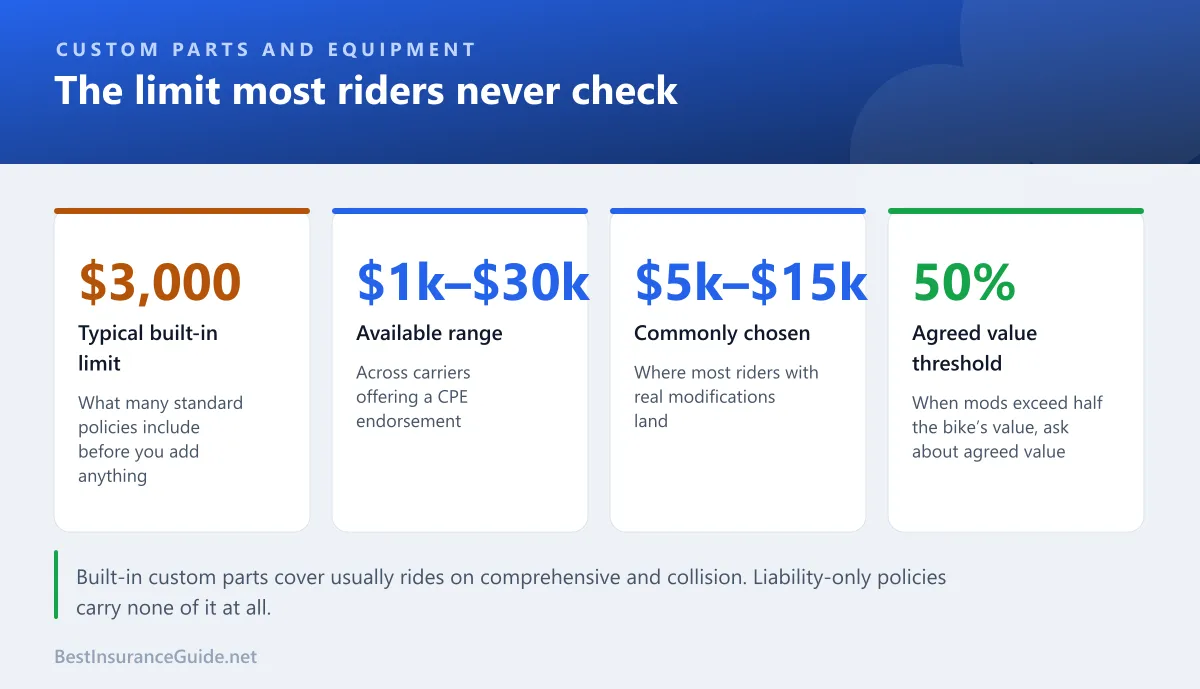
Custom parts and equipment coverage, usually abbreviated CPE, covers anything not fitted by the factory. Exhausts, bars, seats, paint, chrome, luggage, lighting, engine work, wheels.
Three things about it consistently surprise people.
The built-in amount is small. Most standard policies include some CPE automatically, commonly $3,000 or less. That’s realistic for a rider who’s added pipes and a seat. It’s nowhere near realistic for a bagger with a stereo, custom paint and a stage kit.
It rides on comprehensive and collision. CPE isn’t liability coverage. Carry liability only, as plenty of riders do on older machines, and you have no custom parts coverage, because you have no coverage on your own bike at all.
It isn’t automatic even when you have it. Carriers expect modifications to be declared.
Worked example: what the default limit leaves behind
A 2018 Softail, bought for $16,500, with $19,400 of work done over four years. Insured on a standard policy with the default $3,000 CPE allowance. Written off in a collision.
| Amount | |
|---|---|
| Actual cash value of comparable stock bike | $11,200 |
| Custom parts spend | $19,400 |
| CPE limit on the policy | $3,000 |
| Deductible | $1,000 |
| Settlement | $13,200 |
| Rider’s actual investment | $35,900 |
| Shortfall | $22,700 |
Raising the CPE limit from $3,000 to $20,000 on that policy would have cost somewhere around $140 to $220 a year. Four years of that is under $900, against a $22,700 gap.
Carriers commonly offer tiers: $3,000, $5,000, $10,000, $15,000, and up toward $30,000 with some insurers. Add up your receipts honestly and buy the tier above the total.
Actual cash value versus agreed value
This is the more consequential decision, and it’s separate from CPE.
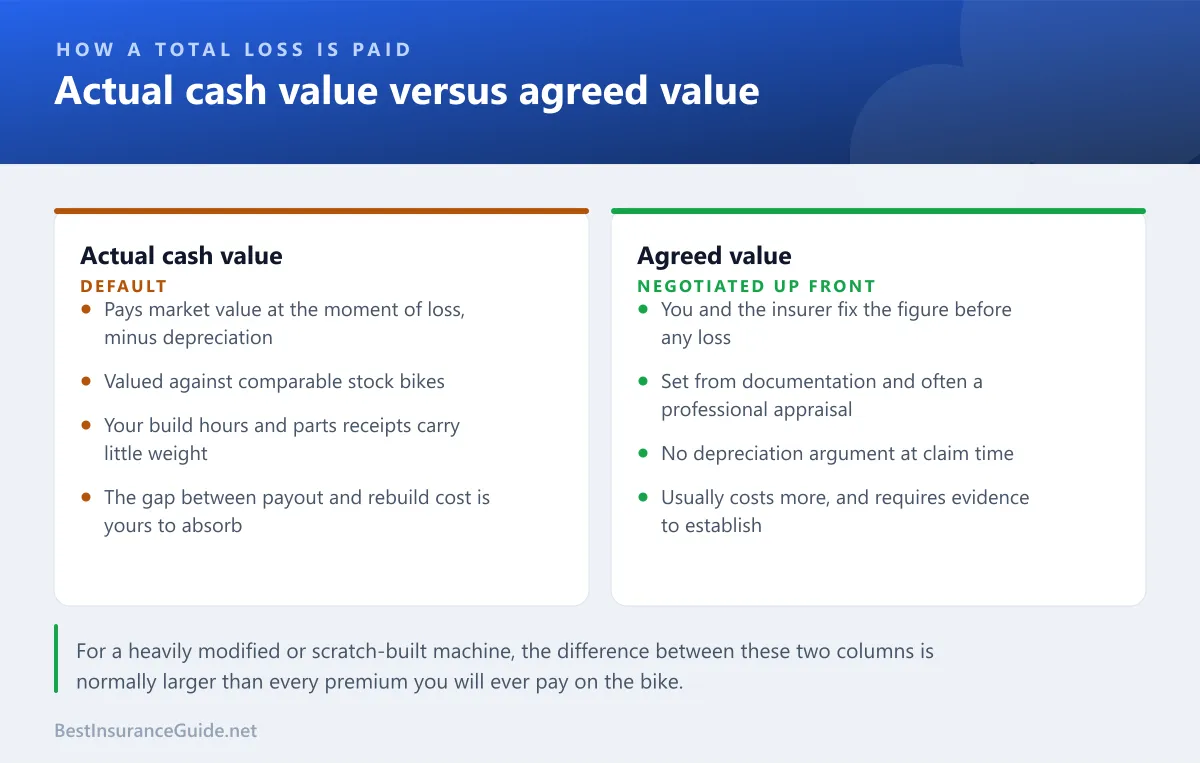
Actual cash value is the default on most motorcycle policies. It asks one question after a total loss: what was this bike worth on the open market the moment before it was destroyed? The answer comes from comparable sales of similar machines, and comparables for a heavily modified bike are, by definition, stock bikes.
Your build hours count for nothing in that calculation. Your parts receipts count only through CPE, up to its limit.
Agreed value inverts it. You establish the figure with the insurer beforehand, supported by documentation and usually an appraisal. If the bike is totalled, that’s the payout. No depreciation discussion, because the number was settled while everyone was calm.
Worked example: the same bike, three ways
A scratch-built café racer. Donor bike $4,000, parts $14,600, professional paint and machining $6,800. Total invested: $25,400. Appraised at $27,000.
| Policy structure | Annual premium | Total loss settlement |
|---|---|---|
| Liability only | $310 | $0 |
| ACV, default $3,000 CPE | $680 | $7,400 |
| ACV, $15,000 CPE | $840 | $19,400 |
| Agreed value at $27,000 | $1,020 | $26,000 |
The difference between the cheapest comprehensive option and agreed value is $340 a year. The difference in what happens after a crash is $18,600.
That’s the whole argument. For a genuine build, the premium gap between these columns is smaller than the settlement gap by an order of magnitude, usually more.
The rough threshold: when modifications exceed about half the base value of the bike, agreed value stops being a luxury. Below that, a generous CPE limit on an ACV policy is often adequate and cheaper.
Where insurers draw lines
Not every modification is treated the same, and a few categories cause problems worth knowing about in advance.
Performance modifications can affect eligibility, not just price. Significant engine work, forced induction, anything materially increasing power may move the bike into a different rating class or make it ineligible with some carriers. Declare it. A policy that wouldn’t have been written had the insurer known is a policy that may not respond.
Frame modifications and scratch builds need a paper trail. Altered frame or built from parts puts you into title and VIN assignment territory, which varies significantly by state. Most states have an inspection and assigned-VIN process for custom-built motorcycles. Insurance follows the title, so sort the title first.
Some parts sit outside CPE entirely. Riding gear, helmets and comms systems often fall under a separate accessories provision or aren’t covered. Trailers are usually separate. Ask specifically.
Storage and use affect the rate more on custom bikes. A machine in a locked garage, ridden seasonally, with limited annual mileage prices very differently from a daily rider parked on the street. If your build genuinely is a fair-weather bike, say so. Laid-up and seasonal policies exist and are considerably cheaper.
Worked example: seasonal versus year-round
Same bike, same agreed value, same rider. Only the declared use changes.
| Declared use | Annual premium |
|---|---|
| Year-round, street parked, 6,000 miles | $1,290 |
| Year-round, garaged, 6,000 miles | $1,020 |
| Garaged, 3,000 miles, seasonal (Apr–Oct) | $760 |
| Garaged, laid up Nov–Mar with comp-only in winter | $645 |
Nearly $650 a year between the top and bottom rows, for a rider whose actual behaviour never changed. They just told the insurer what it was.
Documenting a build before you need to
This is the part riders skip, and it’s the part that determines whether the previous two sections actually pay.
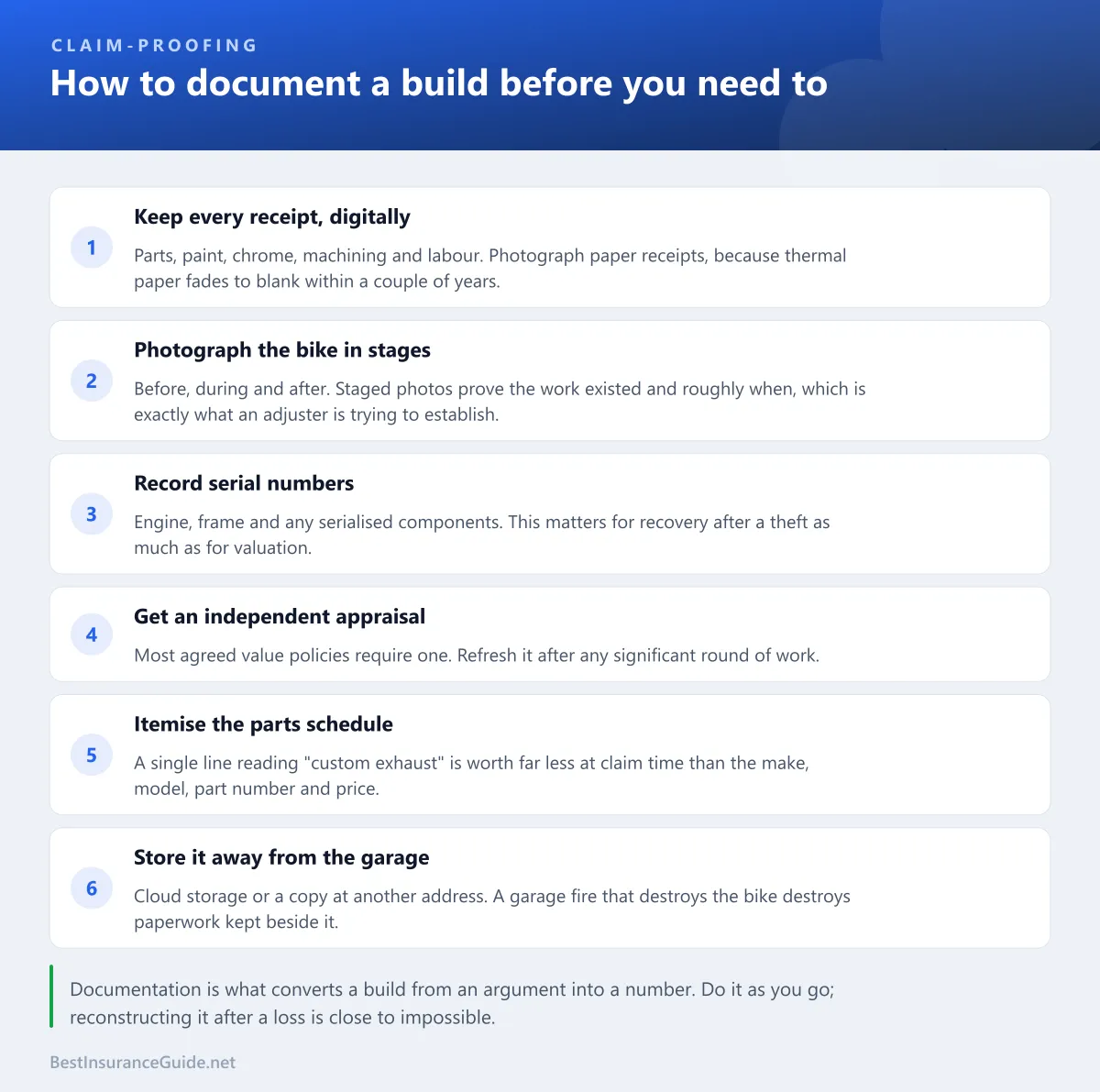
The thermal paper point isn’t small. Most parts receipts print on thermal paper, which fades to a blank sheet within roughly two to five years depending on storage. Riders routinely open a folder after a theft and find a stack of blank slips. Photograph each receipt the day it arrives.
Worked example: what documentation is worth
Two riders, near-identical builds, both totalled. Both on ACV policies with $15,000 CPE.
Rider A has a folder: itemised receipts, staged build photos, a parts schedule listing make, model, part number and price, plus fitting labour invoices.
Rider B has memory and a handful of faded slips.
| Rider A | Rider B | |
|---|---|---|
| Claimed custom parts value | $16,800 | $16,800 |
| Substantiated to adjuster | $16,800 | $6,200 |
| CPE paid (limit $15,000) | $15,000 | $6,200 |
| Time to settle | 3 weeks | 11 weeks |
Same bike, same policy, same limit. $8,800 apart, purely on paperwork. The limit is a ceiling, not a promise. What you can prove is what you get.
On the parts schedule specifically: “custom exhaust, $1,800” is worth much less at claim time than “Vance & Hines 2-into-1, part number, purchased 14 March 2025, $1,800, fitted by [shop], labour $340.” Specificity turns a negotiation into a calculation.
On appraisals: most agreed value policies require one at inception, and it’s worth refreshing after any substantial round of work. An appraisal from three years and $9,000 of parts ago isn’t describing the bike you own.
What this costs
Custom motorcycle pricing varies too much for a national average to mean much. The factors that move it most:
- The base machine. A cruiser, a sportbike and a vintage restoration price very differently.
- Total insured value, including the CPE limit or agreed value figure.
- Rider age, licence and record, which matter more in motorcycle underwriting than in auto.
- Storage, garaged versus street, and whether it’s laid up over winter.
- Annual mileage, where a genuine low-mileage declaration produces a real reduction.
- Where you live, with theft rates driving comprehensive pricing hard.
Rider training courses earn a discount with most carriers and are among the more reliable levers. Multi-bike and multi-policy discounts are usually worth more than shopping on price alone.
Getting it right in the correct order
- Add up what you’ve actually spent on parts, paint and labour, from receipts rather than memory.
- Compare that to your current CPE limit. Most riders find a gap here.
- Decide whether you need agreed value, using the fifty-percent rule of thumb.
- Get an appraisal if you do.
- Declare every modification in writing, and keep the confirmation.
- Build the documentation file and store a copy away from the garage.
- Re-review annually, because builds continue and coverage doesn’t follow automatically.
That last point is where most gaps appear. A bike insured correctly in 2024 for a $6,000 build isn’t insured correctly in 2026 after another $7,000 went in.
For the broader mechanics of limits and deductibles, what insurance actually covers covers the fundamentals, and what drives your premiums explains the rating factors you can influence.
If you ride for paid delivery work, none of this applies to that use. Personal policies exclude it, and our guide to motorcycle courier insurance covers what does.
Do this before the next ride
Find your declarations page and look for the custom parts limit. It’ll be a small number, probably $3,000, possibly not there at all.
Then add up your receipts. If the second figure is bigger than the first, and for most people with a real build it will be by a factor of five or more, you’ve got a gap that costs a couple of hundred dollars a year to close.
And photograph the receipts tonight, because thermal paper doesn’t last and neither does anyone’s memory of what a two-year build cost.