Vet Credit Cards: How Deferred Interest Actually Works
How veterinary credit cards work, why deferred interest is different from 0% APR, and what a missed payoff date actually costs on an emergency vet bill.

Table of contents
At the counter of an emergency clinic, with a four-figure estimate in front of you, a veterinary credit card looks like the obvious answer. Often it is a reasonable one. But the promotional structure most of them use is genuinely different from what people assume, and the difference can cost hundreds of dollars.
What these cards are
Veterinary or healthcare credit cards are ordinary revolving credit accounts, issued by a bank, that are accepted at participating veterinary practices. They are not a payment plan offered by your vet, and the practice is paid in full immediately; your relationship is with the lender.
Their appeal is the promotional financing: typically six, twelve, eighteen or twenty-four months with no interest payable, provided certain conditions are met.
Those conditions are where the product needs reading carefully.
Deferred interest is not 0% APR
This is the single most important thing in this article.
True 0% APR means no interest accrues during the promotional period. If a balance remains at the end, interest applies to that remaining balance only, going forward.
Deferred interest means interest does accrue during the promotional period, calculated from the purchase date. It is simply not charged to you yet. If you clear the entire balance before the promotion ends, the accrued interest is waived. If any balance at all remains, the whole of that accrued interest is added to your account, calculated from day one.
Most veterinary and healthcare credit cards use deferred interest.
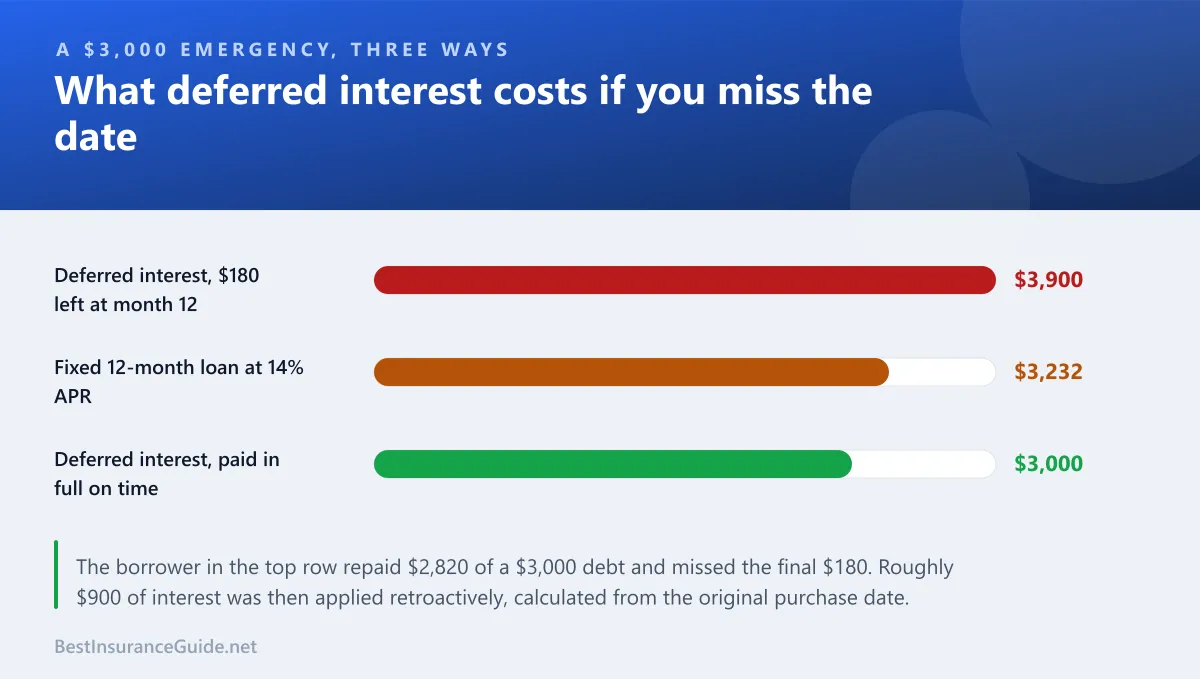
Worked example: a $3,000 emergency, three outcomes
A $3,000 bill on a 12-month promotional plan at 29.99% APR.
| Paid in full on time | $180 left at month 12 | Fixed 12-month loan at 14% | |
|---|---|---|---|
| Promotional interest waived | Yes | No | N/A |
| Interest charged | $0 | About $900 retroactively, plus ongoing | About $232 total |
| Total repaid | $3,000 | About $3,900 | About $3,232 |
The middle column is the trap. The borrower repaid $2,820 of a $3,000 debt, missed the final $180, and had roughly $900 of interest applied retroactively as though the promotion never existed.
That is not a penalty for defaulting. It is the designed operation of the product, and it is disclosed, but it is disclosed in a way most people at an emergency counter do not read.
How to use one safely
If you do use a deferred interest card, the discipline is straightforward and non-negotiable.
Divide the balance by one fewer month than the promotion. On a 12-month promotion, divide by 11. That builds in a buffer and means a single processing delay does not cost you $900.
Do not rely on the minimum payment. Minimum payments on deferred interest accounts are frequently calculated so that following them exactly leaves a balance at the end of the promotion. This is the most common way people fall into the trap while believing they are on track.
Set up an automatic payment for your own calculated amount, not the minimum.
Diary the promotion end date separately, and check the balance a month before.
Do not add new purchases to the account. Payments may be allocated in ways that leave the promotional balance outstanding longer than you expect.
Keep the statement showing a zero balance once it is cleared.
The alternatives, and when each is better
A vet credit card is one option among several, and it is not usually the cheapest.
Point-of-sale veterinary lenders. Several companies offer fixed-instalment loans at veterinary practices, with a stated interest rate and a fixed repayment schedule rather than deferred interest. Some perform only a soft credit check, and approval rates for people with imperfect credit are often better. If the rate is stated as a simple APR with fixed payments, the structure is safer than deferred interest even where the headline rate looks higher.
A credit union or personal loan. Frequently the cheapest borrowing available, often in the single digits or low teens for reasonable credit. Slower to arrange, which is the drawback in an emergency but not for planned treatment.
A 0% purchase credit card, if you already hold one or can get one in time. Genuine 0% rather than deferred interest, so the failure mode is far gentler.
Charitable assistance funds. A number of national and breed-specific charities help with emergency veterinary costs, and many are underused. Eligibility is usually income-related and application takes time, so this suits planned treatment better than a midnight emergency.
Negotiating with the practice directly. Covered in detail in our guide to vets that take payment plans, which deals with what practices themselves will and will not do.
The credit implications
Worth knowing before you apply at a counter under pressure.
Applications involve a hard credit inquiry, which affects your score modestly and temporarily.
Approval is not guaranteed. Relying on a card you have not been approved for, at the moment of an emergency, is a bad plan. If you want this option available, apply before you need it.
The credit limit may be lower than the bill. Approval for $1,500 against a $4,000 estimate is a common and unpleasant surprise.
Utilisation affects your score. A large balance on a new account can move your credit utilisation ratio significantly.
The better answer, arranged in advance
All of this is emergency financing, which is inherently expensive. The cheaper structures are the ones set up before anything happens.
Pet insurance covers the bill rather than financing it, though most policies are reimbursement-based: you pay the practice and claim afterwards. That means you still need the money on the day, which is exactly why the financing question arises even for insured owners. A small number of insurers and practices support direct payment to the vet, and it is worth asking your insurer whether they do before you need it.
A dedicated savings buffer. Even $1,000 set aside changes your options completely, because it covers the deductible and the immediate deposit while a claim is processed.
Both together is the structure that actually works: insurance for the size of the bill, savings for the timing of it.
Our pet insurance cost guide covers what cover costs across an animal’s life, and accident-only pet insurance covers the cheaper option for older animals.
Questions to ask before signing anything
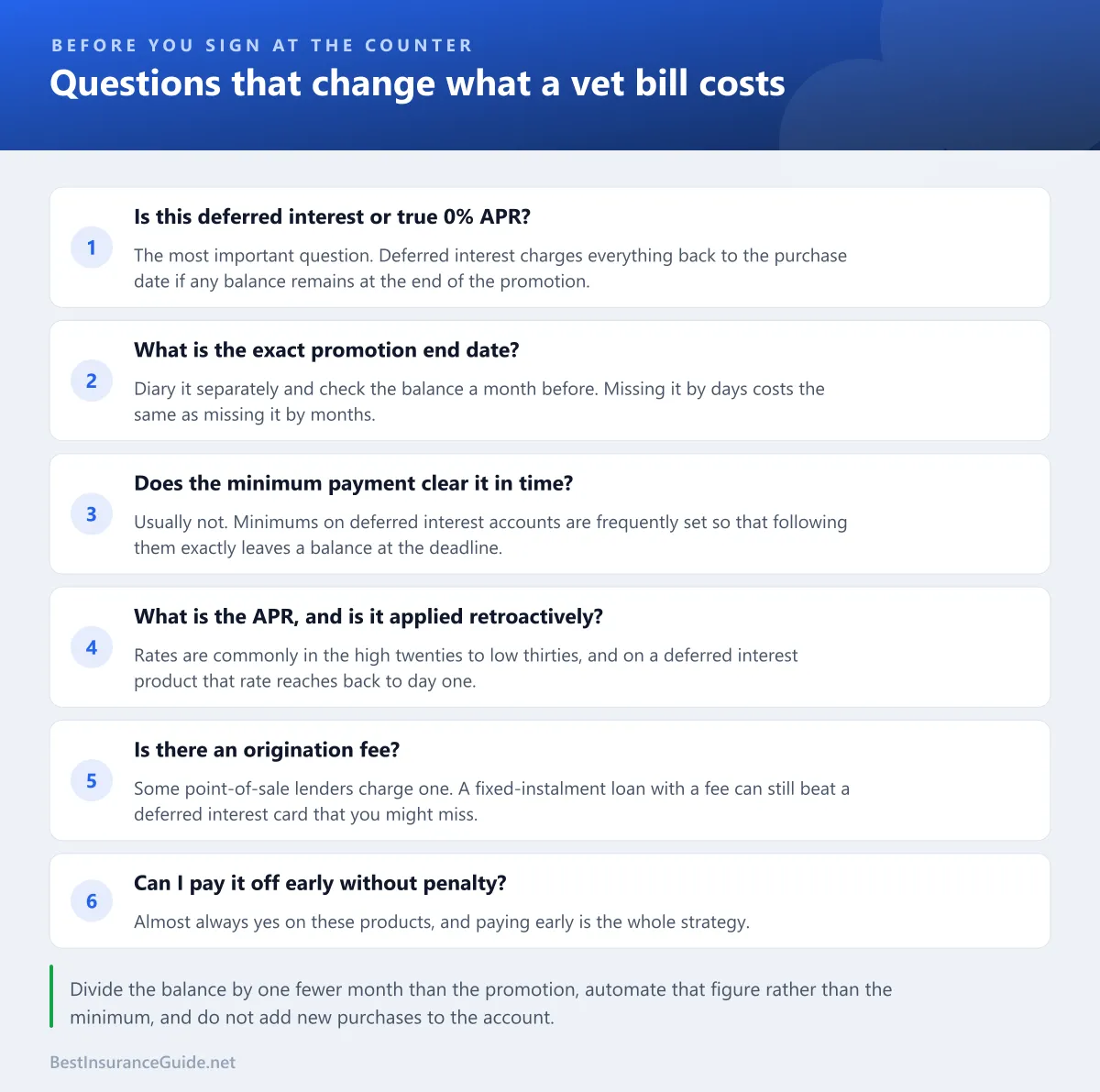
Is this deferred interest or true 0% APR? The most important question, and staff at the counter should be able to answer it.
What is the exact promotion end date?
What is the APR if I do not clear it in time, and is it applied retroactively?
Does the minimum payment clear the balance within the promotional period? Usually no.
Is there a fee? Some point-of-sale lenders charge an origination fee.
Can I pay it off early without penalty?
How payment allocation works, and why it matters
One mechanical detail catches people who use these accounts for more than one purchase, and it is worth understanding.
If you carry both a promotional balance and an ordinary purchase balance on the same card, payments above the minimum are generally applied to the highest-rate balance first under federal rules. That sounds helpful, and it is, but it means your payments may not be reducing the promotional balance as fast as you assume while an ordinary balance sits alongside it.
The practical rule is simple: do not use a veterinary credit card for anything except the treatment it was opened for. One account, one balance, one deadline. Adding a routine purchase to it turns a clear calculation into a muddled one.
Two related points.
Multiple promotional balances have separate deadlines. A second treatment six months later starts its own promotional clock, and clearing one does not protect the other. People with two balances on one account are the most likely to lose a promotion.
Returns and refunds can behave oddly. If part of the treatment is refunded, the credit may not apply to the promotional balance in the way you expect. Check the statement rather than assuming.
What happens if you cannot pay it off
If the promotion is going to expire with a balance outstanding, act before the date rather than after it.
Pay it off with cheaper credit. A credit union loan or a genuine 0% balance transfer card, arranged before the deadline, converts a retroactive interest charge into an ordinary interest rate. This is almost always worth doing, and the saving is the entire accrued interest.
Ask the lender about hardship options before you default. Some will restructure, and the conversation is far more productive before a missed payment than after one.
Do not simply make minimum payments and hope. The minimum is frequently designed to leave a balance at the deadline, which is precisely the outcome the product profits from.
The arithmetic of acting early
| Let the promotion lapse | Refinance one month early | |
|---|---|---|
| Balance remaining | $180 | $180 |
| Retroactive interest applied | About $900 | $0 |
| Interest on refinanced balance | N/A | A few dollars |
| Cost of the last $180 | About $1,080 | About $185 |
That table is the whole argument for diarising the end date and checking the balance a month before.
A note on scope and terms
The mechanics described here are typical of healthcare and veterinary credit cards, but individual products vary and terms change. The APR, promotional length, minimum payment calculation and whether a product uses deferred interest or true 0% financing are all set by the issuer and disclosed in the cardholder agreement.
Read that agreement, or at minimum the promotional financing disclosure, before signing at a counter. The single question that matters is whether interest accrues during the promotional period, and staff at the practice should be able to point you at where the answer is stated.
Nothing here is financial advice, and this site is independent and not affiliated with any lender or insurer. If the amounts are large and your circumstances are difficult, a non-profit credit counselling service will review the options with you at no cost, and that is a better use of an hour than comparing counter offers under pressure.
The short version
Veterinary credit cards are useful, widely accepted and genuinely helpful in an emergency. They are also mostly built on deferred interest, which is not the same as 0% APR.
Under deferred interest, clearing the balance a day late or a dollar short triggers all the interest that accrued from the purchase date. On a $3,000 bill at around 30% APR, that is roughly $900 for missing a final $180.
If you use one, divide the balance by one month fewer than the promotion, ignore the minimum payment, automate your own figure and diary the end date. Compare it against a fixed-instalment lender, a credit union loan or a genuine 0% card first, and apply before an emergency rather than during one.
The structural answer is insurance for the size of the bill and a savings buffer for the timing of it. Everything on this page is what you do when that structure is not in place yet.