What Is AD&D Insurance? Cheap, Narrow, and Not Life Insurance
Accidental death and dismemberment insurance explained: what it pays, the long list of exclusions, how the schedule works, and when it is worth having.

Table of contents
Accidental death and dismemberment is the most commonly misunderstood product in life insurance, and the misunderstanding is always the same: people buy it thinking they have bought life insurance.
What it actually covers
AD&D pays in two situations.
Accidental death. You die as a direct result of an accident, generally within a stated period of it, commonly 90 or 365 days.
Dismemberment and specified losses. You survive but suffer a listed injury, and the policy pays a percentage of the principal sum according to a schedule.
That is the whole of it. There is no third category.
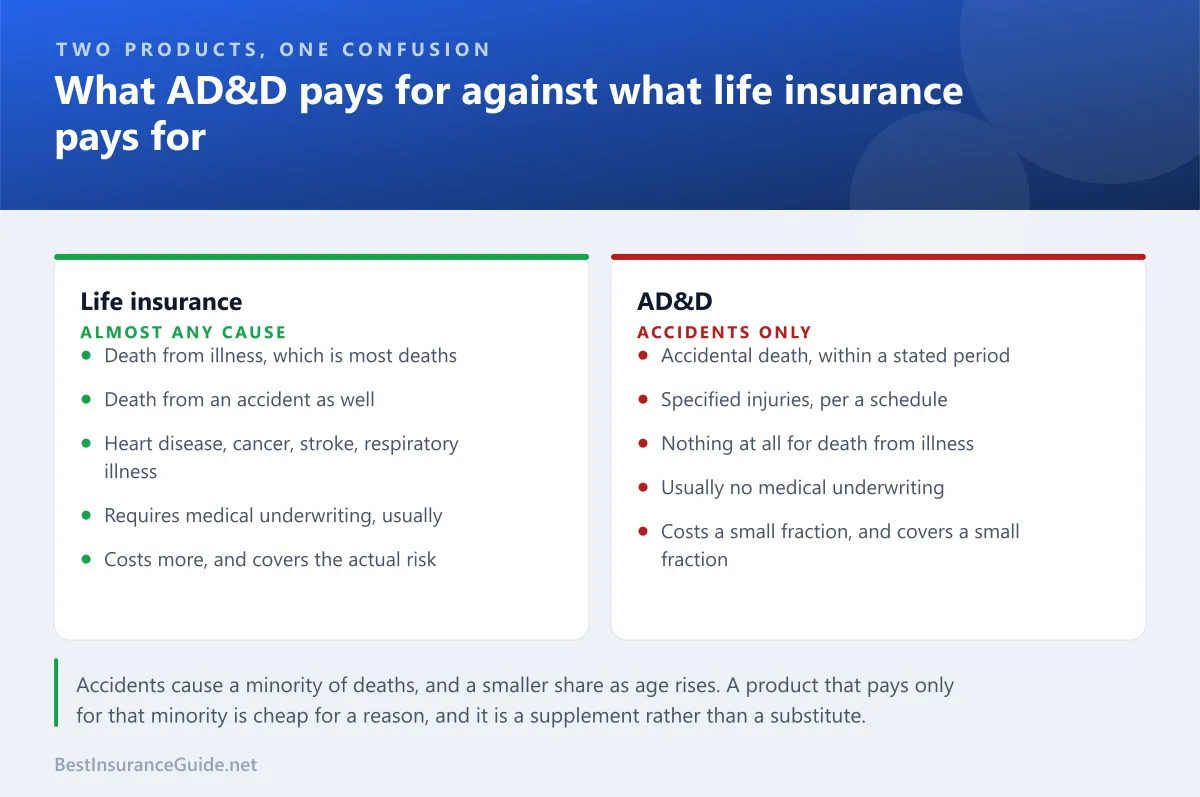
What it does not cover is death from illness, and that is the crucial point. Heart disease, cancer, stroke, respiratory illness and the other ordinary causes of death are all outside it entirely.
Accidents account for a small minority of deaths overall, and a smaller share as age increases. A product that pays only for that minority is priced accordingly, which is why AD&D is cheap.
The schedule
The dismemberment side is governed by a schedule in the policy, and the figures are more specific than people expect.
Typical structures pay:
| Loss | Typical benefit |
|---|---|
| Accidental death | 100% of the principal sum |
| Loss of two or more limbs | 100% |
| Loss of sight in both eyes | 100% |
| Loss of one limb | 50% |
| Loss of sight in one eye | 50% |
| Loss of speech or hearing | Varies, commonly 50% to 100% |
| Loss of thumb and index finger, one hand | Commonly 25% |
Two details matter.
“Loss” is defined, and the definition is technical. Loss of a limb frequently means severance at or above a specified joint, not loss of use. A permanently paralysed limb may not qualify under a standard AD&D schedule, though some policies add a separate paralysis benefit.
There is usually an aggregate cap, so multiple losses from one accident do not exceed the principal sum.
The exclusions, which are the substance
An AD&D policy is defined more by its exclusions than by its coverage, and the list is long.
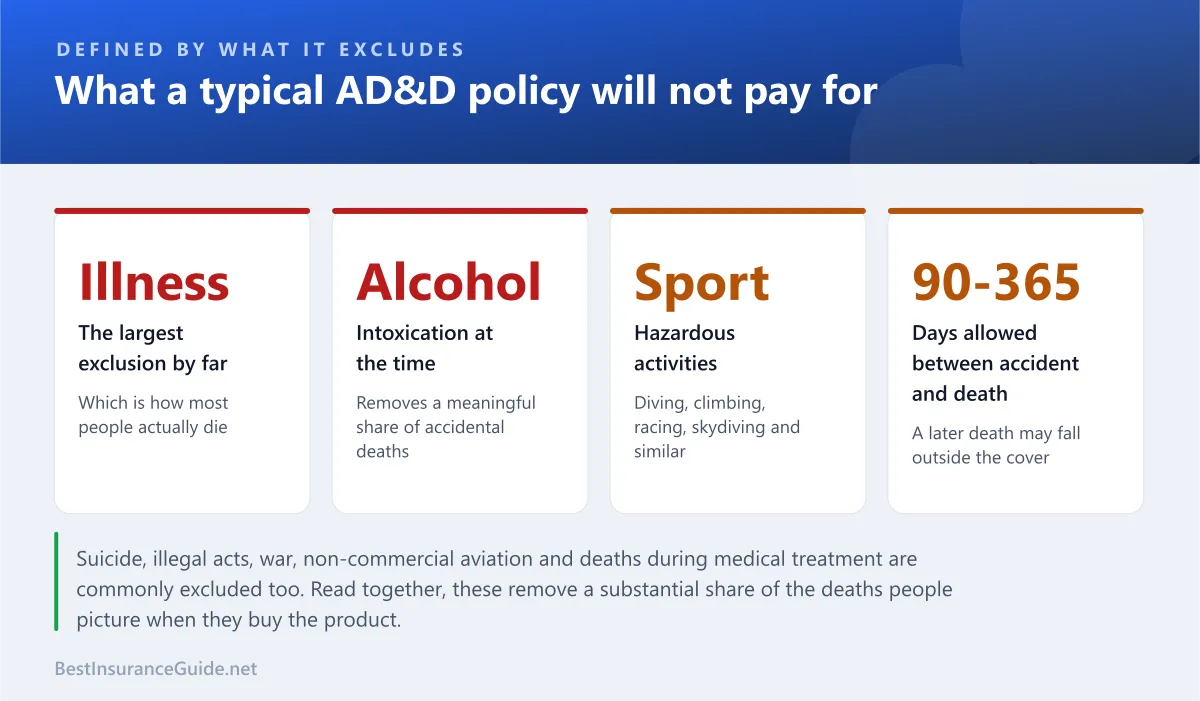
Death from illness or natural causes, which is the vast majority of deaths.
Suicide and intentional self-harm.
Death while intoxicated or under the influence of drugs, which is a broad exclusion in practice and removes a meaningful share of accidental deaths.
Injuries sustained committing an illegal act.
Hazardous activities, commonly including skydiving, scuba diving, motor racing, mountaineering and similar, though some policies cover them for an extra premium.
War and acts of war, and in some policies terrorism.
Aviation, other than as a fare-paying passenger on a scheduled flight.
Medical or surgical treatment, meaning a death during a procedure is generally not an accident for these purposes.
Pre-existing conditions contributing to the death, in some wordings, which can be argued more broadly than expected.
Read together, these remove a substantial proportion of the deaths that people picture when they buy the product.
When it is genuinely worth having
Three situations.
When an employer provides it at low or no cost, which is the most common case. A free or nearly free benefit on top of real life insurance is simply worth having.
As a cheap supplement to adequate term life insurance, where the household already has proper cover and wants an additional layer at low cost.
For someone in a higher-accident occupation who already has life insurance, where the additional layer aligns with the actual risk profile.
Worked example: cost against coverage
| Term life, $500,000 | AD&D, $500,000 | |
|---|---|---|
| Pays on death from illness | Yes | No |
| Pays on accidental death | Yes | Yes, again |
| Pays for dismemberment | No | Yes, per schedule |
| Requires medical underwriting | Usually | Usually not |
| Relative annual cost | Baseline | A small fraction |
The right reading of that table is not that AD&D is better value. It is that they answer different questions, and a household with no term policy has the second column and none of the first.
When it is not
As a substitute for life insurance. If you have dependants and only AD&D, you are insured against a minority of the ways you might die. That is the central failure mode with this product.
When it is being sold as life insurance, which happens in direct-mail and add-on channels, sometimes with wording that emphasises the payout and not the trigger.
When the premium is not trivially small. The whole case for AD&D rests on it being cheap. A policy priced anywhere near term life for the same face value is not worth taking.
When you are relying on employer cover as your plan, since group AD&D usually ends with the job.
What to buy instead, or first
If you have dependants and no life insurance, the order is straightforward.
Term life insurance first, sized from a needs calculation, covering death from almost any cause. Our guide to whether life insurance is worth it works through the calculation.
Disability income insurance second, and this is the genuinely underrated one. You are considerably more likely to be unable to work for an extended period than to die during your working years, and disability cover answers that. It is the protection most households are missing entirely.
AD&D third, as a cheap layer on top, or accepted free from an employer.
That ordering reflects both probability and consequence, and it is the opposite of the order in which these products are typically marketed.
Reading an offer
Check whether it is AD&D or life insurance, in the document rather than the marketing.
Read the exclusions list in full, particularly intoxication, hazardous activities and aviation.
Read the definition of loss on the dismemberment schedule.
Check the time limit between accident and death, commonly 90 or 365 days.
Check whether it is group or individual, and if group, what happens when you leave.
Check the beneficiary designation, which governs payment exactly as it does on a life policy and which is equally neglected.
The short version
AD&D pays for accidental death and for specified injuries according to a schedule. It pays nothing for death from illness, which is how most people die, and it carries a long exclusion list that removes a meaningful share of accidental deaths too.
That makes it cheap, and cheap is the entire case for it. As a free or nearly free employer benefit, or as a small layer on top of adequate term life insurance, it is worth having.
As a substitute for life insurance it is not adequate at any price, and the households most at risk are the ones who believe they are covered because they have it.
If you have dependants, buy term life first and disability cover second, then treat AD&D as the extra it is.
For the fundamentals, see life insurance basics, and for whether you need cover at all, is life insurance worth it.
Where AD&D is sold, and how to read the offer
The product reaches people through four channels, and the channel tells you a great deal about how carefully to read it.
Employer group benefits. Usually the best version: low or no cost, reasonable schedules, and enrolled alongside group life. Take it, and do not mistake it for the group life.
A rider on a life insurance policy. An accidental death benefit rider adds an amount payable if death is accidental. Inexpensive, and worth understanding as a supplement rather than a reason to buy the underlying policy.
Credit card, bank and membership offers. Frequently marketed with a headline sum and a monthly cost of a few dollars. The exclusions are the same as anywhere and the marketing rarely leads with them.
Direct mail and standalone offers. The channel that most warrants care, particularly where the wording emphasises the payout and not the trigger.
Four questions read any of them accurately.
Does it pay for death from illness? If the answer is no, it is AD&D, whatever the envelope says.
What is the full exclusions list?
How is loss defined on the dismemberment schedule?
What happens to it if I leave this job, close this card or cancel this membership?
Worked example: what a household actually has
A family assuming they are covered.
| Cover held | Pays on death from illness | Amount |
|---|---|---|
| Employer group life, one times salary | Yes | $62,000 |
| Employer AD&D | No | $62,000 |
| Credit card accidental death benefit | No | $50,000 |
| Personal term life | Yes | None held |
| Actually available for the most likely cause of death | $62,000 |
Three of the four lines look like protection and only one answers the way most people die. That is the pattern this product creates when it substitutes for real cover rather than supplementing it.
Disability cover, which belongs in this conversation
The reason AD&D gets bought is a general sense that something bad might happen and the household should be protected against it. That instinct is right and the product is usually the wrong answer to it.
During working years, the probability of being unable to work for an extended period is considerably higher than the probability of dying, and the financial consequence is comparable: the income stops, and the expenses do not.
Long-term disability insurance answers that, and most households have either nothing or a thin employer policy replacing a limited share of income, capped, and taxable if the employer paid the premiums.
If you are considering spending money on AD&D beyond what an employer gives you free, disability cover is almost always the better use of the same premium.
Two checks worth doing this week
Find out what your employer actually provides, line by line, and note which line is life insurance and which is AD&D. Benefit statements frequently list them adjacent to one another with similar face amounts, which is exactly how the confusion starts.
Work out what your household would receive if you died of an illness tomorrow. Add up only the cover that pays for death from any cause. If that figure is materially below what a needs calculation produces, the gap is real and AD&D does not close it.
Both take a few minutes and neither costs anything.
What to do with the gap
If the check above showed a shortfall, the order of purchase is the same for almost every household.
Term life insurance first, sized from a needs calculation rather than a multiple, covering death from any cause for the years dependants actually need protecting. For a healthy applicant this is one of the cheapest lines in a household budget relative to what it does.
Long-term disability cover second. During working years the probability of an extended inability to work exceeds the probability of dying, and the financial consequence is comparable. Most households have either nothing or a thin employer policy that replaces a limited share of income, is capped, and is taxable where the employer paid the premiums.
AD&D third, taken free from an employer or added as a small layer once the first two are in place.
That order reflects both probability and consequence, and it is the reverse of the order in which these products are usually marketed to people.
Related reading
If the conclusion here is that you need real life insurance rather than an accident product, two questions follow. Is whole life insurance a good investment covers whether to buy protection and savings in one contract, and how long life insurance takes to pay out covers what the people you are insuring for actually experience when they claim.
A note on scope
AD&D schedules, definitions of loss, exclusions and time limits vary considerably between insurers and between group and individual products, and change over time. The figures here are illustrative of common structures rather than any particular policy.
Your state insurance department publishes consumer guidance on life and accident products, and the NAIC publishes buyer guides. Your own certificate or policy document is the authoritative statement of what is covered and excluded. Nothing here is financial advice. This site is independent and not affiliated with any insurer.