What Is Indexed Universal Life Insurance? The Caps Are the Product
How indexed universal life works, what caps, participation rates and floors actually do, why illustrations mislead, and who IUL genuinely suits.

Table of contents
Indexed universal life is the most complex product commonly sold to retail buyers, and the complexity is not incidental. Understanding four mechanics is the difference between a reasonable decision and an expensive one.
The structure
An IUL policy is permanent life insurance with a flexible premium and an index-linked crediting method.
A death benefit that lasts for life, provided the policy stays funded.
A cash value account, credited with interest based on the movement of a stock market index.
Flexible premiums, within limits, meaning you can vary what you pay.
Policy charges deducted from the cash value: the cost of insurance, administrative charges, and premium loads.
That last item is the one that does the most work in determining outcomes and the one that receives the least attention.
You are not invested in the index
This is the most important sentence in the article.
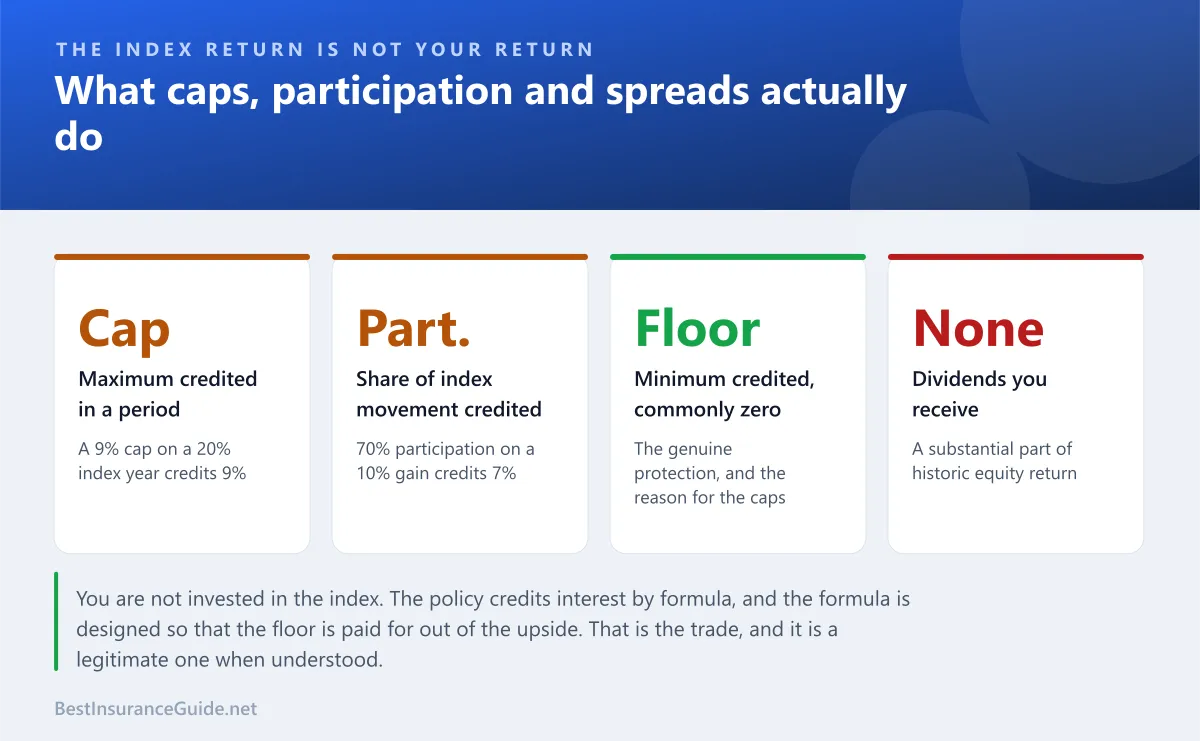
The policy credits interest by formula, based on index movement. You do not own shares. You do not receive dividends, which historically are a substantial part of total equity return. The index return and the credited return are different numbers, and the second is always the smaller one.
Three mechanics produce that difference.
The cap. A maximum credited rate for the period. A cap of 9% means a 20% index year credits 9%.
The participation rate. A percentage of the index movement that is credited. At 70% participation, a 10% index gain credits 7%.
The floor. A minimum credited rate, commonly 0%, which is the genuine protection in the product. A negative index year credits nothing rather than a loss.
Some policies also apply a spread or margin, subtracting a fixed percentage before crediting.
Worked example: the same index year, three policies
An index gains 14% over the crediting period.
| Cap 9%, participation 100% | Cap none, participation 60% | Cap 11%, spread 2% | |
|---|---|---|---|
| Index movement | 14% | 14% | 14% |
| After participation | 14% | 8.4% | 14% |
| After spread | 14% | 8.4% | 12% |
| After cap | 9% | 8.4% | 11% |
| Credited | 9% | 8.4% | 11% |
None of those equal 14%, and none of them include dividends. That is the design, and it is the price of the floor.
The parts that are not guaranteed
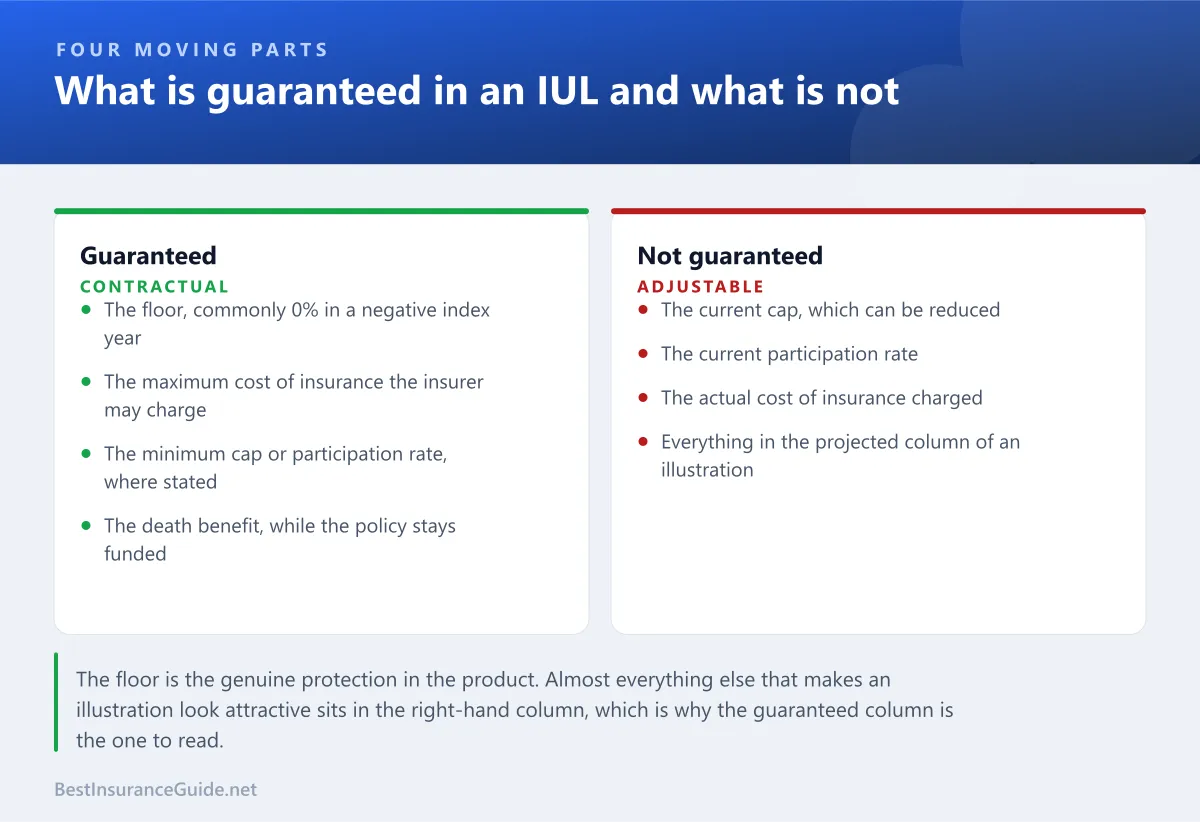
The floor is contractually guaranteed. Several other things are not, and this is where outcomes diverge from illustrations.
Caps and participation rates are generally adjustable by the insurer within contractual limits. A policy sold with a 12% cap may be crediting against a 7% cap a decade later, and nothing improper has occurred.
The cost of insurance rises with age, sometimes steeply, and many policies allow the insurer to increase the charge within a guaranteed maximum.
The illustration is a projection, not a promise. Small changes in the assumed crediting rate compound into very different long-run values, and regulators have repeatedly addressed illustration practices in this product for exactly that reason.
The lapse risk
This is the most serious failure mode and the one buyers are least prepared for.
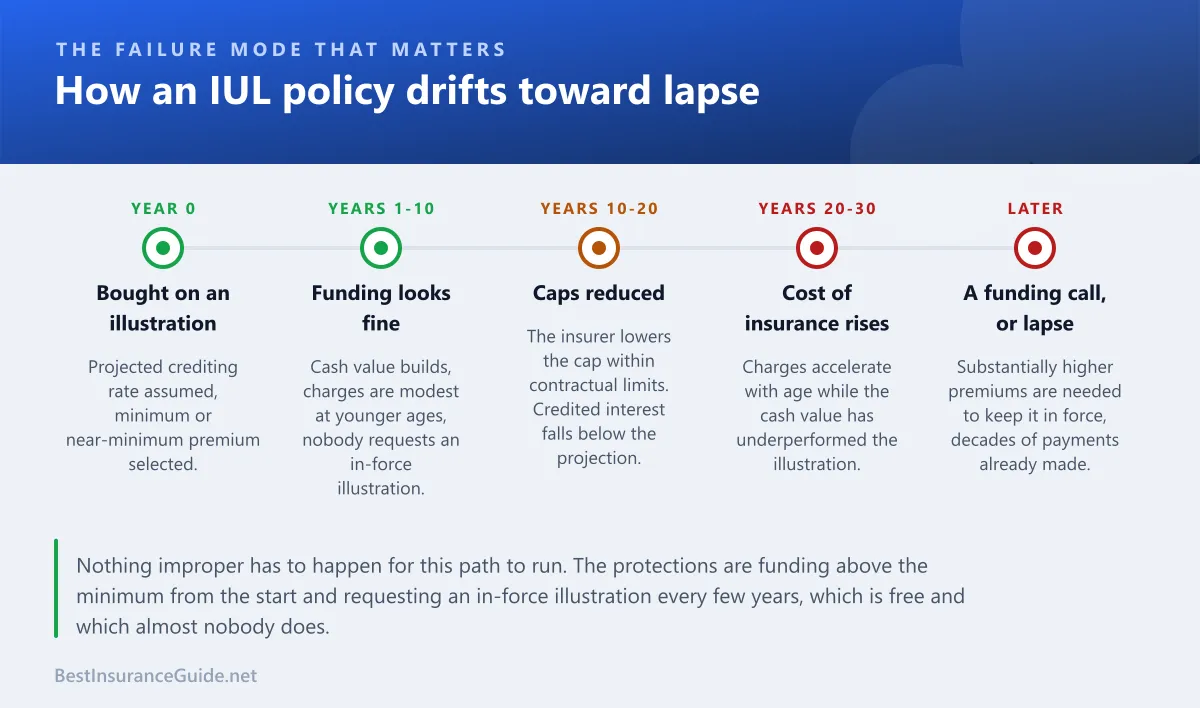
An IUL policy is funded by its cash value. Each period, the cost of insurance and policy charges are deducted. If the cash value is insufficient to cover them, the policy lapses.
That risk is small in early years and grows substantially at older ages, because the cost of insurance rises with age while the cash value may not have grown as illustrated.
The scenario that goes wrong looks like this: a policy is bought at 40 on an illustration assuming a healthy crediting rate; caps are reduced over the following two decades; the cash value underperforms the illustration; at 70 the cost of insurance has risen sharply; the policyholder is asked for substantially higher premiums to keep the policy in force, or it lapses after thirty years of payments with nothing to show for them.
Three protections against that.
Fund it properly from the start, above the minimum premium rather than at it.
Request an in-force illustration every few years, which shows how the policy is actually performing against what was projected. This is free and almost nobody does it.
Understand the no-lapse guarantee if one is offered, including exactly what maintains it, because missing a premium can void it permanently.
Who it genuinely suits
Someone with a genuine permanent death benefit need, meaning a need that does not expire: a lifelong dependant, estate liquidity, business succession.
Someone who has already used more efficient tax-advantaged accounts and is looking for additional tax-deferred accumulation.
Someone who can fund it consistently for decades, because inconsistent funding is what produces the lapse scenario.
Someone who understands the charges and the non-guaranteed elements and has read the guaranteed column.
Who it does not suit
Anyone who needs term life insurance. If the need is protecting dependants for twenty years, term does that for a small fraction of the cost. Our guide to whether life insurance is worth it sets out the needs calculation.
Anyone buying it primarily as an investment, which is how it is frequently presented. It is life insurance with an accumulation feature, not an investment with insurance attached.
Anyone who cannot fund it reliably, since flexible premiums are flexible in both directions and underfunding compounds.
Anyone who does not understand it, which is not a criticism of the buyer. A product this complex should be bought with independent advice or not at all.
Questions to ask before buying
What is the current cap, and what is the guaranteed minimum cap?
What is the participation rate, and can it change?
What is the guaranteed maximum cost of insurance?
Show me the guaranteed column at year 20, 30 and 40.
What premium keeps this in force to age 100 under the guaranteed assumptions?
Is there a no-lapse guarantee, and exactly what maintains it?
What are the surrender charges, and for how many years?
What is your commission on this, and how does it compare with a term policy of the same death benefit?
That last question is entirely fair and the answer is informative.
The short version
Indexed universal life is permanent life insurance whose cash value is credited with interest linked to an index, subject to a floor that protects you and caps and participation rates that limit you. You are not invested in the index and you do not receive dividends.
The floor is guaranteed. The caps, the participation rates and the cost of insurance largely are not, and the illustration is a projection built on assumptions about all three.
The failure mode that matters is lapse: rising insurance costs against underperforming cash value, decades in, after substantial premiums have been paid.
It suits someone with a genuine lifelong need who has exhausted more efficient accounts and can fund it consistently. It does not suit someone who needs term insurance, and it is not an investment with insurance attached.
For the simpler permanent product, see is whole life insurance a good investment, and for the basics, life insurance basics.
How IUL differs from the other permanent products
Three permanent products get compared and the differences matter.
Whole life. Fixed premium, guaranteed cash value growth at a modest rate, guaranteed death benefit, dividends on a participating policy. The most predictable and the least flexible.
Universal life. Flexible premium, cash value credited at a declared interest rate, transparent charges. More flexible than whole life and dependent on the declared rate.
Indexed universal life. Flexible premium, cash value credited by an index-linked formula with a floor and a cap. The most complex and the most sensitive to non-guaranteed elements.
Variable universal life sits alongside these, with cash value invested in subaccounts and genuine market risk including losses. It is a securities product and is sold under different rules.
The pattern across all four is consistent: as flexibility and upside increase, so does the dependence on things the insurer can change and on the policyholder funding it properly.
Worked example: the same premium, different structures
| Whole life | IUL | |
|---|---|---|
| Premium | Fixed and required | Flexible within limits |
| Cash value growth | Guaranteed minimum, plus dividends | Floor of 0%, capped upside |
| Who bears the funding risk | The insurer, largely | The policyholder |
| Lapse risk in later years | Low | Real, and rises with age |
| Complexity | Moderate | High |
Neither column is wrong. The second one requires more from the buyer, and buyers are frequently not told that.
If you already own an IUL
Request an in-force illustration, today, and every two to three years thereafter. It is free, it shows how the policy is actually performing against the original projection, and it is the earliest warning of a funding problem.
Compare the current cap and participation rate against what the policy was sold on.
Ask what premium keeps the policy in force to age 100 on guaranteed assumptions, which is the number that matters and the one nobody volunteers.
Do not surrender impulsively. Surrender charges may still apply, replacing cover at an older age with changed health may be impossible, and gains above the cost basis are taxable.
Take independent advice from somebody who is not selling the replacement, particularly if a 1035 exchange is being suggested.
Two questions that settle it
Do I have a genuine lifelong need for a death benefit? If the need expires when the children are independent and the mortgage is repaid, term insurance answers it for a small fraction of the cost, and no amount of index crediting changes that.
Can I fund this consistently for thirty or forty years, above the minimum premium? Flexible premiums are flexible in both directions, and the lapse scenario is built entirely out of underfunding compounded over decades.
If either answer is no, this is not the product. If both are yes, it may be, and it is worth buying with independent advice from somebody who is not earning the commission.
If somebody is recommending it to you
Three signals are worth noticing in the conversation itself.
The illustration leads with the projected column. Ask to work through the guaranteed one instead and see how the conversation changes.
The product is described as an investment, a retirement plan or a tax-free income stream. It is life insurance with an accumulation feature and specific tax treatment, and describing it in those terms glosses over the charges, the caps and the lapse risk.
Term insurance is not offered as a comparison. For a household with a temporary need, the honest recommendation starts there. An adviser who will not put a term quote alongside the IUL illustration is not helping you compare.
None of that means the product is wrong for you. It means the conversation is being framed by somebody whose compensation depends on the outcome, which is a reason to get a second opinion from somebody paid for advice.
Related reading
For the simpler permanent product, is whole life insurance a good investment covers the same protection-and-savings question without the index mechanics. If health is a factor in the decision, life insurance with cancer sets out what a diagnosis does to the options, including the conversion right on an existing term policy.
A note on scope
Nothing here is financial, tax or investment advice. Crediting methods, caps, participation rates, spreads, charges, guarantees and tax treatment vary considerably between insurers and jurisdictions and change over time. Figures used are illustrative of common structures rather than any particular policy.
Your state insurance department and the NAIC publish buyer guides for universal life products, and the policy illustration and in-force illustrations are the authoritative statement of guaranteed and projected values. A licensed adviser paid for advice rather than product sales is the appropriate source for a personal recommendation. This site is independent and not affiliated with any insurer.