Can You Get Life Insurance If You Have Cancer? Frequently, Yes
What life insurance is available with a cancer diagnosis, during treatment and after remission, how underwriting works, and the guaranteed issue options.

Table of contents

A cancer diagnosis changes what is available and it rarely closes the door entirely. The useful question is not whether cover exists but which route applies to your situation and when.
Three routes, and which applies
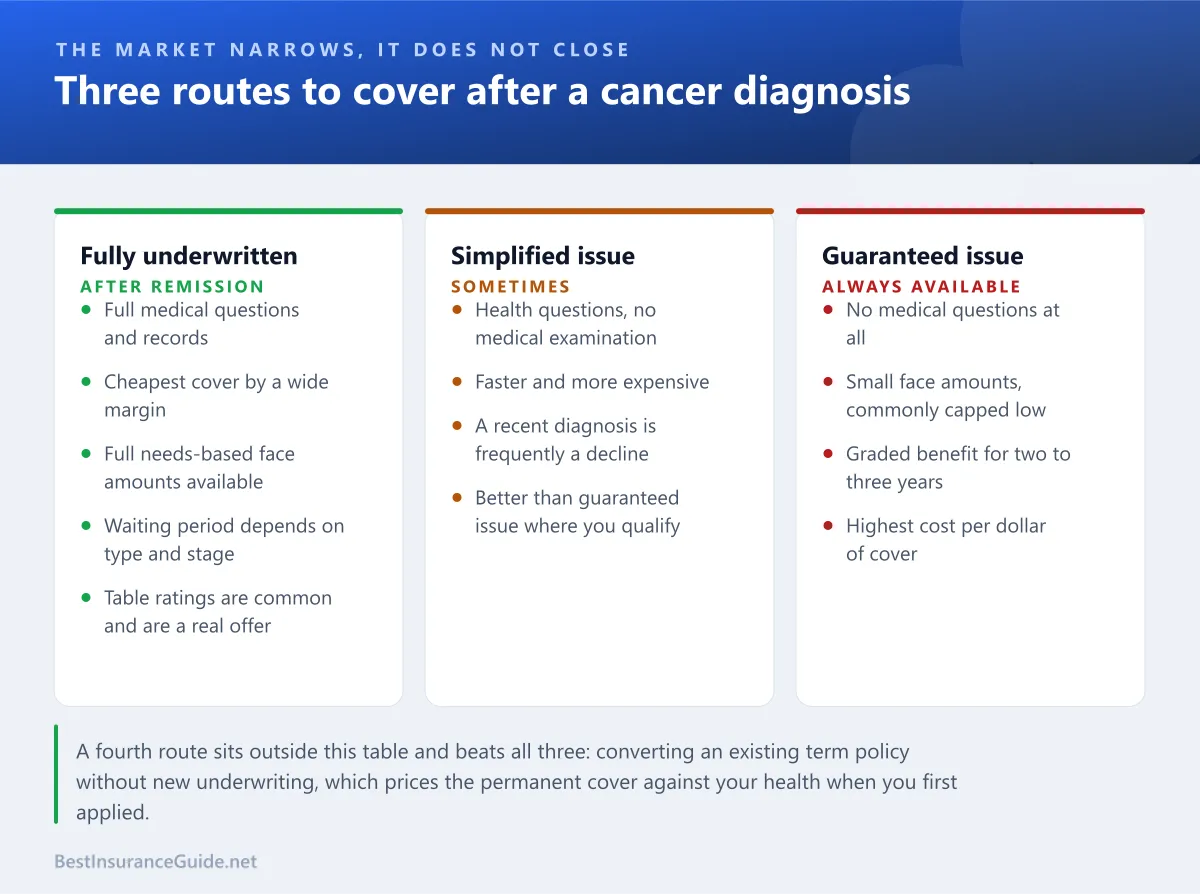
Fully underwritten cover. Medical questions, records and usually an examination. The cheapest cover by a wide margin and the most restrictive on eligibility. Generally available after remission rather than during treatment.
Simplified issue. Health questions but no examination. Faster, more expensive, and the questions frequently include a recent cancer diagnosis as a decline.
Guaranteed issue. No medical questions at all. Always available, small face amounts, high cost relative to benefit, and a graded death benefit period.
Which one applies depends mostly on where you are in the timeline.
During active treatment
Fully underwritten cover is generally not available while treatment is ongoing. That is not a permanent position; it reflects that underwriters need to see an outcome.
Four things are worth doing at this point.
Protect any policy you already hold. An in-force policy cannot be cancelled or repriced because you became ill, provided premiums are paid and the original application was truthful. Never let it lapse, and if paying is difficult, ask the insurer about options before missing a payment rather than after.
Check for a conversion option on an existing term policy. Many term policies include a right to convert to permanent cover without new medical underwriting. After a diagnosis this is frequently the most valuable financial right a person holds, and it has a deadline — commonly an age limit or a period before the term ends — that is easy to miss entirely.
Check employer group life cover. Group policies frequently have a guaranteed issue amount with no medical questions, and open enrolment may allow an increase. Group cover usually ends with employment, but a portability or conversion option may exist.
Consider guaranteed issue, understanding the graded benefit period, if there is an immediate protection need.
After remission
This is where the market reopens, and the timeline varies enormously by diagnosis.
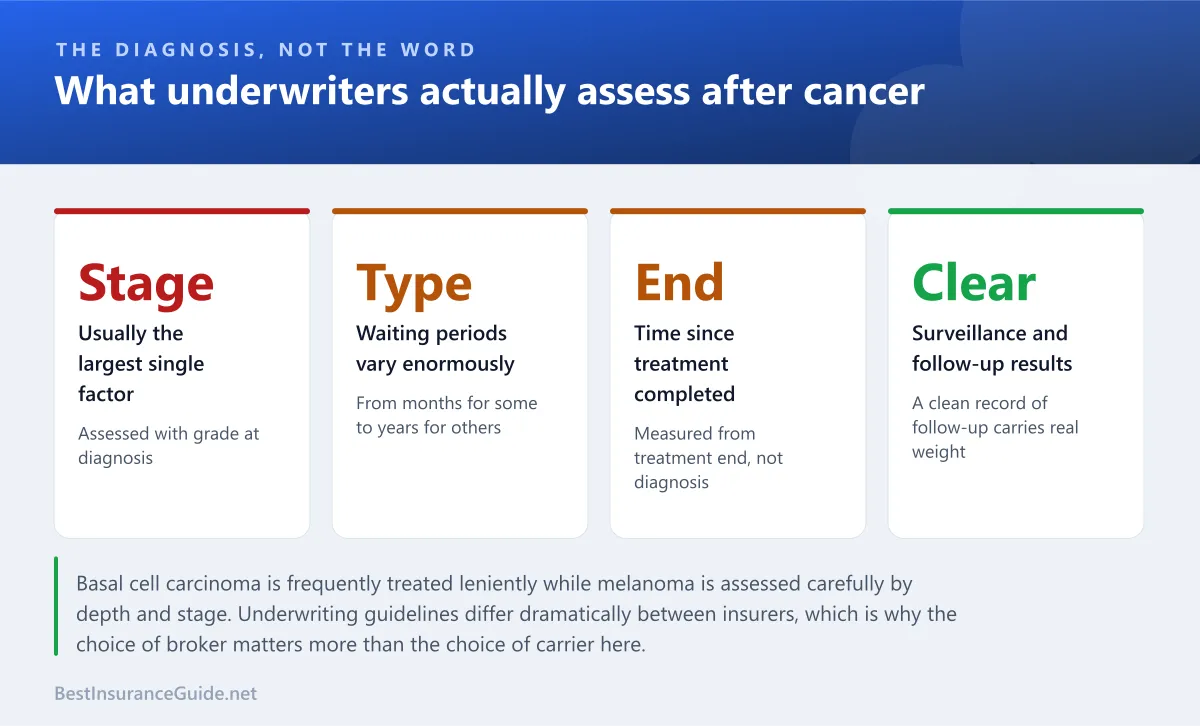
Underwriters assess the specific cancer, not cancer as a category. The factors are:
Type. Some cancers are underwritten within a short period of treatment ending; others require several years.
Stage and grade at diagnosis, which is usually the single largest factor.
Treatment received and its completion date.
Time since treatment ended, with most underwriting guidelines using a waiting period measured from the end of treatment rather than from diagnosis.
Follow-up results and recurrence, and whether surveillance has been clear.
Age at diagnosis, since the same diagnosis is assessed differently at different ages.
Two practical points.
Some diagnoses are treated leniently. Basal cell carcinoma, for example, frequently has little or no effect on rates, and certain very early-stage cancers are underwritten close to standard after treatment.
A rating is not a decline. Many post-cancer applicants are offered cover at a table rating, meaning a percentage loading over standard rates, or with a temporary flat extra that falls away after a stated number of years. That is a real offer and it is frequently much better than guaranteed issue.
Guaranteed issue, and its graded benefit
Because this is the fallback, it is worth understanding precisely.
No medical questions. Acceptance is guaranteed within age limits.
Small face amounts, commonly capped somewhere in the region of $25,000, aimed at final expenses rather than income replacement.
A graded death benefit period, typically two or three years, during which death from natural causes returns premiums paid plus interest rather than the face amount. Accidental death is usually covered in full from the start.
High cost per dollar of cover, which is the price of no underwriting.
Worked example: the same person, three routes
| Fully underwritten, post-remission | Guaranteed issue | Term conversion | |
|---|---|---|---|
| Medical questions | Full underwriting | None | None |
| Face amount available | Full needs-based amount | Small, capped | Up to the existing term amount |
| Graded benefit period | None | Two to three years | None |
| Relative cost per dollar | Lowest | Highest | Priced at original health class |
| Availability | After a waiting period | Immediate | Only if the option exists and has not expired |
The third column is worth the emphasis. Somebody who bought a convertible term policy while healthy and converts it after a diagnosis receives permanent cover priced against their health at the original application. That is why the conversion option matters so much and why the deadline is worth finding today rather than later.
Applying well
Do not apply blind. A declined application is recorded and is asked about on future applications. Work with a broker who knows which carriers are lenient on your specific diagnosis before submitting anything.
Use an independent broker with impaired-risk experience. Underwriting guidelines for cancer vary dramatically between insurers, and the difference between the most and least favourable carrier for the same applicant is frequently the difference between a decline and a standard rating.
Gather the medical record first. Pathology reports, staging, treatment summary, completion dates and follow-up results. A well-documented application with a clear oncologist letter is assessed far more favourably than one requiring the underwriter to chase records.
Answer everything truthfully. A policy issued on a false application can be rescinded during the contestability period, commonly two years, which means the claim fails at exactly the moment it matters. There is no version of this where omitting a diagnosis works.
Ask about reconsideration. Many insurers will review a rating after a further period of clear follow-up, and a policy issued at a table rating can frequently be improved later. Diarise it, because the insurer will not.
Do not cancel existing cover to buy new cover until the new policy is issued and in force.
For families and dependants
Two points that are frequently missed.
The healthy partner should be insured too, and if a stay-at-home parent is uninsured, that is usually the largest uncovered exposure in the household. Our guide to whether life insurance is worth it works through the replacement cost of unpaid work.
Review beneficiary designations and estate documents. A diagnosis is the moment these get attention, and they are the documents that actually determine where money goes. Beneficiary designations override wills.
The short version
A cancer diagnosis narrows the life insurance market rather than closing it. During active treatment, fully underwritten cover is generally unavailable and the routes are guaranteed issue, employer group cover, and any conversion option on an existing term policy.
After remission the market reopens, on a timeline that depends on the specific type, stage and treatment rather than on the word cancer. Table ratings and temporary flat extras are common and are much better outcomes than guaranteed issue.
The single most valuable thing to check today is whether an existing term policy has a conversion option and when it expires, because that right is priced against your health when you bought it.
And whatever else happens, do not let an existing policy lapse.
For the basics, see life insurance basics, and for whether you need cover at all, is life insurance worth it.
The conversion option, in detail
Because this is frequently the most valuable right a person holds after a diagnosis, it is worth setting out properly.
What it is. A right written into many term policies allowing conversion to a permanent policy from the same insurer without new medical underwriting.
Why it matters. The permanent policy is priced against the health class you had when you bought the term policy, not your health today. After a diagnosis, that is the difference between a full-sized policy at reasonable rates and a small guaranteed issue one.
When it expires. Typically at a stated age, or after a stated number of policy years, or a set period before the term ends. Whichever comes first. Missing it is permanent.
What to do now. Find your term policy, read the conversion provision, and write the deadline down. If you cannot find the policy, ask the insurer directly for the conversion terms in writing.
Partial conversion is usually allowed, meaning you can convert part of the face amount and let the rest run as term, which keeps the cost manageable.
Worked example: the value of the option
A person diagnosed at 48, holding a $600,000 twenty-year term policy bought at 40 at preferred rates.
| Converts the policy | Does not convert | |
|---|---|---|
| Medical underwriting required | None | Full, and likely declined |
| Face amount obtainable | Up to $600,000 | Perhaps $25,000 guaranteed issue |
| Priced against health at | Age 40, preferred | Not applicable |
| Cover after the term expires | Permanent | None |
The conversion right cost nothing extra when the term policy was bought. It is worth a great deal at exactly the moment nothing else is available.
What to do in the first month after a diagnosis
Find every policy you hold, personal and through an employer, and check that each is in force and paid.
Read the conversion provision on any term policy and note the deadline.
Check your employer group life amount and whether open enrolment allows an increase without medical questions.
Check whether any group cover is portable or convertible when employment ends.
Review beneficiary designations on every policy, and contingent beneficiaries.
Do not cancel or replace anything.
Make sure somebody else knows what exists and where the documents are.
Two things to do today
Find every policy and check the conversion provision. For anybody holding term insurance, the conversion right is the single most valuable thing in the file after a diagnosis, and it expires on a date nobody remembers. Read it, write the deadline down, and if the policy cannot be found, ask the insurer for the terms in writing.
Make sure the healthy adults in the household are insured. A diagnosis focuses attention on the person diagnosed, and the largest uncovered exposure in many households is a partner nobody thought to insure, frequently one doing unpaid work with a substantial replacement cost.
Neither requires an application and both take an afternoon.
What a broker actually does here
For anybody applying after a diagnosis, the choice of broker matters more than the choice of insurer, and it is worth understanding why.
Underwriting guidelines vary enormously by carrier for the same diagnosis. One insurer may require five years of remission for a particular cancer type and stage while another requires two, and neither publishes that openly.
A good impaired-risk broker shops informally first. They present an anonymised summary of the medical picture to underwriters at several carriers and get an informal indication before any formal application is submitted. That avoids a recorded decline, which is asked about on every future application.
They know how to present the file. A clear treatment summary, staging, completion dates, clean follow-up results and a supportive letter from the treating oncologist produce a materially better outcome than a bare application that leaves the underwriter to chase records.
They know when to wait. Sometimes the right advice is to apply in eighteen months rather than now, because a waiting period is about to be crossed. That advice costs the broker a sale today and is frequently the correct recommendation.
Related reading
Two related situations come up alongside a diagnosis. Life insurance on your parents covers insuring an older family member, including what happens when health limits the available products. What a contingent beneficiary is covers the designation review that a diagnosis usually prompts and that most families have never done.
A note on scope
Nothing here is medical, financial or legal advice. Underwriting guidelines for cancer vary enormously between insurers and change over time, and outcomes depend entirely on individual medical circumstances.
Your state insurance department and the NAIC publish consumer guidance on life insurance underwriting, and your oncology team and a licensed independent broker with impaired-risk experience are the appropriate sources for a personal situation. Your own policy documents state whether a conversion option exists and when it expires. This site is independent and not affiliated with any insurer.