Non-Owner SR-22 Insurance: What It Is and How to Buy It Online
What a non-owner SR-22 policy is, who needs one, what it covers and does not, how long the filing lasts, and how to buy one without owning a car.

Table of contents
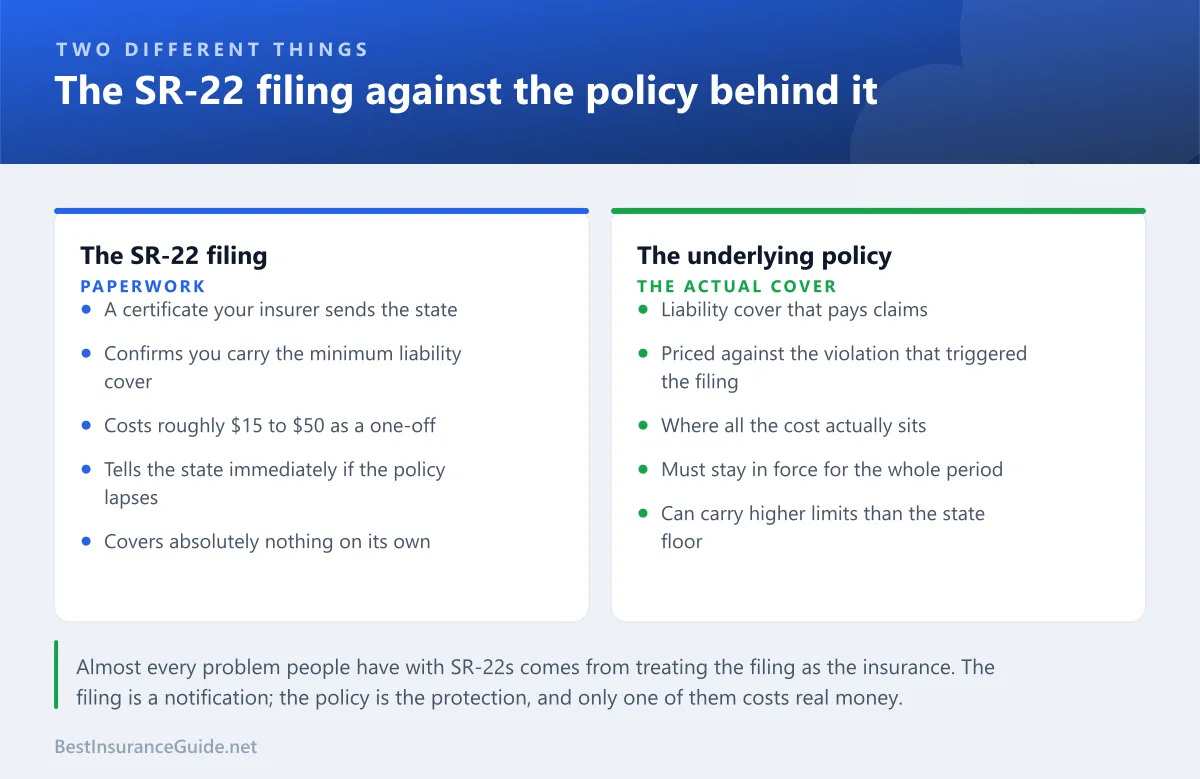
The single most useful thing to understand about an SR-22 is that it is not insurance. Almost every problem people have with the process comes from that misunderstanding.
What an SR-22 actually is
An SR-22 is a certificate of financial responsibility. Your insurer files it with the state to confirm that you carry at least the minimum liability coverage the state requires.
It is a piece of paperwork attached to a policy, not a product you buy on its own. You cannot have an SR-22 without an underlying policy, and the filing does nothing except tell the state that the policy exists.
Two consequences follow.
The state is notified if the policy lapses. That is the entire point of the filing. If the underlying policy cancels, the insurer tells the state, and the licence suspension typically resumes immediately.
The cost is in the policy, not the filing. The filing fee is small, commonly in the region of $15 to $50. What makes an SR-22 policy expensive is the violation that triggered the requirement, which is being priced into the underlying premium.
Who needs one
The requirement follows certain violations, and the list varies by state. The common triggers are:
Driving under the influence, the most frequent reason.
Driving without insurance, or being in an at-fault crash while uninsured.
Driving with a suspended or revoked licence.
Accumulating too many points on the licence.
Repeated serious moving violations.
A judgment arising from a crash that went unpaid.
In each case the state suspends the licence, and reinstatement requires the SR-22 filing alongside whatever fines, courses and waiting periods apply.
Why a non-owner policy
If you own a car, the SR-22 attaches to your ordinary auto policy and the question does not arise.
A non-owner policy exists for the situation where you need the filing and do not have a vehicle to insure. Four situations produce it.
You sold the car, or it was repossessed or written off, and you still need the licence reinstated.
You drive for work in a vehicle somebody else owns and insures.
You rent or borrow vehicles occasionally and want liability cover of your own.
You intend to buy a car later and want to avoid a gap in coverage history, which is itself expensive.
What a non-owner policy covers
Liability only. Bodily injury and property damage you cause to other people while driving a vehicle you do not own.
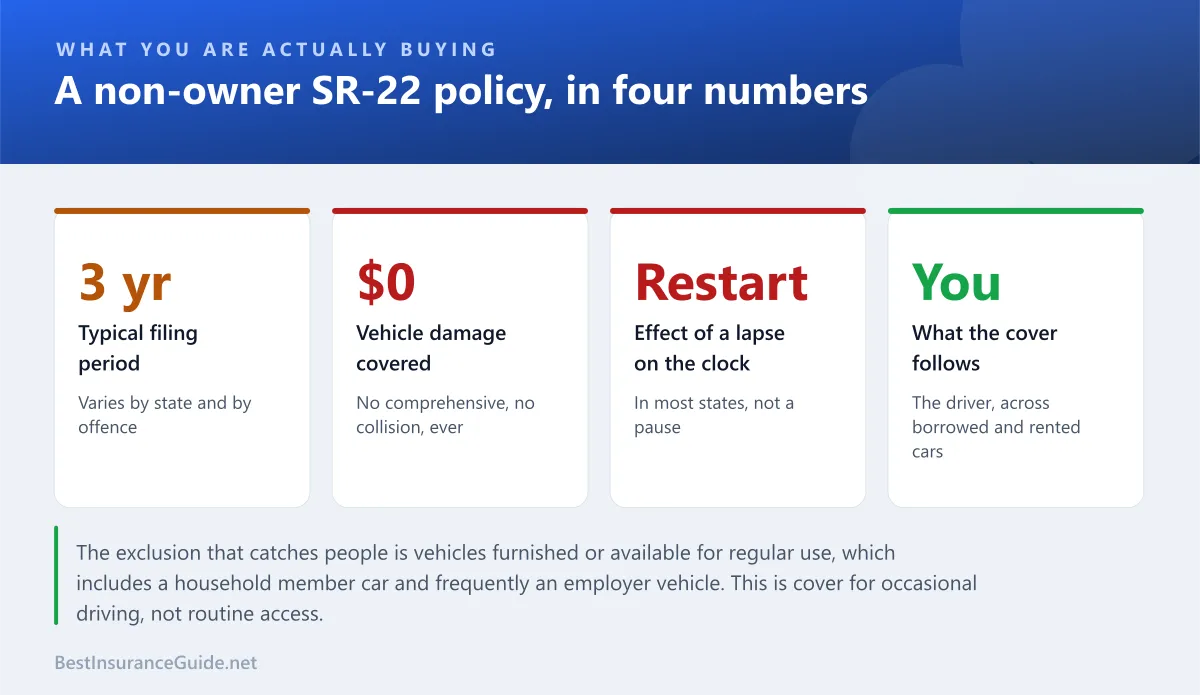
It follows you, not a car. The coverage attaches to you as a driver, which is why it works across borrowed and rented vehicles.
It is secondary in most cases. If the vehicle’s own policy responds first, yours sits above it. That matters when borrowing a car whose owner carries thin limits.
What it does not cover
This is where the misunderstandings concentrate.
No vehicle damage of any kind. No comprehensive, no collision. There is no vehicle attached to the policy to repair.
No vehicle furnished or available for your regular use. This is the important exclusion. A car belonging to somebody in your household, or an employer’s vehicle you drive routinely, is generally excluded. Non-owner cover is for occasional driving of vehicles you do not have routine access to.
Frequently no medical payments or uninsured motorist cover by default, though some insurers offer them and they are worth asking about.
Not a substitute for a rental company’s own products in every case, since a rental damage waiver covers the vehicle and your policy covers your liability. They answer different questions.
Worked example: what each policy answers
You borrow a friend’s car occasionally and cause a crash with $80,000 of injuries and $22,000 of vehicle damage to the other party, plus $9,000 of damage to your friend’s car.
| Loss | Answered by |
|---|---|
| Other party injuries, $80,000 | Friend’s liability first, your non-owner policy above it |
| Other party vehicle, $22,000 | Same |
| Friend’s car, $9,000 | Friend’s own collision cover. Your policy pays nothing |
| Your own injuries | Your health insurance, or med pay if you added it |
The last two rows are the ones people are surprised by, and both follow directly from the policy covering liability rather than property.
How long the filing lasts
Commonly three years, though it varies by state and by offence and can be longer for repeat or serious matters.
Two features of the clock matter.
It runs from a date the state sets, which is frequently the date of conviction or of reinstatement rather than the date you bought the policy.
A lapse restarts it rather than pausing it in most states. If the underlying policy cancels for non-payment, the insurer notifies the state, the suspension resumes, and the three years may begin again. That makes paying this particular policy on time considerably more consequential than an ordinary premium.
When the period ends, the requirement does not always drop off automatically. Confirm with the state and then tell the insurer to remove the filing, because the SR-22 designation on a policy can affect pricing beyond the point where it is required.
Buying one, practically
Confirm what your state actually requires before shopping. Most states use an SR-22; a few use different filings or none. Virginia and Florida use an FR-44 for certain alcohol-related offences, which requires substantially higher liability limits and is a different and more expensive proposition.
Not every insurer files SR-22s, and the ones that do vary widely in what they charge for the underlying risk. This is a market where an independent agent earns their keep, because they know which carriers in your state write this business willingly.
Get at least three quotes, and match the liability limits across them.
Buy above the state minimum if you can afford to. The whole reason you are here is a serious incident, and the minimum limits are thin.
Ask whether medical payments and uninsured motorist cover can be added, because a driver in borrowed vehicles has no other first-party protection.
Pay annually if possible. It avoids the monthly cancellation risk that restarts the filing clock, and it usually attracts a discount.
Tell the insurer honestly about vehicle access. A non-owner policy issued to someone with a car in the household is a claim denial waiting to happen.
What it costs
The filing fee is small, commonly $15 to $50 one-off.
The policy is priced against the violation, and a serious offence can multiply the underlying rate for several years.
A non-owner policy is generally cheaper than an owner policy with the same filing, because there is no vehicle, no comprehensive and no collision.
The price falls over time as the violation ages, which is a reason to re-shop annually rather than assuming the first quote is what this costs for three years.
The short version
An SR-22 is a filing, not a policy. It tells the state you carry the minimum liability cover, and it tells the state immediately if you stop.
A non-owner SR-22 policy is the way to satisfy that requirement without a car. It covers your liability when driving vehicles you do not own and do not have regular access to, and it covers no vehicle damage at all.
The filing fee is trivial and the underlying premium is not, because it is priced against whatever triggered the requirement. Shop it with an independent agent, pay it annually to protect the clock, and re-quote every year as the violation ages.
For how coverage attaches to a car or a driver more generally, see does insurance follow the car or the driver.
Getting the licence back, in sequence
The SR-22 is one step in a process, and doing the steps out of order wastes money.
Find out exactly what the state requires. The suspension notice states the reason, the reinstatement conditions and the date the filing period runs from. Everything else follows from that document.
Complete whatever else is required first, which commonly includes fines, a course, an interlock requirement, or a waiting period. Buying the policy before those are dealt with starts the premium running without advancing the reinstatement.
Buy the policy and have the insurer file the SR-22. Filing is usually electronic and takes a short time, though it can take longer in some states.
Pay the reinstatement fee to the state, which is separate from anything the insurer charges.
Confirm the filing was received. Do not assume. Check with the state directly, because a filing that did not arrive leaves you suspended while paying for a policy.
Keep the policy paid without interruption for the whole period. This is the part that goes wrong most often, and the consequence is disproportionate.
The lapse problem, specifically
An ordinary policy that cancels for non-payment creates a coverage gap, which is expensive on future quotes.
An SR-22 policy that cancels does considerably more than that. The insurer notifies the state, which is the entire purpose of the filing. The licence suspension typically resumes immediately, and in most states the filing period restarts rather than continuing from where it stopped.
That turns a missed payment into another full term of the requirement, plus a second reinstatement fee, plus the underlying premium for longer.
Three practical protections.
Pay annually if you possibly can, which removes the monthly cancellation risk entirely and usually attracts a discount.
Set the payment to a date immediately after you are paid, not before.
Tell the insurer before you miss a payment rather than afterwards, because arrangements made in advance are far easier than reinstatement after the fact.
What happens when the period ends
Confirm with the state that the requirement has expired, using the date on the original notice rather than your own count.
Tell the insurer to remove the filing. It does not always come off automatically, and an SR-22 designation can affect the premium beyond the point where it is required.
Re-shop immediately. The market for a driver whose filing period has ended is very different from the market for one still under it, and the insurers who write SR-22 business are not usually the cheapest for a driver who no longer needs one.
Keep the coverage continuous through the transition, because a gap at this exact point undoes several years of progress on your rating.
Common misunderstandings, cleared up
“The SR-22 is the insurance.” It is not. It is a filing attached to a policy, and the policy is what actually covers anything.
“I can get an SR-22 without a policy.” No. The filing certifies the existence of coverage, so there has to be coverage to certify.
“A non-owner policy lets me drive any car.” It covers liability when you drive vehicles you do not own and do not have regular access to. A car in your household or an employer vehicle you drive routinely is generally excluded.
“It will repair the car I was driving.” It will not. There is no physical damage cover on a non-owner policy at all.
“The three years started when I bought the policy.” Usually not. The clock generally runs from a date the state sets, frequently the conviction or reinstatement date, and it is stated on the suspension notice.
“If I cancel and restart, I lose a month.” In most states a lapse restarts the whole period rather than pausing it, which turns a missed payment into another full term.
“Every insurer can do this.” Many will not file SR-22s at all, and among those that do, pricing for the same driver varies enormously. This is a market where an independent agent is worth the call.
When you buy a car again
The transition from a non-owner policy to an owner policy is where the filing most often goes wrong, and it is easy to get right.
Tell the insurer before you take delivery, not afterwards. A vehicle you own is not covered by a non-owner policy at all, so there is no grace period to rely on.
Confirm the SR-22 carries across to the new policy and that a fresh filing has been made where the state requires one. Do not assume the change is automatic.
Do not cancel the old policy until the new one is in force, because even a day between them is a lapse that the filing reports to the state.
Re-quote at the same time, since the market for an owner policy is different and the carrier who was competitive for a non-owner filing may not be.
A note on scope
Requirements for SR-22 and FR-44 filings, the duration of the obligation, the triggering offences and the consequences of a lapse are set by state law and vary considerably. Figures here are illustrative rather than quotes.
Your state department of motor vehicles and state insurance department publish the authoritative requirements, and the NAIC publishes comparative material by state. Nothing here is legal advice, and anything arising from a criminal conviction is worth discussing with a licensed professional. This site is independent and not affiliated with any insurer.