Car Insurance Quotes in Atlanta: Why Your ZIP Code Costs More Than Your Record
Why Atlanta car insurance costs more than the rest of Georgia, how ZIP code rating works, vehicle theft, commuting, and how to lower the number.

Table of contents

Atlanta is where Georgia’s rating map does most of its work. Two drivers with the same record, the same car and the same insurer can pay very different premiums because of where they park at night, and the gap is frequently larger than anything shopping would recover.
Our statewide guide to the cheapest car insurance in Georgia covers the requirements and the uninsured motorist election that apply everywhere in the state. This page is about the metro specifically.
Why the metro rates higher
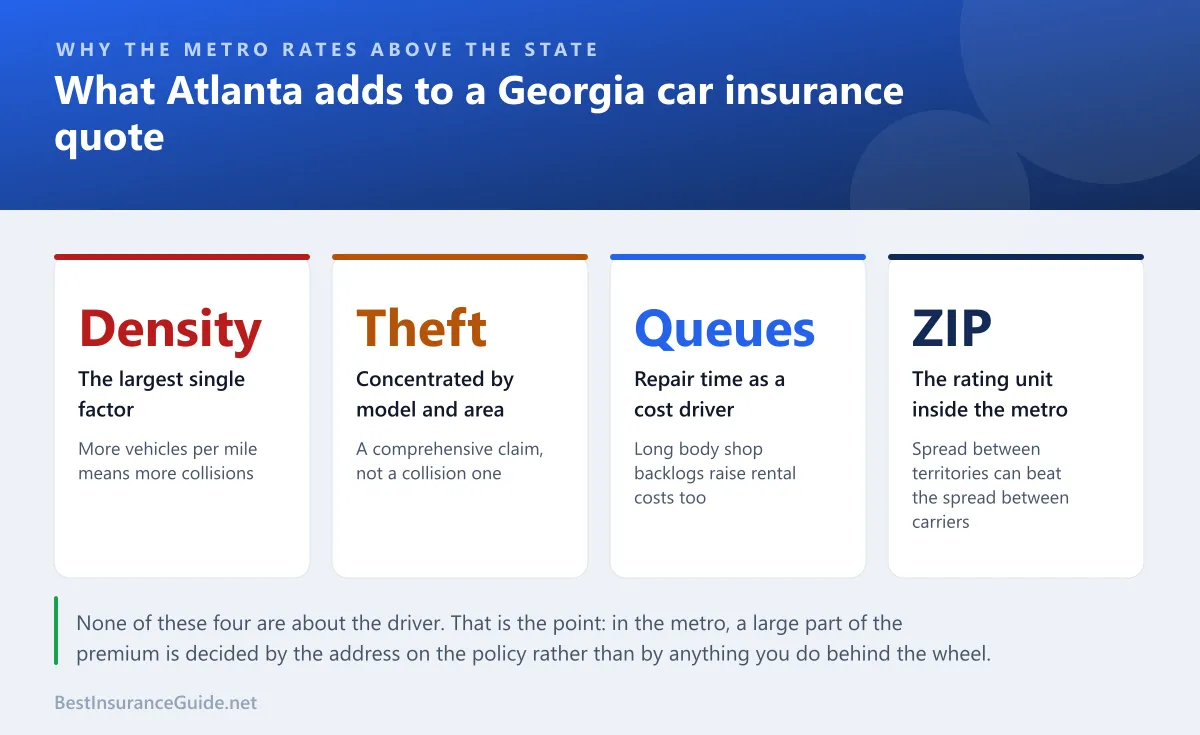
Five factors compound, and none of them are about you.
Traffic density and claim frequency. More vehicles per mile means more collisions per driver, and the metro’s radial commuting pattern concentrates them in predictable corridors at predictable times.
Vehicle theft. Theft rates in parts of the metro sit well above the state average, and certain models are targeted disproportionately. Theft and attempted theft are comprehensive claims.
Repair cost and repair time. Metro labour rates run high, modern vehicles with sensors in bumpers and windscreens have made routine repairs expensive everywhere, and metro body shop queues are long, which raises rental costs alongside repair costs.
Litigation and injury claim costs, which run above the state average in the metro counties.
Uninsured and minimum-limit drivers, concentrated in dense urban areas, which raises what everybody else’s uninsured motorist cover has to absorb.
The ZIP code effect
This is the part drivers find hardest to accept and it is entirely real.
Insurers rate at ZIP code level, using claim experience for that specific territory. Inside the Atlanta metro, the spread between the most and least expensive territories is large enough that moving a few miles can change a premium more than switching insurers would.
Three practical implications.
Get a quote before you move, not after. If you are choosing between two neighbourhoods, the insurance difference is a real line in the comparison and it is easy to check in ten minutes.
Tell your insurer when you move, promptly. A policy rated for the wrong territory is a problem at claim time, and a move into a cheaper territory is a saving nobody applies for you.
Where the car sleeps is what matters, not where you work. Garaging address is the rating input.
The levers that still work
You cannot move the rating map. Four things still move the number materially.
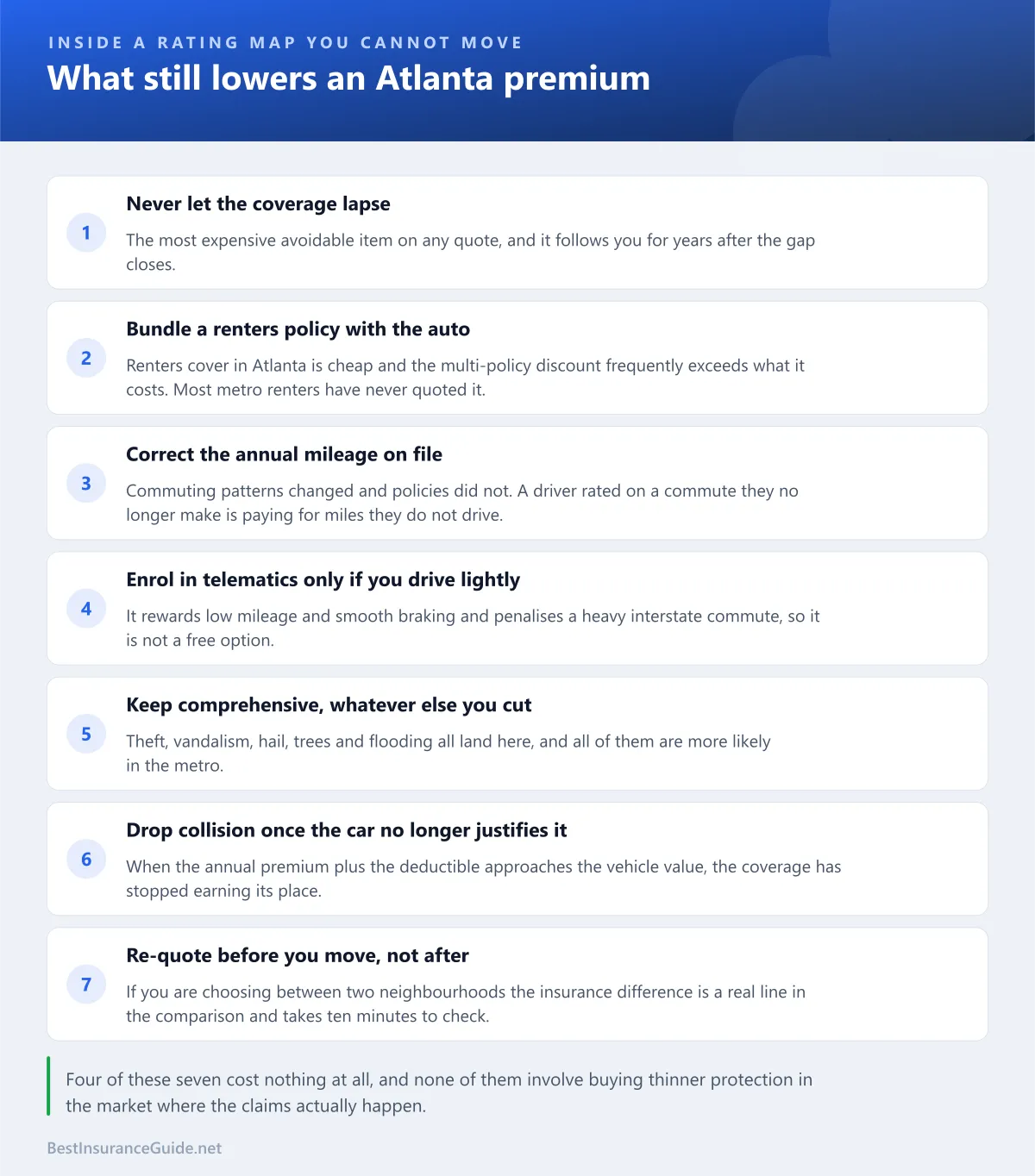
Continuous coverage. A lapse is the most expensive avoidable item on any quote, and it follows you for years.
Bundling. Renters insurance in Atlanta is inexpensive and the multi-policy discount on the auto side frequently exceeds what the renters policy costs. That is close to free money and a large share of metro renters have never quoted it.
Mileage and telematics. Atlanta commutes are long, which cuts both ways. A driver who has moved to a hybrid or remote schedule and is still rated on a 2019 commute is overpaying, and correcting the mileage is immediate. Telematics rewards genuinely low mileage and punishes hard braking, so it suits a light metro driver and not a heavy one.
Deductibles and coverage fit. Raising comprehensive and collision deductibles one step saves a real but modest amount. Dropping collision on a car whose value no longer justifies it saves more.
Worked example: two drivers in the same building
Same age, same clean record, same 2019 sedan, same garaging address.
| Driver A | Driver B | |
|---|---|---|
| Lapse in the last three years | Six weeks | None |
| Bundled with renters insurance | No | Yes |
| Annual mileage on file | 15,000, stale | 5,500, corrected |
| Telematics | Not enrolled | Enrolled, low mileage |
| Deductibles | $500 / $500 | $1,000 / $1,000 |
| Indicative annual premium | $2,980 | $1,680 |
Nothing in that table is about the neighbourhood, the car or the driving record. Four of the five rows cost nothing to change.
What to carry in the metro
Liability well above 25/50/25. Metro repair costs and injury claim values make the state minimum particularly inadequate here. Something around 100/300/100 is the sensible floor.
Uninsured and underinsured motorist on the added-on basis, at limits matching the liability. In a dense metro with a meaningful uninsured population this is doing real work.
Comprehensive, for theft, vandalism, hail, falling trees and flooding. This is the coverage most often dropped to save money in exactly the environment where it is most likely to be needed.
Collision, on any vehicle you could not comfortably replace.
Rental reimbursement, which is worth more in Atlanta than in most places because repair queues are long and a metro household without a car is stuck.
An umbrella policy above the auto liability if you have assets.
The short version
Atlanta rates above the rest of Georgia because of frequency, theft, repair cost and litigation cost, and inside the metro the ZIP code does more work than most drivers realise. The spread between territories can exceed the spread between insurers.
You cannot change the rating map, but four things still move the number: no lapse, bundling, an accurate and low mileage figure, and sensible deductibles. Those are available to everybody and largely free.
Then shop three carriers at genuinely matched coverage, including an independent agent, and re-do it every two years.
For the statewide requirements and the uninsured motorist election, see the cheapest car insurance in Georgia, and for the full discount list, auto insurance discounts.
Theft, and what actually reduces it
Vehicle theft is a larger component of Atlanta pricing than most drivers realise, and it is one of the few risk factors an individual can genuinely affect.
Know whether your model is targeted. Theft is highly concentrated by make, model and year, and the concentration shifts as vulnerabilities become known. A vehicle on the current target list rates worse, and in some cases carriers restrict comprehensive cover on it entirely.
Off-street and secured parking matters, both for the claims it prevents and because garaging arrangements can affect the rating.
Aftermarket immobilisers and trackers are worth pricing, particularly on a targeted model. Some carriers offer a credit and the recovery rate on tracked vehicles is substantially higher.
Do not leave the vehicle running unattended, which is both a theft route and, in most policies, an argument the insurer can raise.
Keep nothing visible, since a large share of vehicle break-ins are opportunistic. Items taken from inside the car are a renters or homeowners claim rather than an auto one, as our guide to car break-ins sets out.
Photograph the vehicle and record the VIN somewhere you can reach from your phone. A recovery is faster when the details are immediate.
Worked example: what a theft claim actually pays
A four-year-old vehicle, actual cash value $17,200, stolen and not recovered, $500 comprehensive deductible.
| Comprehensive carried | Liability only | |
|---|---|---|
| Settlement basis | Actual cash value | Nothing |
| Paid | $16,700 | $0 |
| Outstanding finance, if any | Settled to the extent of the value | Still owed in full |
| Gap between value and loan | Covered only by gap insurance | Entirely yours |
That last row is worth noting in a metro with a high proportion of financed vehicles. Where the loan exceeds the vehicle’s value, comprehensive settles the value and the balance remains a personal debt unless gap cover is in place. Our guide to gap insurance works through when it is worth carrying.
Inside the metro: what changes where
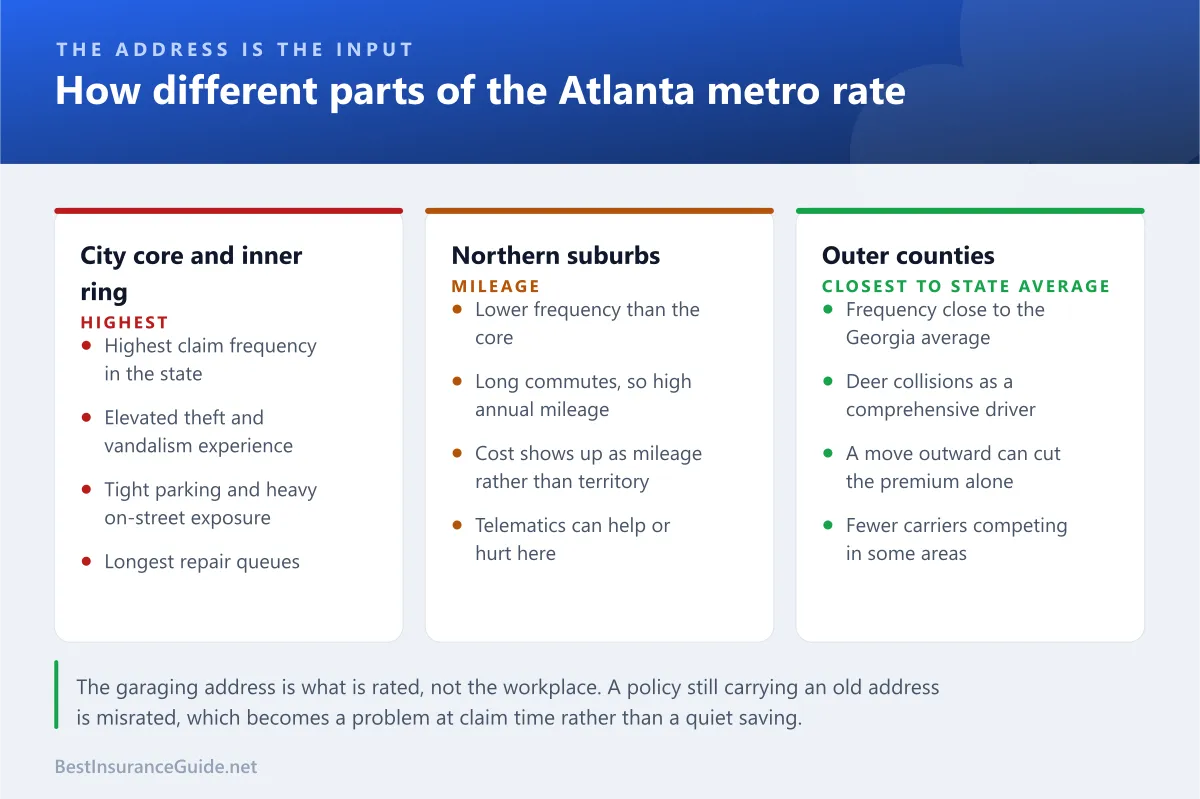
The city core and the inner ring carry the highest frequency and theft rates, and the tightest parking.
The northern suburbs rate lower on frequency and carry longer commutes, which shows up as mileage rather than territory.
The outer counties rate closer to the state average, which is why a move outward can produce a noticeable reduction with no other change.
The interstate corridors matter for how you drive rather than where you park, and telematics programmes notice hard braking on them.
The garaging address is the input, not the workplace. A driver who moved out and kept the old address on the policy is misrated in a way that becomes a problem at claim time rather than a saving.
When to re-quote in Atlanta
After any move, including within the metro.
After a change in commuting pattern, which since remote and hybrid work is the most commonly stale figure on a metro policy.
After a vehicle change, since theft rating and repair cost drive the number rather than the purchase price.
When a violation or at-fault accident ages off, typically at three to five years.
Every two years regardless, at genuinely matched coverage across three carriers including an independent agent.
Rental reimbursement, and why it matters more here
Most drivers treat rental reimbursement as a small optional extra. In Atlanta it is closer to essential, and the reason is repair queues rather than the crash itself.
Metro body shops run long backlogs in normal conditions, and after any regional weather event they run considerably longer. A repair that takes ten days elsewhere routinely takes four to six weeks in the metro, and a household without a second vehicle is stuck for the duration.
The coverage is typically written as a daily limit and a total cap, and the two figures matter differently.
The daily limit determines what class of vehicle you can actually rent. A limit set years ago may no longer cover the daily rate for a comparable car.
The total cap determines how long the coverage lasts. A cap sized for a two-week repair runs out during a six-week one.
Two related points. Comprehensive claims trigger it too, not just collisions, which matters in a metro with meaningful theft and hail exposure. And some credit cards and some memberships provide a partial substitute, though the terms are narrower than most people assume and are worth reading before relying on them.
Two checks worth doing this month
Confirm the garaging address and the annual mileage on your declarations page. Both are frequently stale, and stale in the expensive direction. A metro driver whose commuting pattern changed and never told the insurer is paying for miles they no longer drive.
Confirm your uninsured motorist cover is on the added-on basis rather than reduced-by. In a metro with meaningful uninsured density, that election is worth exactly the at-fault driver’s limit on every serious claim, and it is a line most drivers have never consciously chosen.
What a metro renter should do first
If you rent in Atlanta and have never quoted renters insurance, that is the single most valuable phone call available to you, and it is not really about the renters policy.
Renters cover in Atlanta is inexpensive, commonly in the region of $15 to $25 a month. The multi-policy discount it unlocks on the auto side frequently offsets most or occasionally all of that cost, which means the household ends up with contents cover and $300,000 of personal liability for close to nothing.
Our guide to whether you need renters insurance works through the arithmetic, and in a metro where most car insurance customers are renters, it is the most commonly missed discount in the market.
How other metros compare
Metro rating is its own subject, and the pattern repeats across cities with different underlying state rules.
Philadelphia is the closest comparison: the most expensive territory in its state, driven by the same frequency, theft and repair cost factors, but sitting on top of Pennsylvania’s very low statutory minimums and its tort election.
For the statewide picture around Atlanta, see the cheapest car insurance in Georgia, and for a state where the rural-to-metro spread runs the other way, car insurance in Montana.
A note on scope
Premium figures here are illustrative rather than quotes, and Atlanta pricing varies substantially by ZIP code, driving record, vehicle, coverage selected and individual insurer. Territory ratings, theft patterns and repair costs change over time.
The Georgia Office of Commissioner of Insurance and Safety Fire publishes the current requirements, consumer guidance and complaint records for licensed insurers, and the NAIC publishes comparative data by state. This site is independent and not affiliated with any insurer.