Do I Need Renters Insurance? The Liability Answer, Not the Contents One
Whether you need renters insurance comes down to liability, not belongings. What your landlord's policy does not cover and what a claim against you costs.

Table of contents

Most people answer this question by looking around the room and estimating what their belongings are worth. That is a reasonable instinct and it is the wrong calculation.
The landlord’s policy covers nothing of yours
Start here, because it is the misunderstanding that stops most people buying.
Your landlord insures the building: the structure, the roof, the common areas, their liability as an owner, and their lost rental income if the place becomes unrentable.
It covers nothing you own. Not one item.
Picture a fire starting in the flat above yours, caused by someone you have never met. The landlord’s insurer rebuilds. Your furniture, laptop, clothes, bike and everything else are simply gone, and whose fault it was makes no difference to your position.
The calculation people actually make
The instinct is to compare the premium against the value of your possessions.
That comparison usually produces an answer like “I own maybe $8,000 of stuff and it costs $240 a year, so it is marginal.”
Two things are wrong with it.
People underestimate their contents by roughly half. Almost everyone does. Clothing is the category most badly undercounted, because nobody has ever priced replacing an entire wardrobe at once.
Contents is not the main thing you are buying.
Worked example: a one-bedroom flat, counted properly
Someone who would confidently say they own “maybe eight thousand dollars of stuff”.
| Category | Replacement cost |
|---|---|
| Clothing, shoes, coats | $6,400 |
| Kitchen: appliances, cookware, crockery | $3,900 |
| Furniture: bed, sofa, table, shelving | $7,200 |
| Electronics: laptop, phone, TV, console | $5,100 |
| Bedding, towels, curtains, rugs | $1,800 |
| Bike, sports and outdoor gear | $2,300 |
| Books, tools, small appliances, misc | $2,600 |
| Jewellery and watches | $2,900 |
| Total | $32,200 |
Four times the guess, and nothing on that list is extravagant.
The real reason, which has nothing to do with belongings
Here is the part that decides the question.
Personal liability responds when you are legally responsible for injuring someone or damaging their property. On a renters policy it typically starts at $100,000.
In a rented flat, particularly a multi-unit building, the realistic exposures are large and ordinary.
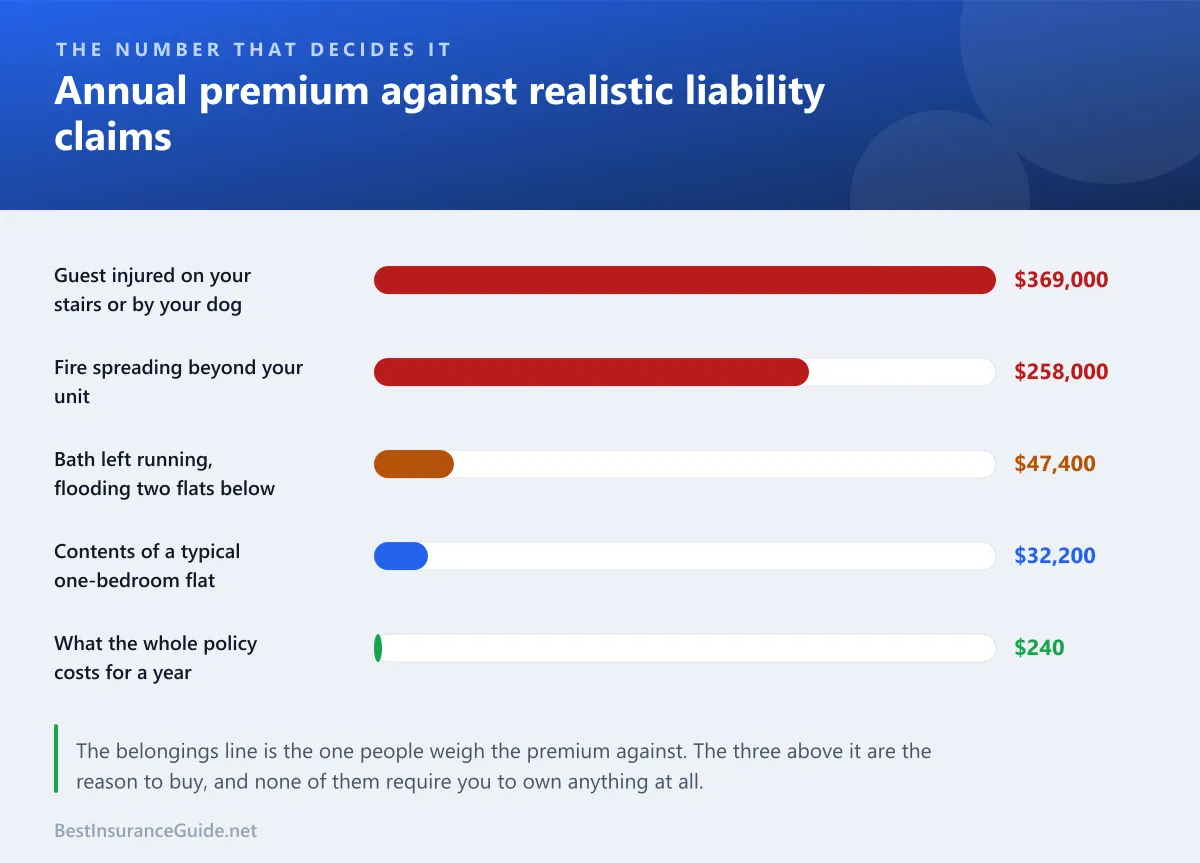
A bath left running, flooding two flats below. Our guide to whether renters insurance covers appliances works through a $47,400 example.
A candle or a pan fire spreading beyond your unit. Our guide to fire damage works through a $258,000 example.
A guest injured on your stairs or by your dog. Our guide to injuries works through a $369,000 example.
None of those require you to own anything. They require you to live somewhere with other people below, beside and above you.
That is what $15 to $30 a month buys. The contents cover is the part you notice; the liability cover is the part that prevents a judgment.
Who genuinely does not need it
Being honest about the exceptions, they are narrow.
Someone living alone in a detached property with no neighbours, no visitors, no pets and nothing worth replacing has a weak case. That is a small population.
Someone whose landlord’s lease genuinely prohibits it, which effectively does not happen.
Someone already covered under another policy, most commonly a student living in halls or at home who remains covered under a parent’s homeowners policy. That coverage is usually limited and worth confirming rather than assuming, but it can be real.
For everybody else, the honest answer is yes.
It is frequently required anyway
No state requires renters insurance by law.
Leases increasingly do. Most now specify a minimum personal liability limit, commonly $100,000 or $300,000, and many require the landlord be named as an additional interested party, which costs nothing and simply means they are told if the policy lapses.
Two cautions on lease requirements.
Do not name the landlord as an additional insured unless the lease explicitly requires it, because that extends your liability limit to protect them as well.
Check the required limit before quoting, since a policy at $100,000 will not satisfy a lease demanding $300,000 and you will have to redo it.
Our guide to renters insurance in Ohio sets out how to read a lease clause properly, and the same approach applies anywhere.
What it costs, and the bundling trick
Commonly $15 to $30 a month, or roughly $180 to $360 a year, moving with your city, building, deductible and contents limit.
The single most effective saving is bundling with an existing auto policy.
Worked example: renters cover that pays for itself
| Before | After | |
|---|---|---|
| Auto premium | $1,640 | $1,443 |
| Renters premium | $0 | $186 |
| Annual total | $1,640 | $1,629 |
The multi-policy discount cut the auto premium by $197. The renters policy costs $186. This household is $11 a year better off and now has $35,000 of contents cover and $100,000 of liability it did not have.
That outcome is not universal, but it is common enough that quoting renters cover with your existing auto insurer should always be the first call.
If you buy it, buy it properly
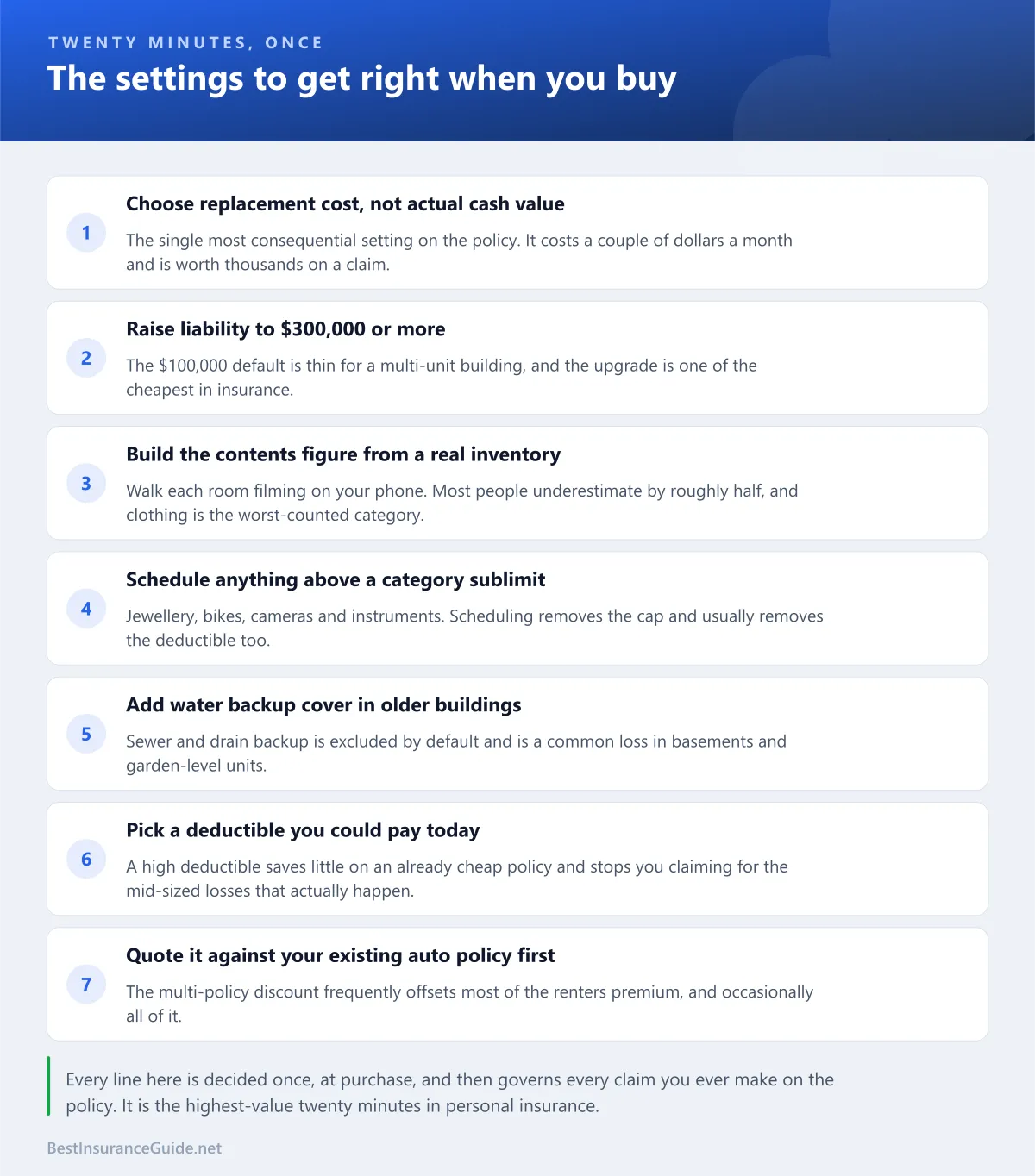
Replacement cost, not actual cash value. The single most consequential setting, worth thousands on a claim and a couple of dollars a month.
Liability at $300,000 or more, not the $100,000 default. In a multi-unit building this is the number that matters most and the upgrade is trivially cheap.
A contents limit based on a real inventory, not a guess. Walk each room with your phone recording.
Schedule anything above a category sublimit, particularly jewellery, bikes and cameras. Our guide to theft coverage sets out where those caps sit.
Add water backup cover if you are in an older building or below ground level, since sewer and drain backup is excluded by default.
A deductible you could actually pay today. A high deductible saves little on an already cheap policy and stops you claiming for the mid-sized losses that actually happen.
The short version
Your landlord’s insurance covers their building and nothing of yours. That is the starting point.
But the reason to buy renters insurance is not your belongings, even though you almost certainly own more than you think. It is liability: a fire, a water escape or an injury originating with you can produce claims in the hundreds of thousands, and that exposure exists regardless of what you own.
For $15 to $30 a month, frequently offset entirely by the bundling discount on an existing auto policy, that is the cheapest meaningful protection available anywhere in personal finance.
If you buy it, get replacement cost, raise the liability limit above the default, and build the contents figure from an actual inventory rather than a guess.
For the full picture on what the policy does, see the renters insurance guide and what renters insurance covers.
The objections, answered
Five reasons people give for not buying it, and what is actually true.
“My belongings are not worth much.” Almost certainly more than you think, as the inventory above shows. But more importantly, the belongings are not the main reason. Liability is, and that exposure does not scale with what you own.
“My landlord has insurance.” They insure the building and their own liability. Their policy covers nothing of yours, and if you cause a loss, their insurer may pursue you for it through subrogation. That is not a theoretical risk; it is a routine practice.
“I live somewhere safe.” Fire, water escape and injury claims are not concentrated in high-crime areas. A burst supply hose does not care about the neighbourhood.
“I could not afford it.” At $15 to $30 a month it is frequently the cheapest recurring cost in a household budget, and bundling with auto insurance regularly makes it close to free.
“I would just move if something happened.” Move to what, funded how? A total loss means replacing everything you own and finding new housing simultaneously, and loss of use is what funds the second part.
The subrogation point, expanded
This is the argument that closes it for most people and it is rarely made.
If a fire or water escape starts in your unit, the landlord’s insurer pays the landlord, then pursues you to recover what they paid. So does every other tenant’s insurer whose policyholder you damaged.
Without renters insurance, those recovery actions come to you personally. With it, they go to your insurer and your liability coverage handles them, including your legal defence.
So the question is not really whether you can afford to replace your own belongings. It is whether you can absorb being sued by three insurance companies at once for damage a rubber hose caused while you were at work.
Worked example: the recovery action
| Claim against the tenant | Amount |
|---|---|
| Landlord’s insurer, building repairs | $28,400 |
| Downstairs tenant’s insurer, contents | $9,100 |
| Downstairs tenant’s insurer, loss of use | $4,800 |
| Landlord, lost rental income | $6,200 |
| Total pursued | $48,500 |
With a renters policy at $100,000 liability, that is absorbed entirely and costs the tenant a deductible on their own contents claim. Without one, it is a personal debt.
The situations where the answer is most obvious
Some circumstances move this from a sensible purchase to something close to negligent to skip.
Living above the ground floor, where any water escape from your unit reaches other people’s homes. This is the single largest driver of tenant liability claims and it has nothing to do with what you own.
Living in a multi-unit building of any kind. Shared walls, shared plumbing and shared structure mean an event that starts with you rarely stops with you.
Owning a dog. Dog bite claims are among the most expensive liability claims in personal insurance, routinely reaching six figures, and they are made against the owner personally. Note that many insurers restrict certain breeds, so confirm rather than assume.
Having people in the home regularly, whether guests, a housemate’s visitors or children’s friends. Injury on your premises is a liability claim.
Being the sole earner or having no savings buffer. The less capacity you have to absorb a shock, the more valuable the transfer of that shock to an insurer, which is the opposite of the intuition most people apply.
Having a lease that requires it. Uninsured occupancy in breach of a lease term is a route to eviction quite apart from the underlying risk.
Buying it, practically
The purchase takes about twenty minutes and most of that is the inventory.
Walk each room with your phone recording, narrating what things are and roughly what they cost. That gives you the contents figure and doubles as claim evidence later, which is the single highest-value thing you will do.
Quote your existing auto insurer first, because the bundling discount is frequently large enough to make the renters premium close to free.
Then quote two others at matched coverage. Matched means the same contents limit, the same liability limit, the same deductible and replacement cost on both, otherwise the comparison is meaningless.
Check the lease requirement before binding, particularly the minimum liability limit and whether the landlord needs naming as an interested party.
Read the declarations page when it arrives. Confirm replacement cost, the liability limit, the loss of use figure and any scheduled items. Two minutes now prevents discovering an actual cash value setting during a claim.
Store the policy number and the claims line somewhere reachable from your phone, since the scenario in which you need it is one where you may not be able to get into your home.
A note on scope
Premium figures here are illustrative ranges rather than quotes. Lease requirements, subrogation practice and landlord obligations vary by jurisdiction and by contract.
Quote with your existing auto insurer first to capture the bundling discount, then compare two others at matched coverage. This site is independent and not affiliated with any insurer.