Does Renters Insurance Cover a Car Break-In? The Contents, Not the Car
Renters insurance covers items stolen from your car; auto comprehensive covers the car itself. How the split works and when neither claim is worth filing.

Table of contents

A car break-in is the clearest example of two policies covering one event, and the split confuses people every time.
The rule
The car is your auto policy. The contents are your renters policy.
That single line answers most of it, and the boundary is whether the item is part of the vehicle.
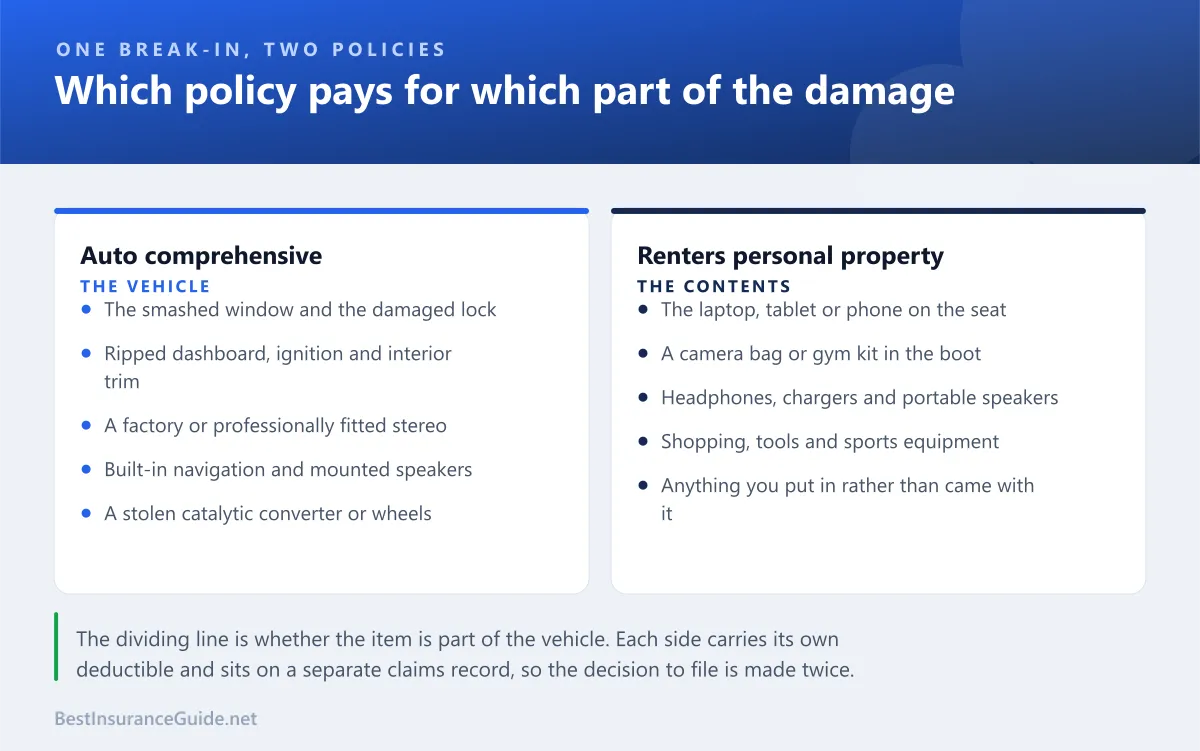
Auto comprehensive covers: the smashed window, the damaged door lock, the ripped-out dashboard, the ignition, the trim, and anything permanently installed in the vehicle. That includes a fitted stereo, a built-in navigation unit, and permanently mounted speakers, sometimes subject to a custom equipment limit.
Renters personal property covers: the laptop on the seat, the camera bag in the boot, the gym kit, the headphones in the door pocket, the child’s tablet, the shopping. Anything you put in the car rather than anything that came with it.
Neither covers items belonging to someone else, business property beyond a small limit, or cash beyond the tiny cash sublimit covered in our guide to whether renters insurance covers theft.
Two claims, two deductibles
This is where the practical decision sits.
Worked example: one break-in, both claims
A window is smashed and a laptop and camera taken.
| Loss | Policy | Deductible | Settlement |
|---|---|---|---|
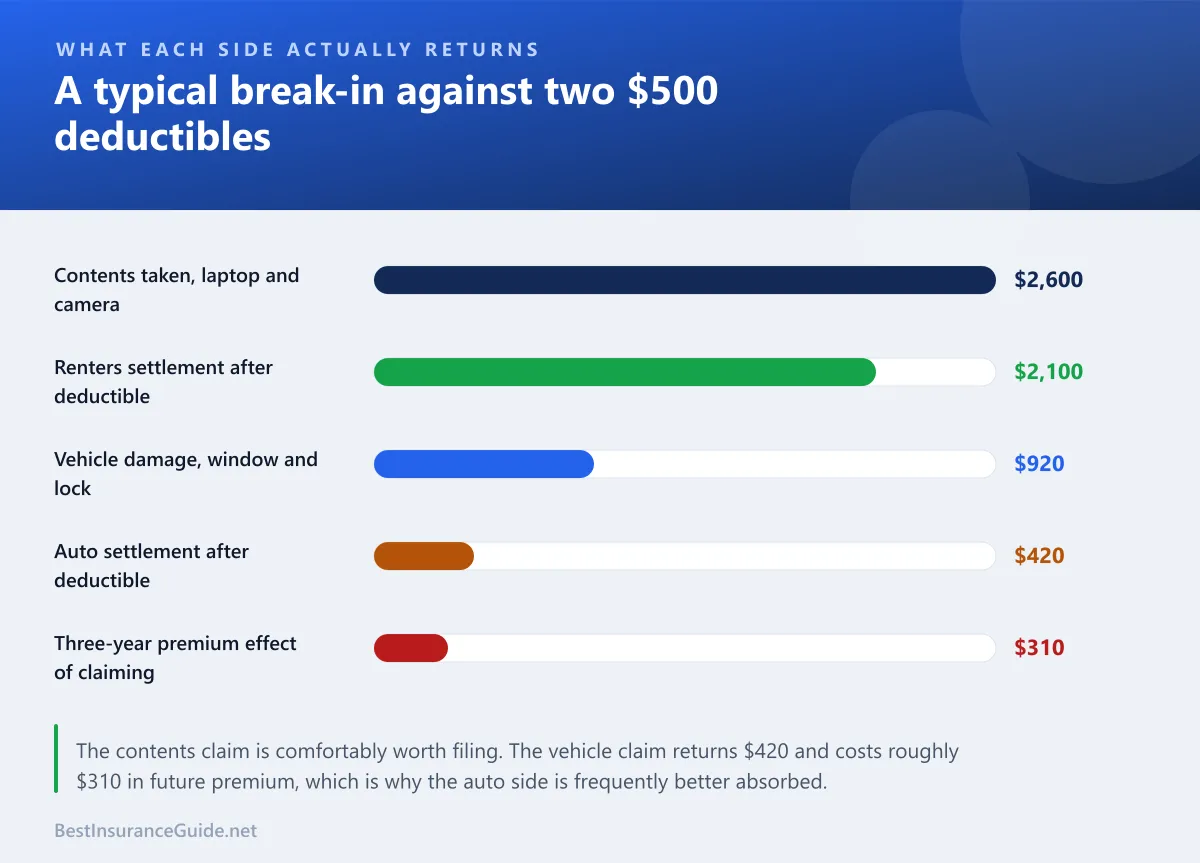
| Window, door lock and trim, $920 | Auto comprehensive | $500 | $420 |
| Laptop and camera, $2,600 | Renters personal property | $500 | $2,100 |
| Total recovered | $2,520 |
Two separate claims, two separate deductibles, two separate claims records.
That last point is the one people underweight. An auto comprehensive claim sits on your auto record and a renters claim sits on your property record, and both are visible to future insurers through the CLUE database for several years.
When not to claim
The arithmetic is worth doing before you pick up the phone.
The auto side is frequently not worth it. A $920 window against a $500 comprehensive deductible returns $420. Comprehensive claims are generally treated more gently than at-fault collision claims, but they still appear on your record and some insurers surcharge for frequency. For $420, absorbing it is often the better decision.
The renters side usually is worth it if the contents loss is meaningful, because renters premiums are low and the settlement is proportionally large.
Neither is worth it if the whole loss is close to your deductibles. A stolen gym bag and a cracked window quarter panel that comes to $700 across two policies with $500 deductibles each returns almost nothing and puts two claims on your record.
The general rule that applies across every line of insurance: below roughly one and a half times the deductible, absorb it.
What is actually covered on the renters side
Standard off-premises personal property rules apply, which means the same limits you have at home.
Category sublimits still apply. Jewellery, cash, firearms and collectibles carry the same caps in a car as in the flat, and the cash limit of around $200 to $300 is the one that catches people.
Replacement cost against actual cash value matters as much here as anywhere. On electronics, which is most of what gets stolen from cars, the difference is substantial. Our guide to whether renters insurance covers electronics sets out the arithmetic.
Off-premises limits. Some policies apply a percentage cap to property away from the residence. That is more commonly an issue for storage units than car contents, but it is worth knowing your figure.
Business property is frequently excluded or capped low. A work laptop taken from a car is a common and awkward claim, and the answer depends on who owns it.
Rental cars, and travelling
Two situations worth separating.
Items stolen from a rental car are covered by your renters policy in the normal way, because off-premises coverage follows your belongings rather than the vehicle you happened to put them in.
The rental car itself is a different question entirely, handled by your own auto policy’s comprehensive coverage, a credit card benefit, or the rental company’s damage waiver. Our guide to whether insurance follows the car or the driver covers how that works.
Theft while travelling abroad is usually still covered by renters insurance, though some policies limit off-premises coverage outside the country. Check before a long trip, and note that you will need a local police report which is far easier to obtain before you fly home than afterwards.
What to do after a break-in
Photograph everything before you clean up. The broken glass, the damaged lock, the interior, the location and any nearby camera that might have caught it. Wide shots as well as close-ups.
File the police report the same day, and get the reference number. Both insurers will want it.
List what was taken precisely, with model and serial numbers where you have them. “A laptop” settles conservatively; a specific model with a serial number settles against a real replacement price.
Do not repair the vehicle before the auto insurer has seen it or released you, if you intend to claim.
Keep the receipts for temporary repairs, such as taping plastic over a window, which are usually recoverable.
Check whether the theft was of a set. If one item of a matched pair or set was taken, some policies cover the diminished value of the remainder.
Reducing the odds
Car break-ins are overwhelmingly opportunistic, and the deterrents are simple.
Leave nothing visible. Not a bag, not a charging cable, not a coat. A visible cable suggests a device in the glovebox.
Do not use the boot as storage in a car park, and never transfer items to the boot after arriving where someone can see you do it.
Park in lit, overlooked places, and prefer somewhere with camera coverage.
Take the removable face or the whole unit if you have aftermarket audio equipment.
Do not leave documents in the glovebox containing your home address alongside a garage remote, which is a genuine burglary route.
The short version
A car break-in produces two claims. The vehicle damage and anything permanently fitted is your auto policy under comprehensive. Your belongings that were inside are your renters policy under off-premises personal property.
Each carries its own deductible and sits on a separate claims record, so the decision to file is separate for each side. On a modest break-in the auto side is frequently not worth claiming, and if the whole loss is close to both deductibles, neither is.
Category sublimits still apply to items stolen from a car, and the cash limit of a couple of hundred dollars is the one that surprises people.
File the police report the same day, photograph before you clean up, and list what was taken with serial numbers.
For the wider picture on theft cover, see does renters insurance cover theft, and for what a renters policy covers generally, what renters insurance covers.
Which claim to file, worked through
Because a break-in produces two possible claims, the decision is worth making deliberately rather than reflexively.
Scenario one: minor damage, valuable contents
| Amount | |
|---|---|
| Window and lock damage | $640 |
| Auto comprehensive deductible | $500 |
| Auto settlement | $140 |
| Contents taken | $3,200 |
| Renters deductible | $500 |
| Renters settlement | $2,700 |
File the renters claim, absorb the auto side. A $140 recovery is not worth a comprehensive claim on your record.
Scenario two: major damage, trivial contents
| Amount | |
|---|---|
| Window, dashboard and ignition damage | $2,400 |
| Auto comprehensive deductible | $500 |
| Auto settlement | $1,900 |
| Contents taken, an old gym bag | $120 |
| Renters deductible | $500 |
| Renters settlement | $0 |
File the auto claim only. The contents loss is below the deductible and there is nothing to claim.
Scenario three: both modest
| Amount | |
|---|---|
| Window damage | $580 |
| Contents taken | $700 |
| Combined recovery after two deductibles | $280 |
File neither. Two claims on two records for $280 is a poor trade, and both will be visible to future insurers through the CLUE database for several years.
The claims record consequence
This is the part people underweight when deciding.
Property and auto claims are reported to a shared industry database, and future insurers see them when quoting. The effect varies: comprehensive claims are generally treated more gently than at-fault collision, and a single renters claim is rarely dramatic. Frequency is what causes problems.
Two or three claims in three years, of any type, moves you into a worse pricing tier and in some cases affects whether an insurer will write you at all. That is why absorbing small losses is genuinely the better financial decision, not merely a cautious one.
The general test: below roughly one and a half times the deductible, absorb it. Between that and about three times, think about it. Above that, claim.
Where your things were parked matters less than you think
A recurring question is whether coverage changes with location, and for the renters side the answer is largely no.
Off-premises personal property coverage follows your belongings, not the address. A bag taken from a car outside your flat, at a trailhead two hundred miles away, in an airport car park or on a work trip is treated the same way, subject to the same deductible and the same category sublimits.
Three situations do change the analysis.
A vehicle you do not own. Items stolen from a friend’s car, a hire car or a work vehicle are still yours and still covered. The vehicle damage in that case is not your problem to claim, though the owner may well have a deductible and a conversation to have with you about it.
Long-term storage. Belongings kept in a vehicle semi-permanently start to look less like personal property in transit and more like stored property, and some policies apply an off-premises percentage cap. It is rarely an issue for a laptop on a seat and occasionally an issue for someone living out of a car between homes.
Property that is not really yours. A work laptop owned by an employer, a friend’s camera you borrowed, or stock belonging to a side business all sit outside or at the edge of a standard renters policy. Business property is typically capped at a few thousand dollars away from the residence and sometimes considerably less.
What the two deductibles really cost
The deductible arithmetic looks simple and hides a second cost that only shows up at renewal.
A claim does not just cost you the deductible. It costs the deductible plus whatever the claim does to your pricing for the following three to five years, and that second figure is invisible at the moment you decide.
Worked example: the three-year cost of a small claim
| File the claim | Absorb it | |
|---|---|---|
| Loss | $920 | $920 |
| Deductible paid | $500 | n/a |
| Insurer pays now | $420 | $0 |
| Premium effect, three years | -$310 | $0 |
| Net position | +$110 | -$920 |
That example still favours claiming, narrowly. Move the loss down to $700 and the premium effect up slightly, which is entirely realistic in a market that surcharges frequency, and the claim becomes a losing trade.
The honest summary: on a break-in, do the arithmetic on each side separately, treat the premium effect as real rather than theoretical, and remember that the number of claims on your record matters more than the size of any single one.
A note on scope
Coverage terms, off-premises limits, custom equipment provisions and claims-reporting practices vary between insurers and change over time. The figures here are illustrative rather than any particular policy’s schedule.
Both your renters and your auto declarations pages state the relevant deductibles, and knowing both before an incident is worth more than reading this afterwards. This site is independent and not affiliated with any insurer.