Does Renters Insurance Cover Electronics? Yes, at the Wrong Value
Renters insurance covers electronics against theft and named perils. Why actual cash value guts the payout, category sublimits, and what is never covered.

Table of contents

Electronics are covered by renters insurance, and the answer people actually need is not whether but for how much.
What is covered, precisely
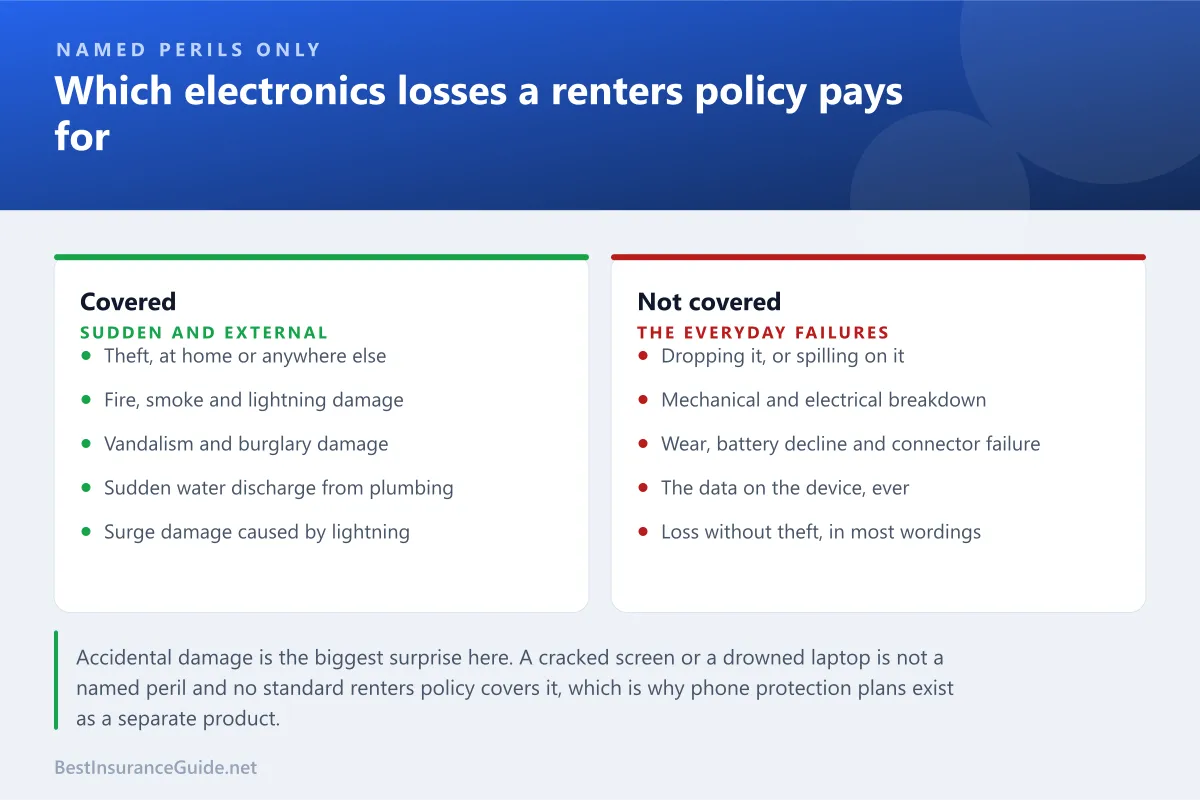
Electronics are ordinary personal property. They are covered against the named perils listed on your policy: fire, smoke, lightning, theft, vandalism, windstorm, hail, explosion, falling objects, and sudden water discharge from plumbing or appliances.
Coverage generally follows the item away from home. A laptop taken from a café, a camera stolen on holiday, headphones lifted from a gym locker: all normally covered, subject to your deductible.
That is genuinely broad. The problems are elsewhere.
What is not covered
Accidental damage. This is the biggest surprise. Dropping a phone, standing on a tablet, spilling coffee into a laptop keyboard: none of those are named perils, and none are covered by a standard renters policy. If accidental damage is what you are worried about, you need an endorsement or a separate device policy.
Mechanical breakdown. A television that simply fails, a hard drive that dies, a battery that stops holding charge. Insurance covers sudden accidental damage, not the end of a service life or a manufacturing defect.
Wear and tear, including screen degradation and connector failure.
Data. Photographs, documents, music, anything stored on the device. A policy replaces hardware, not what was on it. Back up separately, because no insurance product will restore your files.
Loss without theft. Leaving a phone on a train is not theft, and mysterious disappearance is excluded on most policies.
Damage from flood or earthquake, both excluded from every standard renters policy regardless of what was damaged.
The setting that decides the payout
This matters more for electronics than for any other category, because nothing you own depreciates faster.
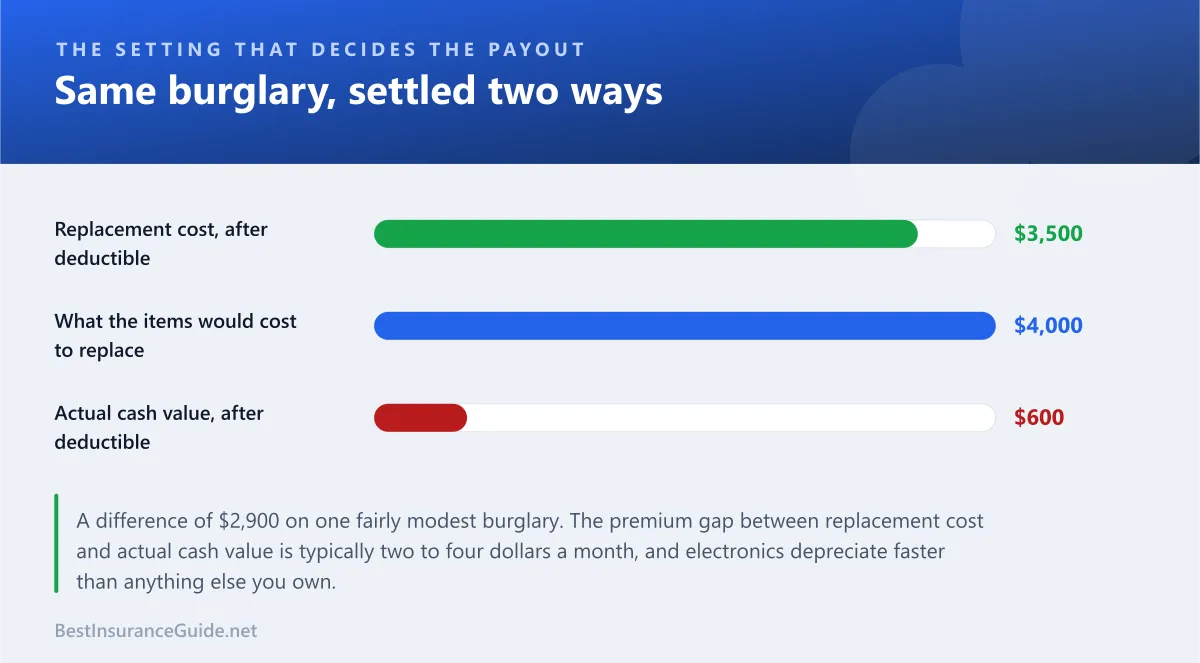
Actual cash value pays what the item was worth immediately before the loss: replacement price less depreciation. On a four-year-old laptop that is a fraction of what a comparable machine costs today.
Replacement cost pays what it costs to buy a comparable new item, subject to your limits and deductible.
Worked example: a burglary, settled two ways
Four items taken, $500 deductible.
| Item | Paid | Age | Replacement today | ACV after depreciation |
|---|---|---|---|---|
| Laptop | $1,600 | 4 yrs | $1,500 | $380 |
| Television | $900 | 5 yrs | $700 | $180 |
| Games console and games | $750 | 3 yrs | $650 | $250 |
| Camera and lens | $1,200 | 6 yrs | $1,150 | $290 |
| Total | $4,450 | $4,000 | $1,100 |
With a $500 deductible:
- Replacement cost: $4,000 − $500 = $3,500
- Actual cash value: $1,100 − $500 = $600
A difference of $2,900 on one fairly modest burglary. The premium gap between the two settings is typically $2 to $4 a month.
Actual cash value is frequently the default on cheap quotes and it is rarely labelled clearly. Check the declarations page rather than assuming, because this single line is worth more than every other decision in this article.
Category sublimits
Even on a replacement cost policy, many insurers apply a sublimit to electronics as a category, sitting well below your overall contents limit.
Where that exists, a home office with two laptops, a monitor, a camera, a console and audio equipment can exceed it in a single theft, and the policy pays the sublimit rather than the loss.
Two things to do.
Find out whether your policy has one, and what the figure is. It is in the declarations or the special limits section.
Schedule anything significant. Scheduling lists an item individually with an agreed value, usually removes it from the category sublimit, and frequently removes the deductible on that item as well. It is the right answer for expensive cameras, professional audio equipment and high-value computers.
Power surges, and the endorsement worth having
Surge damage is where policies diverge, and it is worth knowing which you have.
A surge caused by lightning is a named peril and is normally covered.
A surge originating from the utility supply, or from work on the local network, is treated differently by different insurers. Some cover it, some exclude it as a power interruption, and the wording is rarely obvious.
An equipment breakdown endorsement typically covers both, along with mechanical and electrical breakdown of appliances and electronics generally. It usually costs a small amount per year and it fills two gaps at once. In a flat full of your own electronics and appliances it is reasonable value, and our guide to whether renters insurance covers appliances covers the appliance side of the same endorsement.
Surge protectors are the cheaper first line, and a decent one costs less than a deductible.
Working from home
This catches a growing number of renters and the answer is unhelpful.
Business property is commonly excluded or sublimited on a personal contents policy. Some policies carry a small business property limit, frequently a few hundred to a couple of thousand dollars, and some exclude it entirely.
Employer-owned equipment is usually the employer’s asset to insure. A company laptop stolen from your home is generally their loss and their policy, though the practical arrangements vary and it is worth asking your employer rather than assuming.
Self-employed equipment is your problem. If you run a business from home and your income depends on the equipment, personal contents cover is the wrong product. A business owners policy or a small commercial property policy is the right one, and our guide to business insurance by trade covers how that works.
The test is whether the equipment generates income. If it does, ask specifically before a claim.
Car break-ins produce two claims
Worth stating because it confuses people every time.
The car is your auto policy’s problem. The smashed window, the damaged door lock and anything fitted to the vehicle are comprehensive claims on your car insurance.
The contents are your renters policy’s problem. The laptop on the seat, the camera bag in the boot, the headphones in the door pocket.
Two claims, two deductibles. On a modest theft it is frequently worth claiming only the larger side, since a $780 window against a $500 comprehensive deductible may not be worth the effect on your auto renewal.
What to do this week
Check whether you are on replacement cost. The single highest-value thing in this article, and it is one line on the declarations page.
Check for an electronics sublimit, and compare it against what you actually own.
Schedule anything expensive, particularly cameras and professional equipment.
Photograph serial numbers. Model, serial and a purchase receipt turn a described item into a proven one, and adjusters settle proven items considerably better.
Store the record off-site. An inventory that burns with the flat is not an inventory.
Consider an equipment breakdown endorsement if you own a lot of electronics and appliances.
Making an electronics claim
Electronics claims are settled almost entirely on evidence, and the evidence is easy to gather beforehand and nearly impossible afterwards.
Report promptly. Policies require notice within a reasonable time, and delay is the most common reason a valid claim gets questioned. For theft, file the police report the same day and get the reference number.
Provide model and serial numbers. This is the single largest difference between a well-settled and a badly settled electronics claim. A “laptop, about four years old” is settled conservatively. A specific model with a serial number and a purchase date is settled against a real replacement price.
Provide proof of purchase where you have it. Receipts, order confirmation emails, credit card statements or even a photograph of the box will do. Adjusters accept a range of evidence, and something is dramatically better than nothing.
Do not dispose of damaged items until the adjuster has seen them or released you in writing. A destroyed laptop is evidence of a destroyed laptop.
Ask how replacement cost is paid. Many replacement cost policies pay actual cash value first and release the balance once you have actually replaced the item and submitted the receipt. That is normal, and it means you need the cash flow to buy the replacement before the full settlement arrives.
Check for a per-item cap as well as the category sublimit. Some policies limit what they will pay for any single item regardless of the category total.
Worked example: two claims, identical loss
| Documented | Undocumented | |
|---|---|---|
| Items claimed | Laptop, monitor, camera | Laptop, monitor, camera |
| Evidence provided | Serials, receipts, photographs | Verbal description |
| Claimed | $3,900 | $3,900 |
| Settled | $3,400 | $1,750 |
Both were covered. Both were within limits. The difference was entirely what could be proven.
Comparing quotes on electronics cover
Two renters quotes at the same premium can differ enormously in what they do for electronics. Four questions separate them.
Is this replacement cost or actual cash value? Worth more than everything else combined.
Is there an electronics category sublimit, and what is it?
Is there a per-item cap within that?
Is a power surge from the utility supply covered, or only from lightning?
Ask those before comparing price, and get the answers against the policy wording rather than the summary page.
A note on scope
Sublimits, endorsement availability and the treatment of surge damage vary considerably between insurers and change over time. The figures here are illustrative ranges rather than any particular company’s schedule.
Your own declarations page and policy wording are the authority, and the special limits section is where the category caps are usually stated. This site is independent and not affiliated with any insurer.
Alternatives worth knowing about
If electronics are the main thing you are trying to protect, renters insurance is not always the best tool.
Manufacturer and retailer protection plans cover accidental damage and mechanical failure, which renters insurance excludes. They are expensive per dollar of cover and they only protect one device, but for a phone they frequently make more sense than a renters claim ever would.
Credit card purchase protection on some cards covers theft or damage for a period after purchase, often 90 to 120 days, and extends manufacturer warranties. It costs nothing extra if you already hold the card, and it is routinely forgotten.
Standalone device insurance covers accidental damage, liquid damage and loss, which no renters policy does.
The sensible arrangement for most people is renters insurance for the household as a whole, with a separate arrangement for a phone if accidental damage is your real concern. Filing a renters claim for a cracked screen is not possible anyway, and filing one for a modest theft frequently costs more in future premium than it returns.
The short version
Renters insurance covers electronics against theft, fire and the other named perils, at home and away from it. It does not cover dropping them, mechanical failure, wear, or the data on them.
The decision that matters is replacement cost against actual cash value, because electronics depreciate faster than anything else you own. On a modest burglary that setting is worth thousands, and it costs a couple of dollars a month.
After that, check for a category sublimit, schedule anything valuable, and resolve the work-from-home question before you need to rather than after.
For the wider picture on what a renters policy does, see the renters insurance guide, and for the full list of named perils, what renters insurance covers.