Does Renters Insurance Cover Bike Theft? Usually, Up to a Sublimit
Renters insurance covers a stolen bike wherever it was taken from, subject to sublimits and your deductible. Why e-bikes are often excluded and when to schedule.

Table of contents
Bike theft is one of the more common renters insurance claims and one of the most frequently disappointing, because the coverage is real and the payout often is not.
What is covered
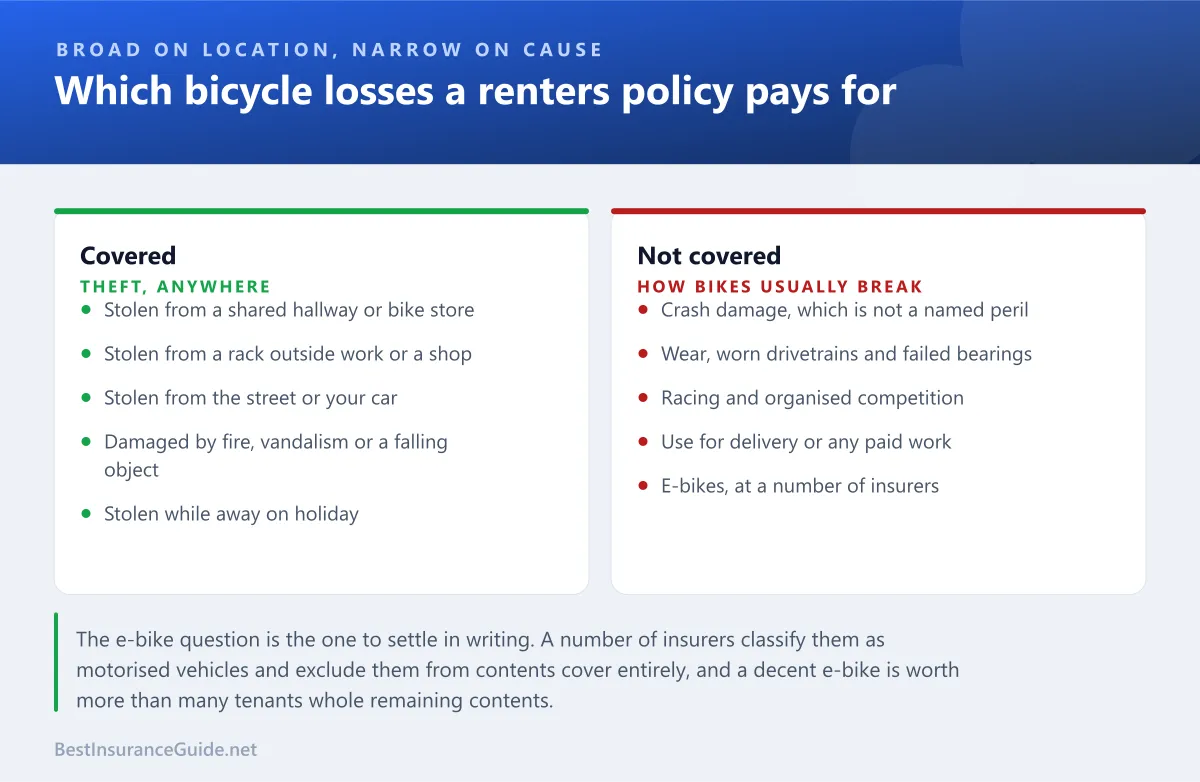
A bicycle is personal property, and theft is a named peril. So a stolen bike is normally covered, and the coverage is broader than people expect about location.
From a shared hallway or bike store in your building.
From a rack outside work, a shop, a station or a gym.
From the street, locked or otherwise, though a policy may take a dim view of an unlocked bike left overnight.
From your car or a roof rack.
On holiday, since off-premises coverage generally follows your belongings anywhere in the country and frequently abroad.
That breadth is genuine and useful. The limits are where it falls down.
What is not covered
Crash damage. This is the big one. Collision is not a named peril, so if you come off and crack the frame, bend a wheel or destroy a derailleur, a renters policy pays nothing. The most common way an expensive bike gets damaged is entirely outside the cover.
Wear and mechanical failure. Worn drivetrains, seized bearings, failed suspension.
Racing and competition, excluded by most policies.
Parts stolen from a bike left in place, in some wordings, though a stolen wheel or saddle is usually treated as theft of personal property.
Bikes used for business, including delivery work, which sits outside personal contents cover entirely.
The e-bike problem
This deserves its own section because it catches a lot of people and the sums involved are large.
A number of insurers classify e-bikes as motorised vehicles and exclude them from personal property cover entirely, in the same way a moped or scooter would be excluded. Others cover them normally, and some apply a lower sublimit.
Given that a decent e-bike costs more than many people’s entire remaining contents, this is the single most important thing to confirm if you own one.
Ask the question directly and get it in writing: is my e-bike covered as personal property, and to what limit?
If the answer is no, the options are a specialist e-bike policy or, in some cases, adding it to an auto policy. Neither is expensive relative to the machine.
There is a second e-bike issue worth knowing. Lithium battery fires are an increasing cause of residential fires, several jurisdictions now restrict charging in shared residential buildings, and many leases prohibit it. A fire started by your e-bike charging is a liability claim against you, which our guide to whether renters insurance covers fire damage covers in detail. Charge on the original charger, not overnight, and not in a hallway.
The arithmetic that makes claims pointless
Here is why bike theft claims disappoint even when they are covered.
Worked example: three bikes, one policy
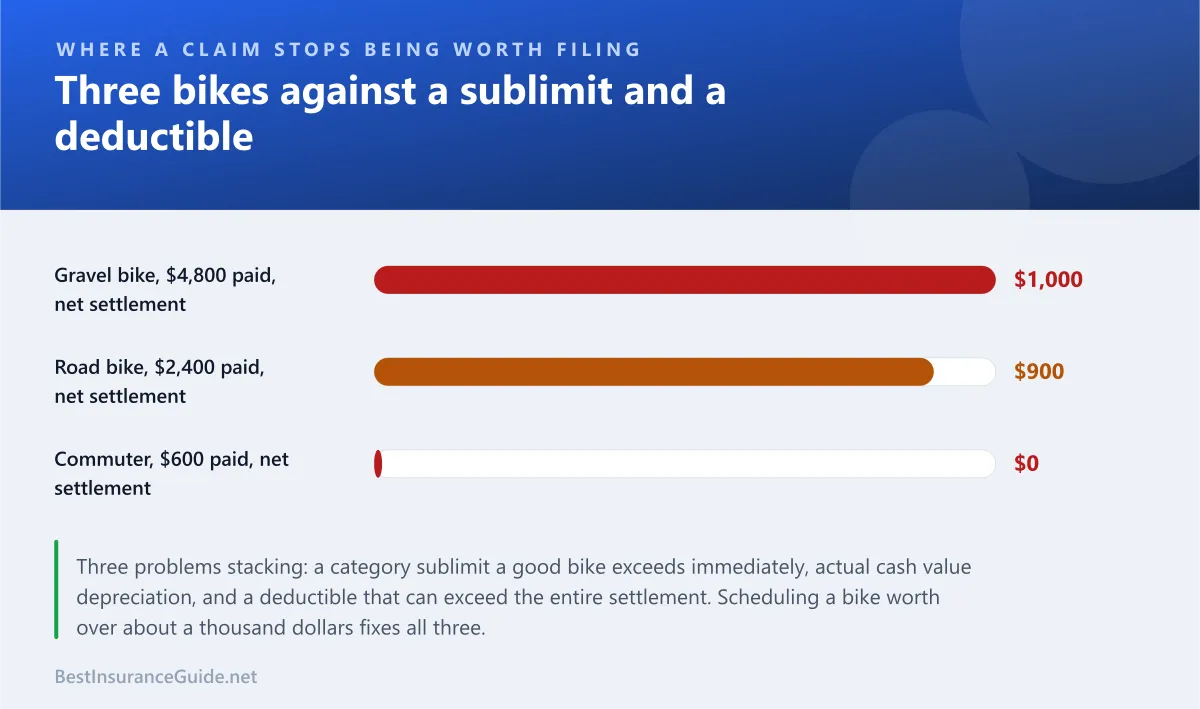
$500 deductible, $1,500 bicycle sublimit, actual cash value settlement.
| Bike | Paid | Age | Replacement | ACV | Sublimit applied | Less deductible | Net |
|---|---|---|---|---|---|---|---|
| Commuter hybrid | $600 | 4 yrs | $650 | $260 | $260 | -$500 | $0 |
| Road bike | $2,400 | 3 yrs | $2,500 | $1,400 | $1,400 | -$500 | $900 |
| Gravel bike | $4,800 | 2 yrs | $5,000 | $3,600 | $1,500 | -$500 | $1,000 |
Three problems visible at once.
The commuter bike claim is worthless. The depreciated value is below the deductible, so there is nothing to pay. Filing it would put a claim on your record for no money.
The road bike loses to depreciation. Actual cash value cut the settlement by $1,100 before the deductible.
The gravel bike loses to the sublimit. A $5,000 bike returned $1,000, because the sublimit capped it at $1,500 and the deductible took $500 of that.
Scheduling, which fixes most of it
If your bike is worth more than roughly $1,000, scheduling it is usually the right answer.
Scheduling lists the bike individually on the policy with an agreed value, established when you add it.
Three things change.
It comes out of the category sublimit, so the $1,500 cap no longer applies.
It is settled at agreed value, so depreciation does not gut the payout.
The deductible is frequently waived on scheduled items, which on a bike claim is often the difference between worthwhile and pointless.
Scheduling costs a small annual amount per thousand dollars of value, and for the gravel bike above it would have converted a $1,000 settlement into something close to $5,000.
You will need the purchase receipt or a valuation, and photographs.
Specialist bicycle insurance
For an expensive bike, a dedicated policy frequently beats a renters endorsement, because it covers what renters insurance structurally cannot.
Crash damage, which is the main way bikes actually get damaged and which no renters policy covers.
Racing and organised events, generally excluded from renters cover.
Worldwide travel and transit, including damage in transit to an event.
Lower or zero deductibles, and agreed value as standard.
Liability while riding, which some specialist policies include and which is a genuine gap otherwise. Your renters liability may respond to injury you cause while cycling, but it is worth confirming rather than assuming.
For a $600 commuter bike this is unnecessary. For a $6,000 bike ridden competitively it is usually the better product, and the two can coexist: keep renters insurance for the flat and specialist cover for the bike.
Reducing the odds and improving the claim
Register the frame number. National bicycle registers exist and cost little or nothing. A registered frame number materially improves both the recovery chance and the claim, because it converts a description into a proven item.
Photograph the bike, including the frame number, any distinguishing features and the serial on the bottom bracket.
Keep the receipt. Scheduling requires it and claims settle better with it.
Use two locks of different types, at least one a good D-lock, secured through the frame and to something immovable.
Do not store it in a communal hallway if you can avoid it. Shared bike stores are a common theft location because thieves get unobserved time and cover.
File the police report the same day. A report made three days later invites questions on any theft claim.
Making a bike theft claim
Bike claims are refused or reduced more often than most, and the reasons are usually documentary.
File the police report the same day. Every insurer asks for one, and a report filed three days later invites questions about whether the bike was actually stolen.
Provide the frame number. Without it, you are claiming for “a bike”, and settlements for described items are conservative. With it, you are claiming for an identifiable object.
Provide the purchase receipt or a valuation. This is what establishes value, particularly if the bike was upgraded from stock.
Photograph the lock and the location if the bike was taken from a rack or a communal store. Evidence of forced entry or a cut lock supports the claim; a bike that simply vanished from an unlocked hallway invites scrutiny.
List upgrades separately. Wheels, groupset, saddle and finishing kit frequently exceed the original frame value on an upgraded bike, and they are only covered if you can evidence them.
Ask about the deductible before filing. On a modest bike the claim may be worth nothing after depreciation and deductible, and a filed claim sits on your record for years and affects future pricing.
When not to claim
Run the arithmetic before filing.
| Value | |
|---|---|
| Bike replacement cost | $900 |
| Actual cash value after four years | $380 |
| Deductible | $500 |
| Settlement | $0 |
Filing that claim produces no money and a claim record. The general rule across every line of insurance applies here: below roughly one and a half times your deductible, absorb it.
Renters cover or a specialist policy?
For anyone with a bike worth more than a few thousand dollars, this is a real decision rather than a formality.
| Renters policy | Specialist bicycle policy | |
|---|---|---|
| Theft | Yes, subject to sublimit | Yes, usually agreed value |
| Crash damage | No | Usually yes |
| Racing and events | No | Frequently yes |
| Worldwide cover | Limited | Usually yes |
| Deductible | Your policy deductible | Often lower or zero |
| Liability while riding | Sometimes, via personal liability | Frequently included |
| Cost | Included, or small scheduling fee | Separate annual premium |
The honest split: a commuter bike belongs on your renters policy, scheduled if it is worth over about a thousand dollars. A bike you race, tour on, or have spent five figures building belongs on a specialist policy, with renters insurance continuing to cover the flat.
The two coexist without conflict, and the specialist policy covers the crash damage that renters insurance structurally cannot.
A note on scope
Bicycle sublimits, e-bike treatment and scheduling terms vary considerably between insurers and change over time. The figures here are illustrative rather than any particular company’s schedule.
The e-bike question in particular is worth confirming in writing before relying on cover, since classification as a motorised vehicle varies between insurers and the sums involved are substantial. This site is independent and not affiliated with any insurer.
If the bike is recovered
Bikes are recovered more often than most stolen property, particularly where the frame number was registered, and the sequence afterwards is worth knowing.
Tell the insurer immediately if it turns up before the claim settles. Continuing a claim on a recovered bike is fraud.
If it is recovered after settlement, the bike generally belongs to the insurer, since they have paid you for it. Many will let you buy it back for the settlement figure, which is frequently worth doing if you liked the bike.
Damage found on recovery is usually covered as part of the original theft claim rather than as a separate loss.
Keep the police reference number, because that is what links a recovered bike back to you months later.
The short version
Renters insurance covers bike theft wherever the bike was taken from, which is genuinely broad. It does not cover crash damage, which is how bikes are most commonly damaged.
The disappointment comes from three things stacking: a category sublimit that a decent bike exceeds immediately, actual cash value depreciation, and a deductible that can exceed the whole settlement on a modest bike.
If your bike is worth over about $1,000, schedule it. That removes the sublimit, fixes the value in advance and frequently waives the deductible.
If you own an e-bike, confirm in writing whether it is covered at all, because a meaningful number of insurers exclude them as motorised vehicles.
And register the frame number, which costs nothing and helps both the claim and the recovery.
For the full list of named perils, see what renters insurance covers, and for how category sublimits work generally, the renters insurance guide.