Does Renters Insurance Cover Fire Damage? Yes, Including the Water
Renters insurance covers fire, smoke without flame, and firefighting water damage. Plus hotel costs and the liability claim if the fire started in your unit.

Table of contents
Fire is the peril renters insurance handles best, and the coverage is broader than most tenants realise. It is also where the largest financial exposure sits, and that part has nothing to do with your belongings.
What is covered
Fire and smoke are core named perils on every renters policy. Three features of that are worth stating explicitly, because each surprises people.
It does not matter where the fire started. A blaze in the flat above yours, caused by a neighbour you have never met, produces exactly the same claim as a fire in your own kitchen. Fault is irrelevant to whether your own policy pays.
Smoke damage without flame is covered. Clothing, bedding, curtains, upholstery and soft furnishings that smell of smoke are a covered loss even where nothing in your unit burned. Professional smoke and odour remediation is normally claimable and it is frequently a large part of the total.
Water and firefighting damage is covered. Water used to extinguish a fire is part of the same loss. For a unit below the one that burned, this is frequently the entire claim and it can exceed what the fire itself did.
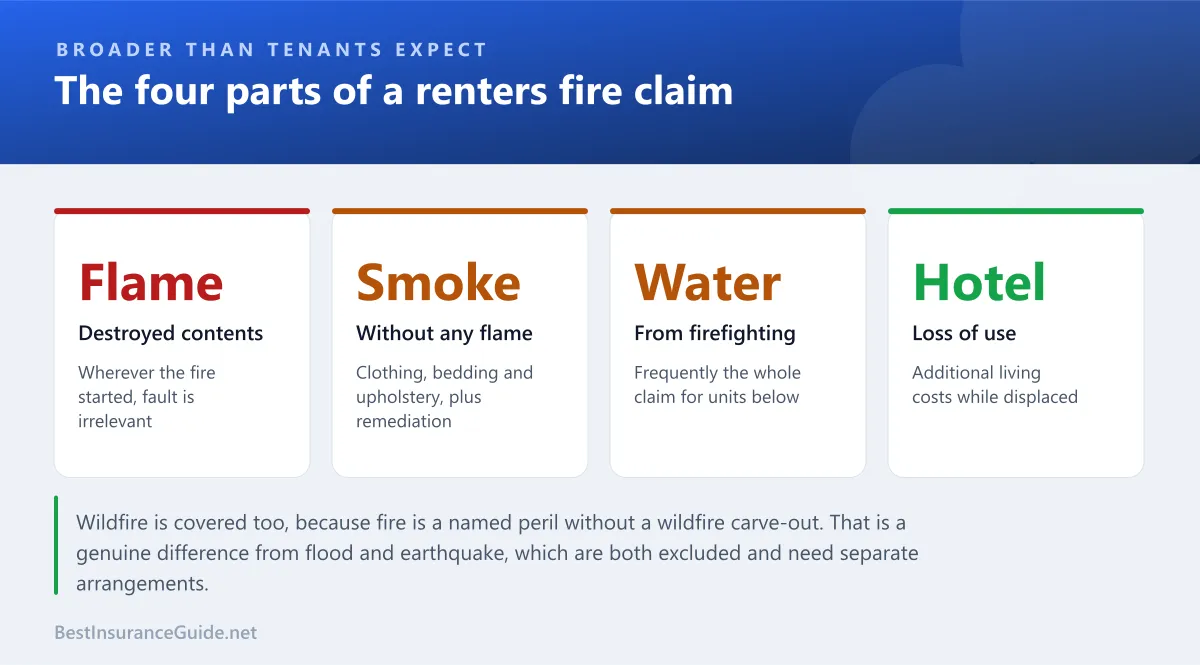
Wildfire is fire. Because fire is a named peril without a wildfire carve-out, wildfire losses are covered by a standard renters policy. That is a genuine and important difference from flood and earthquake, which are both excluded and need separate arrangements, as our guide to renters earthquake coverage sets out.
Worked example: a kitchen fire, contained to one room
| Item | Settled |
|---|---|
| Contents destroyed in the kitchen | $4,600 |
| Smoke damage: clothing, curtains, bedding | $3,100 |
| Professional smoke and odour remediation of contents | $1,400 |
| Water damage from extinguishing | $1,900 |
| Hotel for 11 nights while cleaning ran | $1,650 |
| Additional food and laundry costs | $420 |
| Total | $13,070 |
| Less deductible | $500 |
| Net to the tenant | $12,570 |
Note how much of that is not flame. The fire was out in minutes; the smoke and water accounted for well over half the claim.
Loss of use, including the part nobody claims
Loss of use, sometimes called additional living expense, pays the additional cost of living elsewhere while your unit is uninhabitable because of a covered loss.
That word “additional” does the work. The insurer pays the difference between your normal costs and your displaced ones, so money you no longer spend at home offsets what you spend away.
Worked example: three weeks displaced
| Normal month | Displaced month | Additional | |
|---|---|---|---|
| Rent, still owed | $1,650 | $1,650 | $0 |
| Hotel, 21 nights | $0 | $2,730 | $2,730 |
| Groceries | $420 | $180 | -$240 |
| Restaurant meals | $140 | $760 | $620 |
| Laundry and parking | $30 | $180 | $150 |
| Extra commuting | $0 | $135 | $135 |
| Storage of undamaged belongings | $0 | $190 | $190 |
| Additional living expense claimed | $3,585 |
Keep every receipt including the small ones. Loss of use is the coverage tenants most consistently underclaim, simply because laundry, parking and extra commuting do not feel like insurance claims.
Civil authority coverage is the piece almost nobody knows about. Where a government order prevents you accessing your home, even if your unit itself is undamaged, loss of use frequently still applies. It is usually time-limited, commonly around two weeks, and it is exactly what responds during a wildfire evacuation of an unburned neighbourhood.
If you are evacuated by order, keep receipts from day one and ask your insurer about civil authority cover specifically.
The exposure that dwarfs your belongings
Here is the part of this article that matters most, and it is not about your possessions at all.
If a fire starts in your unit through your negligence, you are liable for the damage it causes to everyone else.
Your personal liability coverage responds to those claims: the landlord’s building damage, other tenants’ destroyed belongings, their displacement costs, and your legal defence.
Worked example: a fire that started with a candle
A candle left burning ignites a curtain. The fire spreads to two other units before it is contained.
| Claim against the tenant | Amount |
|---|---|
| Landlord: structural repair and remediation | $148,000 |
| Upstairs neighbour: contents and displacement | $41,000 |
| Adjacent unit: smoke and water damage | $28,000 |
| Landlord: lost rental income during repairs | $19,000 |
| Legal defence costs | $22,000 |
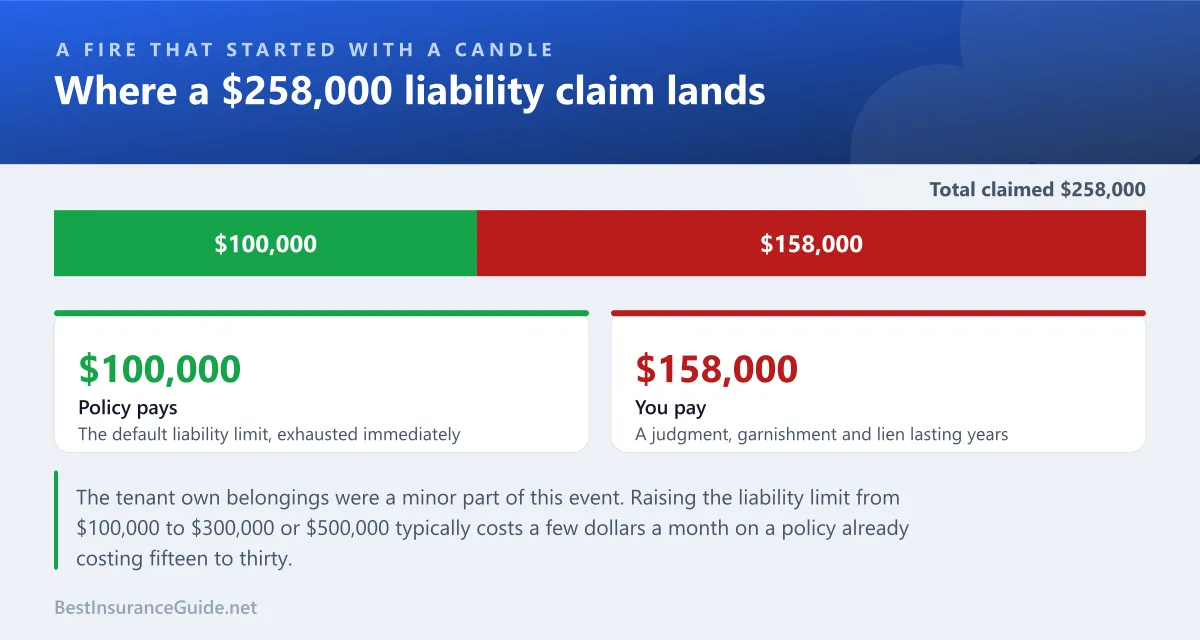
| Total | $258,000 |
| Liability limit carried | $100,000 |
| Paid personally | $158,000 |
The tenant’s own belongings were a minor part of the event. The claim that mattered was entirely liability, and a $100,000 limit was not enough.
Two fixes, both cheap.
Raise the liability limit to $300,000 or $500,000. On a renters policy this typically costs a few dollars a month, and in a multi-unit building it is the single most important number on the page.
Consider an umbrella policy if you have assets to protect. It sits above your renters liability and continues paying when that limit is exhausted.
What is not covered
Arson by the policyholder, and intentional damage generally.
Damage from your own gross negligence in some wordings, though ordinary carelessness is precisely what liability cover exists for.
The building itself. That is the landlord’s policy, and it is not your loss regardless of who caused it.
Your roommate’s belongings, unless they are a named insured. Roommates need their own policy, as our renters insurance guide explains.
Gradual heat damage from something like a heater against furniture over months, which is treated as maintenance rather than a sudden loss.
The most common causes, and what they cost you
Fire claims cluster around a short list, and knowing it is genuinely preventive.
Cooking, which is the leading cause of residential fires by a distance. Unattended pans account for most of it.
Heating equipment, particularly portable space heaters placed too close to furnishings or left running overnight.
Electrical faults, including overloaded extension leads and damaged cables.
Candles.
Smoking, particularly indoors and on balconies.
Lithium battery fires, an increasing cause, especially from e-bikes, scooters and cheap chargers left on overnight. Several jurisdictions now restrict charging e-bikes in shared residential buildings, and some leases prohibit it.
That last one deserves attention if you own an e-bike. Charging on a non-original charger, or overnight in a hallway, is a genuine fire risk and a genuine liability exposure. Our guide to whether renters insurance covers bike theft covers how e-bikes are treated as property.
After a fire
Get out and stay out. Nothing in the flat is worth re-entry.
Report to your insurer immediately, even before you know the extent. Policies require prompt notice and many insurers can advance funds for immediate needs.
Do not throw anything away until the adjuster has seen it or released you in writing. Disposing of damaged property turns a documented loss into a described one.
Photograph everything, including smoke-damaged items that look superficially fine.
Keep every receipt from the first night, including clothing and toiletries bought because you left with nothing.
Ask about an advance. Most insurers will release funds quickly after a total loss, and you do not have to wait for the full claim to settle.
Get the fire report from the fire department, since it establishes cause and will matter if liability is contested.
Comparing quotes on fire coverage
Fire is covered by every renters policy, so the differences between quotes are in the surrounding terms rather than the peril itself.
The liability limit. The most important number on the page for anyone in a multi-unit building, for the reasons set out above. Compare $100,000 against $300,000 or $500,000 and look at what the upgrade actually costs; it is usually a few dollars a month.
Replacement cost against actual cash value on contents. On a total loss this decides whether you can actually replace what you owned.
The loss of use limit, expressed either as a percentage of the contents limit or as a time cap. After a serious fire, displacement runs for months rather than weeks, and a thin loss of use limit is a real problem.
Whether civil authority coverage is included, and for how long. Commonly around two weeks, and it is what responds to a wildfire evacuation.
Smoke remediation. Whether professional cleaning of smoke-affected contents is treated as a covered cost, which it usually is but is worth confirming.
Reducing the risk, and the liability
Because the liability exposure is the largest part of a fire claim, prevention is worth more here than in most areas of insurance.
Working smoke alarms on every level, tested monthly. Many insurers offer a protective device discount for monitored alarms.
Never leave cooking unattended, which addresses the leading cause of residential fires.
Keep space heaters clear of furnishings and never run them overnight or unattended.
Do not overload extension leads, and replace damaged cables rather than taping them.
Charge lithium batteries on original chargers, not overnight, and not in hallways or near exits. E-bike and scooter battery fires are an increasing cause of serious residential fires and several jurisdictions now restrict charging in shared buildings.
Know where your fire exits are and keep them clear, which matters for your safety and for any argument about contributory negligence.
A fire extinguisher rated for kitchen fires, kept accessible rather than under the sink behind everything else.
A note on scope
Loss of use limits, civil authority provisions and liability options vary between insurers and change over time. The figures here are illustrative rather than any particular policy’s terms.
Your own declarations page states your liability limit and loss of use basis, and both are worth checking tonight rather than after an event. This site is independent and not affiliated with any insurer.
A note on wildfire specifically
Wildfire is covered because fire is a named peril, and that is worth restating because it is one of the few catastrophe exposures a standard renters policy does handle.
Two practical points for anyone in a wildfire-prone area.
Insurers may impose binding restrictions during active fire conditions. A number will not write new policies or increase limits while a fire is burning nearby, sometimes within a defined radius. Buying or increasing cover in June is straightforward; doing it when smoke is visible frequently is not.
Keep the inventory somewhere that is not your home. Wildfire evacuations are fast and total, and a claim after one is settled entirely against evidence you took with you or stored in the cloud.
The short version
Renters insurance covers fire comprehensively: the flame, the smoke without flame, the water used to fight it, and the cost of living elsewhere while your home is uninhabitable. Wildfire is included, unlike flood and earthquake.
Loss of use is broader than tenants use it, covering additional food, laundry, parking, commuting and storage, and frequently extending to evacuation by civil authority even where your unit was undamaged.
The largest exposure is liability. A fire that starts in your unit can produce six-figure claims from the landlord and other tenants, and the default $100,000 limit is frequently inadequate in a multi-unit building.
Raise the liability limit, keep every receipt if you are displaced, and check what your lease says about e-bike charging.
For the full list of named perils, see what renters insurance covers.