What Is an AOP Deductible? The One That Applies to Everything Else
What an AOP deductible is, how it differs from wind, hail and named storm deductibles, why percentage deductibles rise silently, and how to set them.

Table of contents
AOP stands for All Other Perils, and the name tells you what it is: the deductible that applies to everything without a deductible of its own.
Where it sits
A modern homeowners policy commonly carries two or three deductibles, and understanding which applies to what is the single most useful thing you can learn from your own declarations page.
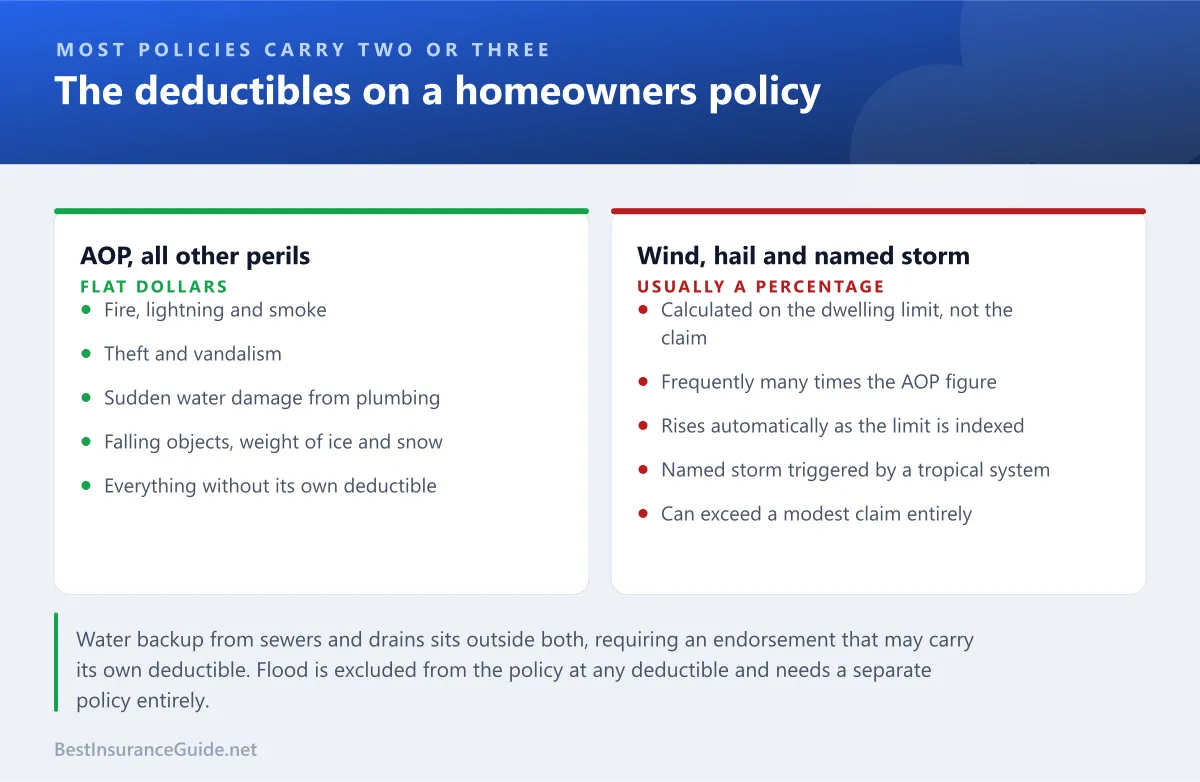
The AOP deductible. Usually a flat dollar figure: $500, $1,000, $2,500. Applies to fire, lightning, theft, vandalism, sudden water damage, falling objects, weight of ice and snow, and everything else without its own deductible.
A wind and hail deductible. Increasingly a percentage of the dwelling limit rather than a flat figure, in hail-exposed states.
A named storm or hurricane deductible. A percentage, in coastal states, triggered by a named tropical system.
Many coastal policies carry all three at once, and they can be very different numbers.
The percentage problem
This is what makes the distinction matter rather than being administrative trivia.
A percentage deductible is calculated on the dwelling limit, not on the claim.
On a $450,000 dwelling limit:
| Deductible | Amount you pay first |
|---|---|
| AOP, flat | $1,000 |
| 1% wind and hail | $4,500 |
| 2% wind and hail | $9,000 |
| 5% named storm | $22,500 |
Two consequences follow, and both catch people.
A modest hail claim can fall entirely below the deductible. A $6,000 roof repair against a 2% deductible on a $450,000 home returns nothing.
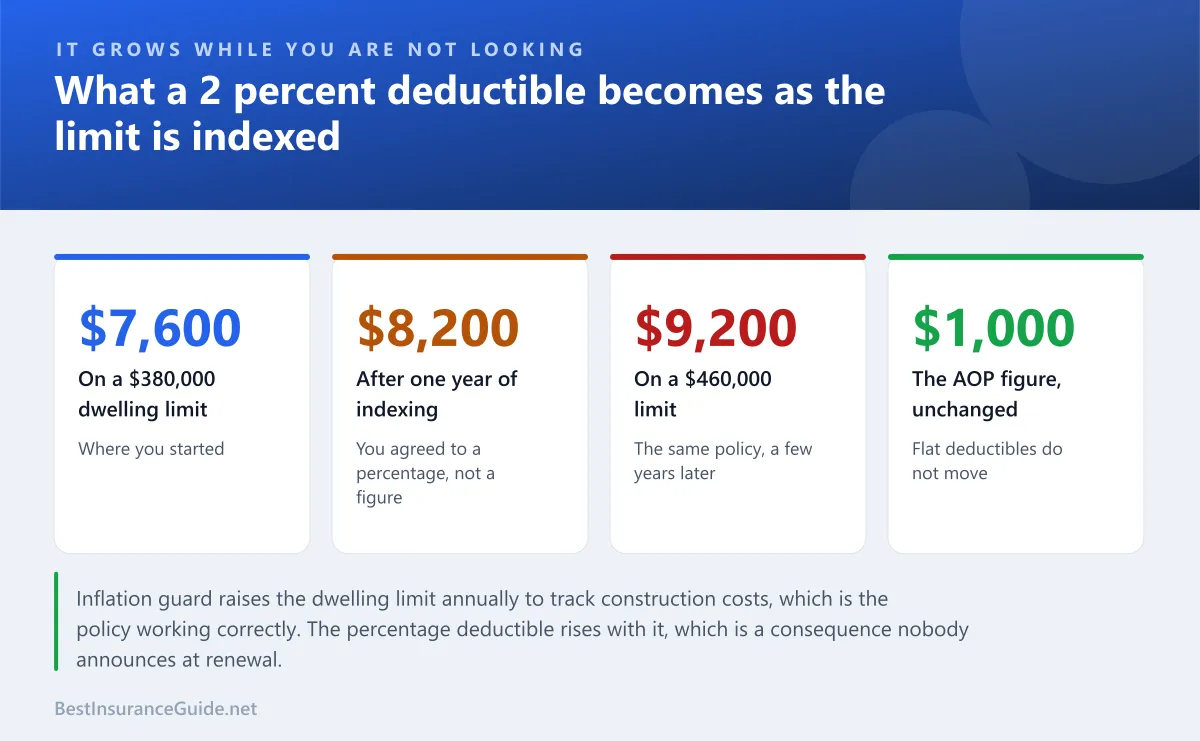
The percentage deductible rises every year, silently. Most policies index the dwelling limit annually to track construction costs. A 2% deductible on a limit that has risen from $380,000 to $460,000 has grown from $7,600 to $9,200, and nobody sends a letter about it.
Which deductible applies to which loss
The allocation is by peril and it is worth knowing in advance.
AOP applies to: a kitchen fire, a lightning strike, a burglary, vandalism, a burst supply pipe, a failed water heater, a tree falling from your own garden in still conditions, weight of ice and snow on the roof, and vehicle impact.
Wind and hail applies to: roof damage from hail, wind-driven rain entering through storm damage, siding and gutter damage, and trees brought down by wind.
Named storm applies to: everything caused by a tropical system the National Hurricane Center has named, including contents and additional living expense, in states and policies where that deductible exists.
Two boundary areas that produce arguments.
A tree falling in a storm. Generally wind, not AOP, because the wind caused it. In still conditions from disease or age, generally AOP.
Water entering through storm-damaged roofing. Generally the wind deductible, because the wind created the opening.
Water backup from sewers or drains is excluded from a standard policy entirely and requires an endorsement, which frequently carries its own separate deductible.
Flood is excluded at any deductible and needs separate flood insurance.
Setting it sensibly
The AOP deductible is the one you have most control over and the one where a low setting is cheapest.
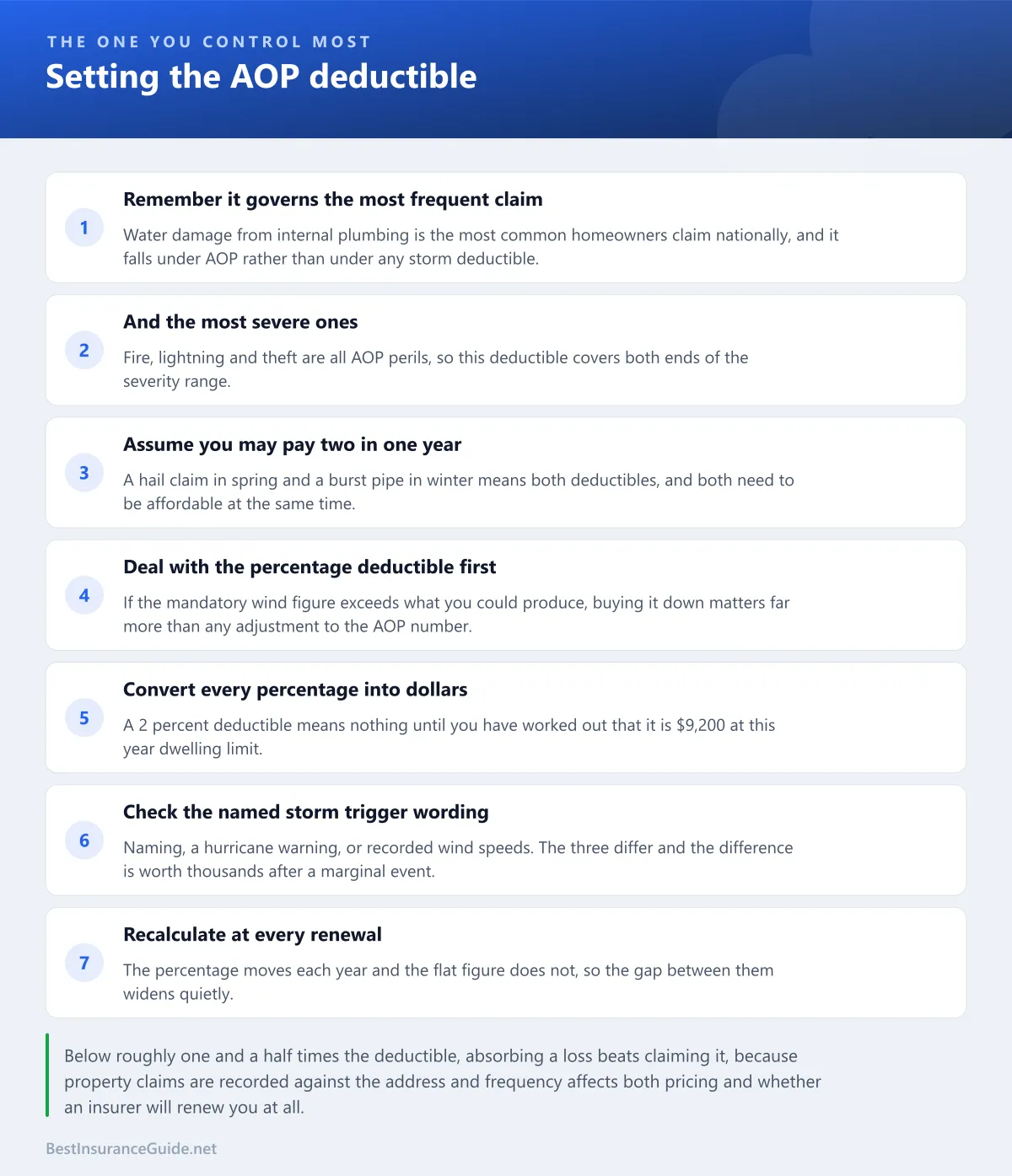
It is the claim you are most likely to make. Water damage from plumbing is the most frequent homeowners claim nationally, and it falls under AOP.
The saving from raising it is modest, particularly at the higher levels where the diminishing-returns pattern applies just as it does elsewhere. Our guide to why higher deductibles lower premiums sets out that curve.
You may face two deductibles in one year. A hail claim in spring and a burst pipe in winter means paying both, and both figures need to be affordable simultaneously.
Consider the percentage deductible first. If the mandatory wind deductible on your policy exceeds what you could produce, buying that down matters far more than adjusting the AOP figure, and many insurers will sell a lower percentage or a flat figure for additional premium.
Recalculate annually at renewal, because the percentage moves and the AOP does not.
When not to claim
The same threshold logic applies here and it interacts with the deductible level.
Below roughly one and a half times the deductible, absorb it. A $1,400 loss on a $1,000 AOP deductible returns $400 and puts a claim on the property’s record for several years, visible to future insurers through the shared claims database.
Frequency is what damages you, more than any single claim. Two or three property claims in three years moves you into a worse pricing tier and, in a hardening market, can affect whether an insurer will renew you at all.
Two exceptions. Always report anything that could produce further damage, such as a water escape, even if you intend to absorb the repair, because failing to mitigate can prejudice a later claim. And always report liability incidents, which can surface years later.
What to check on your declarations page
Five lines, five minutes.
The AOP deductible figure.
Whether a separate wind and hail deductible exists, and whether it is a percentage or a flat amount.
Whether a named storm deductible exists, and what triggers it — the naming of a storm, a hurricane warning, or recorded wind speeds. Those wordings differ and the difference is worth thousands.
The current dwelling limit, so you can calculate what any percentage deductible actually is in dollars today.
Whether water backup coverage is present, and what deductible applies to it.
Most homeowners can quote one of those five, and it is usually the first.
The short version
AOP means All Other Perils. It is the flat deductible applying to fire, theft, water damage from plumbing, vandalism and everything else without a deductible of its own.
The reason it matters is what it does not cover. In hail and coastal states, wind, hail and named storm losses sit under separate percentage deductibles calculated on the dwelling limit rather than on the claim, and those figures are frequently many times the AOP one.
Percentage deductibles also rise automatically each year as the dwelling limit is indexed, which nobody announces.
Set the AOP figure at what you could genuinely produce, remember that a bad year can mean paying two deductibles, and if the mandatory wind percentage exceeds what you could fund, buying it down matters more than anything you do to the AOP number.
For the general principle, see why higher deductibles lower premiums, and for the full picture, your homeowners insurance deductible.
The claim most homeowners actually make
The reason to keep the AOP deductible low is what sits under it, and the frequency distribution is not intuitive.
Water damage from internal plumbing is the most frequent homeowners claim type nationally. Burst supply lines, failed water heaters, washing machine hoses, split pipes after a freeze, and overflow from appliances. All of it falls under AOP.
Fire and lightning are less frequent and far more severe, and also fall under AOP.
Theft and vandalism likewise.
So the AOP deductible governs both the most common claim and the most catastrophic ones, while the percentage deductibles govern a specific and seasonal category.
That argues for a structure most homeowners do not have: a low AOP deductible and, where you can control it, a wind and hail deductible you have deliberately chosen rather than accepted.
Worked example: a burst supply line
A supply line to an upstairs bathroom fails while the house is occupied. Damage to flooring, ceilings and contents totals $23,400.
| $1,000 AOP | $2,500 AOP | $5,000 AOP | |
|---|---|---|---|
| Loss | $23,400 | $23,400 | $23,400 |
| You pay | $1,000 | $2,500 | $5,000 |
| Insurer pays | $22,400 | $20,900 | $18,400 |
| Annual premium saving against the $1,000 level | — | Roughly $120 | Roughly $220 |
The saving is real and modest. The exposure is immediate and it lands in the week the ceiling comes down, which is precisely when a household is least able to absorb an extra few thousand dollars.
Two things to do at renewal
Recalculate every percentage deductible against the current dwelling limit. The limit rises annually through inflation guard and the deductible rises with it, silently. A homeowner who set a 2% wind deductible five years ago is carrying a materially larger number today than they chose.
Ask what a lower percentage would cost. Where the mandatory figure exceeds what you could produce after a storm, buying it down converts an unmanageable number into a manageable one, and it is frequently cheaper than expected.
Reading the declarations page properly
The deductible section of a homeowners declarations page is short and it repays five minutes.
Look for the word “deductible” more than once. If it appears once, you have a single flat deductible. If it appears two or three times, note each figure and each peril.
Convert every percentage into dollars using the current dwelling limit, and write the number down. A 2% figure means nothing until it is $9,200.
Find the named storm trigger wording if you are coastal. Some policies trigger on a storm being named, some on a hurricane warning being issued for the area, and some on recorded wind speeds. Those differ and the difference is worth thousands after a marginal event.
Check for a water backup endorsement, and whether it carries its own deductible.
Note whether any deductible is a minimum dollar amount or a percentage, whichever is greater, which is a wording some policies use and which produces the higher of the two.
Two things worth doing at the next renewal
Convert every percentage deductible into a dollar figure using the new dwelling limit, and compare it against what you could produce in the week after a storm. The number will have grown since last year and nobody will have mentioned it.
Ask what it would cost to buy the wind percentage down to a lower percentage or to a flat figure. Many insurers offer it, few volunteer it, and where the mandatory figure exceeds your capacity it is the most useful adjustment available on the whole policy.
The decision, summarised
Set the AOP deductible at what you could produce this week, remembering that a bad year can bring a second deductible on a different peril.
Treat the percentage deductibles as the priority, because they are far larger, they rise automatically, and they apply to the seasonal claim you are most likely to face in a storm state.
Convert every percentage into dollars annually, at renewal, because that conversion is the only way to know what you have actually agreed to carry.
Where the term comes from
The abbreviation appears on declarations pages without explanation and it is worth knowing why it exists at all.
Homeowners policies were originally written with a single deductible applying to every covered loss. As catastrophe modelling improved and hail and hurricane losses grew, insurers began pricing those perils separately and attaching separate, larger deductibles to them.
The remaining deductible needed a name, and “all other perils” is exactly what it describes: the figure that applies to everything the separate deductibles do not claim.
Two consequences of that history are still visible on modern policies.
The AOP deductible is usually the older, smaller number, because it was set when it applied to everything and has been carried forward.
The separate deductibles were added later, frequently at renewal, and frequently without much discussion. Many homeowners hold a percentage wind deductible they were never asked about, which arrived as a policy change at a renewal several years ago.
That is why the annual check matters: the AOP figure is usually something you chose, and the percentage figures are frequently something that happened to you.
A note on scope
Figures here are illustrative rather than quotes. Deductible structures, percentage triggers, named storm wordings and which perils carry separate deductibles vary considerably by state, by insurer and over time.
Your state insurance department publishes consumer guidance on homeowners deductible structures, and your own declarations page and endorsement schedule are the authoritative statement of which deductibles you hold and which perils they apply to. This site is independent and not affiliated with any insurer.