Your Homeowners Insurance Deductible: The Number You Probably Have Wrong
How homeowners insurance deductibles work, flat versus percentage, wind and hurricane deductibles, what raising yours saves, and when a claim is worth filing.

Table of contents

Most homeowners can tell you their deductible and most of them are quoting the wrong one. The flat figure on the front of the declarations page is frequently not the number that will apply to the claim they actually make.
The mechanism
A deductible is the amount you pay toward a covered loss before the insurer pays anything.
On a $12,000 claim with a $1,000 deductible, the insurer pays $11,000. It is not a fee, it is not billed, and it is not payable unless you claim. It is simply the first slice of every loss, retained by you.
Two features catch people out.
It applies per claim, not per year. Two covered losses in one year means two deductibles. Health insurance works the other way round and the assumption carries over.
It is subtracted from the settlement, not paid separately. On a repair the insurer pays the contractor the settlement net of your deductible, and you pay the rest.
Flat against percentage
This is the distinction that matters, and it is where the surprises live.
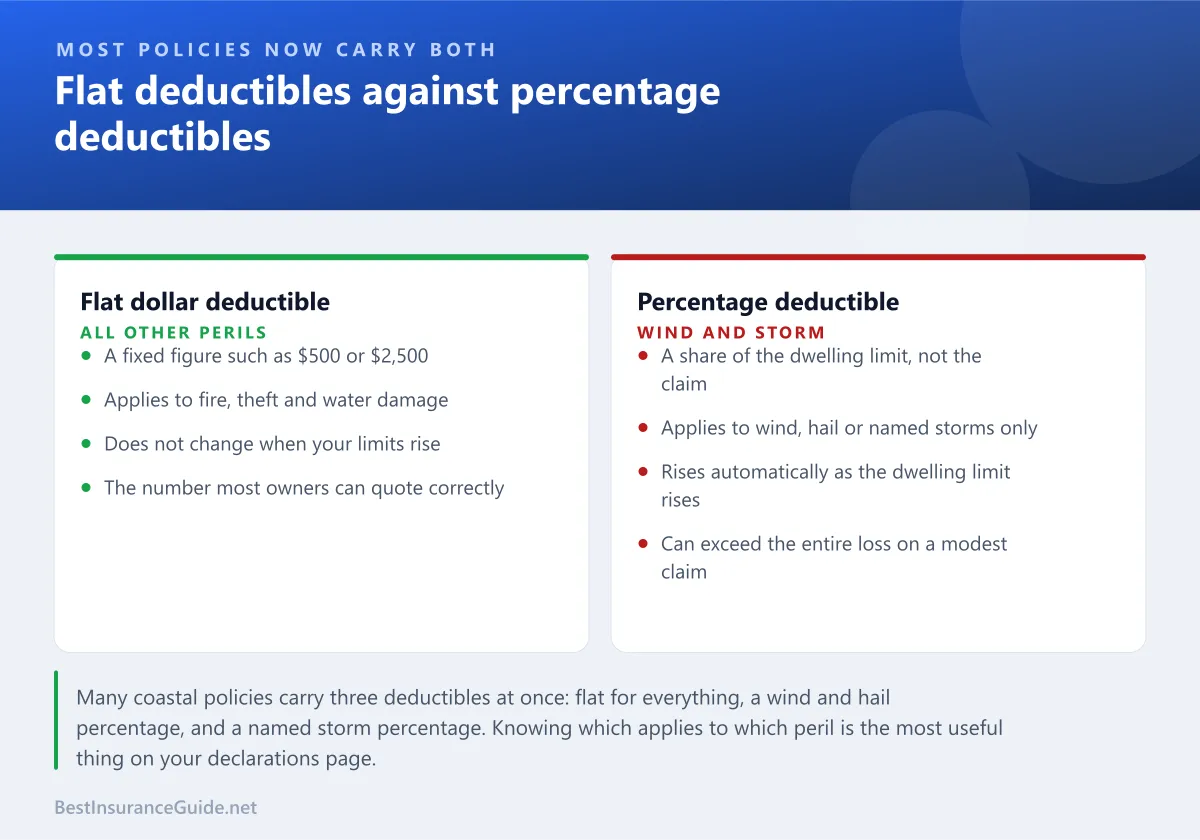
A flat deductible is a dollar figure. $500, $1,000, $2,500. It applies to the loss regardless of the size of your home.
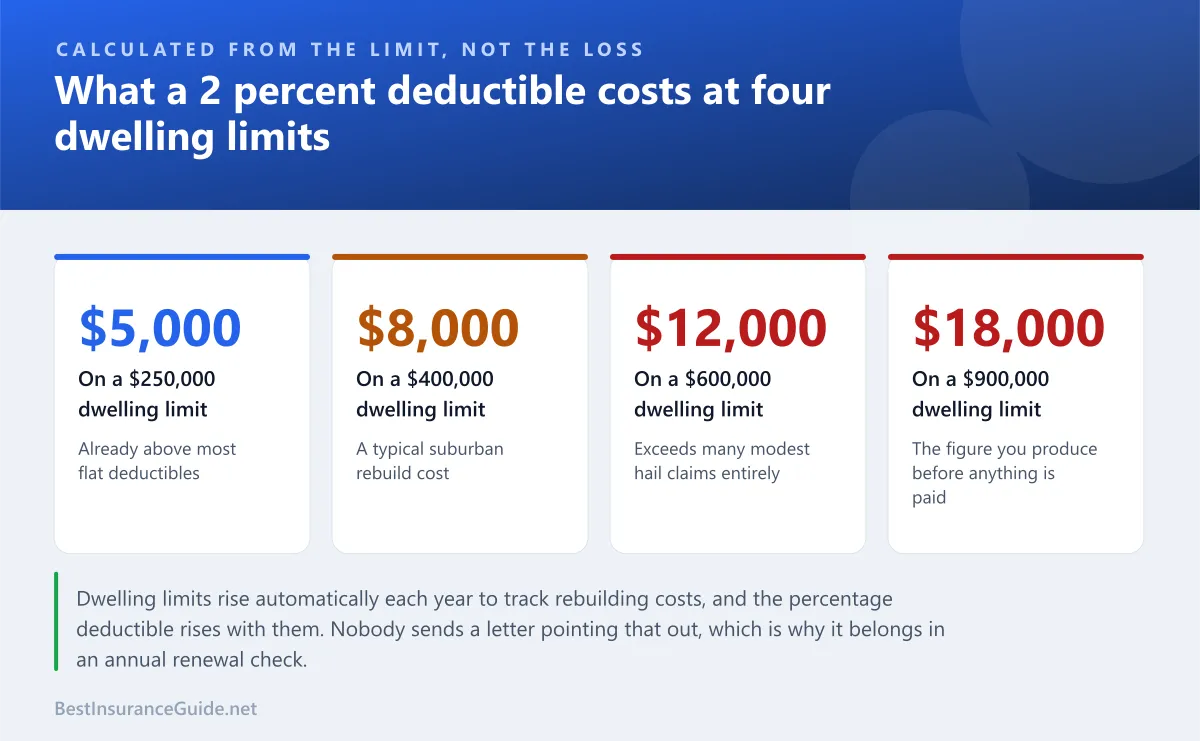
A percentage deductible is a share of the dwelling limit, not of the claim. That second half is the part people misread.
On a $400,000 dwelling limit:
| Deductible | Amount you pay first |
|---|---|
| Flat $1,000 | $1,000 |
| 1% of dwelling limit | $4,000 |
| 2% of dwelling limit | $8,000 |
| 5% of dwelling limit | $20,000 |
A 2% deductible on a $9,000 hail claim leaves you with nothing to claim at all, because the deductible exceeds the loss.
Percentage deductibles are applied to specific perils rather than everything, and there are usually three tiers on a modern policy:
The all-other-perils deductible, usually flat. Fire, theft, water damage, liability-adjacent property losses.
A wind and hail deductible, increasingly a percentage, in hail-exposed states.
A named storm or hurricane deductible, a percentage, in coastal states, triggered by a named tropical system.
Many coastal policies carry all three at once. Knowing which applies to which peril is the single most useful thing you can learn from your own declarations page.
What raising it actually saves
The saving is real and it is smaller than people expect.
Moving up one step typically reduces premium by somewhere in the region of 5% to 15%, varying considerably by insurer, by state and by where you are starting from. The proportional saving is largest at the bottom of the range and flattens out quickly.
Worked example: four deductible levels on the same policy
A house with a $2,200 annual premium at a $500 deductible.
| Deductible | Annual premium | Annual saving | Extra risk carried |
|---|---|---|---|
| $500 | $2,200 | — | — |
| $1,000 | $2,000 | $200 | $500 |
| $2,500 | $1,820 | $380 | $2,000 |
| $5,000 | $1,660 | $540 | $4,500 |
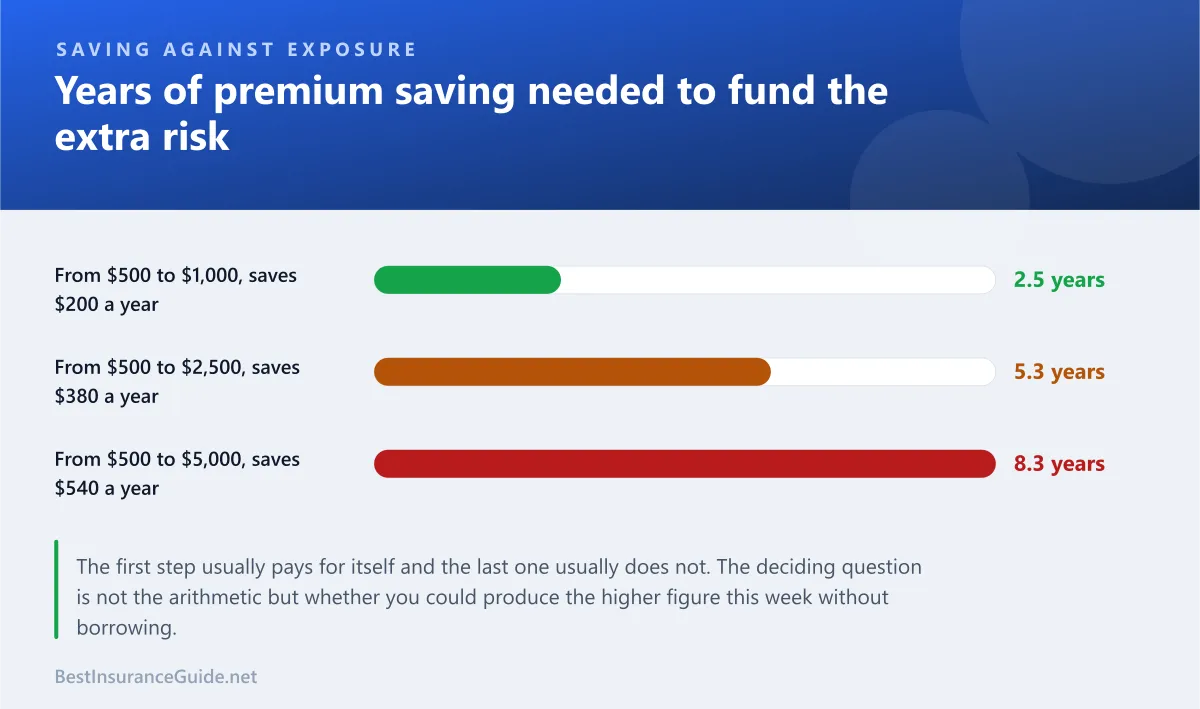
The arithmetic that matters is how long the saving takes to fund the extra risk. Moving from $500 to $1,000 saves $200 a year against $500 of extra exposure: that pays for itself in two and a half claim-free years, which is a good trade for almost anyone.
Moving from $500 to $5,000 saves $540 a year against $4,500 of extra exposure: eight and a half years. That is a poor trade unless you are genuinely comfortable absorbing $5,000 at no notice, and a great many households that choose it are not.
The test that actually matters
Forget the break-even arithmetic for a moment, because it assumes the money is available.
Could you produce this figure this week, without borrowing and without disrupting anything else?
If the answer is no, the deductible is too high, and the reason has nothing to do with expected value. A deductible you cannot produce quickly stops you claiming for the mid-sized losses that actually happen — the $6,000 water damage, the $9,000 hail claim — and a policy you cannot afford to use is not doing its job.
Two related points.
Keep the deductible in cash, not in theory. The households that do well with a high deductible are the ones holding it in an account, not the ones intending to put it on a card.
Remember it is per claim. A bad year with two losses means paying it twice.
When not to claim
Separate from choosing the number is deciding whether to use it, and the answer is often no.
Property claims are reported to a shared industry database and are visible to insurers for several years. The effect of a single claim is usually modest. The effect of frequency is not: two or three claims in three years moves you into a worse pricing tier and, in hardening markets, can affect whether an insurer will renew you at all.
The general rule that holds up across the market:
Below roughly one and a half times your deductible, absorb it. A $1,300 loss on a $1,000 deductible returns $300 and buys you a claim on your record for five years.
Between one and a half and three times, think about it, weighing the recovery against the likely renewal effect.
Above three times, claim. That is what the policy is for.
Two exceptions. Always report liability incidents, however small they look, because the claim may arrive years later and late notice can prejudice cover. And always report anything that could produce further damage, such as a water escape, even if you intend to absorb the repair.
Getting the structure right
Find all your deductibles, not just the headline one. They are on the declarations page and in the endorsement schedule.
Check whether wind and hail is separate, and whether it is a percentage.
Check the named storm trigger if you are coastal, since the difference between naming-triggered and wind-speed-triggered wordings is worth a great deal.
Set the all-other-perils deductible at what you could pay this week.
Consider buying the percentage down where a high mandatory wind deductible sits above what you could produce. It costs premium and it converts an unmanageable number into a manageable one.
Recheck after any increase in the dwelling limit, because a percentage deductible rises automatically with it and nobody sends a letter pointing that out.
The short version
A deductible is the first slice of every claim, applied per claim rather than per year, and most modern policies have more than one.
The percentage deductibles are the ones to understand, because they are calculated from your dwelling limit rather than from the loss, and they rise silently every time that limit is increased.
Raising a deductible saves real but modest money, roughly 5% to 15% a step. The right level is not the one the break-even arithmetic favours; it is the highest figure you could genuinely produce this week, held in cash rather than in theory.
And once it is set, use it deliberately: below about one and a half times the deductible, absorbing the loss usually beats filing a claim that follows you for five years.
For what the deductible applies to in the first place, see what home insurance covers, and for a state where percentage wind deductibles are now standard, homeowners insurance in Ohio.
How the deductible interacts with everything else
A deductible is not chosen in isolation. Three other settings on the policy change what it means in practice.
Replacement cost against actual cash value. On a replacement cost policy the insurer typically pays actual cash value first and releases the recoverable depreciation once the work is completed and invoiced. Your deductible comes off the first payment, which means the initial cheque can be considerably smaller than the settlement figure suggests.
Percentage deductibles rise with the dwelling limit. Most policies increase the dwelling limit automatically each year to keep pace with rebuilding costs. A 2% deductible on a limit that has risen from $380,000 to $460,000 has quietly grown from $7,600 to $9,200 without anybody choosing that.
Separate structures, contents and loss of use. On most policies a single deductible applies to the whole claim rather than one per coverage part, which works in your favour on a large loss involving several coverages.
Worked example: what you actually receive first
A $52,000 fire loss on a replacement cost policy with a $2,500 deductible.
| Stage | Amount |
|---|---|
| Full replacement cost of the loss | $52,000 |
| Depreciation withheld initially | $11,000 |
| Actual cash value payment | $41,000 |
| Less deductible | $2,500 |
| First cheque | $38,500 |
| Recoverable depreciation, released after work is invoiced | $11,000 |
| Total received | $49,500 |
Owners who do not know the second payment exists frequently never claim it. Completing the work and submitting the invoices is what releases it, and there is usually a time limit stated in the policy.
Special deductible situations
Four cases behave differently and are worth knowing about.
Disappearing or vanishing deductibles. Some insurers reduce your deductible for each claim-free year, occasionally to zero. It is a genuine benefit and it resets on a claim.
Deductible waivers on large losses. A number of policies waive the deductible entirely where the loss exceeds a stated threshold, commonly a total loss or a loss above a set percentage of the dwelling limit. Worth asking about, and rarely volunteered.
Buying down a mandatory percentage deductible. Where a wind or named storm percentage is imposed by the carrier, many will sell a lower percentage or a flat figure for additional premium. If the mandatory figure exceeds what you could produce, this is money well spent.
Separate deductibles for specific perils beyond wind. Earthquake endorsements almost always carry their own percentage deductible, frequently 10% to 20%, and it applies separately to the dwelling, contents and other structures rather than once across the claim.
Reviewing yours annually
The deductible structure is one of the few things on a policy that changes without anybody telling you, so a short annual check is worth doing at renewal.
Read every deductible on the declarations page, not the first one.
Recalculate the percentage figures against the current dwelling limit rather than last year’s.
Confirm the wind and hail treatment has not moved from flat to percentage, which insurers do at renewal in hardening markets.
Check whether a cosmetic damage exclusion has appeared, which frequently arrives at renewal in hail states.
Confirm you still hold the deductible in cash, which is the only part of this that depends on you rather than the insurer.
Ask what the premium would be one step in each direction, since the saving curve moves and the trade that made sense three years ago may not now.
A simple way to decide
If the choice still feels arbitrary, three questions settle it.
What could you produce this week, in cash, without borrowing? That figure is your ceiling. Not your target, your ceiling.
How many separate claims could you absorb in a bad year? The deductible applies per claim, so a household holding exactly one deductible in reserve is one unlucky year from a problem.
What is the mandatory percentage deductible on your worst-case peril? In a wind or hail state that number is frequently far larger than the flat deductible people quote, and if it exceeds the answer to the first question, buying it down matters more than any other adjustment to the policy.
Answer those three and the deductible chooses itself.
A note on scope
Premium figures and savings percentages here are illustrative rather than quotes, and the relationship between deductible level and premium varies substantially by insurer, by state and by the individual risk. Deductible structures, percentage triggers and claim-reporting practices differ between insurers and change over time.
Your state insurance department publishes consumer guidance on deductible structures, and the NAIC publishes comparative material on policy forms. Your own declarations page and endorsement schedule are the authoritative statement of which deductibles you hold and which perils they apply to. This site is independent and not affiliated with any insurer.