Homeowners Insurance in Ohio: Cheap Premiums, Expensive Water
What homeowners insurance costs in Ohio, why hail and sewer backup drive claims, percentage wind deductibles, and what to check on an Ohio policy.

Table of contents
Ohio is one of the better states in the country to insure a house in, and homeowners here routinely discover that the cheap premium came with two gaps they did not price.
What it costs, and why it is low
Ohio premiums sit consistently below the national average. Typical figures for a mid-priced home fall somewhere in the region of $1,100 to $1,900 a year, with wide variation by county and by the house itself.
The reason is structural. Ohio has no hurricane exposure, limited wildfire exposure, and moderate rebuilding costs compared with the coasts. What it does have is severe convective weather, which is expensive but nothing like as expensive as a hurricane coast.
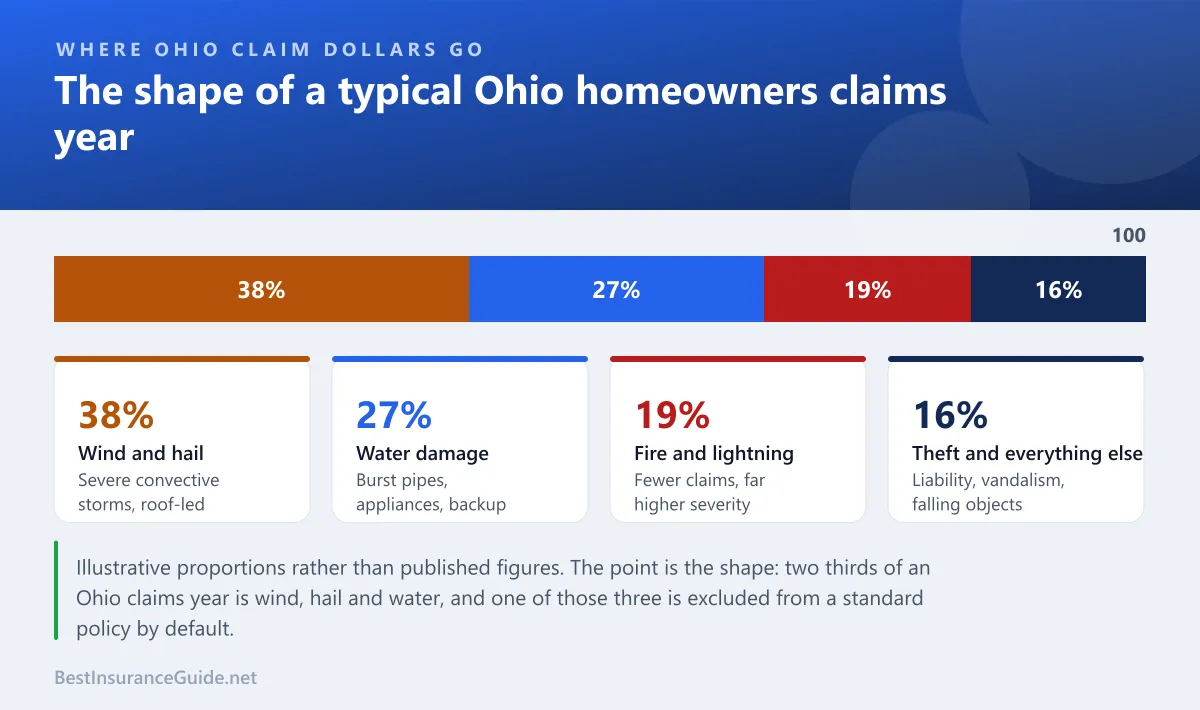
Four things move an individual Ohio premium more than the county does.
The roof. Age, material and shape. This is now the dominant rating factor in every hail-exposed state and Ohio is firmly one. A roof over about fifteen years old will attract a worse rate, a worse settlement basis, or both.
The age and wiring of the house. Ohio has a great deal of pre-1950 housing stock, and knob-and-tube wiring, fuse boxes, galvanised supply plumbing and older heating all move the rate.
Your deductible structure, which in Ohio increasingly means two deductibles rather than one.
Claims history, both yours and the property’s, which follows the address through the shared industry database for several years.
The hail problem
Severe convective storms are Ohio’s catastrophe exposure, and hail is the expensive half of them.
The insurance consequence has been a steady shift in how policies are written, and three changes matter to an Ohio homeowner.
Percentage wind and hail deductibles. Many Ohio policies now apply a separate deductible to wind and hail losses expressed as a percentage of the dwelling limit rather than a flat dollar figure. On a $400,000 dwelling limit, a 2% wind deductible is $8,000.
Actual cash value roof settlement. A growing number of policies settle roof claims on a depreciated basis rather than replacement cost, particularly for older roofs. On a fifteen-year-old roof this can halve the payout.
Cosmetic damage exclusions, which exclude hail damage to metal roofing, siding and gutters that affects appearance but not function.
None of those are hidden. All three are on the declarations page and in the endorsement schedule, and almost nobody reads them until after a storm.
Worked example: the same hailstorm, two policies
A $400,000 home needing a full roof replacement at $24,000 plus $6,000 of siding and gutter damage.
| Flat deductible, RC roof | 2% wind deductible, ACV roof | |
|---|---|---|
| Roof claim basis | $24,000 replacement | $13,200 depreciated |
| Siding and gutters | $6,000 | $6,000, less cosmetic exclusion $2,400 |
| Deductible | $1,000 | $8,000 |
| Settled | $29,000 | $8,800 |
| Homeowner funds | $1,000 | $21,200 |
The premium difference between those two policies is a few hundred dollars a year. The claim difference is over twenty thousand.
The water problem
This is the gap that catches more Ohio homeowners than hail does, and it is a function of the state’s infrastructure.
Sewer and drain backup is excluded from every standard policy. So is sump pump failure. Both need a water backup endorsement, which is inexpensive and which a large share of Ohio homeowners do not carry.
Ohio’s older cities were built with combined sewer systems that carry sewage and storm water in the same pipes. Heavy rainfall overwhelms them, and the water goes somewhere. In a city with a great deal of basement housing stock, that somewhere is frequently a basement.
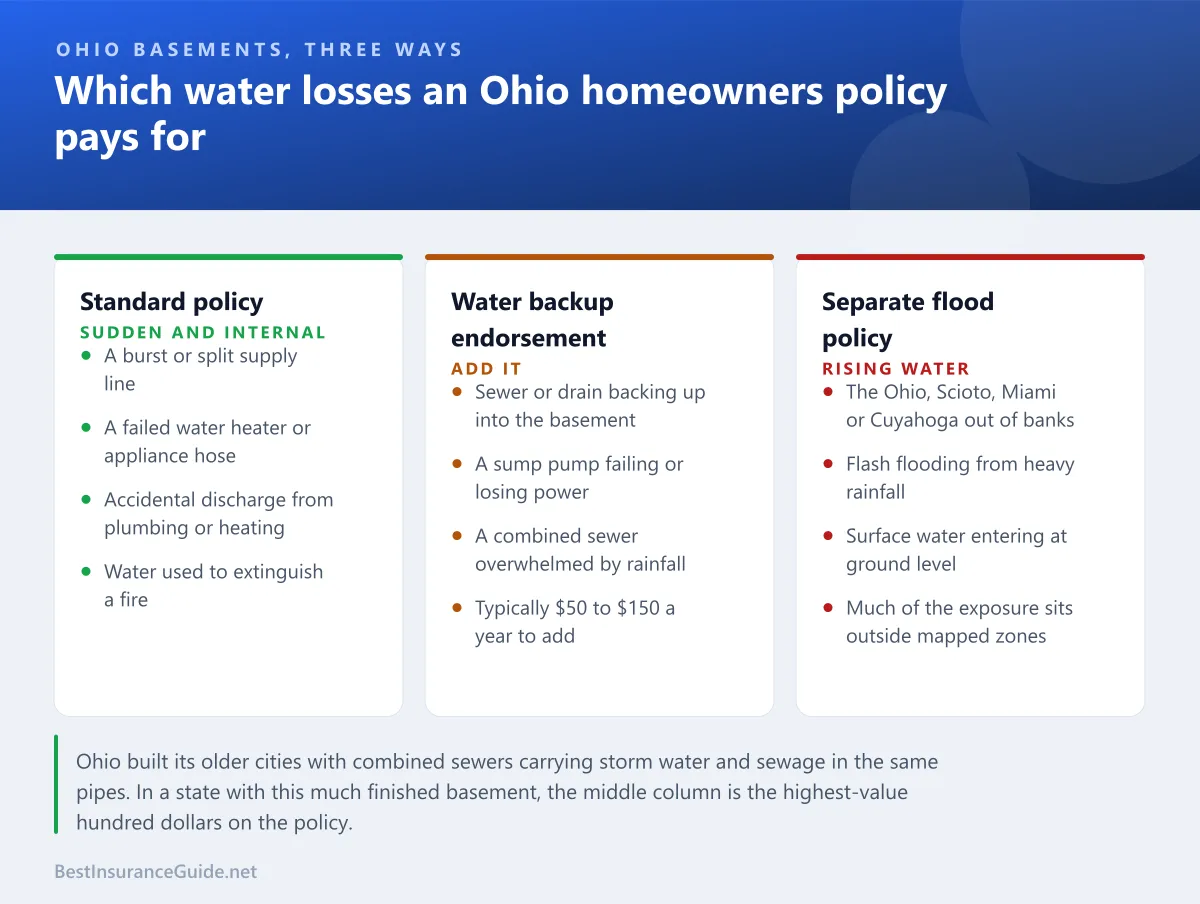
The three-way split matters:
Sudden internal water is covered. A burst supply line, a failed washing machine hose, a pipe that freezes and splits.
Backup and sump failure needs the endorsement. Water that comes back up through a drain, or that the pump failed to remove.
Surface flooding needs a separate flood policy. Water that arrives from outside and rises. Ohio has substantial riverine flood exposure along the Ohio, Scioto, Miami and Cuyahoga systems, and a great deal of that exposure sits outside mapped high-risk zones.
The endorsement typically costs in the region of $50 to $150 a year depending on the limit. A finished basement loss runs into five figures routinely. It is the clearest value decision on an Ohio policy.
What Ohio policies get wrong on rebuilding cost
Two settings decide whether a total loss is actually covered, and both are frequently stale.
Your dwelling limit should reflect the cost to rebuild, not what the house is worth. Those are different numbers and in much of Ohio the market value is the lower of the two, particularly in older urban neighbourhoods where a replacement build costs more than the house would sell for.
Extended or guaranteed replacement cost is the safety net. It adds a margin, commonly 25% or 50%, above your dwelling limit for the situation where rebuilding costs more than the policy assumed. After a widespread hail or wind event, regional demand surge makes that scenario considerably more likely.

Ordinance or law coverage is the third. Ohio’s older housing stock means a substantial repair frequently triggers current code requirements the original house did not meet: electrical, egress, insulation. Standard policies include only a small amount of ordinance or law cover, and increasing it is cheap.
The FAIR Plan, briefly
The Ohio FAIR Plan Underwriting Association exists for property owners who cannot obtain cover in the standard market, usually because of the age, condition or location of the property.
It is a genuine safety net and it is not a substitute for shopping. FAIR Plan coverage is narrower than a standard policy, typically written on a basic named-peril form, frequently without liability, and frequently on an actual cash value basis.
If you are being declined in the standard market, the usual causes are a roof past its life, an older electrical system, an unrepaired prior claim, or a vacant period. Fixing the underlying issue is almost always cheaper than living on a FAIR Plan policy.
What to check on your Ohio declarations page
Your wind and hail deductible, and whether it is a percentage or a flat figure. This is the single most common surprise.
Your roof settlement basis, replacement cost or actual cash value, and whether a cosmetic damage exclusion applies.
Whether water backup coverage is present, and at what limit. If it is absent, add it.
Your dwelling limit against a current rebuild estimate, not the market value and not what it said five years ago.
Extended replacement cost, and how much margin it provides.
Ordinance or law coverage, particularly on a house built before about 1980.
Your personal property basis, replacement cost rather than actual cash value.
Liability, which defaults to $300,000 and should usually be higher, with an umbrella policy above it if you have assets to protect.
The short version
Ohio is cheap to insure because it has no hurricane and little wildfire exposure, and typical premiums fall in the region of $1,100 to $1,900 a year for a mid-priced home.
The two things that actually cost Ohio homeowners money are hail, where percentage deductibles and depreciated roof settlement quietly moved most of the risk back onto the owner, and sewer backup, which is excluded by default in a state whose older cities have combined sewers and finished basements.
Check the wind deductible, check the roof settlement basis, and add water backup coverage. Those three lines matter more than the premium difference between any two insurers.
For the coverage fundamentals, see what home insurance covers and our explanation of hazard insurance versus homeowners insurance.
The roof, in more detail
In a hail state the roof is not one rating factor among many. It is the rating factor, and Ohio insurers now underwrite it more aggressively than they did a decade ago.
Three things about your roof determine what you pay and what you get paid.
Age. Most Ohio carriers price sharply against roofs over about fifteen years and some will not write them at all beyond twenty. A roof approaching that threshold is worth addressing before renewal rather than after a decline.
Material. Three-tab asphalt shingle is the baseline. Architectural shingle, metal and impact-resistant products rate better, and several insurers offer a discount for a Class 4 impact-rated roof that is substantial enough to matter over the life of the roof.
Settlement basis. This is the one owners miss. A policy may cover the roof on replacement cost, paying what a new roof costs, or on actual cash value, paying the depreciated value of the old one. Some Ohio policies apply a roof payment schedule, a sliding scale that depreciates by age even where the rest of the policy is replacement cost.
Worked example: the roof settlement schedule
A fifteen-year-old architectural shingle roof, $26,000 to replace.
| Settlement basis | Depreciation applied | Paid before deductible |
|---|---|---|
| Replacement cost | $0 | $26,000 |
| Roof payment schedule at 15 years | 50% | $13,000 |
| Actual cash value | 60% | $10,400 |
The premium difference between a replacement cost roof endorsement and a scheduled one is typically a few hundred dollars a year. The claim difference here is $13,000.
Storms, and what to do in the week after one
Ohio’s severe weather season produces a predictable sequence, and the owners who do well are the ones who move early.
Photograph the property before the season, from all four sides plus the roof if you can do it safely. A pre-loss record settles a great many arguments about whether damage was pre-existing.
Report promptly after an event, even if you are unsure whether the damage exceeds the deductible. An inspection costs you nothing and a late report is the most common reason a valid hail claim runs into difficulty.
Do not sign anything a door-knocking contractor puts in front of you. After every major Ohio hail event, out-of-state roofing operations move into the affected counties. Some are legitimate and some are not, and an assignment of benefits signed on a doorstep hands your claim to a stranger.
Get your own contractor estimate alongside the adjuster’s, and understand that the two are a starting point for a conversation rather than a final answer.
Keep every receipt for emergency mitigation, tarping and temporary repairs. Those are recoverable and routinely unclaimed.
Ask about recoverable depreciation. On a replacement cost policy the insurer typically pays actual cash value first and releases the remainder once the work is done and invoiced. A great many owners never claim the second payment because nobody explained that it exists.
Discounts worth asking about in Ohio
Most Ohio premiums have more room in them than the quote suggests, and the reductions that actually move the number are not the ones advertised.
A Class 4 impact-resistant roof. The largest single discount available in a hail state, and it applies for the life of the roof rather than for one year. Worth pricing at the point of replacement rather than as a standalone project.
Bundling home and auto, which remains the largest routine discount for most households.
A monitored alarm and water leak detection. Leak sensors in particular are increasingly recognised because water is the most frequent claim type, and the devices cost very little.
Claims-free and loyalty credits, which are one more reason to absorb small losses rather than file them.
Paid in full and paperless, which are small individually and add up.
Age of home and new purchase credits, which some carriers apply for several years after a build or a purchase.
Ask for the full discount schedule rather than accepting the quoted figure. Ohio is a competitive market and the same house will frequently draw quotes several hundred dollars apart at genuinely matched coverage.
How other states compare
Ohio’s combination of low premiums, percentage hail deductibles and excluded sewer backup has parallels and contrasts elsewhere.
Georgia shares the hail exposure and the roof-focused underwriting inland, while adding a coastal wind market Ohio has no equivalent of. New Jersey shares the older housing stock and the sewer backup problem, and adds a flood exposure that sits largely outside the mapped zones.
For what the deductible structure means in practice, see the AOP deductible explained.
A note on scope
Premium figures here are illustrative ranges rather than quotes, and Ohio pricing varies considerably by county, by the age and construction of the house, by roof condition and by the deductible structure selected. Policy forms and endorsements differ between insurers and change over time.
The Ohio Department of Insurance publishes consumer guidance and a complaint record for insurers licensed in the state, and the NAIC publishes comparative data on average premiums by state. Your own declarations page is the authoritative statement of what you actually hold. This site is independent and not affiliated with any insurer.