Homeowners Insurance in New Jersey: The Wind and Water Line
New Jersey homeowners insurance costs, named storm deductibles at the shore, the wind versus flood distinction, and what to check on your policy.

Table of contents

New Jersey homeowners generally have adequate wind cover and inadequate water cover, and the gap between those two is where nearly every uninsured loss in this state comes from.
What it costs
New Jersey premiums are moderate by Northeast standards. Typical figures for a mid-priced home fall in the region of $1,300 to $2,400 a year, with a real spread across the state.
Shore counties — Monmouth, Ocean, Atlantic, Cape May — are rated for tropical wind and carry percentage named-storm deductibles as standard. Premiums run materially higher and carrier appetite is narrower.
Northern and central inland counties are rated much more like the rest of the Mid-Atlantic: winter storm, wind, water damage and fire, with flat deductibles and a broad market.
Beyond geography, the same three factors dominate an individual premium: the roof, its age and material; the age and systems of the house, and New Jersey has a great deal of older housing stock; and the claims history on the address, which follows the property rather than the owner.
Wind and water, which is the whole story
The single most consequential thing to understand about insuring a New Jersey home is that a coastal storm produces two kinds of damage and only one of them is on your policy.
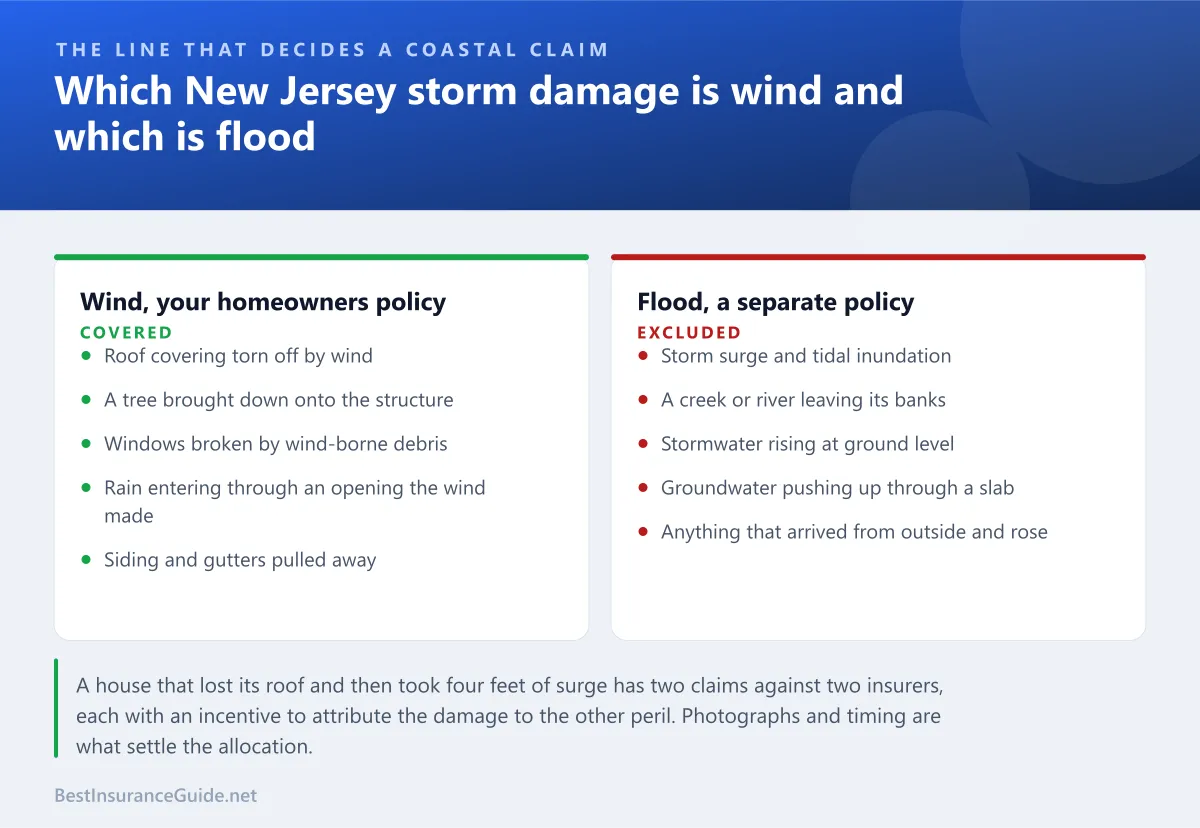
Wind is your homeowners policy. Roof damage, a tree through the structure, wind-driven rain entering through an opening the wind created, broken windows.
Water that rises from outside is flood. Storm surge, tidal inundation, a creek out of its banks, water backing up through the ground. None of that is on a homeowners policy at any limit.
After a landfalling storm, the allocation between those two determines the claim, and it is genuinely contested. A house that lost its roof to wind and then took four feet of surge has two claims against two different insurers, each of which has an incentive to attribute the damage to the other peril.
Three things help, all of them done before or immediately after the event rather than during the argument:
Photograph the property from all sides before storm season, so the pre-loss condition is documented.
Photograph and video during and immediately after, capturing the sequence. Establishing that the roof failed before the water arrived is worth a great deal.
Note water lines and timing. High water marks inside and outside, and when the water arrived relative to the wind, are the evidence that decides the allocation.
The flood gap
This is where New Jersey homeowners are most exposed, and it is a mapping problem as much as an insurance one.
Flood insurance is only required where a federally backed mortgage covers a property inside a FEMA-designated high-risk zone. Everywhere else it is voluntary.
That requirement is doing far less work than people assume, for two reasons.
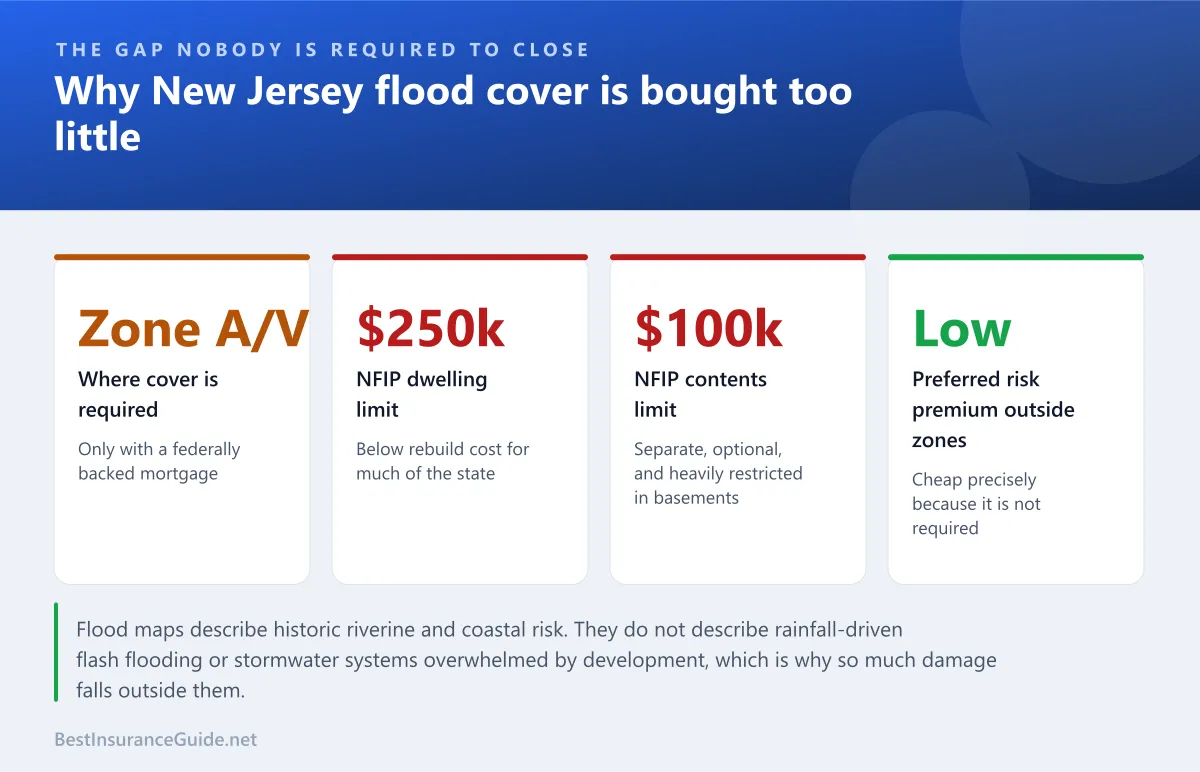
A substantial share of flood claims nationally occur outside high-risk zones. Flood maps describe historic riverine and coastal risk, not rainfall-driven flash flooding, not stormwater systems overwhelmed by development, and not conditions that have changed since the map was drawn.
Preferred risk policies outside high-risk zones are inexpensive, precisely because the mapped risk is low. The annual cost of a preferred risk flood policy is typically a fraction of what it costs inside a mapped zone, and it covers exactly the scenario nobody plans for.
Two further points specific to New Jersey.
NFIP policies have limits — a dwelling limit of $250,000 and contents of $100,000 — which is below the rebuild cost of a great many New Jersey homes. Excess flood cover from private insurers fills the gap and is worth pricing.
Contents cover under NFIP is separate and optional, and basement contents coverage is extremely restricted. A finished basement’s contents are largely uninsurable under a standard NFIP policy, which is worth knowing before finishing one.
The named storm deductible
If you own at the shore, this is the line that decides your exposure.
A named storm deductible is a percentage of the dwelling limit, not of the claim, and it applies to the entire claim including contents and additional living expense.
On a $500,000 dwelling limit:
| Deductible | You pay first |
|---|---|
| 1% named storm | $5,000 |
| 2% named storm | $10,000 |
| 5% named storm | $25,000 |
| Flat $1,500, other losses | $1,500 |
Read the trigger. New Jersey wordings vary in whether the deductible is triggered by the National Hurricane Center naming a storm, by a hurricane warning being issued for the area, or by recorded wind speeds. A storm that arrives as a strong extratropical system after losing tropical characteristics can fall on either side depending on the wording, and that difference is worth tens of thousands.
How a coastal claim actually runs
The sequence matters, and knowing it in advance changes the outcome.
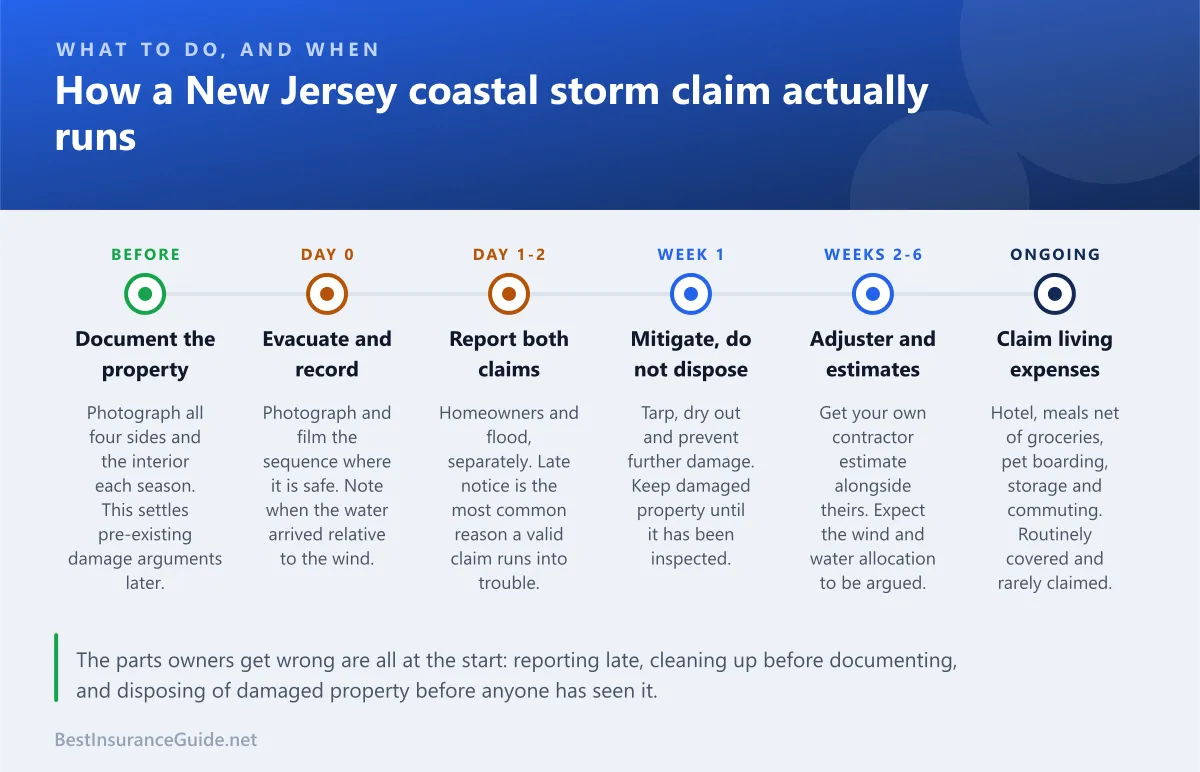
The parts owners consistently get wrong are the early ones. Reporting late, cleaning up before documenting, and disposing of damaged property before it is inspected all weaken a claim that would otherwise have been paid in full.
The parts owners consistently forget are the additional living expense items: hotel, meals net of normal grocery spend, pet boarding, storage and extra commuting. Those are covered and routinely unclaimed.
The New Jersey FAIR Plan
The New Jersey Insurance Underwriting Association is the market of last resort, used mostly for coastal and older properties that the standard market has declined.
Its coverage is narrower than a standard policy and it should be treated as a fallback rather than a comparison point. Owners who end up there usually have a fixable cause: a roof at the end of its life, older electrical or plumbing systems, a prior unrepaired claim, or a vacancy period. An independent agent with access to surplus lines carriers will often find something between the standard market and the FAIR Plan.
What to check on a New Jersey policy
Which deductible applies to which peril. Flat, wind and hail, named storm.
The named storm trigger wording, if you are coastal or near-coastal.
Whether you carry flood cover at all, and if you do, whether the limits match the rebuild cost.
Your dwelling limit against a current rebuild estimate, which in New Jersey has moved considerably.
Extended replacement cost, which matters most after a regional event when demand surge pushes rebuilding costs up.
Ordinance or law coverage, which matters in older housing stock and matters enormously in coastal zones where rebuilding may trigger current elevation requirements. This is the single most under-bought coverage at the shore.
Water backup coverage for sewer and drain backup, which is excluded by default.
Personal property on a replacement cost basis, and liability with an umbrella above it.
The short version
New Jersey homeowners are generally well covered for wind and poorly covered for water, and the state’s flood exposure is concentrated where nobody is required to buy.
At the shore, the named storm deductible is a percentage of the dwelling limit rather than the claim, and the trigger wording is worth reading carefully. Ordinance or law coverage matters more here than almost anywhere because rebuilding may trigger elevation requirements.
Everywhere in the state, price a flood policy even if no lender is demanding one. Outside the mapped high-risk zones it is cheap, and outside the mapped zones is where a great deal of the damage happens.
For coverage fundamentals, see what home insurance covers, and for the terminology, hazard insurance versus homeowners insurance.
The inland New Jersey risks
Most writing about New Jersey insurance is about the shore, which leaves the majority of the state’s homeowners reading about somebody else’s risk profile.
Inland, four exposures drive claims.
Winter weather. Ice dams, frozen and burst supply pipes, and roof collapse under snow load. Frozen pipe damage is covered where you took reasonable care to heat the property, and excluded where the house was left unheated, which catches owners of second homes and anyone away over a cold snap.
Wind without a tropical system. Nor’easters and strong frontal systems produce roof and tree damage every year, and these fall under the flat deductible rather than the named storm one, which is the good news.
Water damage from the house itself. Burst supply lines, failed water heaters, washing machine hoses and, in older housing stock, galvanised plumbing reaching the end of its life. This is the most frequent homeowners claim nationally and New Jersey’s older stock makes it more so.
Sewer and drain backup, excluded by default and common in older municipal systems with combined storm and sanitary sewers.
Worked example: a frozen pipe in a second home
An owner leaves a shore property unheated over January. A supply line splits and runs for eleven days.
| Heated and maintained | Left unheated | |
|---|---|---|
| Structure damage | $46,000 paid | Excluded |
| Contents | $12,000 paid | Excluded |
| Mould developing from the water | Covered to sublimit | Excluded |
| Settled | $57,500 after deductible | $0 |
The exclusion turns on whether reasonable care was taken to maintain heat or to shut off and drain the system. For a seasonally occupied New Jersey property, that single decision is worth more than every other coverage choice on the policy combined.
What ordinance or law actually does here
This is the coverage New Jersey owners under-buy most, and the coastal case for it is unusually strong.
A standard policy pays to rebuild what was there. Ordinance or law coverage pays the additional cost of complying with current building codes when you rebuild, and it comes in three parts: demolition of the undamaged portion, the increased cost of construction, and the loss in value of the undamaged part.
In coastal New Jersey, a substantial repair can trigger current elevation requirements. A house that was legal at its existing height when built may have to be raised to be rebuilt, and raising a house is a six-figure exercise that a standard policy does not fund.
Standard policies typically include ordinance or law cover at 10% of the dwelling limit. Increasing it to 25% or 50% costs a modest amount of premium and is the difference between rebuilding and selling a lot.
Two related points. Substantial improvement rules mean that once repair costs exceed a defined share of the structure’s value, the whole building must be brought to current standards rather than just the damaged part. And elevation raises your NFIP rating in your favour, so the work partly pays for itself in future flood premium.
Shopping a New Jersey policy
Match the coverage before comparing the price. Dwelling limit, all three deductibles, roof settlement basis, extended replacement cost percentage and ordinance or law percentage.
Use an independent agent at the shore, because carrier appetite in Monmouth, Ocean, Atlantic and Cape May counties changes frequently.
Get a flood quote at the same time, both NFIP and private, since the private market in New Jersey now writes a meaningful share of residential flood and sometimes at better terms and higher limits.
Ask about excess flood if the rebuild cost exceeds the $250,000 NFIP dwelling limit, which in much of the state it does.
Confirm what happens to a claim spanning both policies, and consider using the same agent for both so that somebody has an interest in the allocation being handled sensibly.
Check the insurer’s complaint record with the New Jersey Department of Banking and Insurance before binding.
How other states compare
New Jersey’s problem is wind cover that works and water cover that frequently does not exist.
Georgia shares the coastal structure closely, including percentage named storm deductibles and the wind against water allocation that decides a claim. Ohio shares the older housing stock and the sewer backup exclusion without any tropical exposure.
For what a policy costs generally, see homeowners insurance on a $400,000 house.
A note on scope
Premium figures here are illustrative ranges rather than quotes, and New Jersey pricing varies considerably by county, distance from the coast, the age and construction of the house, roof condition and deductible structure. Policy forms, deductible triggers and endorsements differ between insurers and change over time.
The New Jersey Department of Banking and Insurance publishes consumer guidance and rate comparison material, FEMA publishes flood zone determinations and NFIP terms, and the NAIC publishes comparative data on average premiums by state. Your own declarations page is the authoritative statement of what you hold. This site is independent and not affiliated with any insurer.