How Much Is Homeowners Insurance on a $400,000 House?
What homeowners insurance costs on a $400,000 house, why the purchase price barely matters, and the five factors that actually set the premium.

Table of contents

This is one of the most-asked questions in home insurance and it contains a false assumption. The price of the house is not what the policy is priced on.
What the range actually looks like
Across most of the country, insuring a $400,000 house commonly falls somewhere in the region of $1,400 to $4,500 a year, and that spread is enormous for a single question.
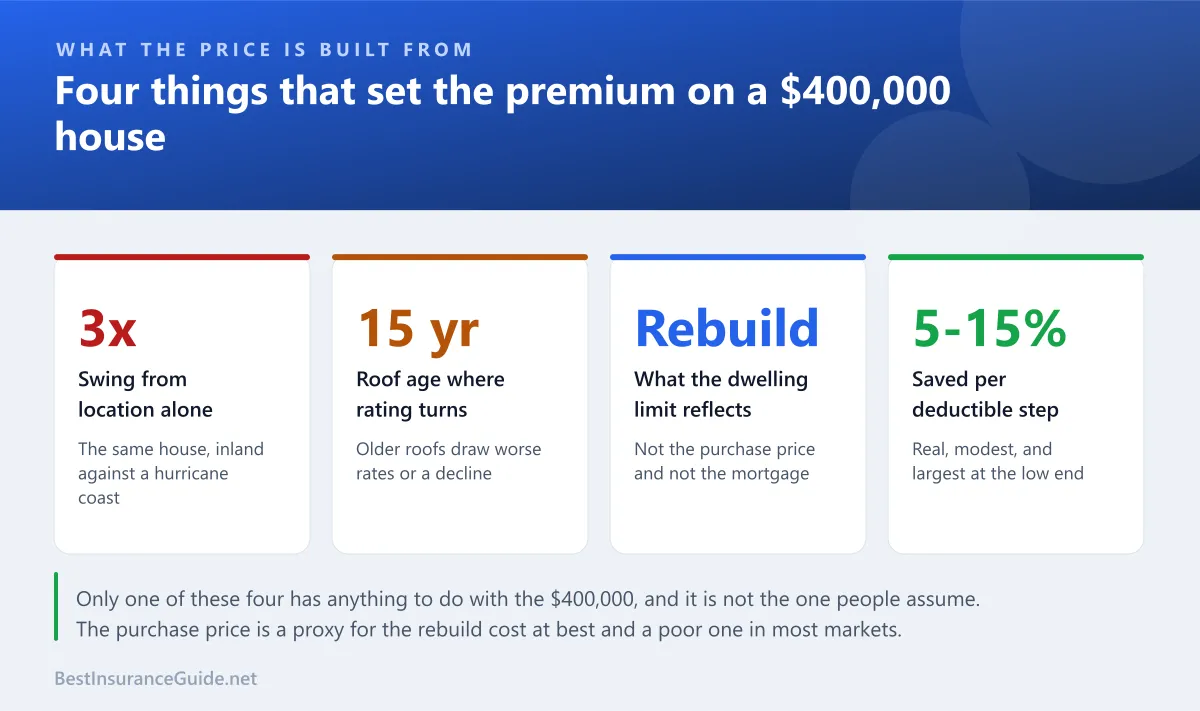
The reason the range is so wide is that four of the five things driving it have nothing to do with the $400,000.
Broadly, the same house lands in three very different places:
Low-catastrophe inland states — much of the Midwest, the interior Northeast, the northern Plains — commonly sit toward the bottom of the range.
Moderate-exposure states — hail-exposed inland South and Mountain West, most of the Mid-Atlantic — sit in the middle.
High-catastrophe states — hurricane coasts, wildfire-exposed parts of the West, and states with severe convective storm and litigation cost pressure — sit well above the top of it, sometimes at multiples.
Why the purchase price is the wrong number
A homeowners policy insures the structure, not the transaction.
You are not insuring the land. Land does not burn down. In a market where land is half the purchase price, the rebuild cost is around half of what you paid.
You are not insuring the market. What a buyer would pay reflects schools, commute, scarcity and interest rates. What a builder would charge reflects square footage, construction type, finishes and local labour rates.
Those two numbers diverge in both directions. In an expensive coastal metro, a $400,000 condominium might cost $180,000 to rebuild. In a rural county with cheap land and expensive labour, a $400,000 house might cost $520,000 to rebuild.
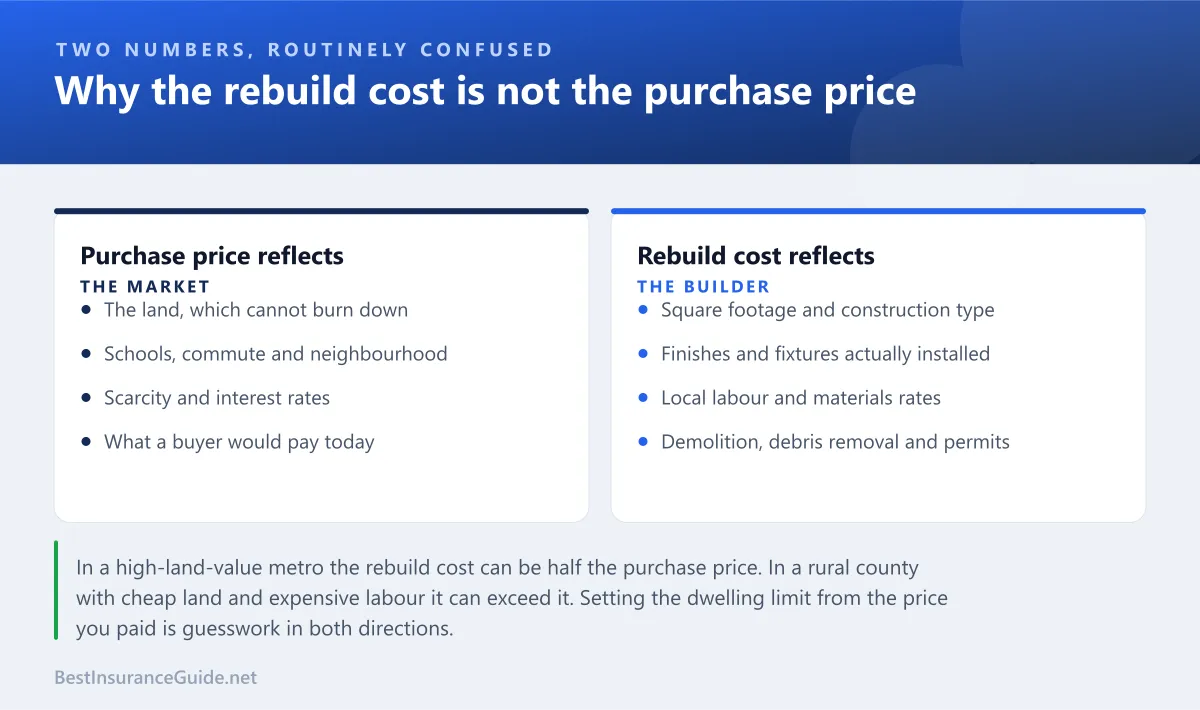
The practical consequence is that you should never set the dwelling limit from the purchase price or the mortgage balance. Both are the wrong number and both produce a policy that is either wastefully large or dangerously small.
The five things that actually set the premium
Location, by a distance. State, county and in catastrophe-exposed regions the specific address. This single factor can move the premium by a factor of three on an identical house.
The roof. Age, material and shape. In every hail- and wind-exposed state this is now the dominant property-level factor, and a roof past about fifteen years attracts a worse rate, a worse settlement basis, or a decline.
The rebuild cost, which is what the dwelling limit should reflect and which drives the contents, loss of use and other structures limits derived from it.
Your deductible structure, including whether wind and hail carries a separate percentage.
Claims history, both yours and the property’s. Claims follow the address through the shared industry database for several years, which is why a house with two prior water claims prices worse regardless of who owns it now.
Below those five, a long tail of smaller factors: construction type, distance to a fire hydrant and a fire station, plumbing and electrical age, a pool or trampoline, a dog of a restricted breed, and in most states a credit-based insurance score.
Worked example: the same $400,000 house in three places
Identical 2,100 square foot house, ten-year-old architectural shingle roof, $1,000 all-perils deductible where available.
| Inland Midwest | Inland Southeast | Hurricane coast | |
|---|---|---|---|
| Dwelling limit set to rebuild cost | $360,000 | $390,000 | $420,000 |
| All-perils deductible | $1,000 | $1,000 | $1,500 |
| Wind and hail deductible | $1,000 flat | 1%, $3,900 | 2% named storm, $8,400 |
| Indicative annual premium | $1,650 | $2,700 | $5,100 |
The house did not change. The address did, and so did what the policy actually promises when a storm arrives.
What the dwelling limit should be
Three ways to get to a defensible number, in order of reliability.
A replacement cost estimator, which your insurer will run and which asks about square footage, construction, finishes and local costs. Ask to see the output rather than accepting the figure.
A builder’s or contractor’s estimate, if you want an independent check. Worth doing on an unusual, historic or high-specification house where the estimator’s assumptions are least likely to fit.
A per-square-foot local build cost, as a sanity check. If the insurer’s number is far from local build costs multiplied by your square footage, something is wrong in the inputs.
Then add the safety margins.
Extended replacement cost adds a stated margin, commonly 25% or 50%, above the dwelling limit for the case where rebuilding costs more than assumed. After a widespread regional event, demand surge makes that likely rather than hypothetical.
Ordinance or law coverage pays the additional cost of building to current codes. Standard policies include around 10%, which is thin on anything built before about 1980.
Inflation guard, which most policies apply automatically, raising the limit each year. Useful, and worth knowing about because your percentage deductible rises with it.
What you can actually change
Half the premium is decided by where the house is, and you are not moving. The other half has real levers.
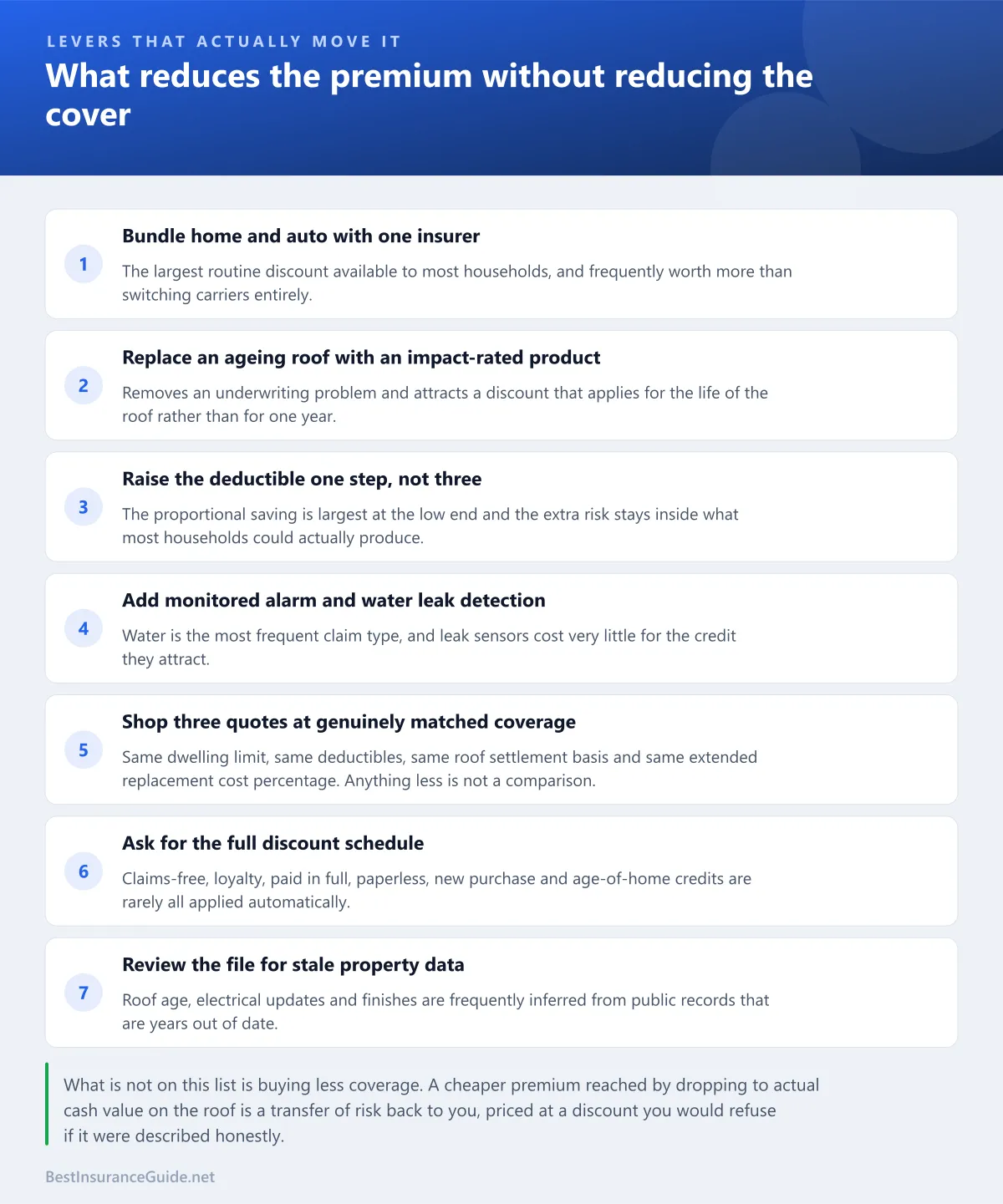
The two largest are bundling home and auto, which remains the biggest routine discount available to most households, and the roof, where replacing an ageing roof with an impact-resistant product both removes an underwriting problem and attracts a discount for the life of the roof.
After those, raising the deductible one step, adding monitored alarm and water leak detection, and shopping properly at matched coverage each move the number a useful amount.
What does not work is buying less coverage. A cheaper premium achieved by dropping to actual cash value on the roof and contents, or by accepting a 5% wind deductible you could not produce, is not a saving. It is a transfer of risk back to you, priced at a discount you would not accept if it were presented as one.
The short version
Homeowners insurance on a $400,000 house commonly runs somewhere between about $1,400 and $4,500 a year, and where you land in that range is decided by the state far more than by the house.
The purchase price is close to irrelevant, because the policy insures the cost to rebuild the structure and not the value of the transaction. Set the dwelling limit from a replacement cost estimate, add extended replacement cost and increase the ordinance or law percentage, and check the whole thing again whenever you renovate.
Then shop at genuinely matched coverage. Two quotes on the same house are only comparable once the dwelling limit, every deductible, the roof settlement basis and the extended replacement cost percentage all line up.
For what the policy actually covers, see what home insurance covers, and for the deductible structure in detail, your homeowners insurance deductible.
What the premium is actually buying
It helps to see where the money goes, because a homeowners premium is not one price for one thing.
Coverage A, the dwelling. The structure itself, at the rebuild cost. This is the largest component and every other limit is derived from it.
Coverage B, other structures. Detached garages, fences, sheds, driveways. Usually set at 10% of Coverage A automatically, which is fine for a suburban lot and thin for a property with a detached workshop or a long run of fencing.
Coverage C, personal property. Everything you own, usually 50% to 70% of Coverage A by default. On a $400,000 rebuild cost that is $200,000 to $280,000 of contents cover, which most households will never use and some will badly exceed.
Coverage D, loss of use. The additional cost of living elsewhere while the house is repaired, usually 20% to 30% of Coverage A. After a total loss this matters more than owners expect, because rebuilding a house takes nine to eighteen months and considerably longer after a regional catastrophe.
Coverage E, personal liability. Commonly $100,000 or $300,000 by default and almost always too low. Raising it is one of the cheapest things on the policy.
Coverage F, medical payments to others. A small no-fault amount, typically $1,000 to $5,000, for minor injuries to guests.
The point of listing them is that a $400,000 house does not buy $400,000 of insurance. It buys a package derived from the rebuild cost, and several of those derived percentages are defaults that suit an average household rather than yours.
Worked example: how the limits derive from Coverage A
A $400,000 rebuild cost, standard percentages.
| Coverage | Default | Limit |
|---|---|---|
| A, dwelling | Rebuild cost | $400,000 |
| B, other structures | 10% | $40,000 |
| C, personal property | 60% | $240,000 |
| D, loss of use | 25% | $100,000 |
| E, personal liability | Set separately | $300,000 |
| F, medical payments | Set separately | $5,000 |
Two of those defaults are worth checking every year. Coverage B, if you have added a detached structure, a pool house or extensive fencing. And Coverage E, which should generally be at least $500,000 with an umbrella above it if you have assets worth protecting.
Why the premium keeps rising without a claim
This is the most common complaint about homeowners insurance and there are three separate causes.
Inflation guard raises your dwelling limit automatically. Most policies increase Coverage A each year to keep pace with construction cost inflation. More coverage costs more premium, and every derived limit rises with it. This is the policy working correctly, and it is also why your percentage deductible grows silently.
Reinsurance costs have risen. Insurers buy their own catastrophe protection and its price has climbed sharply across nearly every exposed market. That cost is passed through to policyholders whether or not their own region had a bad year.
Construction cost inflation exceeded the index. In several markets the actual cost of materials and labour rose faster than the inflation guard assumed, which forced insurers to reprice rather than merely index.
None of those are about you. What is about you is whether the coverage still fits: whether the roof has aged into a worse rating band, whether a claim has entered the record, and whether the discounts you were originally given are all still applied. A renewal is worth ten minutes rather than an autopay.
Comparing two quotes on the same house
Two numbers are only comparable once six lines match, and quote engines are not built to make that easy.
The dwelling limit. If one quote assumes a $360,000 rebuild cost and the other $420,000, the cheaper one is not cheaper. It is smaller.
Every deductible. All-perils, wind and hail, named storm. A quote carrying a 2% wind deductible against another carrying a flat $1,000 is a different product at a different price.
The roof settlement basis. Replacement cost, actual cash value, or an age-based payment schedule. This single line is worth more on a hail claim than the entire annual premium difference between most carriers.
Extended replacement cost. None, 25% or 50%. The margin above the dwelling limit for the case where rebuilding costs more than assumed.
Ordinance or law percentage. Usually 10% as standard and worth raising on anything built before about 1980.
Personal property basis and limit. Replacement cost rather than actual cash value, and whether the contents percentage was reduced to hit a price.
Write those six down, quote that exact package with three insurers, and only then compare the premium. Any quote that came back materially cheaper without matching all six did so by covering less.
A note on scope
Premium figures here are illustrative ranges rather than quotes. Homeowners pricing varies enormously by state, county, address, construction, roof condition, claims history and deductible structure, and rates change over time.
Your state insurance department publishes consumer rate comparison material, and the NAIC publishes comparative data on average premiums by state. A replacement cost estimate for your specific property is the only reliable basis for a dwelling limit. This site is independent and not affiliated with any insurer.