Does Renters Insurance Cover Fleas? No, and Nor Do Most Policies
Renters insurance excludes fleas, bed bugs and all infestations as maintenance. Who is responsible between landlord and tenant, and what actually helps.

Table of contents

This is one of the clearest no answers in renters insurance, and the reason is the same rule that governs mould, wear and gradual water damage.
Why infestations are excluded
Renters insurance covers sudden and accidental losses. A pipe bursts, a fire starts, a thief breaks in. Discrete events with a date.
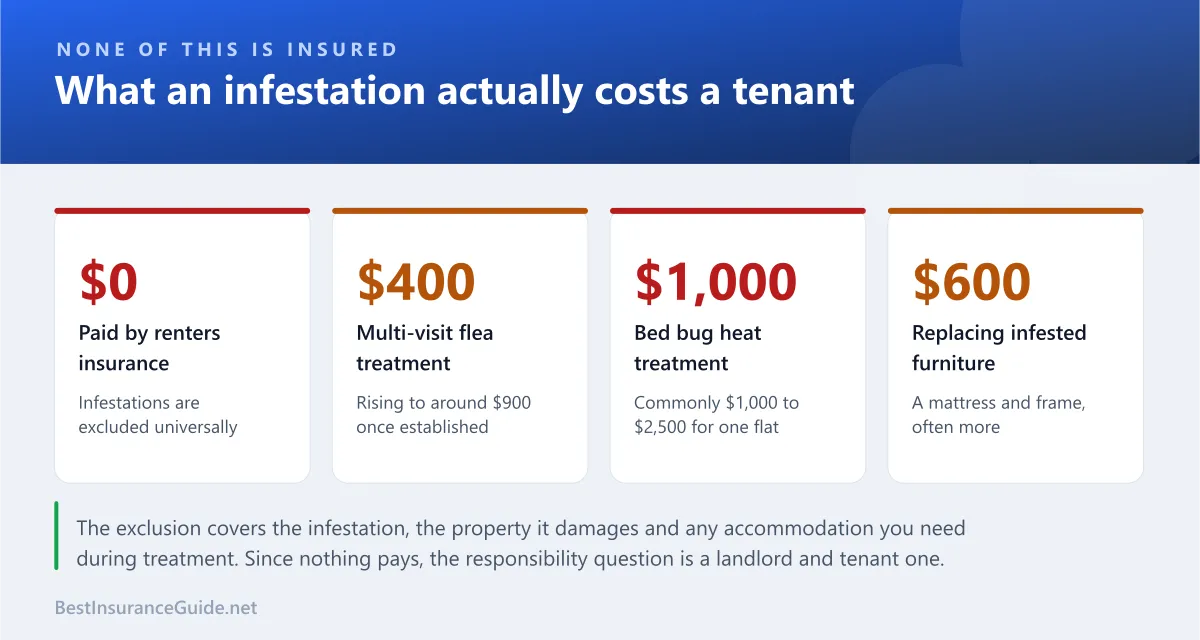
An infestation is neither sudden nor accidental. Fleas arrive, breed and establish over weeks. Bed bugs spread gradually. Rodents move in over a season. Insurers treat all of it as a maintenance and housekeeping matter, and every standard policy excludes it.
The exclusion is normally drafted broadly, covering “birds, vermin, rodents, insects” or similar, and it applies to both the infestation and its consequences.
What that means in practice
Treatment costs are not covered. Professional flea treatment of a flat runs from a couple of hundred dollars to well over a thousand for a serious infestation requiring multiple visits. None of it is claimable.
Damaged property is not covered. Infested mattresses, bedding, upholstered furniture and carpets frequently have to be disposed of. That is a real loss and it is excluded, because the cause is excluded.
Chewed wiring and rodent damage is not covered, which surprises people because it looks like accidental damage. It is not; it is pest damage.
Temporary accommodation during treatment is not covered. Loss of use requires a covered peril, and an infestation is not one. Our guide to whether renters insurance pays for a hotel sets out what does trigger it.
Your liability does not fund the building’s treatment, even where the lease makes you responsible. Liability responds to sudden accidental damage you cause, not to gradual infestation.
There is one narrow exception worth knowing. If pest damage leads to a separate covered peril — rodents chewing wiring that then causes a fire — the fire damage is generally covered even though the chewing is not. The fire is a covered peril in its own right.
Who is actually responsible
Since insurance is not the answer, the question becomes a landlord-tenant one, and the answer varies.
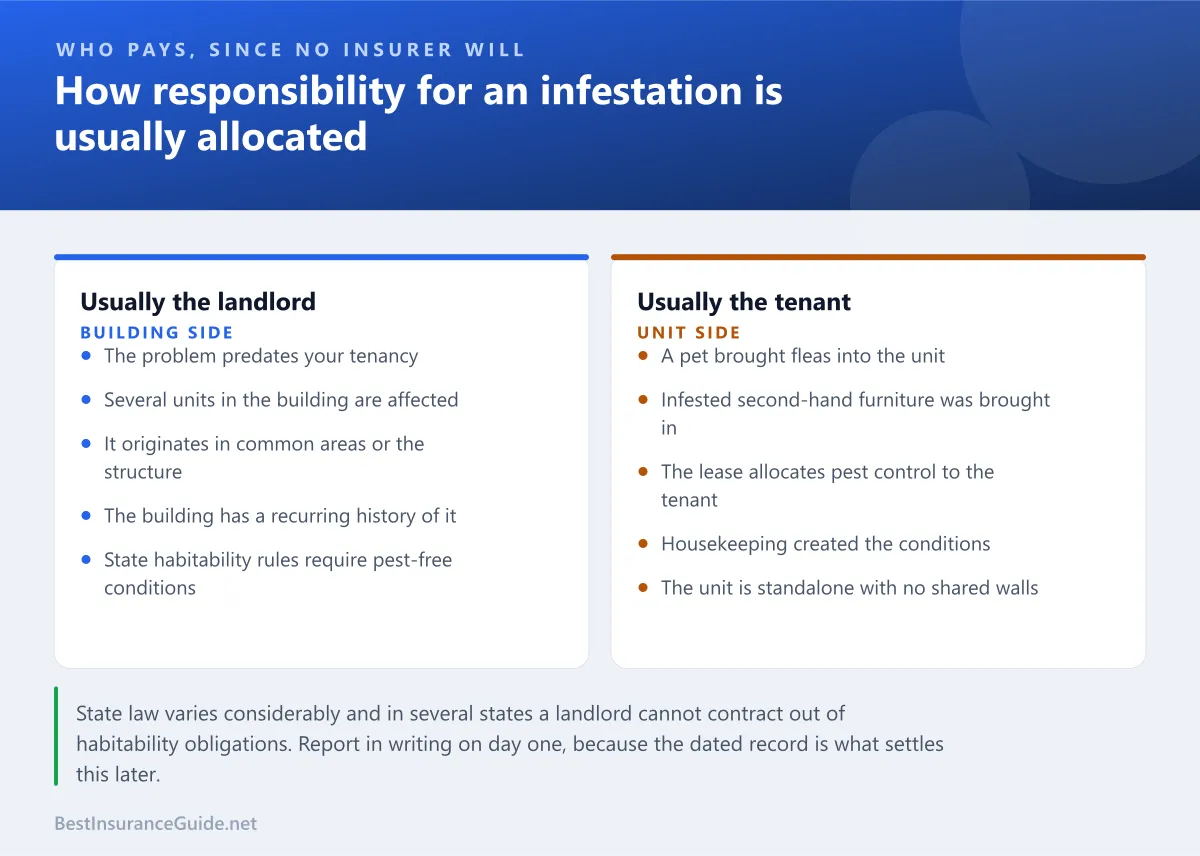
The landlord is frequently responsible where:
The infestation existed before your tenancy began.
It affects multiple units, since that indicates a building-wide problem rather than a unit-specific one.
It originates in common areas, the structure, or from another tenant.
The building has a recurring problem the landlord has failed to address.
Your state implies a warranty of habitability that includes pest-free conditions, which many do.
The tenant is frequently responsible where:
You introduced the problem, most commonly through a pet with fleas or by bringing in infested second-hand furniture.
The lease explicitly allocates pest control to the tenant, which many do for units without shared walls.
Poor housekeeping created the conditions.
Two important qualifications. State law varies considerably, and in several states a landlord cannot contract out of habitability obligations regardless of what the lease says. And lease terms vary, so read yours before assuming.
Your state or city may also have a tenant rights office, and many publish guidance on exactly this question. It is worth a search before an argument.
What to do if it happens
Report it in writing immediately. Dated, by email. This is the single most important step, because it establishes when the problem was reported and starts any obligation the landlord has. A phone call proves nothing later.
Photograph and document. Bites, live insects, droppings, affected furniture. Date-stamped.
Read the lease for the pest control clause before the conversation, so you know what it actually says rather than what you assume.
Check your state and local rules on habitability and pest control obligations.
Do not treat it yourself first if you believe the landlord is responsible, because doing so muddies who caused what and may waive your position.
Keep every receipt if you do end up paying, because reimbursement or a rent reduction may be available depending on your jurisdiction.
Escalate properly if the landlord does not act: written notice, then whatever your local process provides, which in some places includes repair-and-deduct or a habitability complaint.
For bed bugs specifically, several jurisdictions have disclosure requirements obliging landlords to inform prospective tenants of recent infestations. Worth checking if you are moving in.
The pet side of it
If the fleas came in on an animal, the insurance answer is a different one and it is more useful.
Core pet insurance does not cover flea preventives, which are routine care and sit under a wellness add-on if you have one.
It does cover the consequences. Flea allergy dermatitis is one of the most common chronic claims in pet insurance, particularly in warm states with no winter die-off. Secondary skin infections and, in heavy infestations of small animals, anaemia are also covered as illness.
Our guides to pet insurance in Alabama and pet insurance in Florida cover why year-round flea pressure makes this the dominant chronic claim in the South.
The practical point: prevention is cheap and it is the only thing that works. Year-round flea preventive for a pet costs a few hundred dollars a year, and it prevents both a veterinary claim you would have to pay a deductible on and a household infestation nobody will cover at all.
Preventing the household problem
Since no policy will pay, prevention is the entire strategy.
Year-round flea prevention on every pet, not seasonally. Fleas survive indoors through winter perfectly well.
Treat the environment, not just the animal. Most of a flea population is eggs, larvae and pupae in carpets and soft furnishings rather than adults on the pet. Treating the pet alone does not clear an established infestation.
Vacuum frequently and thoroughly, including under furniture and along skirting, and empty the vacuum outside.
Wash pet bedding hot, weekly during an active problem.
Inspect second-hand furniture carefully before bringing it in. This is the most common route for bed bugs specifically, and a discarded mattress on a pavement is discarded for a reason.
Check luggage after travel for bed bugs, and unpack directly into a washing machine after staying somewhere you are unsure about.
Act early. A small flea problem is a couple of hundred dollars. An established one across a whole flat with infested furniture is several thousand, and none of it is insured.
The short version
Renters insurance does not cover fleas, bed bugs, rodents or any other infestation, and it does not cover the property they damage or the accommodation you need during treatment. The exclusion is universal and it is not negotiable.
The question is therefore a landlord-tenant one. Responsibility depends on your lease and on your state’s habitability rules, and broadly turns on whether the problem predates your tenancy or affects multiple units, against whether you introduced it.
Report it in writing immediately, photograph everything, read the lease clause and check your local tenant rights guidance before the conversation.
And since nothing will pay for it, prevention is the whole answer: year-round flea preventive on pets, treat the environment rather than just the animal, and inspect second-hand furniture before it comes through the door.
For what a renters policy does cover, see what renters insurance covers, and for the same sudden-versus-gradual test applied to water, does renters insurance cover mold.
What treatment actually costs
Since none of it is insured, the numbers are worth knowing before you decide who should be paying.
| Situation | Typical cost |
|---|---|
| Single flea treatment of a one-bedroom flat | $150 to $350 |
| Multi-visit flea treatment of an established infestation | $400 to $900 |
| Bed bug heat treatment of a one-bedroom flat | $1,000 to $2,500 |
| Replacing an infested mattress and bed frame | $600 to $1,800 |
| Rodent exclusion and trapping | $300 to $800 |
| Temporary accommodation during treatment | Whatever it costs, uninsured |
Bed bugs are the expensive one by a distance, and they are also the one most likely to require replacing furniture and multiple treatment rounds.
That spread is why the landlord-tenant responsibility question is worth resolving properly rather than paying to make it go away. A few hundred dollars is often not worth the argument; several thousand is.
Escalating properly
If the landlord is responsible and is not acting, most jurisdictions provide a route, and following it in order matters.
Written notice first, dated, describing the problem and requesting remedy within a reasonable period. Keep a copy.
Follow up in writing if nothing happens, referencing the first notice.
Check your local process. Depending on where you live this may include a habitability complaint to a housing or code enforcement authority, a rent escrow procedure, or a repair-and-deduct remedy. These vary enormously and several have strict procedural requirements that must be followed exactly.
Do not simply withhold rent. In most places that is not a lawful remedy on its own and it can expose you to eviction. Where rent withholding is available it usually requires a formal process.
Document throughout. Photographs, dates, correspondence, receipts, and any pest control reports.
Your state or city tenant rights office publishes the correct process, and many offer free advice lines. That is a considerably better source than general guidance, because the procedures are jurisdiction-specific.
Second-hand furniture, briefly
This is the single most common route for bed bugs into a home, and the advice is simple.
Inspect any second-hand upholstered furniture or mattress carefully in daylight before it comes through the door: seams, tufts, the underside of the frame, and screw holes. Look for live insects, shed skins and dark spotting.
A discarded mattress on a pavement is almost always discarded for a reason. Do not take it.
If you buy second-hand upholstered furniture, treating it before it enters the flat is considerably cheaper than treating the flat afterwards.
Why the exclusion is not unfair, even though it feels it
Tenants reasonably ask why a policy that pays for a burst pipe will not pay for bed bugs, and the answer is worth understanding because it applies far beyond pests.
Insurance prices uncertainty. A fire, a theft or a burst supply hose is a discrete event with a low probability and a known cost, and thousands of policyholders can pool that risk cheaply.
An infestation is different in kind. It develops gradually, it is strongly influenced by how a property is kept, it recurs, and in many buildings it is close to inevitable over a long enough period. Risks that are near-certain and partly within the policyholder’s control are not insurable at a premium anyone would pay; they are maintenance.
That same logic explains three other exclusions tenants find surprising.
Mould, which is excluded unless it follows a covered water loss, for exactly the same gradual-and-preventable reason.
Wear and deterioration, which is why a carpet that has simply aged is not a claim.
Mechanical breakdown, which is why a failed appliance is a repair rather than a loss.
Once the pattern is visible, the boundary of a renters policy becomes much easier to predict: sudden and accidental events are in, gradual and manageable conditions are out.
The lease clause to read before you sign
Since insurance will never answer a pest problem, the lease is where your position is actually determined, and it is worth reading the relevant clause before signing rather than during an infestation.
Look for who is allocated pest control, and whether the allocation distinguishes between problems existing at move-in and those arising later.
Look for a move-in condition statement, and complete it honestly and in detail. A dated record noting the unit was pest-free at move-in is what later establishes that a problem is not yours.
Look for a disclosure clause on recent infestations, which several jurisdictions now require for bed bugs specifically.
Look for a treatment cooperation clause, which typically obliges you to prepare the unit, allow access and follow the treatment protocol. Failing to cooperate can shift responsibility to you even where it started with the landlord.
Be sceptical of a blanket clause making the tenant responsible for all pest control regardless of cause. In several states a landlord cannot contract out of habitability obligations, so such a clause may be partly unenforceable, but you would rather not test that during a live problem.
Related reading
Renters insurance in Indiana covers what a tenant can do where statutory remedies against a landlord are thin, which is the practical position in a pest dispute. Does renters insurance cover mold covers the same sudden-versus-gradual test applied to water rather than pests.
A note on scope
Landlord and tenant obligations for pest control are set by state and local law and by the lease, and they vary considerably. Nothing here is legal advice.
Your state or city tenant rights office, and your state attorney general’s consumer pages, publish guidance on habitability obligations and are the authoritative source. This site is independent and not affiliated with any insurer.