Best Pet Insurance in Florida: What Actually Matters Here
Choosing pet insurance in Florida: year-round parasites, cane toad poisoning, heat, hurricanes and age limits. The terms that actually decide claims here.

Table of contents
Searching for the best pet insurance in Florida produces a lot of insurer rankings and not much about Florida. The useful version is the other way round: work out what this state actually does to pets, then judge policies against it.
What sets the price here
Pet insurance reimburses a share of your actual vet bill, so the premium follows local veterinary pricing rather than anything about your animal.
Miami-Dade, Broward and Palm Beach price highest, followed by the Tampa Bay and Orlando metros. High clinic overheads, competitive labour markets and dense emergency and specialist capacity all feed into the bills insurers reimburse.
North Florida and rural counties quote lower. The University of Florida’s veterinary teaching hospital at Gainesville provides genuine specialist access without south Florida metro pricing.
Florida sits above the national middle overall, mostly because so much of the population lives in the expensive metros. Our pet insurance by state guide covers why the ZIP code rather than the state line is the real rating factor.
The emergency that kills in minutes
Cane toads are established across central and south Florida, and they are the most time-critical risk in this article.
A dog that mouths or bites one absorbs a toxin through the gums that acts fast. Signs include profuse drooling, bright red gums, disorientation, vomiting, cardiac arrhythmias and seizures, and a large dog can deteriorate within fifteen to thirty minutes. Small dogs can die.
What to do, in order. Rinse the mouth with running water for five to ten minutes, directing the water sideways out of the mouth rather than down the throat so the dog does not inhale it. Wipe the gums and tongue with a cloth. Then get to a vet immediately, and call ahead so they are ready.
Insurance covers the treatment as poisoning. It does not make the drive shorter, which is why the response above matters more than the policy does.
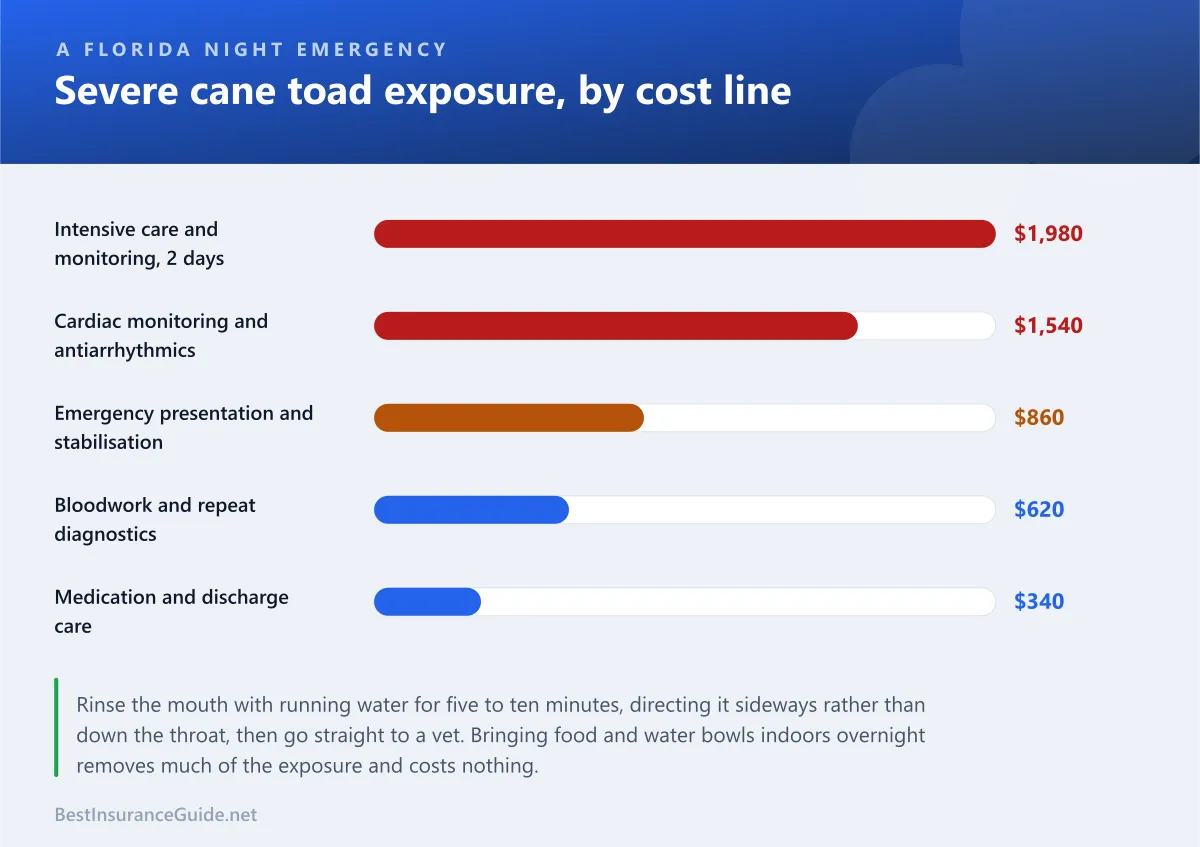
Worked example: a severe cane toad exposure
Policy: $500 annual deductible, 80% reimbursement, $10,000 annual limit.
| Item | Cost |
|---|---|
| Emergency presentation and stabilisation | $860 |
| Cardiac monitoring and antiarrhythmic treatment | $1,540 |
| Intensive care and monitoring, two days | $1,980 |
| Bloodwork and repeat diagnostics | $620 |
| Medication and discharge care | $340 |
| Total | $5,340 |
| Less deductible | $500 |
| Reimbursed at 80% | $3,872 |
| Owner pays | $1,468 |
Toads are most active at night and after rain, and they gather around water bowls, pet food left outside and lit patios. Bringing water and food indoors overnight removes a large share of the exposure and costs nothing.
The year-round parasite load
Florida has no winter at all, which means the parasite cycle never resets. This is the heaviest sustained parasite pressure in the country.
Heartworm. Prevalence is consistently among the highest nationally with year-round mosquito activity. Prevention is a wellness item and is not covered. Treatment is covered provided the dog was clear at enrolment. A dog that arrives positive is excluded permanently for that condition, which matters enormously given Florida’s large rescue and transport population. Test before you enrol.
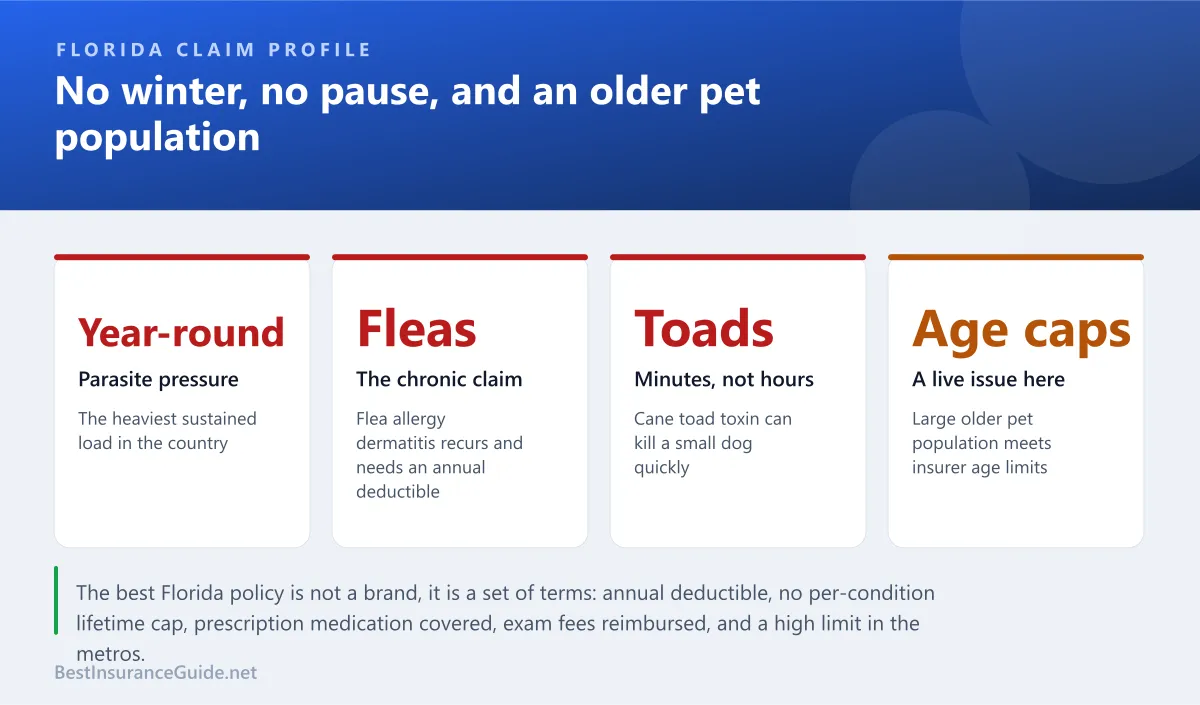
Fleas. Florida flea pressure is as severe as anywhere in the United States, and flea allergy dermatitis is the most common chronic claim in the state. Recurring skin disease, secondary infections and repeated consultations. That single fact drives the most important buying decision below.
Ticks, carrying ehrlichiosis and Rocky Mountain spotted fever more than Lyme. Covered as illness.
Intestinal parasites in warm, sandy soil, with hookworm burdens high.
The rest of the Florida profile
Heat and humidity. Heat injury cases arrive across a long season and severe ones are multi-day intensive care admissions. Brachycephalic breeds are heavily over-represented and are extremely popular across south Florida.
Snake bites. Rattlesnakes, cottonmouths, copperheads and coral snakes are all present. Antivenom is expensive and treatment is an emergency admission. Covered as an accident.
Water hazards. Alligators are a genuine risk for dogs near fresh water anywhere in Florida, and injuries are covered as accidents. Saltwater ingestion and blue-green algae in slow water are both real seasonal presentations.
Hurricanes. Storm injuries are covered as accidents. Boarding, evacuation and relocation costs are not, and belong to homeowners or renters loss-of-use cover. Confirm what your property policy pays before the season, and identify boarding well outside your county in advance.
Foreign body ingestion, the most common expensive emergency nationally.
The age question, which comes up more here
Florida has a large population of older pets, partly because it has a large population of older owners, and age limits become a live issue more often than in most states.
Most insurers cap new accident and illness policies somewhere between ten and fourteen depending on the company and sometimes the breed. Above that, accident-only cover is often still available, and our guide to accident-only pet insurance covers when that makes sense.
Everything already in the notes is excluded. For a dog of nine or ten in Florida that has been screened annually for heartworm and tick disease, that list is usually meaningful. Read the proposed exclusions before paying anything, because the value of the policy is entirely what remains.
Premiums accelerate after about seven, which is exactly when owners cancel and exactly when claims begin. If the number stops working, raise the deductible or lower the reimbursement percentage rather than cancelling. Both keep the enrolment date; cancelling destroys it permanently.
What separates a good Florida policy
Match four fields across every quote before comparing any premium: the annual limit, the deductible and whether it is annual or per condition, the reimbursement percentage, and the waiting periods.
Then judge on five terms that matter more here than the insurer’s brand.
An annual deductible, not per condition. Flea allergy dermatitis is the most likely recurring claim in Florida, and per-condition designs punish exactly that over three or four years.
No per-condition lifetime cap. Chronic skin disease and chronic cardiac management both run for years.
Prescription medication covered at the full percentage. Dermatology medication is a large recurring line.
Exam fees reimbursed. A dog with chronic skin disease generates a long run of consultations, and insurers split roughly evenly on whether the consultation itself is claimable. Across several years this runs to several hundred dollars.
A high annual limit in the metros. South Florida specialist pricing finds the top of a $5,000 cap quickly.
Vaccines, prevention and wellness riders
Core pet insurance covers neither vaccines nor neutering, and it does not cover heartworm, flea or tick prevention. All are preventive or elective.
Florida’s preventive load is the heaviest in the country:
| Preventive item | Typical annual cost |
|---|---|
| Year-round heartworm prevention | $130 to $230 |
| Year-round flea and tick prevention | $220 to $340 |
| Annual heartworm and tick-borne disease testing | $60 to $110 |
| Core vaccinations and boosters | $90 to $170 |
Every Florida owner should be carrying all of that regardless of whether they insure. Whether a wellness rider is worth buying is arithmetic: total the published allowances, subtract the rider premium, and buy only if the result is positive for care you would purchase anyway. It generally comes out ahead in a puppy’s first year and loses money afterwards.
Do not confuse the products. The rider smooths a predictable few hundred dollars. The policy underneath is for the $5,300 night.
Regulation
Pet insurance in Florida is regulated by the Florida Office of Insurance Regulation as a property and casualty line rather than as health insurance. That is why it reimburses you after the fact and why there is no provider network: any licensed vet works, including Gainesville.
A growing number of states have adopted rules based on the NAIC Pet Insurance Model Act, standardising how waiting periods, pre-existing condition definitions and exam requirements are disclosed. Adoption has been moving, so check the office’s current position rather than assuming a particular protection applies.
Read the pre-existing condition definition yourself regardless. It varies more between insurers than any other term and it decides most declined claims.
The mistakes that cost Florida owners money
Choosing an insurer on a national ranking rather than on the terms above. The rankings are not written for Florida’s claim profile.
Enrolling after the annual heartworm test. Florida vets test annually as standard.
Insuring a rescue or transport dog before testing. Test and treat first.
Choosing a per-condition deductible. Chronic skin disease is the most likely recurring claim in the state.
Leaving food and water bowls outside overnight. The cheapest cane toad prevention available.
Assuming pet insurance covers hurricane boarding. It does not, anywhere.
Cancelling as premiums rise with age. Adjust the deductible or reimbursement percentage instead.
Cats in Florida
Cats cost substantially less to insure and their expensive claims differ: urinary blockage, chronic kidney disease in older cats, hyperthyroidism, dental disease and foreign body ingestion.
Feline heartworm is present in Florida and is harder to manage than the canine form, because the adulticide protocol used in dogs is not safe in cats. Prevention carries more weight for that reason and remains a wellness item. Outdoor cats carry very heavy flea burdens and abscesses from fight wounds.
A male cat with a urinary blockage is a sudden emergency with a four-figure bill and no warning, which justifies cover on a strictly indoor cat by itself.
A note on figures and sources
Premiums and treatment costs here are illustrative, drawn from typical ranges rather than any single insurer’s rate filing, and this site is independent and not affiliated with any insurer. Actual pricing depends on your ZIP code, the species, breed and age of the animal, and the limits chosen, and veterinary charges differ substantially between south Florida and the panhandle.
Heartworm and tick prevalence shift over time. The American Heartworm Society and the Companion Animal Parasite Council publish regularly updated county-level maps, both more current than any article, and your own veterinarian will know what is presenting locally.
A note on independence
This site is independent and not affiliated with, endorsed by, or acting as an agent for any pet insurer. Nothing here is a recommendation of a particular company, and the framing throughout is deliberately about policy terms rather than brands, because the terms are what decide claims.
Any specific allowance, coverage or price should be confirmed directly with the insurer, since availability differs by state, by policy form and over time. Your state insurance department and the NAIC both publish complaint and financial data worth checking before buying from anyone.
Comparable states
Florida’s year-round parasite load is shared across the Gulf. Louisiana carries a similar burden plus an annual evacuation risk, and Alabama sits in the same heartworm belt without the coastal complications. Texas overlaps along its own Gulf coast while being too large to quote as one market.
The short version
The best pet insurance in Florida is not a brand, it is a set of terms. An annual deductible rather than per condition, no per-condition lifetime cap, prescription medication covered at the full percentage, exam fees reimbursed, and a high annual limit if you are in a metro.
Those matter because of what Florida actually does: the heaviest year-round parasite load in the country, chronic flea allergy dermatitis as the most likely recurring claim, dangerous heat, and cane toads that can kill a small dog in under half an hour.
Enrol before the next heartworm test, keep food and water bowls indoors overnight, and settle your hurricane boarding plan under your property policy rather than expecting a pet policy to cover it.
For lifetime costs and how premiums climb with age, see the pet insurance cost guide.