Dog Insurance in Texas: Four Regions, Chagas Disease and Serious Heat
Dog insurance in Texas: metro pricing, Chagas disease, heartworm, extreme heat and snake bites. What is covered, what is not, and how to buy.

Table of contents

Texas is the clearest example in the country of why quoting on a state name is close to meaningless. Four distinct regions with different climates, different risks and very different veterinary pricing.
Four markets, one state
Pet insurance reimburses a share of your actual vet bill, so the premium follows local veterinary pricing rather than anything about your dog.
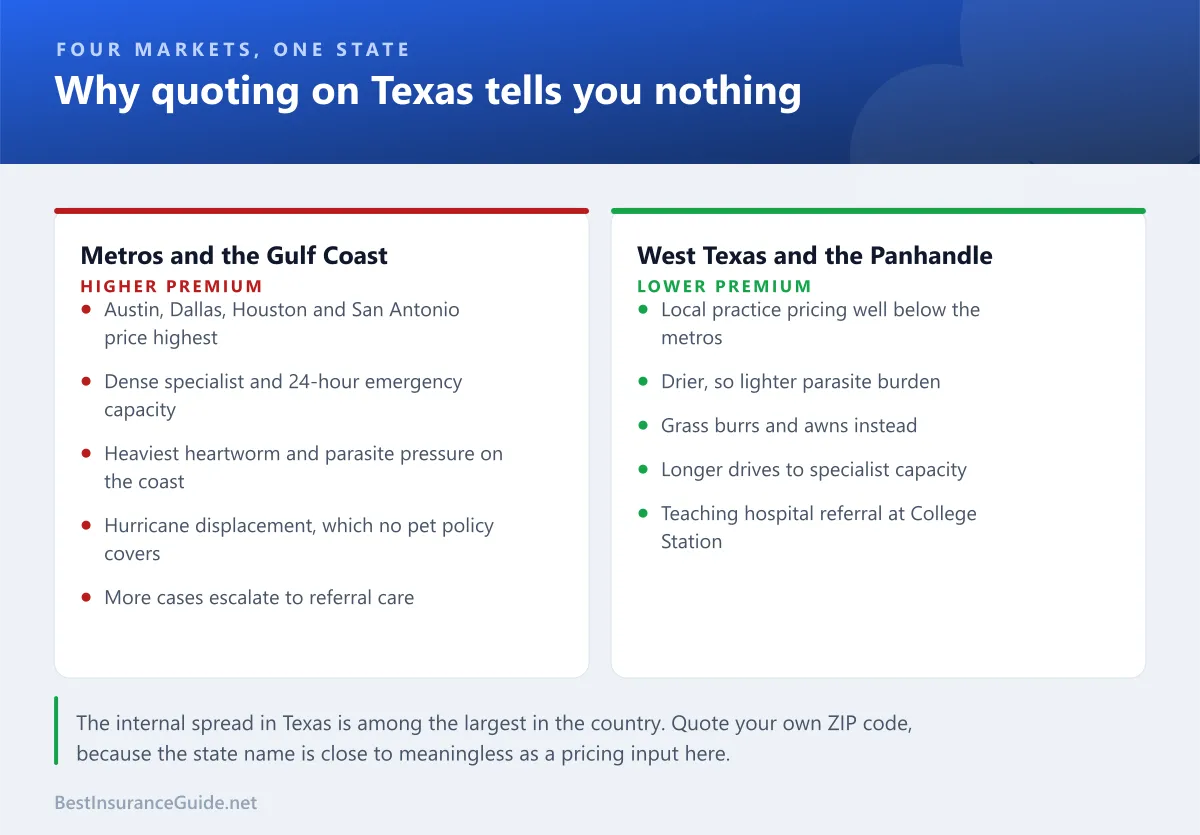
The metro triangle, meaning Austin, Dallas–Fort Worth, Houston and San Antonio, prices highest. High clinic overheads, competitive veterinary labour markets and dense specialist and 24-hour emergency capacity. Where referral care is available, more cases escalate to it.
The Gulf Coast carries the heaviest parasite burden and hurricane exposure.
East Texas is humid and heavily wooded, with high heartworm and tick pressure.
West Texas and the Panhandle are dry, quote lowest, and swap parasites for grass burrs, heat and longer drives to specialist care.
Texas A&M’s veterinary teaching hospital at College Station provides genuine referral access outside metro pricing. Our pet insurance by state guide covers why the spread inside a state routinely exceeds the difference between two states, and Texas is the extreme case.
Chagas disease, the Texas outlier
This is the risk most Texas owners have never heard of, and it deserves the space.
Chagas disease is caused by a parasite transmitted by triatomine insects, commonly called kissing bugs. Dogs are infected by ingesting the bug or through contamination of a bite wound. Texas is the centre of canine Chagas in the United States, and it is well documented across central, southern and western parts of the state.
Three things make it insurance-relevant.
It attacks the heart. The parasite causes myocarditis and can progress to dilated cardiomyopathy and arrhythmias. In young dogs it can be acute and rapidly fatal; in others it produces chronic heart disease that develops over years.
There is no reliably curative treatment. Management is supportive and cardiac: medication, monitoring, echocardiography and sometimes antiarrhythmic therapy, potentially for life.
Outdoor and kennelled dogs are most exposed. Dogs sleeping outside, in kennels, or near woodpiles and rodent habitat have the highest exposure.
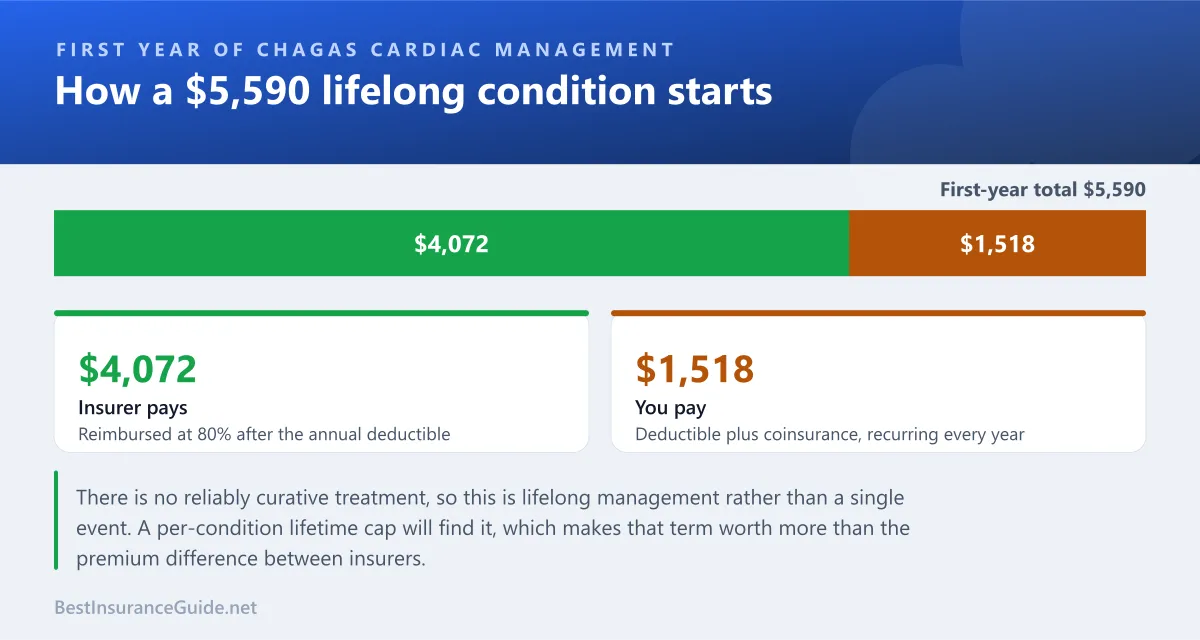
Worked example: first year of Chagas cardiac management
Policy: $500 annual deductible, 80% reimbursement, $10,000 annual limit.
| Item | Cost |
|---|---|
| Initial workup, bloods and serology | $780 |
| Cardiology referral and echocardiography | $1,150 |
| Holter monitoring and ECG | $640 |
| Cardiac medication, first year | $1,620 |
| Repeat echocardiography and monitoring | $980 |
| Rechecks and bloods | $420 |
| Total, first year | $5,590 |
| Less deductible | $500 |
| Reimbursed at 80% | $4,072 |
| Owner pays | $1,518 |
This is a lifelong management case rather than a single event. Two policy features therefore matter more than the premium: whether a single condition can be claimed across multiple policy years without a per-condition lifetime cap, and whether prescription medication is covered at the full reimbursement percentage.
Prevention is behavioural and not covered: reduce outdoor sleeping where practical, control rodent habitat and woodpiles near the house, and use outdoor lighting sparingly since it attracts the insects.
The rest of the Texas profile
Heartworm. High prevalence across most of the state with a long mosquito season, and worst on the Gulf Coast and in East Texas. Year-round prevention is standard advice. Prevention is a wellness item; treatment is covered provided the dog was clear at enrolment. Rescue intake positivity is a live consideration in Texas, so test before you enrol.
Extreme heat. Texas summers are genuinely dangerous for dogs. Heat stroke cases arrive every year and severe ones are multi-day intensive care admissions with organ monitoring. Brachycephalic breeds are heavily over-represented. Paw burns from pavement are common and underestimated. All covered as illness or accident.
Snake bites. Texas has all four groups of venomous snakes found in the United States: rattlesnakes, copperheads, cottonmouths and coral snakes. Antivenom is expensive and frequently requires multiple vials alongside hospitalisation. Covered as an accident; the rattlesnake vaccine is preventive and is not.
Tick-borne illness, skewing toward ehrlichiosis and Rocky Mountain spotted fever rather than Lyme. Covered as illness.
Fire ants. A genuinely Texan problem. Mass stinging events cause severe local reactions and occasionally anaphylaxis, particularly in puppies and small dogs. Covered as an accident.
Grass burrs and foxtails in the drier western half, lodging in paws and occasionally migrating.
Hurricane exposure on the Gulf Coast. Storm injuries are covered as accidents. Boarding, evacuation and relocation are not, and belong to homeowners or renters loss-of-use cover. Our renters insurance guide covers how displacement costs work.
Foreign body ingestion, the most common expensive emergency nationally.
How to buy in Texas
Match four fields across every quote before comparing a premium: the annual limit, the deductible and whether it is annual or per condition, the reimbursement percentage, and the waiting periods.
Four Texas leanings.
Confirm a single condition can be claimed across multiple policy years. Chagas cardiac management is lifelong, and so is much of what follows a serious heat injury. A per-condition lifetime cap will find both.
Confirm prescription medication is covered at the full percentage. Cardiac medication is a large recurring line.
Prefer an annual deductible. Chronic cardiac management, chronic skin disease and tick complications all span years.
Take a high annual limit in the metros. Austin, Dallas and Houston specialist pricing finds the top of a $5,000 cap quickly. In West Texas a moderate limit stretches further.
Vaccines, prevention and wellness riders
Core pet insurance covers neither vaccines nor neutering, and it does not cover heartworm, flea or tick prevention. All are preventive or elective.
Texas’s preventive load is heavy along the coast and in the east, lighter in the west. Whether a wellness rider pays is arithmetic: total the insurer’s published allowances, subtract the rider premium, and buy only if the result is positive for care you would purchase anyway.
As usual it tends to earn its value in a puppy’s first year, when the vaccination series and the neuter land alongside preventives, and to lose money afterwards. Do not confuse it with the policy underneath, which exists for the $5,600 year.
Regulation
Pet insurance in Texas is regulated by the Texas Department of Insurance as a property and casualty line rather than as health insurance. That is why it reimburses you after the fact and why there is no provider network: any licensed vet works, including College Station.
A growing number of states have adopted rules based on the NAIC Pet Insurance Model Act, standardising how waiting periods, pre-existing condition definitions and exam requirements are disclosed. Adoption has moved quickly, so check the Department’s current position rather than assuming.
Read the pre-existing condition definition yourself regardless. It varies more between insurers than any other term and it decides most declined claims.
The mistakes that cost Texas owners money
Quoting on the state rather than the ZIP code. The internal spread here is among the largest in the country.
Enrolling after the annual heartworm test. Texas vets test annually as standard.
Insuring a rescue before testing. Test and treat first if you want heartworm to remain insurable.
Buying a policy with a per-condition lifetime cap. Chagas and chronic cardiac disease will find it.
Assuming pet insurance covers hurricane evacuation. It does not, anywhere.
Cancelling as premiums rise with age. Raise the deductible or lower the reimbursement percentage instead; both keep the enrolment date, which is the asset you have been paying to build.
Cats in Texas
Cats cost substantially less to insure and their expensive claims differ: urinary blockage, chronic kidney disease in older cats, hyperthyroidism, dental disease and foreign body ingestion.
Two Texas notes. Feline heartworm is present and is harder to manage than the canine form, because the adulticide protocol used in dogs is not safe in cats, which makes prevention more important and keeps it a wellness item. And outdoor cats carry heavy flea and tick burdens plus abscesses from fight wounds.
A male cat with a urinary blockage is a genuine emergency with a four-figure bill and no warning, which justifies cover on an indoor cat by itself.
A note on figures and sources
Premiums and treatment costs here are illustrative, drawn from typical ranges rather than any single insurer’s rate filing. Actual pricing depends on your ZIP code, the species, breed and age of the animal, and the limits selected, and veterinary charges differ enormously between Austin and the Panhandle.
Heartworm, tick and Chagas distribution all shift over time. The American Heartworm Society and the Companion Animal Parasite Council publish regularly updated county-level prevalence maps, and Texas A&M maintains research and surveillance on canine Chagas specifically. All are more current than any article, and your own veterinarian will know what is presenting locally.
The metro and the ranch are different policies
One practical consequence of Texas being four markets: the right policy shape differs by where you are, more than in most states.
In the metros, buy a high annual limit and take the higher reimbursement percentage. Austin, Dallas and Houston specialist pricing is at the upper end nationally, and the percentage applies to bigger numbers. A $5,000 cap is genuinely thin here.
In West Texas and rural areas, a moderate limit stretches considerably further because local pricing is lower, but the referral question changes. A serious case may travel to College Station or a metro specialist, and that treatment is priced like referral care rather than like your local practice. Travel is never covered.
Working and ranch dogs face elevated accident exposure: livestock injuries, machinery, vehicle strikes on rural roads, and snake bites. All are covered as accidents. If a dog genuinely works stock, declare it, because a small number of insurers ask and rate accordingly.
Outdoor and kennelled dogs carry the highest Chagas exposure, which is a further argument for confirming that a single condition can be claimed across multiple policy years before you buy.
Cats in Texas
Cats cost substantially less to insure and their expensive claims differ: urinary blockage, chronic kidney disease in older cats, hyperthyroidism, dental disease and foreign body ingestion.
Feline heartworm is present across Texas and is harder to manage than the canine form, because the adulticide protocol used in dogs is not safe in cats. Prevention carries more weight for that reason and remains a wellness item. Outdoor cats carry heavy flea and tick burdens plus abscesses from fight wounds, and in rural areas they face the same snake and predator exposure dogs do.
A male cat with a urinary blockage is a sudden emergency with a four-figure bill and no warning, which justifies cover on a strictly indoor cat by itself.
Comparable states
Texas is too large to quote as one market, which is the same problem Illinois and Georgia have at smaller scale. Its Gulf coast shares the parasite burden of Louisiana, while its western end sits closer to Arizona.
The short version
Texas is four insurance markets in one state, and the ZIP code decides which one you are buying in. Metro pricing is high with dense specialist access; West Texas is cheap with longer drives.
Chagas disease is the genuine Texas outlier: a parasite-borne heart disease with no reliable cure, managed for life. Alongside it sit high heartworm prevalence, dangerous summer heat, all four groups of venomous US snakes, and fire ants.
Because the two most distinctive risks here are both long-term, the terms that matter most are whether a single condition can be claimed across multiple policy years and whether prescription medication is covered at the full percentage. Sort those before comparing premiums.
For lifetime costs and how premiums climb with age, see the pet insurance cost guide.