Pet Insurance in Arizona: Valley Fever, Heat and Rattlesnakes
Pet insurance in Arizona has to account for Valley fever, heat injury and snake bites. What is covered, what is excluded, and why timing your enrolment matters.

Table of contents

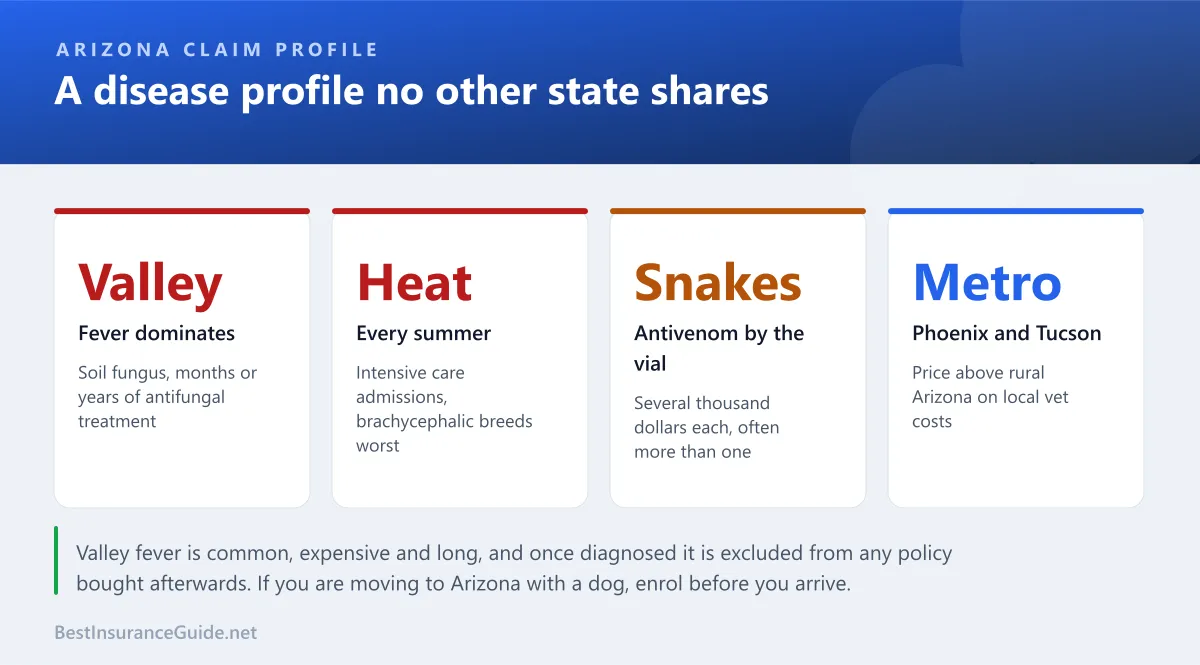
Arizona has a claim profile that does not look like anywhere else in the country, and one condition dominates the conversation.
Valley fever changes the arithmetic
Coccidioidomycosis, universally called Valley fever, is a fungal infection caused by spores that live in desert soil across central and southern Arizona. Dogs inhale them when soil is disturbed by wind, digging or construction. They do not need to be adventurous to be exposed; a back garden is sufficient.
Three features make it the defining pet insurance issue in this state.
It is common. In the endemic areas around Phoenix, Tucson and the surrounding desert, exposure is widespread. Dogs new to the region are considered particularly susceptible, having no prior immunity.
It is expensive and it is long. Diagnosis usually involves imaging and titre testing. Treatment is antifungal medication for six to twelve months at minimum, and disseminated cases affecting bone, joints or the nervous system can require treatment for years or for life.
It creates a pre-existing condition problem. A dog that has been diagnosed, or has shown symptoms, before enrolment will have Valley fever excluded permanently by essentially every insurer. Since the disease often presents as a vague persistent cough or intermittent lameness, owners frequently have a documented visit on file before they think about insurance.
The practical conclusion is blunt: in Arizona, the value of a pet policy falls sharply the longer you wait. If you are moving here with a dog, enrol before you arrive.
Worked example: a disseminated Valley fever case
Policy: $500 annual deductible, 80% reimbursement, $10,000 annual limit.
| Item | Cost |
|---|---|
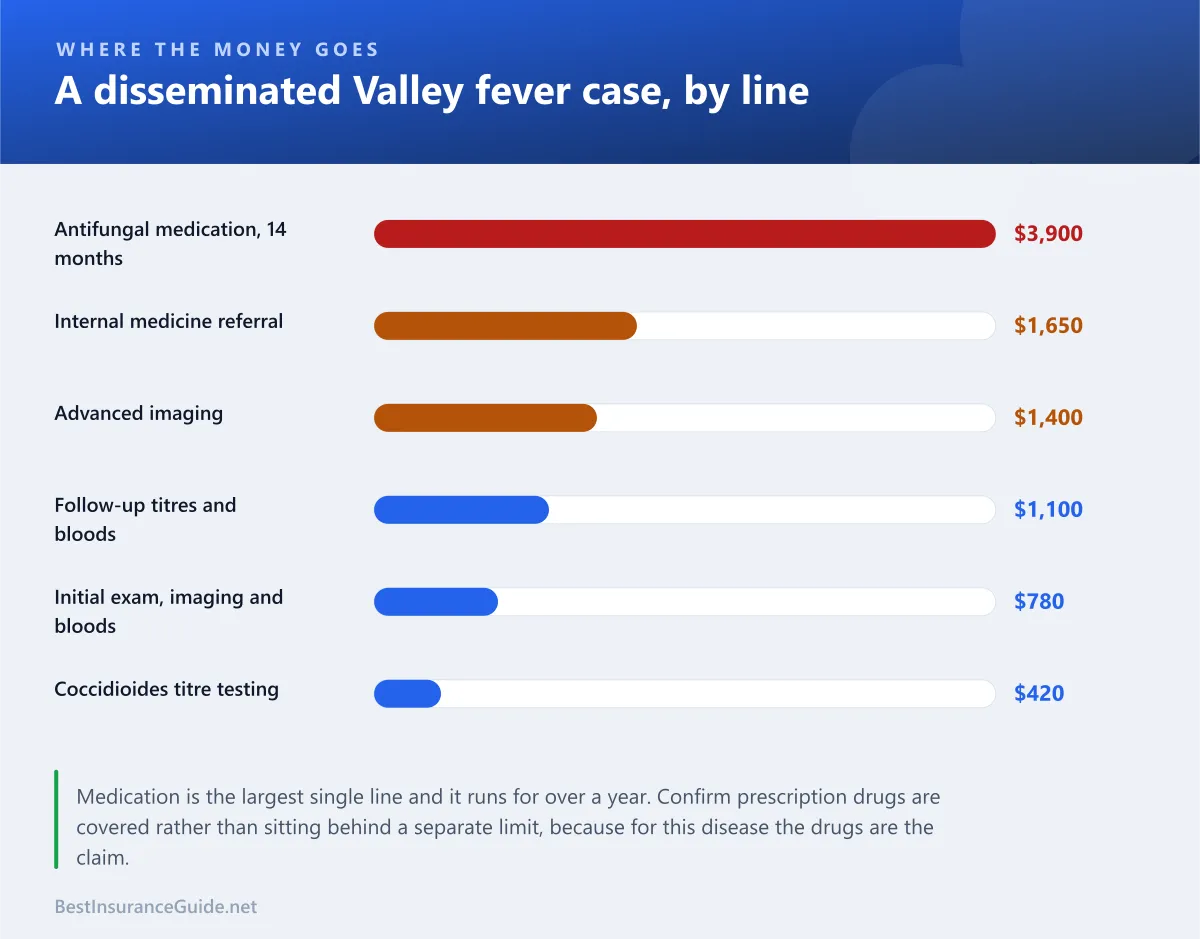
| Initial exam, chest imaging and bloods | $780 |
| Coccidioides titre testing, initial and repeat | $420 |
| Antifungal medication, 14 months | $3,900 |
| Follow-up titres and monitoring bloods | $1,100 |
| Internal medicine referral for bone involvement | $1,650 |
| Advanced imaging | $1,400 |
| Total across two policy years | $9,250 |
| Deductibles (two policy years) | $1,000 |
| Reimbursed at 80% | $6,600 |
| Owner pays | $2,650 |
Two lessons in that table.
The claim spans policy years, which is normal for Valley fever and unusual for most pet claims. That makes the deductible type important: an annual deductible resets once a year, while some per-condition designs behave differently across renewals. Read which you are buying.
And medication is the bulk of it. Confirm that prescription medication is covered by the policy rather than sitting behind a separate limit or exclusion, because for this disease the drugs are the claim.
The rest of the Arizona profile
Heat injury. Every summer produces heat stroke cases, and severe ones are intensive care admissions with organ monitoring over several days. Brachycephalic breeds are disproportionately represented. Covered as an illness, and expensive enough to matter.
Rattlesnake bites. Genuinely common across the state. Antivenom runs to several thousand dollars per vial and multiple vials are frequently needed, alongside hospitalisation and monitoring. Treatment is covered. The rattlesnake vaccine is preventive and sits under a wellness rider, not core cover.
Foxtails and desert awns. Cholla segments, foxtails and grass awns lodge in paws, ears and noses, and can migrate internally. A recurring mid-sized surgical claim.
Bufo toad and scorpion. Sonoran Desert toad toxicity is an emergency during monsoon season, and scorpion stings present regularly in the Phoenix area.
Paw burns. Pavement injuries in summer are common and often underestimated.
What this means for how you buy
Match the annual limit, deductible and its type, reimbursement percentage and waiting periods across quotes before comparing premiums. Beyond that, Arizona pushes in three specific directions.
Confirm chronic and long-term conditions are covered across renewals. Some cheaper policies restrict how long a single condition can be claimed for, or cap it per condition for the life of the pet. Valley fever is precisely the disease that exposes those limits. Ask directly: if my dog needs antifungals for three years, does this policy keep paying?
Confirm prescription medication is included. It is the majority of a Valley fever claim.
Prefer a higher annual limit. A $5,000 cap looks adequate until a disseminated case adds imaging and specialist referral on top of medication.
Phoenix and Tucson postcodes will price above rural Arizona, following local vet costs and specialist availability. Our pet insurance by state guide explains why that intra-state spread is often larger than the gap between states.
Vaccines, neutering and wellness
As everywhere, core pet insurance does not cover vaccines or neutering. They are preventive and elective.
Arizona makes the wellness rider slightly more interesting than usual, because the rattlesnake vaccine is a preventive item many owners here would buy regardless. Combined with the puppy vaccination series and a neuter, a routine care rider often comes out ahead in year one and rarely afterwards.
There is no vaccine for Valley fever in general veterinary use, so prevention there is limited to reducing soil exposure, which is difficult in practice.
Regulation
Pet insurance is regulated by the Arizona Department of Insurance and Financial Institutions as property and casualty cover, which is why it reimburses you rather than operating a network. Any licensed vet is fine.
A number of states have adopted rules based on the NAIC Pet Insurance Model Act, standardising disclosure of waiting periods, pre-existing condition definitions and exam requirements. Check the Department’s current position rather than assuming.
Insuring a dog that already lives in Arizona
Most advice on Valley fever assumes you are enrolling a clean record. Plenty of Arizona owners are not, so here is the realistic version.
A prior diagnosis will be excluded. If Valley fever is in the clinical notes, essentially every insurer will exclude it, and no amount of shopping changes that.
An undiagnosed cough in the notes is a grey area. A single visit for a cough that resolved without a Coccidioides titre is not the same as a diagnosis. Insurers vary in how aggressively they read ambiguous history, and this is where a broker who places impaired risk regularly earns their fee.
A negative titre helps. If you are about to enrol and your dog has any respiratory or lameness history, a clean titre documented before the policy starts is genuinely useful evidence. It costs relatively little and it removes the ambiguity that underwriters resolve against you.
The rest of the policy still has value. A Valley fever exclusion does not touch foreign body surgery, cancer, dental disease, orthopaedic injury, snake bites or heat stroke. Arizona has plenty of expensive claims that are not Valley fever, and a policy with one exclusion is far better than no policy.
Cats get it too, and less often. Feline Valley fever exists but is considerably rarer than the canine form. Cats in Arizona are cheaper to insure and their expensive claims skew toward urinary blockage, chronic kidney disease and dental work.
What the policy costs as the dog ages
Premiums rise with age everywhere, and they accelerate after about seven. In a state where a single chronic condition can run for years, that curve deserves planning for rather than discovering.
| Age band | Indicative monthly premium | Paid in the band |
|---|---|---|
| Years 1 to 3 | $38 | $1,368 |
| Years 4 to 6 | $53 | $1,908 |
| Years 7 to 9 | $79 | $2,844 |
| Years 10 to 12 | $118 | $4,248 |
| Total to age twelve | $10,368 |
The trap is cancelling at ten because the premium has doubled. That is exactly when the claims arrive, and re-enrolling elsewhere is impossible because everything on the record is now pre-existing, Valley fever included.
If the later numbers are unaffordable, raise the deductible or lower the reimbursement percentage at renewal. Both keep the enrolment date, which is the asset you have been paying to build.
The mistakes that cost Arizona owners money
Waiting until the first cough. By then it is too late, and the cough is often the first sign of the exact condition you were trying to insure against.
Buying a policy with a per-condition lifetime cap. Some cheaper policies limit what they will ever pay for a single condition. Valley fever is precisely the disease that finds that limit, because it can run for years.
Not confirming that prescription medication is covered. Antifungals are the majority of a Valley fever claim. A policy that excludes or sublimits drugs is close to useless for this disease.
Assuming the rattlesnake vaccine is covered. It is preventive care and sits under a wellness rider. The bite treatment is covered; the vaccine is not.
Skipping cover for an indoor dog. Valley fever spores are inhaled from disturbed soil. A dog that only goes into the back garden is still exposed, and construction and wind events raise risk across whole neighbourhoods.
Questions worth asking an Arizona insurer
Will you pay for a single condition across multiple policy years, without a per-condition lifetime cap? The most important question in this state.
Are prescription medications covered at the same reimbursement percentage as treatment?
Is the deductible annual or per condition?
How do you treat a documented respiratory episode with no Coccidioides diagnosis?
What is the waiting period for illness, and does Valley fever fall under it? Illness waiting periods are commonly fourteen to thirty days, and a dog incubating an infection at enrolment can be declined.
Getting the quote right
Take three quotes at matched annual limits, matched deductibles and matched reimbursement percentages, then interrogate the terms that decide an Arizona claim: whether a single condition can run across multiple policy years without a lifetime cap, whether prescription medication is reimbursed at the full percentage, and how the insurer reads an ambiguous respiratory history.
Those three questions are worth more than the premium difference between any two insurers writing in this state, because Valley fever is a long, drug-heavy, multi-year claim and a policy that fails any one of them will fail exactly when you need it.
If you are relocating to Arizona with an insured dog, keep the policy and change the address. The premium will re-rate upward, but the enrolment date survives and any Valley fever contracted after the move is a new condition on an existing policy. Cancelling and rebuying locally means arriving in an endemic region with a fresh waiting period and a new pre-existing exclusion list, which is the worst possible combination in this particular state.
A note on figures
Premium and treatment figures in this article are illustrative, drawn from typical ranges rather than from any single insurer’s rate filing. Actual pricing depends on your ZIP code, the species, breed and age of the animal, and the limits you choose, and veterinary costs vary substantially between practices even within the same city.
Quote your own postcode and animal before relying on any number here, and confirm coverage terms in the policy wording rather than the summary.
Comparable states
Arizona’s Valley fever exposure is regional rather than national. Utah shares the low parasite burden and high injury rate of the dry interior west, and Colorado shares the altitude and trail injury profile with a very different vet market. Texas overlaps at its western end.
The short version
Arizona pet insurance is really a conversation about Valley fever. It is common in the endemic desert areas, it is expensive, it is long, and once diagnosed it is excluded from any policy you buy afterwards.
Enrol early, ideally before moving to the state. Choose an annual deductible, a high annual limit, and confirm both that prescription medication is covered and that a single chronic condition can be claimed across multiple policy years.
Heat injury, snake bites and desert awns fill out the rest of the profile, and all are covered as accidents or illnesses. The rattlesnake vaccine is not: that is a wellness item.
For lifetime costs, see the pet insurance cost guide.