Pet Insurance in Alabama: Year-Round Parasites and Heartworm Country
Pet insurance in Alabama is cheaper than most states but the parasite risk is higher. Heartworm, year-round fleas and ticks, and what core cover actually pays.

Table of contents
Alabama is one of the cheaper states in the country to insure a pet and one of the harder ones to keep a pet healthy in. Those two facts are not in tension. They come from different causes.
What sets the price here
Pet insurance reimburses a share of your actual vet bill, so the premium tracks what local practices charge rather than anything about your animal.
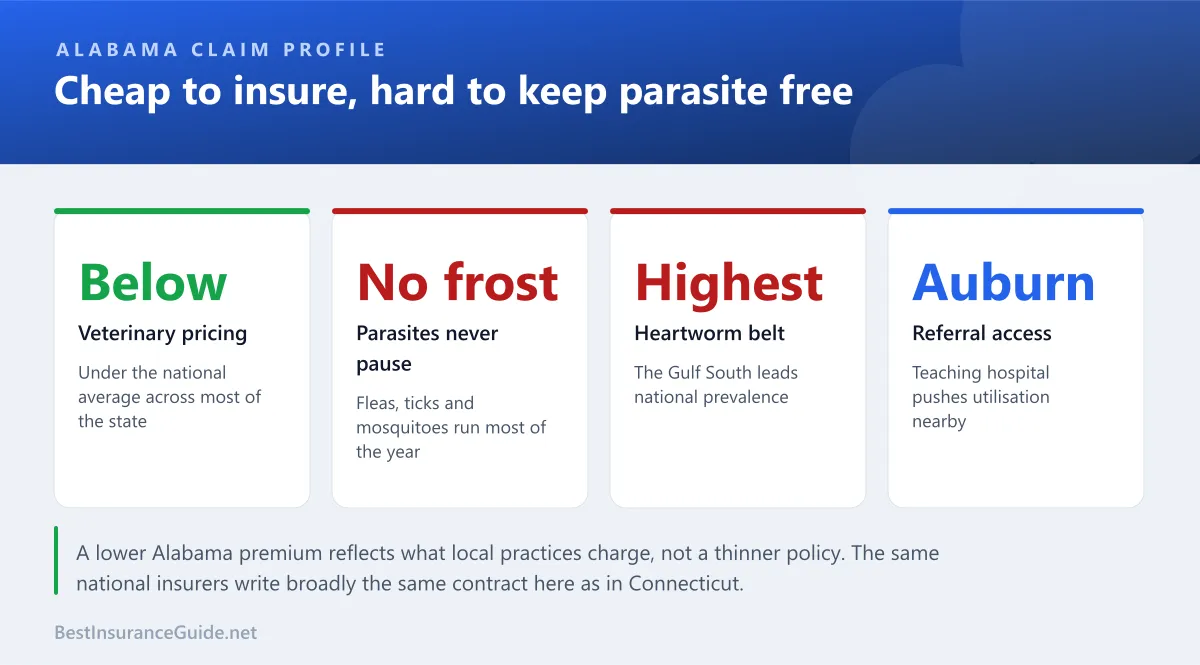
Veterinary pricing across Alabama runs below the national average, which is the main reason quotes here sit toward the cheaper end. That is a cost-of-care difference, not a coverage difference: the same national insurers write broadly the same contracts in Alabama as in Connecticut.
Birmingham, Huntsville and Mobile price above rural Alabama, following clinic overheads and the concentration of emergency and referral hospitals. Auburn’s veterinary teaching hospital provides genuine specialist access, which is excellent when you need it and does push utilisation up in the surrounding area.
Rural Alabama is cheapest, though it comes with longer drives to specialist care.
Our pet insurance by state guide covers why the spread inside a state is frequently wider than the gap between two states.
The thing that actually defines Alabama: no winter
Most of the country gets a hard frost that knocks parasite populations down for a few months. Alabama largely does not, and the consequences run through the entire claim profile.
Heartworm is the headline. The Gulf South records among the highest heartworm prevalence in the country, and Alabama is squarely inside that belt. Mosquito activity extends across most of the calendar, so the transmission window is not a season, it is a year.
The insurance position is clear and worth stating plainly:
Prevention is not covered. Monthly heartworm preventive is a wellness item. Core insurance does not pay for it.
Treatment is covered, provided the dog was clear at enrolment and the waiting period had passed.
A dog that arrives heartworm positive is excluded for that condition, permanently, by essentially every insurer. Adopting a rescue in Alabama, where positive intake rates are meaningfully higher than the national average, means testing and treating before enrolling if you want any chance of that condition being insurable later.
Worked example: adulticide heartworm treatment
A four-year-old dog diagnosed at a routine screening, treated with the standard staged protocol. Policy: $500 annual deductible, 80% reimbursement.

| Item | Cost |
|---|---|
| Diagnostic testing and confirmation | $210 |
| Chest radiographs and bloodwork | $480 |
| Pre-treatment doxycycline and stabilisation | $260 |
| Staged melarsomine injections | $1,180 |
| Hospitalisation and monitoring across the series | $640 |
| Follow-up testing at six and nine months | $290 |
| Total | $3,060 |
| Less deductible | $500 |
| Reimbursed at 80% | $2,048 |
| Owner pays | $1,012 |
Two things worth noting. Treatment runs across months, so it can straddle a policy anniversary and a second deductible. And the strict exercise restriction that accompanies treatment is not a cost, but it is a real burden that owners underestimate.
Prevention costs a fraction of this and is the correct answer. Insurance is what covers you when prevention was missed, when a rescue arrived positive, or when a dose was vomited and nobody noticed.
The rest of the Alabama profile
Flea allergy dermatitis. With no winter die-off, flea pressure is continuous. Flea allergy dermatitis is one of the most common chronic claims in the Deep South, and chronic is the operative word: it recurs, it needs repeated visits, and it frequently involves secondary skin infections. This is where the deductible type matters, because an annual deductible handles a recurring condition far better than a per-condition one.
Tick-borne illness. Alabama’s tick burden skews toward ehrlichiosis and Rocky Mountain spotted fever rather than the Lyme disease that dominates the Northeast. Both are covered as illness, and both are diagnosed on panels that Alabama vets run routinely, which creates the same pre-existing condition trap: a positive result recorded before enrolment excludes that condition.
Intestinal parasites. Hookworm and roundworm burdens are high in warm, humid soil. Usually inexpensive to treat, occasionally not, particularly in puppies.
Heat injury. Summer heat stroke cases arrive every year, and severe ones are intensive care admissions with organ monitoring over several days. Brachycephalic breeds are heavily over-represented.
Snake bites. Copperheads, cottonmouths and rattlesnakes across much of the state. Antivenom is expensive and treatment is an emergency admission. Covered.
Parvovirus. Vaccination rates vary and parvo remains a live risk in parts of the state. Treatment is covered as illness once the waiting period has passed, and it is a multi-day hospitalisation with a four-figure bill. The vaccine itself is a wellness item.
Hurricane exposure on the Gulf Coast. Not a medical claim, but worth planning for. Pet insurance does not cover boarding or evacuation costs; that is a homeowners or renters loss-of-use question.
How to buy
Match four fields across every quote before you compare a single premium: the annual limit, the deductible and whether it is annual or per condition, the reimbursement percentage, and the waiting periods.
Three Alabama-specific leanings.
Prefer an annual deductible, strongly. Flea allergy dermatitis, tick-borne illness and skin infections are all recurring here. Per-condition designs look cheaper on the quote and cost more across three years with a chronically itchy dog.
A moderate annual limit goes further here. Because Alabama vet costs are lower, a $10,000 limit stretches noticeably further than the same limit in a high-cost metro. That is one of the genuine advantages of insuring a pet in this state.
Check whether exam fees are reimbursed. A dog with chronic skin disease generates a long run of consultations. Insurers split roughly evenly on whether the consultation itself is claimable, and across a few years that difference runs to several hundred dollars.
Vaccines, prevention and wellness riders
As everywhere, core pet insurance covers neither vaccines nor neutering, and it does not cover heartworm, flea or tick prevention. Those are preventive; core cover exists for the unexpected.
Alabama makes the wellness rider argument stronger than average, because the preventive load here is genuinely heavy and genuinely non-optional.
| Preventive item | Typical annual cost |
|---|---|
| Year-round heartworm prevention | $120 to $220 |
| Year-round flea and tick prevention | $200 to $320 |
| Annual heartworm and tick-borne disease testing | $60 to $110 |
| Core vaccinations and boosters | $90 to $160 |
| Total | $470 to $810 |
That is a real recurring cost and every Alabama owner should be carrying it whether or not they insure. Whether a rider is worth buying is arithmetic rather than principle: add the published allowances, subtract the rider premium, and buy it only if the result is positive for care you would purchase anyway. As usual, it tends to come out ahead in a puppy’s first year, when the vaccination series and the neuter land alongside everything above, and to lose money afterwards.
The important thing is not to confuse the two products. The rider smooths a predictable few hundred dollars. The policy underneath exists for the $3,000 heartworm treatment or the $7,000 foreign body surgery.
Regulation
Pet insurance in Alabama is regulated by the Alabama Department of Insurance as a property and casualty line rather than as health insurance. That structure is why it reimburses you after the fact and why there is no provider network: any licensed vet is fine, including the teaching hospital at Auburn.
A growing number of states have adopted rules based on the NAIC Pet Insurance Model Act, which standardises how insurers must disclose waiting periods, pre-existing condition definitions and any exam requirements. Adoption has been moving, so check the Department’s current position rather than assuming a particular protection applies.
Whatever the regulatory position, read the pre-existing condition definition yourself. It varies more between insurers than any other term and it decides most declined claims.
The mistakes that cost Alabama owners money
Enrolling after the annual heartworm test. The same timing trap as tick panels elsewhere, and Alabama vets test annually as standard.
Insuring a rescue before testing. If the dog is heartworm positive at intake, you want that known and treated, not discovered after enrolment where it becomes a coverage argument.
Choosing a per-condition deductible. Chronic skin disease is the single most likely recurring claim in this state.
Skipping prevention because there is a policy. Insurance does not pay for prevention and prevention is dramatically cheaper than treatment. The policy is the backstop, not the plan.
Cancelling when the premium rises. Premiums climb with age everywhere. Raise the deductible or lower the reimbursement percentage instead, because both keep the enrolment date, which is the asset you have been paying to build.
A note on the figures
Premium and treatment figures here are illustrative, drawn from typical ranges rather than any single insurer’s rates. Actual pricing depends on your ZIP code, the species, breed and age of the animal, and the limits you choose, and veterinary charges differ meaningfully between practices within the same region. Quote your own postcode and confirm terms in the policy wording rather than the marketing summary.
Insuring a rescue
Alabama has a large and active rescue network, and adopting is the most common route to dog ownership here. It also creates the most common insurance problem.
Test before you enrol, not after. Heartworm positivity at intake is meaningfully higher in the Gulf South than nationally. If the dog is positive, you want that diagnosed and treated on a clear timeline rather than surfacing three weeks into a new policy where it becomes a coverage argument.
Get the full intake record. Insurers request complete clinical history at the first claim, and a rescue’s records are often thinner than a breeder’s. Anything missing gets resolved against you. Ask the rescue for everything they hold and read it.
Watch for vague notes. “Mild skin irritation on intake” or “slight limp, resolved” are the entries that later support an exclusion. If something is recorded and resolved, ask the insurer in writing how they will treat it before you pay a premium.
Enrol during the settling-in period if you can. The first weeks in a new home are when stress-related gastrointestinal upset and skin flare-ups appear, and anything recorded then becomes history.
Consider the age honestly. A rescue of unknown age listed as “around seven” will be underwritten on that estimate. If the dog is older, exclusions and pricing follow accordingly.
None of this argues against adopting. It argues for sequencing: adopt, test, treat what needs treating, gather the records, then insure.
A note on regional variation
Heartworm prevalence, tick species distribution and parasite pressure all vary within Alabama as well as between states, and they shift over time as climate and land use change. The American Heartworm Society and the Companion Animal Parasite Council both publish regional prevalence maps that are updated regularly and are more current than any article.
Your own veterinarian is the better guide to local risk than a national average, because they see what is actually presenting in your county.
Comparable states
Alabama’s parasite profile is shared along the Gulf. Louisiana carries a similar year-round burden with an evacuation risk on top, and Florida adds cane toads and an older pet population to the same heartworm picture. Georgia shares the climate and splits sharply between metro and rural vet pricing.
The short version
Alabama is a comparatively cheap state to insure a pet and a demanding one to keep a pet healthy in, because there is no winter to interrupt the parasite cycle.
Heartworm dominates. Treatment is covered, prevention is not, and a dog that arrives positive is permanently excluded for that condition. Flea allergy dermatitis, tick-borne illness, heat injury and snake bites fill out the rest.
Buy an annual deductible rather than a per-condition one, check whether exam fees are reimbursed, and enrol before the next annual heartworm test rather than after it.
For lifetime cost expectations and how premiums climb with age, see the pet insurance cost guide.