Pet Insurance in Georgia: Atlanta Pricing and a Long Parasite Season
Pet insurance in Georgia costs most inside the Atlanta perimeter. Heartworm, year-round fleas, heat and what a policy actually pays for in this state.

Table of contents

Georgia is one of the clearest examples of a state where quoting on the state name will mislead you. Inside the Atlanta perimeter and two hours south are effectively different insurance markets.
The Atlanta premium
Pet insurance is rated on what your vet charges, which means it is rated on your postcode rather than your pet.
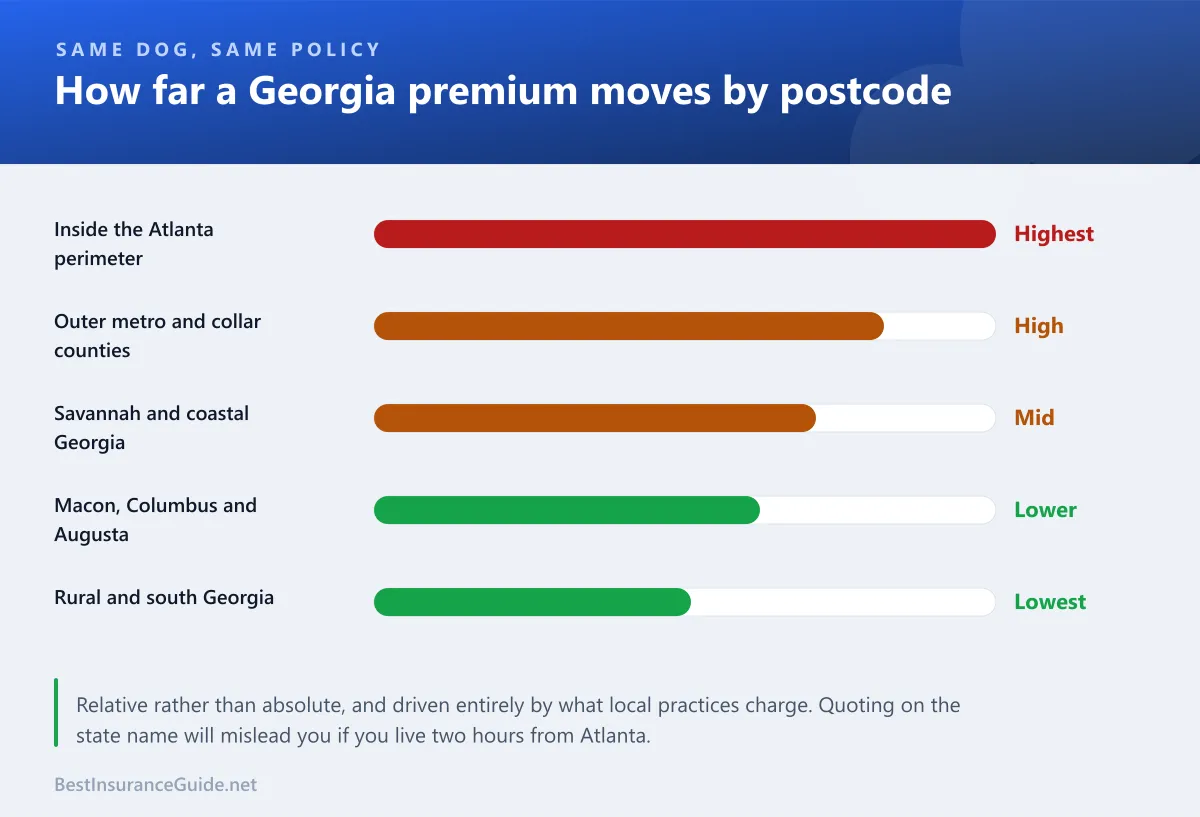
Three forces push Atlanta quotes above the rest of the state.
Clinic overheads and staffing. Metro Atlanta competes for veterinary labour in a high-cost market, and those costs land in the bills insurers reimburse.
Referral density. The metro has substantial specialist and 24-hour emergency capacity, with the University of Georgia’s teaching hospital an hour away in Athens. Where referral care is readily available, more cases escalate to it. Availability creates utilisation, and utilisation is priced.
Claim severity. A specialist workup in Buckhead and the same workup in a rural practice are not the same bill.
Outside the perimeter, and particularly in south Georgia, the same policy for the same dog costs noticeably less. Our pet insurance by state guide covers why that intra-state spread routinely exceeds the difference between two states.
The long season
Georgia’s defining feature for pet health is that the warm months run long and the cold snap that would interrupt parasite cycles largely does not arrive.
Heartworm is the headline risk. Georgia sits in the Southeast belt where prevalence runs among the highest nationally, and year-round prevention is standard veterinary advice here rather than a precaution.
The insurance position is the same as everywhere in the South: prevention is a wellness item and is not covered by core insurance; treatment is covered provided the dog was clear at enrolment and past the waiting period. A dog that arrives heartworm positive has that condition excluded permanently by essentially every insurer, which matters enormously for anyone adopting from a Georgia rescue.
Flea allergy dermatitis is the most common chronic claim in the region. Continuous flea pressure with no winter die-off means recurring skin disease, secondary infections, repeated consultations and frequently a dermatology referral. Chronic is the operative word, and it drives one specific buying decision covered below.
Tick-borne illness here skews toward ehrlichiosis and Rocky Mountain spotted fever rather than the Lyme disease that dominates the Northeast. Both are covered as illness.
Heat injury arrives every summer. Severe cases are intensive care admissions across several days, and brachycephalic breeds are heavily over-represented. Given how popular French bulldogs and similar breeds have become in Atlanta, this is a live consideration rather than a footnote.
Snake bites across much of the state, covered as accidents. The rattlesnake vaccine, where used, is preventive and sits under a wellness rider.
Coastal exposure around Savannah and the low country adds hurricane displacement, which pet insurance does not cover. Boarding and evacuation costs are a homeowners or renters loss-of-use question rather than a pet insurance one.
Worked example: a summer emergency in metro Atlanta
A three-year-old French bulldog with heat exhaustion progressing to a respiratory crisis. Policy: $500 annual deductible, 80% reimbursement, $10,000 annual limit.
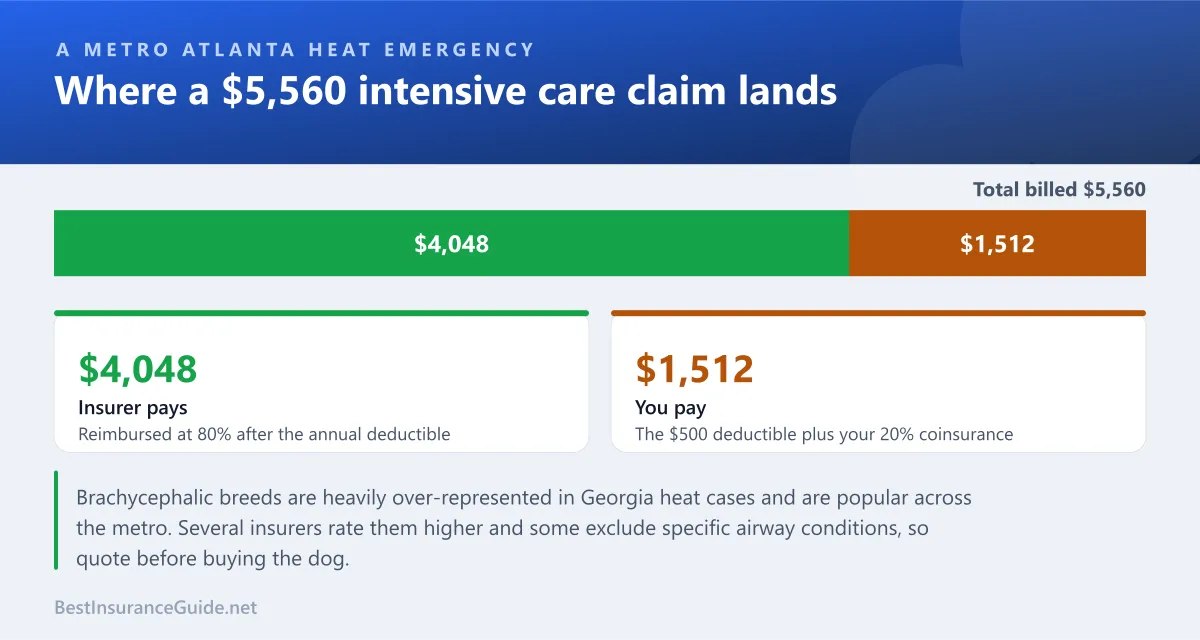
| Item | Cost |
|---|---|
| Emergency presentation and stabilisation | $980 |
| Oxygen therapy and intensive monitoring, three days | $2,760 |
| Bloodwork, imaging and repeat diagnostics | $860 |
| Internal medicine consultation | $310 |
| Medication and discharge care | $430 |
| Follow-up rechecks | $220 |
| Total | $5,560 |
| Less deductible | $500 |
| Reimbursed at 80% | $4,048 |
| Owner pays | $1,512 |
The same presentation in a rural Georgia practice would produce a smaller bill, a smaller reimbursement and a similar out-of-pocket share. What changes with the postcode is the scale, not the mechanics.
How to buy in Georgia
Match four fields across every quote before comparing a premium: the annual limit, the deductible and whether it is annual or per condition, the reimbursement percentage, and the waiting periods.
Three Georgia leanings.
Prefer an annual deductible. Flea allergy dermatitis and recurring ear and skin disease are the most likely repeat claims in this state, and per-condition designs are exactly what those punish over three or four years.
Take the higher reimbursement percentage if you are in the metro. The percentage applies to bigger numbers inside the perimeter. On the claim above, the gap between 70% and 90% is just over $1,000.
Buy a limit that survives an intensive care admission. A $5,000 annual cap looks generous until a three-day oxygen admission plus diagnostics approaches it.
Vaccines, prevention and wellness riders
Core pet insurance covers neither vaccines nor neutering, and does not cover heartworm, flea or tick prevention. All are preventive or elective.
Georgia’s preventive load is heavy and non-optional, which strengthens the wellness rider case relative to a low-parasite state:
| Preventive item | Typical annual cost |
|---|---|
| Year-round heartworm prevention | $120 to $220 |
| Year-round flea and tick prevention | $200 to $320 |
| Annual heartworm and tick-borne disease testing | $60 to $110 |
| Core vaccinations and boosters | $90 to $160 |
Whether a rider pays is arithmetic: total the published allowances, subtract the rider premium, and buy only if the result is positive for care you would purchase anyway. As usual, it earns most of its value in a puppy’s first year when the vaccination series and the neuter land together, and loses money afterwards.
Do not confuse the two products. The rider smooths a predictable few hundred dollars a year. The policy underneath is for the $5,500 week.
Regulation
Pet insurance in Georgia is overseen by the Georgia Office of Insurance and Safety Fire Commissioner as a property and casualty line rather than as health insurance. That is why it reimburses rather than operating a network, and why any licensed vet works, including the teaching hospital at Athens.
A growing number of states have adopted rules based on the NAIC Pet Insurance Model Act, standardising disclosure of waiting periods, pre-existing condition definitions and exam requirements. Adoption has moved quickly, so check the office’s current position rather than assuming.
Regardless, read the pre-existing condition definition yourself. It is the term most likely to decide a claim and it varies more between insurers than any other.
The mistakes that cost Georgia owners money
Enrolling after the annual heartworm test. Georgia vets test annually as standard, and a positive result on file excludes the condition permanently.
Adopting a rescue and insuring before testing. Test and treat first, then enrol, if you want any chance of that condition being insurable later.
Choosing a per-condition deductible. Chronic skin disease is the most probable recurring claim here.
Buying a brachycephalic breed without pricing insurance first. Several insurers rate these breeds substantially higher, and some exclude specific airway conditions. Quote before you buy the dog, not after.
Assuming a rural quote applies inside the perimeter. Rating is by ZIP code. If you are moving into Atlanta, expect the premium to re-rate at renewal, and tell your insurer rather than letting them discover it at claim time.
Cancelling as premiums rise with age. Raise the deductible or lower the reimbursement percentage instead. Both preserve the enrolment date, which is the genuinely valuable asset in any pet policy.
A note on the figures
Premiums and treatment costs in this article are illustrative, drawn from typical ranges rather than any single insurer’s rate filing. Actual pricing depends on your ZIP code, the species, breed and age of the animal, and the limits selected, and veterinary charges vary substantially between practices even within metro Atlanta. Quote your own circumstances and read the policy wording rather than the summary.
What a Georgia policy costs across a dog’s life
The first-year premium is the least useful number in pet insurance. Premiums rise with age at every insurer and accelerate after about seven, and in a metro market that curve is steeper in absolute terms.
| Age band | Indicative monthly premium, metro Atlanta | Paid in the band |
|---|---|---|
| Years 1 to 3 | $46 | $1,656 |
| Years 4 to 6 | $63 | $2,268 |
| Years 7 to 9 | $94 | $3,384 |
| Years 10 to 12 | $141 | $5,076 |
| Total to age twelve | $12,384 |
Outside the perimeter the same shape applies at meaningfully lower numbers.
Two honest conclusions. Across a healthy dog’s whole life you will probably pay more in premium than you claim back; that is what insurance is, and you are buying protection against the year that costs $5,500 without warning. And the predictable failure is cancelling at ten, having paid for a decade, immediately before the claims arrive.
If the later numbers stop working, raise the deductible or lower the reimbursement percentage at renewal. Both keep the enrolment date, which is the asset you have been paying to build. Cancelling destroys it, because everything on the record by then is pre-existing.
Cats in Georgia
Most of this article describes dogs, because dogs are the ones carrying the heartworm and heat risk that make Georgia distinctive. Cats cost substantially less to insure and their expensive claims look different: urinary blockage, chronic kidney disease in older cats, hyperthyroidism, dental disease and foreign body ingestion.
Two Georgia-specific feline notes. Heartworm affects cats too, and feline heartworm disease is harder to treat than the canine version because the adulticide protocol used in dogs is not safe in cats; prevention matters more, and it remains a wellness item. And outdoor cats in the warm months carry heavy flea burdens and abscesses from fight wounds, both common claims.
A male cat with a urinary blockage is a genuine emergency with a four-figure bill and no warning, which is reason enough to insure even a strictly indoor cat.
Questions worth asking a Georgia insurer
Five questions separate a policy that works here from one that disappoints.
Is the deductible annual or per condition? Chronic skin disease makes this the most consequential question in the state.
Are exam fees reimbursed? A dog with recurring dermatology generates a long run of consultations, and insurers split roughly evenly on whether the consultation itself is claimable.
Do you cover a chronic condition across renewals without treating it as pre-existing at the anniversary? Rare to fail, catastrophic where it does.
How are brachycephalic airway conditions handled? Several insurers exclude or restrict them, and these breeds are popular across the metro.
What is the orthopaedic waiting period, and can a vet exam shorten it? Many insurers will reduce it after a clean examination within a set window, and almost nobody is told this unprompted.
Comparable states
Georgia’s metro-and-rural split is the pattern to compare rather than the disease profile. Texas and Illinois show the same problem at larger scale, where a single state average conceals two markets. On disease, Alabama and Florida share the parasite picture.
The short version
Georgia is really two pet insurance markets. Atlanta prices like a major metro, with the specialist access to match; the rest of the state costs considerably less for the same policy.
The claim profile is Southern: heartworm, continuous flea pressure and chronic skin disease, tick-borne illness, heat injury and snake bites. Treatment is covered for all of them. Prevention for none.
Buy an annual deductible, take the higher reimbursement percentage if you are inside the perimeter, and enrol before the next annual heartworm test.
For lifetime costs and how premiums climb with age, see the pet insurance cost guide.