Pet Insurance in Hawaii: Island Vet Costs and Referrals That Need a Flight
Pet insurance in Hawaii: high island vet costs, limited specialist access, rat lungworm and cane toads, and why referral travel is never covered.

Table of contents
Hawaii is unlike anywhere else in the United States for pet ownership, and two of the differences have direct insurance consequences.
What sets the price
Pet insurance reimburses a share of your actual vet bill, so premiums follow local veterinary pricing.
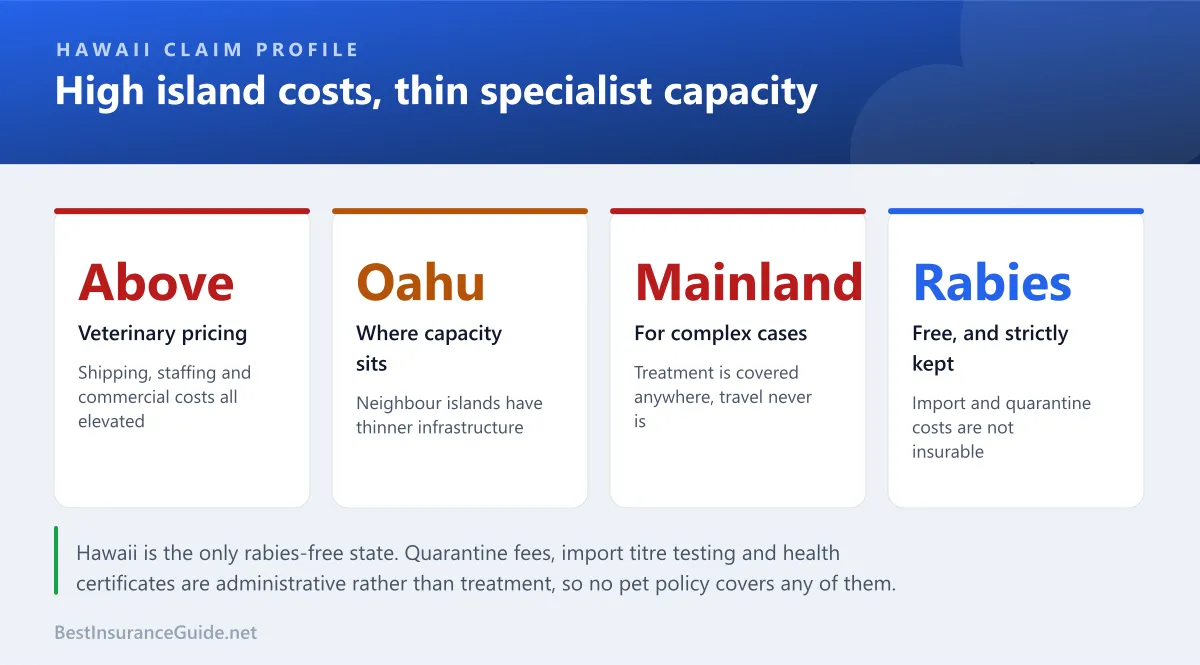
Hawaii veterinary costs sit well above the national average. Everything a practice uses arrives by ship or plane, staffing is expensive, and commercial costs are high. That flows directly into the bills insurers reimburse and therefore into premiums.
Oahu prices above the neighbour islands, holding most of the state’s emergency and referral capacity.
Maui, Kauai, Hawaii Island and Molokai have thinner veterinary infrastructure, and on the smaller islands the choice of practice can be genuinely limited.
Our pet insurance by state guide covers why local cost of care, rather than the policy itself, sets the premium.
The access problem is the real story
Hawaii has no veterinary teaching hospital and limited board-certified specialist capacity. For a complex case, the options are a short list of specialists on Oahu, or the mainland.
That produces a gap larger than in any other state.
Your policy covers treatment anywhere in the United States. If your dog is treated at a specialist hospital in California, the veterinary costs are claimable exactly as they would be at home. There is no network to worry about.
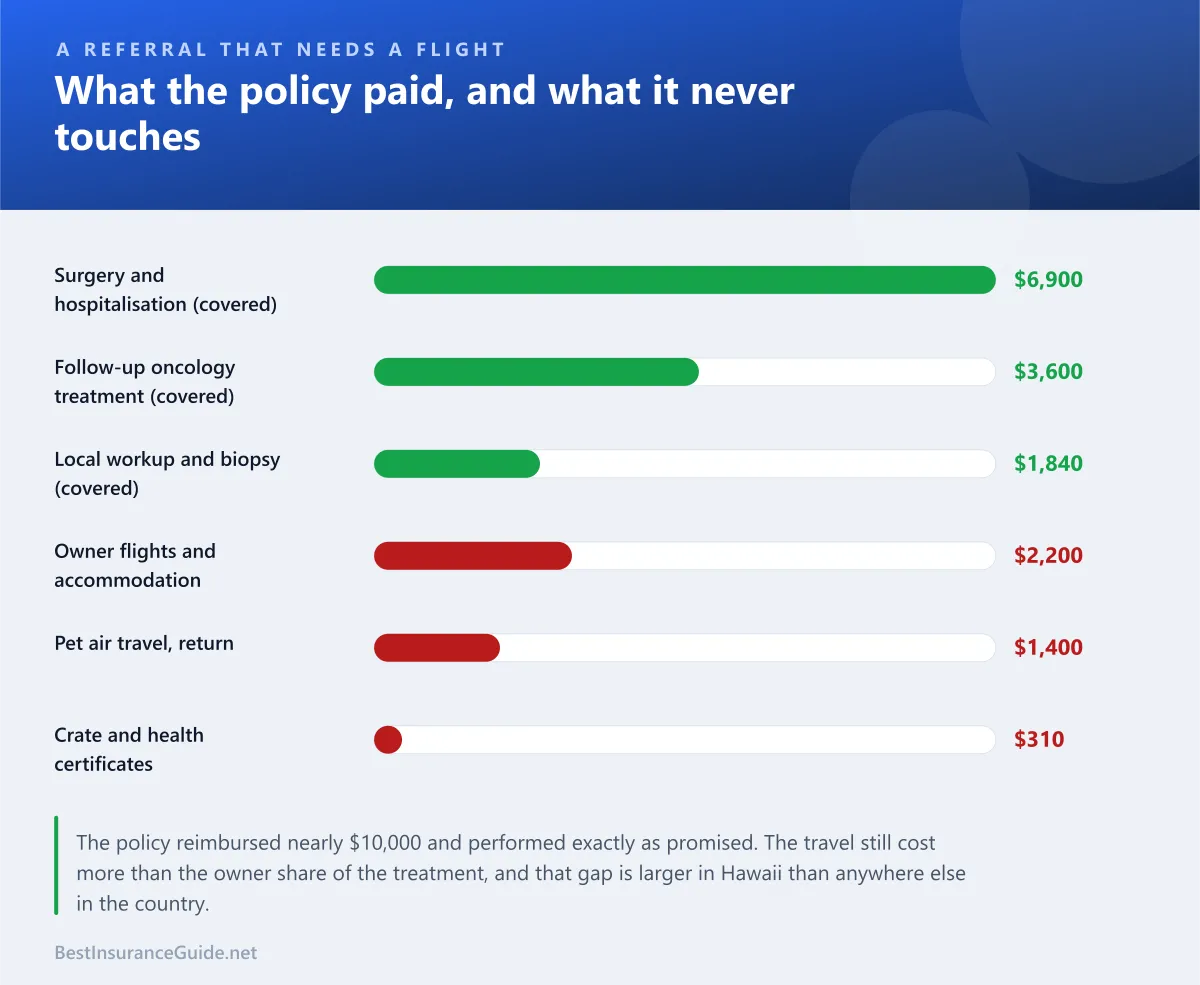
Your policy covers none of the travel. Flights for the animal, an airline-approved crate, health certificates for travel, your own flights and accommodation, and time off work are all outside every pet insurance policy. For an inter-island referral that is inconvenient. For a mainland referral it can exceed the veterinary bill.
Worked example: an oncology case referred to the mainland
A seven-year-old dog with a tumour requiring specialist surgery and follow-up not available locally. Policy: $500 annual deductible, 80% reimbursement, $15,000 annual limit.
| Item | Cost | Covered? |
|---|---|---|
| Local workup, imaging and biopsy | $1,840 | Yes |
| Mainland specialist consultation | $420 | Yes |
| Surgery and hospitalisation | $6,900 | Yes |
| Follow-up oncology treatment | $3,600 | Yes |
| Veterinary total | $12,760 | |
| Less deductible | $500 | |
| Reimbursed at 80% | $9,808 | |
| You pay on treatment | $2,952 | |
| Pet air travel, return | $1,400 | No |
| Airline crate and health certificates | $310 | No |
| Owner flights and accommodation | $2,200 | No |
| Travel total | $3,910 | No |
| Total actual cost | $6,862 |
The policy performed exactly as promised and paid nearly $10,000. The travel still cost more than the owner’s share of the treatment.
Two practical conclusions for Hawaii owners. Buy a high annual limit, because island and mainland specialist pricing is at the top end. And budget separately for referral travel, because it is a genuine and uninsurable cost that mainland owners simply do not face.
Rabies-free, and what that changes
Hawaii is the only rabies-free state in the United States, maintained by a strict animal import and quarantine programme.
Two consequences.
Rabies vaccination is not required for animals already living in Hawaii in the way it is across the mainland. It is required, along with titre testing and documentation, to bring an animal in.
Import and quarantine costs are not covered by insurance. Quarantine fees, the required rabies titre testing, microchipping, health certificates and the associated paperwork are administrative and preventive rather than treatment for illness or injury. No pet policy covers any of it.
If you are relocating to Hawaii, that is a meaningful budget line and it is entirely separate from insurance. The state publishes the current requirements and fee schedule, and the qualification periods are long enough that planning has to start months ahead.
One useful point: if you are moving with an already-insured pet, change the address rather than switching insurers. Your enrolment date is the most valuable thing about an existing policy, and switching converts your animal’s entire history into pre-existing exclusions on day one. The premium will re-rate upward to Hawaii’s costs, which is legitimate, but the continuity is worth far more.
The island claim profile
Leptospirosis is a genuine and well-documented Hawaii risk. Rainfall, standing water, streams and rodent populations sustain it, and dogs that swim in or drink from streams are exposed. It attacks kidneys and liver; severe cases mean hospitalisation, aggressive fluid therapy and sometimes dialysis referral. Treatment is covered; the vaccine is preventive and is not.
Rat lungworm. Dogs that eat slugs, snails or unwashed produce can contract angiostrongyliasis, which can cause serious neurological disease. Treatment is covered as illness. Prevention is behavioural: discourage slug and snail eating, wash produce, and control snails around the property.
Cane toad toxicity. Cane toads are widespread across the islands, and a dog that mouths one can deteriorate very quickly. The toxin causes hypersalivation, vomiting, disorientation, cardiac arrhythmias and seizures. Immediate rinsing of the mouth with running water, directed outward rather than down the throat, and immediate veterinary attention are what matter. Treatment is covered as poisoning.
Centipede stings, which are painful and occasionally produce significant reactions.
Heat and humidity year-round, with brachycephalic breeds over-represented in heat cases.
Saltwater and marine hazards, including saltwater ingestion, coral cuts and fish hook injuries.
Fleas year-round, with no seasonal break, driving flea allergy dermatitis as a recurring chronic claim. That is the strongest argument for an annual deductible rather than a per-condition one.
Heartworm is present in Hawaii, and year-round prevention is standard advice. Prevention is a wellness item; treatment is covered.
How to buy in Hawaii
Match four fields across every quote before comparing a premium: the annual limit, the deductible and whether it is annual or per condition, the reimbursement percentage, and the waiting periods.
Four Hawaii leanings.
Buy the highest annual limit you can justify. Island and mainland specialist pricing sits at the top of the national range, and a $5,000 cap is thin here.
Take the higher reimbursement percentage. The percentage applies to larger numbers in Hawaii than almost anywhere.
Prefer an annual deductible. Chronic flea allergy dermatitis is common with no seasonal break.
Confirm treatment received out of state is covered at the same terms. It generally is, since there is no network, but get it confirmed in writing given how often it will matter here.
Vaccines, prevention and wellness riders
Core pet insurance covers neither vaccines nor neutering, and it does not cover flea, tick or heartworm prevention, or any part of the import and quarantine process.
Hawaii’s preventive load is moderate to heavy: year-round flea control, year-round heartworm prevention, leptospirosis vaccination and core boosters. Whether a wellness rider pays is arithmetic: total the published allowances, subtract the rider premium, and buy only if the result is positive for care you would purchase anyway.
One Hawaii-specific caution: because local veterinary pricing is high, a rider’s fixed allowances cover a smaller share of the bill here than on the mainland. A $50 allowance against a $95 exam is worth less than the same allowance against a $60 exam. That works against the rider in this state, and argues for putting the money into the annual limit instead.
Regulation
Pet insurance in Hawaii is regulated by the Insurance Division of the Department of Commerce and Consumer Affairs as a property and casualty line rather than as health insurance. That is why it reimburses you after the fact and why any licensed veterinarian works, including mainland specialists.
A growing number of states have adopted rules based on the NAIC Pet Insurance Model Act, standardising how waiting periods, pre-existing condition definitions and exam requirements are disclosed. Check the Division’s current position rather than assuming.
Read the pre-existing condition definition yourself regardless. It varies more between insurers than any other term and decides most declined claims.
The mistakes that cost Hawaii owners money
Switching insurers after relocating. Change the address instead. Switching resets waiting periods and converts your pet’s entire history into exclusions.
Buying a low annual limit because the premium is already high. That is backwards; the limit is what protects you against exactly the specialist pricing driving the premium.
Assuming quarantine and import costs are insurable. They are not, anywhere.
Assuming referral travel is covered. It is not, and in Hawaii it is the largest uninsured cost most owners will meet.
Overbuying a wellness rider. Fixed allowances go less far against high island pricing.
Cancelling as premiums rise with age. Raise the deductible or lower the reimbursement percentage instead; both preserve the enrolment date.
Cats in Hawaii
Cats cost less to insure than dogs and their expensive claims differ: urinary blockage, chronic kidney disease in older cats, hyperthyroidism, dental disease and foreign body ingestion.
Hawaii’s outdoor cat population is substantial, and outdoor cats carry heavy flea burdens, abscesses from fight wounds, and exposure to toxoplasmosis. Indoor cats avoid most of it and still warrant cover: a male cat with a urinary blockage is a sudden emergency with a four-figure bill, and in Hawaii that bill is at the higher end.
A note on the figures
Premiums, treatment costs and travel figures here are illustrative, drawn from typical ranges rather than any single insurer’s rates or carrier’s fares. Actual pricing depends on your island and ZIP code, the species, breed and age of the animal, and the limits chosen. Hawaii’s animal import requirements and fees are set by the state and change from time to time, so confirm the current position with the Hawaii Department of Agriculture rather than relying on any article.
Moving to Hawaii with a pet
The relocation sequence matters, and the requirements start further ahead than most people expect.
Start months in advance. Hawaii’s import programme involves microchipping, rabies vaccination history, a rabies antibody titre test and a defined waiting period before arrival. Qualifying for the shortest inspection route requires the paperwork to be completed and submitted in a specific order and within specific windows.
None of it is insurable. Titre tests, health certificates, microchipping, inspection and quarantine fees are administrative and preventive rather than treatment for illness or injury.
Keep the existing policy and change the address. The premium will re-rate upward to Hawaii’s costs, which is legitimate. Switching insurers instead converts your animal’s entire history into pre-existing exclusions on day one, and for a middle-aged pet that is usually the most expensive decision available.
Confirm the requirements directly with the Hawaii Department of Agriculture rather than relying on any article, because the rules and fees are set by the state and change from time to time.
Comparable states
Hawaii’s combination of high cost and limited specialist access has no close parallel, though the access half of it does. Iowa and Maine both pair reasonable premiums with long distances to referral care, which produces the same practical problem in a milder form.
The short version
Hawaii is an expensive place to insure a pet because it is an expensive place to treat one, and the premium reflects local cost of care rather than a different policy.
The distinctive problem is access. With limited specialist capacity, serious cases go to Oahu or the mainland, and while the treatment is covered anywhere in the country, none of the travel is. That gap is bigger here than in any other state and it needs budgeting for separately.
Buy the highest annual limit you can justify, take the higher reimbursement percentage, prefer an annual deductible, and if you are relocating with an insured pet, change the address rather than the insurer.
For lifetime costs and how premiums climb with age, see the pet insurance cost guide.