Pet Insurance in Iowa: Cheap Premiums, Long Drives to Specialists
Pet insurance in Iowa is among the cheapest nationally. Tick risk, farm hazards, winter claims and why referral distance changes how you should buy.

Table of contents

Iowa gives pet owners a genuinely good deal on premiums and a genuinely awkward problem on access, and the second one should shape how you buy.
Why it is cheap here
Pet insurance reimburses a share of your actual vet bill. Iowa vet bills are below the national average, so Iowa premiums are too.
That is worth stating clearly because it is regularly misread as a coverage difference. It is not. The same national insurers write broadly identical policies in Iowa and in Connecticut. Iowa costs less because a foreign body surgery in Cedar Rapids costs less than the same surgery in Fairfield County.
Des Moines, Cedar Rapids, Iowa City and the Quad Cities price above rural counties, following local clinic overheads. Rural Iowa is cheapest. The spread inside the state is real but narrower than in states with one dominant expensive metro, as our pet insurance by state guide describes.
The access trade
Here is the part that matters and that a premium comparison will never show you.
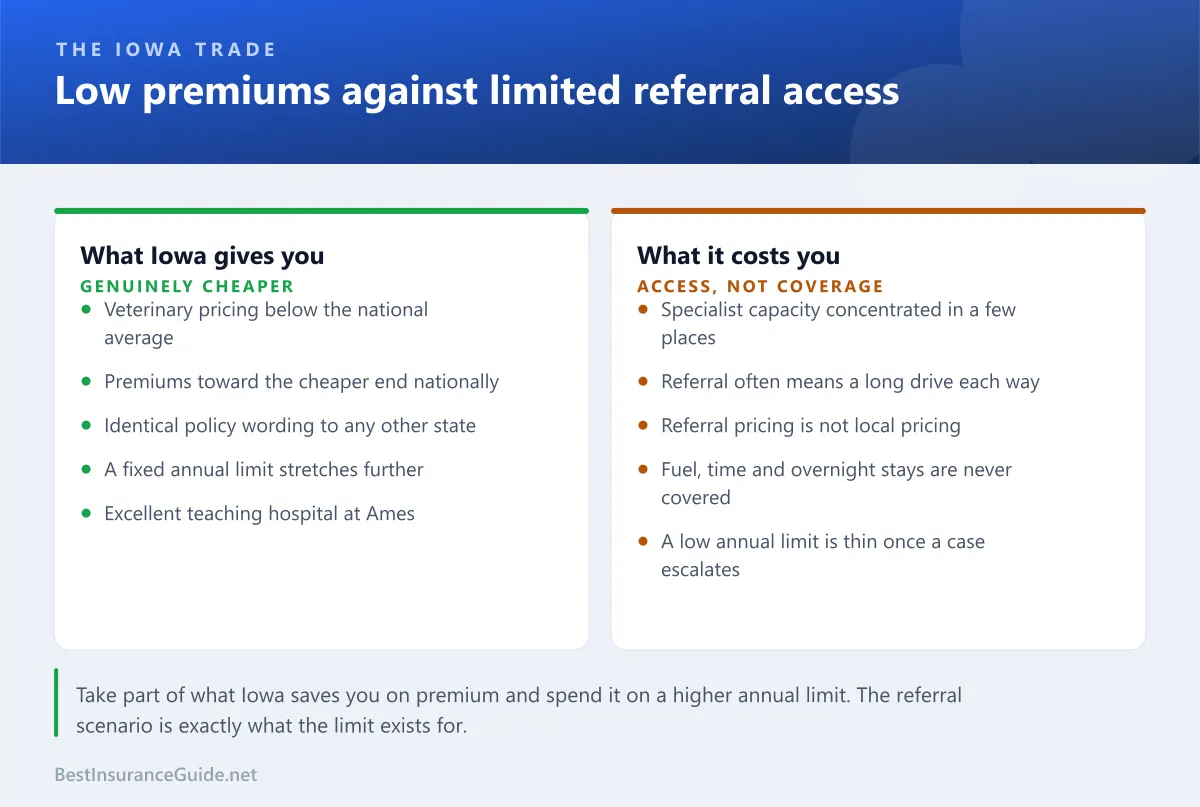
Iowa has one veterinary teaching hospital, at Iowa State in Ames, and it is genuinely excellent. It is also, for a large share of the state, a drive rather than a trip. Board-certified surgeons, oncologists, cardiologists and 24-hour emergency capacity are concentrated in a handful of places.
Three consequences follow for how you insure.
Your claim may be larger than the local price suggests. If a serious case gets referred to Ames, you are paying teaching-hospital specialist pricing rather than rural general practice pricing. The premium was set against the local average; the claim may not be.
Travel is not covered. Pet insurance reimburses veterinary treatment. Fuel, overnight accommodation and time off work are yours. In a state where a referral can mean a two-hour drive each way and repeat visits, that is a real cost sitting outside the policy.
A decent annual limit matters more than the low premium suggests. It is tempting to buy a $5,000 cap because premiums are cheap. If the case that arrives is the one that goes to Ames, a $5,000 cap is thin.
The practical conclusion: take the money Iowa’s lower pricing saves you and spend some of it on a higher annual limit rather than pocketing all of it.
What Iowa pets claim for
Tick-borne illness. Iowa sits at the edge of the upper Midwest tick belt and canine Lyme and anaplasmosis have expanded across the state over recent decades. Treatment is covered; the Lyme vaccine and tick preventives are wellness items. Iowa vets increasingly run tick panels at annual visits, which creates the familiar pre-existing condition trap: a positive result before enrolment excludes that condition permanently.
Farm and rural hazards. This is where Iowa diverges most from urban states. Livestock injuries, machinery trauma, lacerations on wire and equipment, and vehicle strikes on rural roads all appear more often here. All are covered as accidents.
If you have a genuine working farm dog, declare it. A small number of insurers ask about working use and rate or exclude accordingly, and an inaccurate declaration is a coverage problem waiting to happen.
Toxin ingestion. Rodenticides, agricultural chemicals and antifreeze all feature. Anticoagulant rodenticide poisoning in particular is a recurring rural presentation and treatment is covered.
Winter injuries. Antifreeze poisoning is time-critical and expensive. Ice produces cruciate ligament tears and soft tissue injuries, which brings the orthopaedic waiting period into play: many insurers apply six or twelve months to cruciate and hip conditions rather than the few days covering ordinary accidents.
Blue-green algae on Iowa lakes and slow water in summer, rapidly dangerous and covered as toxin ingestion.
Foreign body ingestion, which is not regional but remains the most common expensive emergency nationally.
Worked example: a foreign body referred to Ames
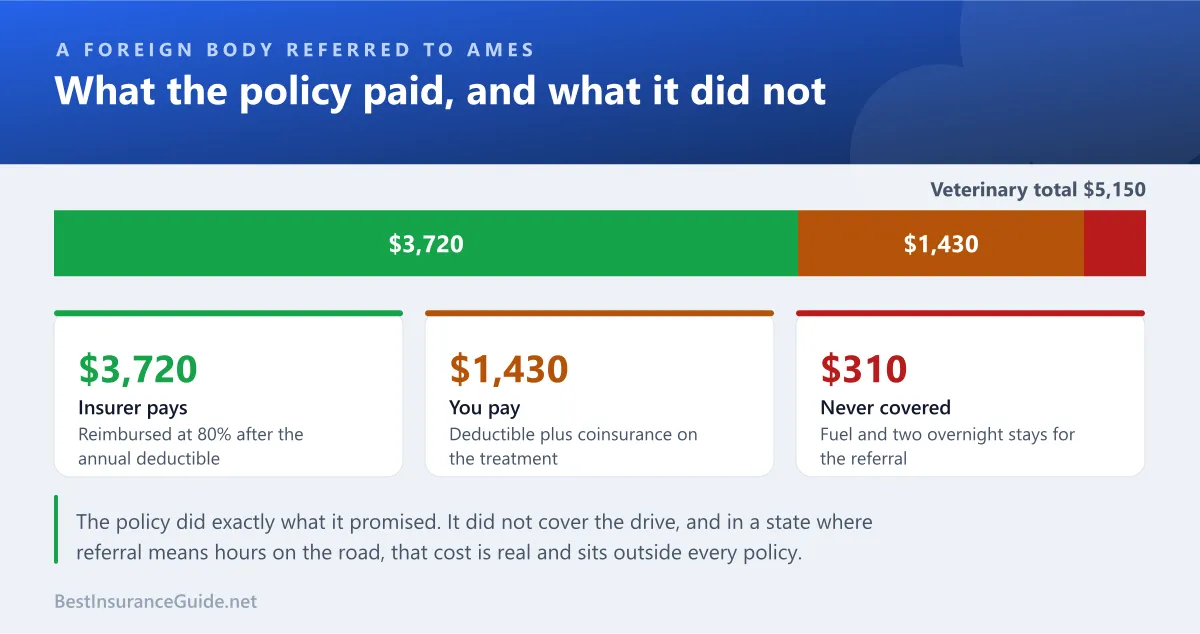
A three-year-old Labrador swallows a corn cob. Local practice stabilises and refers. Policy: $500 annual deductible, 80% reimbursement, $10,000 annual limit.
| Item | Cost |
|---|---|
| Local emergency exam, imaging and stabilisation | $690 |
| Referral surgery, exploratory and enterotomy | $3,100 |
| Hospitalisation, three days | $980 |
| Medication and recheck | $380 |
| Veterinary total | $5,150 |
| Less deductible | $500 |
| Reimbursed at 80% | $3,720 |
| Owner pays for treatment | $1,430 |
| Fuel and two overnight stays, not covered | $310 |
| Total actual cost to the owner | $1,740 |
That last line is the Iowa-specific point. The policy did exactly what it promised. It did not cover the drive.
How to buy in Iowa
Match four fields across every quote before comparing a premium: the annual limit, the deductible and whether it is annual or per condition, the reimbursement percentage, and the waiting periods.
Three Iowa leanings.
Buy a higher annual limit than the local pricing suggests. Referral care is priced differently from local care, and that is the scenario the limit exists for.
Prefer an annual deductible. Chronic tick complications and orthopaedic management both span months.
Check the orthopaedic waiting period before winter, particularly for large breeds, which are common here.
Vaccines, prevention and wellness riders
Core pet insurance covers neither vaccines nor neutering, and it does not cover tick preventives. All are preventive or elective.
A wellness rider reimburses them against fixed allowances. Iowa’s lower baseline vet pricing works in the rider’s favour slightly, because a fixed allowance covers a larger share of a cheaper bill. It still earns most of its value in a puppy’s first year, when the vaccination series and the neuter land together, and generally loses money afterwards.
Total the published allowances, subtract the rider premium, and buy only if the result is positive for care you would purchase anyway.
Regulation
Pet insurance in Iowa is regulated by the Iowa Insurance Division as a property and casualty line rather than as health insurance. That structure is why it reimburses you after the fact and why there is no network: any licensed vet works, including Iowa State.
A growing number of states have adopted rules based on the NAIC Pet Insurance Model Act, standardising disclosure of waiting periods, pre-existing condition definitions and exam requirements. Adoption has been moving, so check the Division’s current position.
Read the pre-existing condition definition regardless. It varies more between insurers than any other term and decides most declined claims.
The mistakes that cost Iowa owners money
Buying the cheapest limit because the premium is cheap. The referral scenario is exactly what you are insuring against.
Enrolling after the annual tick panel. Same trap as everywhere in the tick belt.
Not declaring working farm use where it genuinely applies.
Forgetting travel is uninsured. Budget for it separately rather than being surprised by it.
Cancelling as the premium rises with age. Raise the deductible or lower the reimbursement percentage instead; both keep the enrolment date, which is the asset you have been building.
A note on the figures
Premiums and treatment costs here are illustrative, drawn from typical ranges rather than any single insurer’s rates. Actual pricing depends on your ZIP code, the species, breed and age of the animal, and the limits selected, and veterinary charges differ between local practice and referral centres. Quote your own circumstances and read the policy wording rather than the summary.
Farm dogs, barn cats and working animals
Iowa has more working and semi-working animals than most states, and the insurance treatment differs from a house pet in ways worth knowing before you claim.
Declare working use accurately. A small number of insurers ask whether a dog works livestock or guards property, and some rate or restrict accordingly. An inaccurate declaration is a coverage problem waiting to surface at the worst moment.
Barn cats are usually insurable but often not worth insuring. Semi-feral outdoor cats are difficult to present for the veterinary examinations that underwriting and claims require, and their trauma risk is high enough that exclusions accumulate quickly. For a genuine barn cat, routine preventive care and a modest emergency fund is frequently the more honest plan.
House cats in rural Iowa are cheap to insure and worth it. Urinary blockage in a male cat is an emergency with a four-figure bill and no warning, and Iowa’s lower vet pricing means a fixed annual limit stretches unusually far.
Multi-pet discounts run around five to ten per cent per additional animal at most insurers. Worth asking for, never worth delaying an enrolment over.
What the premium does over time
| Age band | Indicative monthly premium | Paid in the band |
|---|---|---|
| Years 1 to 3 | $33 | $1,188 |
| Years 4 to 6 | $46 | $1,656 |
| Years 7 to 9 | $69 | $2,484 |
| Years 10 to 12 | $103 | $3,708 |
| Total to age twelve | $9,036 |
Those are among the lower figures in the country, and they are the direct consequence of Iowa’s veterinary pricing. It also means the gap between a $5,000 and a $15,000 annual limit costs less here than almost anywhere, which is the argument for buying the higher one.
As everywhere, premiums accelerate after seven. Raise the deductible or lower the reimbursement percentage at renewal rather than cancelling, because the enrolment date is what you have spent a decade building.
Questions worth asking an Iowa insurer
Five questions matter more here than the premium difference between two quotes.
Is the deductible annual or per condition? Chronic tick complications and orthopaedic management both run across months.
What is the orthopaedic waiting period, and can an exam shorten it? Large breeds are common in Iowa and the winter injury pattern is real.
Do you cover a chronic condition across renewals? Rare to fail, but decisive where it does.
Are exam fees and prescription diets covered? Both are recurring costs in chronic cases and both are excluded by a meaningful number of policies.
How are bilateral conditions handled? Cruciate tears frequently affect both knees.
A note on the figures
Premiums and treatment costs here are illustrative, drawn from typical ranges rather than any single insurer’s rates. Actual pricing depends on your ZIP code, the breed, species and age of the animal, and the limits selected, and referral pricing differs from local practice pricing. Quote your own circumstances and read the policy wording.
Comparable states
Iowa’s trade of low premiums against long distances to referral care repeats across the plains and the north. Oklahoma shares the low-premium half, while Maine and Hawaii show what limited specialist access does to a claim in very different markets.
The short version
Iowa is one of the cheaper states in the country to insure a pet, because local veterinary pricing is below average. That is a cost-of-care difference, not a coverage difference.
The trade is access. Specialist and emergency capacity is concentrated, referral often means a drive to Ames, and the travel is not covered by any policy. When a serious case does get referred, the bill is priced like referral care rather than like your local practice.
So take part of what Iowa saves you on premium and spend it on a higher annual limit. Prefer an annual deductible, check the orthopaedic waiting period, and enrol before the next tick panel.
For lifetime costs and how premiums climb with age, see the pet insurance cost guide.