Pet Insurance in Colorado: Costs, Altitude Risks and What to Check
Pet insurance in Colorado costs more along the Front Range than on the plains. Local claim drivers, what to compare, and whether a wellness add-on is worth it.

Table of contents

Colorado is a good illustration of why “pet insurance by state” is slightly the wrong question. The spread inside Colorado is wider than the gap between Colorado and Kansas.
What actually sets the price here
Pet insurance is not rated on your pet in the way you might expect. It is rated on what your vet charges, which means it is rated on your postcode.
Three things push Colorado quotes around.
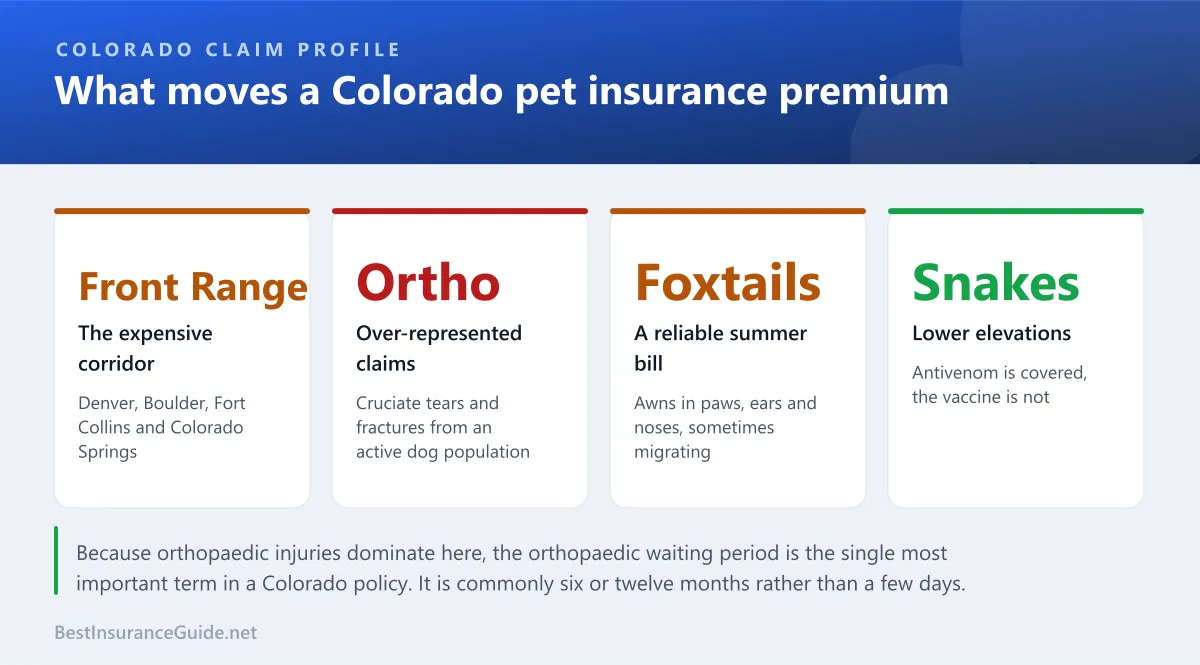
The Front Range premium. Denver, Boulder, Fort Collins and Colorado Springs carry higher clinic overheads, higher staffing costs and more competition for veterinary labour. Those costs land in the bills insurers pay, so they land in your premium.
Specialist density. The Denver metro has a genuinely deep bench of board-certified surgeons, oncologists and 24-hour emergency hospitals. That is excellent when your dog needs one. It also means more cases escalate to specialist care than they would somewhere with fewer referral options, and utilisation is priced.
The Western Slope and Eastern Plains discount. Quote the same dog in Grand Junction, Pueblo or Sterling and the number typically drops, because local practice pricing is lower.
None of this reflects a difference in the policy. The same national insurers write broadly the same contracts across Colorado. What changes is the size of the bill they expect to reimburse.
What Colorado dogs actually claim for
This is where Colorado genuinely diverges from the national pattern, and it should influence how you set your limits.
Orthopaedic injuries. Colorado dogs hike, run trails, chase things at altitude and jump off rocks. Cranial cruciate ligament tears, fractures and soft tissue injuries are over-represented here relative to more sedentary states. A cruciate repair with rehabilitation is one of the most expensive routine-ish claims in pet insurance, and it frequently runs into four figures.
This matters for a specific reason: orthopaedic waiting periods. Many insurers apply a longer waiting period to cruciate and hip conditions, commonly six or twelve months, rather than the few days that apply to ordinary accidents. In a state where those injuries are common, that waiting period is the single most important term in the contract. Ask about it explicitly, and ask whether it can be shortened by a vet exam.
Foxtails and grass awns. From late spring through summer, foxtail seeds work into paws, ears, noses and eyes, and can migrate internally. Removal ranges from a straightforward sedated procedure to genuinely invasive surgery if the awn has travelled. This is a classic mid-sized claim, expensive enough to matter and common enough to expect.
Rattlesnake bites. Real at lower elevations, on the plains, and in the canyons. Antivenom is expensive and treatment is usually an emergency admission. A standard accident and illness policy covers the treatment. The rattlesnake vaccine is preventive care and sits outside core coverage, under a wellness rider if you have one.
Altitude and heat. Less dramatic but worth knowing: dogs new to elevation, and brachycephalic breeds especially, can struggle. Heat injuries on summer trails are a recurring emergency presentation.
Wildlife encounters. Porcupine quills, skunk, and in some areas larger wildlife. Quill removal under sedation is a common Colorado bill.
Worked example: a Front Range cruciate repair
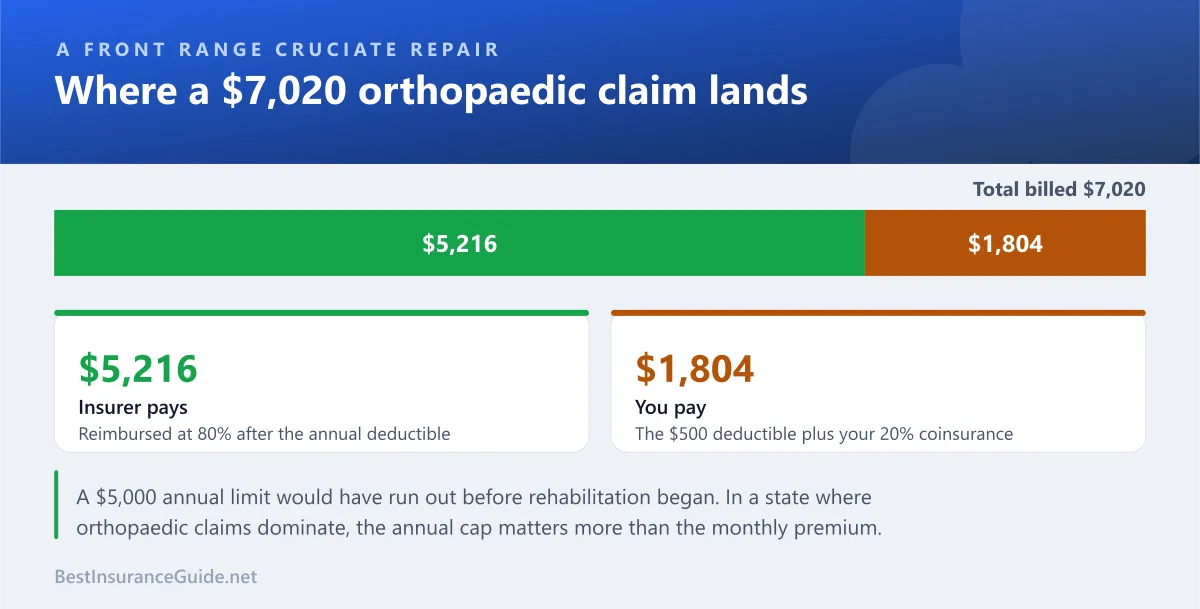
A four-year-old retriever tears a cruciate ligament on a trail. Policy: $500 annual deductible, 80% reimbursement, $10,000 annual limit.
| Item | Cost |
|---|---|
| Emergency exam and initial imaging | $520 |
| Orthopaedic specialist consultation | $180 |
| TPLO surgery | $4,900 |
| Post-operative medication and recheck imaging | $460 |
| Rehabilitation, eight sessions | $960 |
| Total | $7,020 |
| Less deductible | $500 |
| Reimbursed at 80% | $5,216 |
| Owner pays | $1,804 |
Two things to take from that table. The annual limit matters: a $5,000 cap would have been exhausted before rehabilitation. And rehabilitation is often excluded or sublimited, so check whether your policy treats it as covered treatment.
Comparing quotes properly
Colorado quotes are easy to compare badly, because insurers vary the fields that do not appear on the summary page.
Match four things before you look at any premium: the annual limit, the deductible and whether it is annual or per condition, the reimbursement percentage, and the waiting periods.
Two Colorado-specific leanings.
Favour a higher annual limit. Front Range specialist care is expensive enough that a $5,000 cap can be consumed by one orthopaedic event. Unlimited or high-limit policies are worth more here than the premium difference suggests.
Favour 90% reimbursement if you are in the metro. The gap between 70% and 90% is measured in the size of the bill. On the $7,020 claim above, that difference is over $1,400.
Our pet insurance cost guide works through how premiums climb as a pet ages, which is the cost most owners underestimate.
Vaccines, neutering and wellness riders
The same answer applies in Colorado as everywhere: core pet insurance does not cover vaccines or neutering. Those are preventive and elective, and core cover exists for the unexpected.
A wellness or routine care add-on reimburses them against fixed allowances. It usually comes out ahead in a puppy’s first year, when the vaccination series, the neuter and the initial parasite prevention all land together, and usually does not in year four.
Colorado adds one wrinkle worth pricing: the rattlesnake vaccine and, in tick-heavy areas, additional preventive care are wellness items rather than covered treatment. If you are in an area where you would want those anyway, a rider changes the arithmetic slightly in its favour.
Regulation and the practical checks
Pet insurance is regulated by the Colorado Division of Insurance as a property and casualty product rather than as health insurance, which is why it works by reimbursement rather than by network.
A growing number of states have adopted rules based on the NAIC Pet Insurance Model Act, which standardises how insurers must disclose waiting periods, pre-existing condition definitions and any exam requirements. Adoption has been moving quickly, so check the Division’s current position rather than assuming a particular protection applies.
Two practical checks regardless of regulation:
Read the pre-existing condition definition. It is the term that decides most declined claims, and it varies between insurers more than any other.
Never cancel and rebuy after moving within the state. Your enrolment date is the most valuable thing about an older policy. Switching resets waiting periods and turns anything diagnosed since enrolment into a pre-existing condition. Tell your insurer you moved and let them re-rate you instead.
What a Colorado policy costs across a dog’s life
The number that matters is not the first-year premium. It is what you pay across fifteen years, because pet insurance premiums rise with age at every insurer, and the increases accelerate once a dog passes about seven.
That pattern catches people who shopped hard on the introductory price and never modelled the rest.
Worked example: fifteen years on a Front Range policy
Illustrative figures for a medium-breed dog insured from twelve weeks old, holding coverage constant at an $8,000 annual limit, $500 deductible and 80% reimbursement.
| Age band | Indicative monthly premium | Paid in the band |
|---|---|---|
| Years 1 to 3 | $42 | $1,512 |
| Years 4 to 6 | $58 | $2,088 |
| Years 7 to 9 | $84 | $3,024 |
| Years 10 to 12 | $126 | $4,536 |
| Years 13 to 15 | $178 | $6,408 |
| Total premium paid | $17,568 |
Two honest conclusions from that shape.
Insurance is not a saving scheme, and it is not meant to be. Over a healthy dog’s whole life you will very likely pay more in premium than you claim. What you are buying is protection against the year that would otherwise cost you $9,000 in one go, at a moment when you were not expecting it.
The exit is the trap. Premiums climb fastest exactly when a dog becomes most likely to need care, which is when people cancel. Cancelling at eleven means paying for a decade of cover and dropping it just before the claims arrive, and re-enrolling elsewhere is not an option because everything on the record by then is pre-existing.
If the later numbers look unaffordable, the fix is to lower the reimbursement percentage or raise the deductible at renewal rather than to cancel. That keeps the enrolment date, which is the genuinely valuable asset.
The mistakes that cost Colorado owners money
Waiting through the first summer. Foxtail season and trail injuries both land in the warm months. A policy bought in August has waiting periods running through the exact window it was needed for.
Assuming rehabilitation is covered. Colorado orthopaedic claims frequently include hydrotherapy, laser and physiotherapy. Some insurers cover them as part of the treatment, some sublimit them, and some exclude them entirely unless you buy a rider. Given how many claims here are orthopaedic, this is worth confirming in writing.
Buying a $5,000 annual limit on the Front Range. It looks generous until a single TPLO with imaging, specialist fees and rehabilitation approaches it. In the Denver metro, a low cap is the most common cause of a claim that was approved and still left the owner badly short.
Not declaring a move from the Western Slope. Rating is by ZIP code. Moving to Denver and not telling the insurer risks a coverage dispute at exactly the wrong moment, and the saving was never real.
Treating a puppy’s first limp as nothing. Anything recorded in the notes before enrolment, or during a waiting period, becomes pre-existing. An undiagnosed intermittent lameness at nine months can quietly exclude cruciate cover for life.
Questions worth asking before you buy
Ask these five and you will know more than most buyers.
What exactly is the orthopaedic waiting period, and can a vet exam shorten it? Several insurers will waive or reduce it after a clean examination within a set window of enrolling. Almost nobody is told this unprompted.
Is rehabilitation covered, and is it sublimited?
Is the deductible annual or per condition? Annual suits Colorado better, because a dog with a chronic joint issue plus an unrelated illness pays one deductible rather than two.
How is a bilateral condition handled? If one cruciate goes, the other frequently follows. Some insurers treat the second knee as the same pre-existing condition and decline it. This is a genuinely large exclusion in a state with this claim profile.
What happens to the premium at ages eight, ten and twelve? Ask for the actual rating pattern rather than the first-year price.
Cats, and multi-pet households
Most of this article describes dogs, because dogs generate the orthopaedic and outdoor claims that make Colorado distinctive. Cats are cheaper to insure almost everywhere, typically by a wide margin, and their claim profile is dominated by urinary tract disease, kidney problems in older cats, dental disease and foreign body ingestion rather than trail injuries.
Indoor cats in Denver still get insured for good reason: urinary blockage in a male cat is a genuine emergency with a four-figure bill attached, and it arrives without warning.
Multi-pet discounts are widely available and usually modest, often in the region of five to ten per cent per additional animal. Worth asking for, not worth choosing an insurer over.
Comparable states
Colorado’s split between an expensive Front Range and a cheaper rest of state repeats elsewhere. Arizona and Utah share the dry-west profile of low parasite pressure and high injury rates, while Oregon shows the same metro-and-rural divide with a wetter disease picture.
The short version
Pet insurance in Colorado is priced on your ZIP code, not the state line. Front Range postcodes cost meaningfully more than the Western Slope or the plains because vets there charge more and specialists are readily available.
Colorado’s claim profile skews toward orthopaedic injuries, foxtails and snake bites, which argues for a higher annual limit, a higher reimbursement percentage, and very close attention to the orthopaedic waiting period before you buy.
Vaccines and neutering are not covered by core insurance here or anywhere. If you want them included, price a wellness rider and expect it to pay for itself mainly in the first year.
For the wider picture on how state pricing works, see pet insurance by state, and for lifetime costs, the pet insurance cost guide.