Pet Insurance in Oregon: Portland Prices and a Two-Climate State
Pet insurance in Oregon costs most in the Portland metro. Foxtails, leptospirosis and outdoor injuries shape the claim mix. What to compare before buying.

Table of contents

Oregon is really two insurance markets sharing a state line, and the Cascades are the boundary.
What drives the premium
Pet insurance reimburses a percentage of your actual vet bill, so the price follows local veterinary costs. In Oregon that means it follows the I-5 corridor.
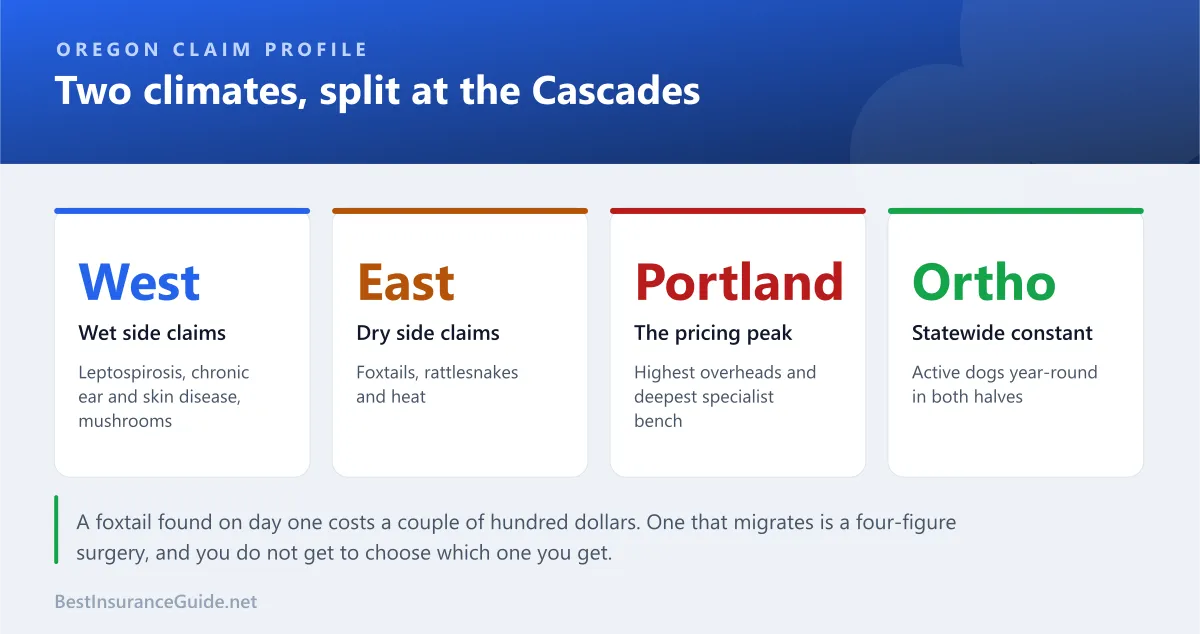
Portland is the expensive end. Higher clinic overheads, a competitive veterinary labour market, and a strong concentration of board-certified specialists and 24-hour emergency hospitals. When referral care is available, more cases use it.
Eugene, Salem, Corvallis and Bend sit below Portland but above rural pricing.
Eastern and coastal Oregon are cheapest, tracking lower local practice pricing.
The same national insurers write broadly the same policy language across all of it. What changes is the size of the bill they expect to reimburse. Our pet insurance by state guide covers why the spread inside a state often exceeds the gap between states.
West of the Cascades
The wet side produces a distinct claim mix.
Leptospirosis. Standing water, streams, and wildlife urine make lepto a real risk in western Oregon. It is a bacterial infection that attacks kidneys and liver, and severe cases mean hospitalisation, IV fluids and sometimes dialysis referral. Treatment is covered as an illness; the vaccine is preventive and sits under a wellness rider.
Skin and ear disease. Persistent damp drives chronic otitis and dermatological problems. These are among the most common claims nationally and the Willamette Valley does nothing to reduce them. They are also frequently chronic, which makes the deductible type matter: an annual deductible handles recurring conditions better than a per-condition one across renewals.
Blue-green algae. A summer risk on Oregon lakes and slow rivers, and rapidly fatal without treatment. Covered as toxin ingestion.
Mushroom toxicity. Genuinely notable in western Oregon in autumn. Amanita ingestion causes liver failure and is an intensive, expensive emergency.
East of the Cascades
The dry side looks more like the interior West.
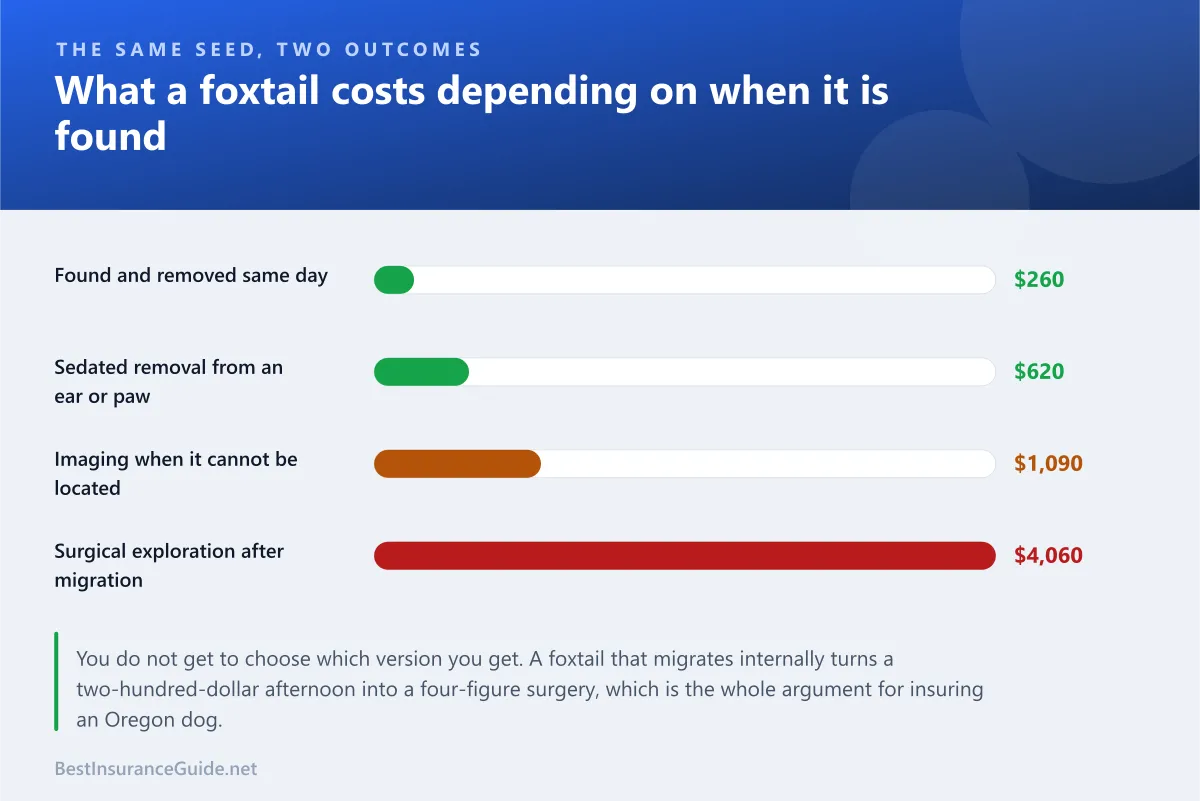
Foxtails and grass awns. From late spring, awns lodge in paws, ears, noses and eyes and can migrate internally. Removal ranges from a sedated procedure to invasive surgery. A reliable mid-sized summer claim, and covered.
Rattlesnake bites at lower elevations in the southeast. Antivenom is expensive and treatment is an emergency admission. Covered; the rattlesnake vaccine is not.
Orthopaedic injuries. Oregon dogs are active year-round in both halves of the state. Cruciate ligament tears and fractures show up often, which makes the orthopaedic waiting period one of the more important terms in an Oregon policy. Many insurers apply six or twelve months to cruciate and hip conditions rather than the few days that cover ordinary accidents. Ask whether a vet exam can shorten it.
Wildfire smoke. An increasingly regular seasonal factor, aggravating respiratory conditions particularly in older animals and brachycephalic breeds.
Worked example: a migrating foxtail
Policy: $500 annual deductible, 80% reimbursement, $10,000 annual limit.
| Item | Cost |
|---|---|
| Initial exam and sedated examination | $410 |
| Imaging after the awn could not be located | $680 |
| Surgical exploration and removal | $2,300 |
| Hospitalisation and medication | $540 |
| Recheck and suture removal | $130 |
| Total | $4,060 |
| Less deductible | $500 |
| Reimbursed at 80% | $2,848 |
| Owner pays | $1,212 |
A foxtail that is found on day one is a couple of hundred dollars. One that migrates is a four-figure surgery, and you do not get to choose which you get.
How to compare quotes
Match four fields before you look at price: the annual limit, the deductible and its type, the reimbursement percentage, and the waiting periods.
Oregon-specific leanings:
Annual deductible over per-condition. Chronic skin and ear disease is common here and is exactly what exposes per-condition designs over several years.
Check the orthopaedic waiting period if you have an active dog, which in Oregon is most of them.
Take the higher reimbursement percentage in the Portland metro, where the bills the percentage applies to are larger.
Vaccines, neutering and wellness
Core pet insurance covers neither vaccines nor neutering, in Oregon or anywhere else. Those are preventive and elective; core cover exists for the unexpected.
A wellness rider pays fixed allowances toward them. Oregon adds a modest argument in its favour on the west side, where the leptospirosis vaccine is a preventive most owners will want regardless. Even so, the rider generally earns its keep in a puppy’s first year and rarely after that.
Regulation
Pet insurance in Oregon is overseen by the Oregon Division of Financial Regulation as a property and casualty product. That structure is why it reimburses rather than running a network, so any licensed vet is fine.
A growing number of states have adopted rules based on the NAIC Pet Insurance Model Act, standardising how waiting periods, pre-existing conditions and exam requirements are disclosed. Check the Division’s current position rather than assuming a particular protection is in force.
Read the pre-existing condition definition yourself in any case. It varies more between insurers than any other term and decides most declined claims.
Chronic skin and ear disease, the quiet Oregon expense
The dramatic claims get the attention, but the condition that most reliably costs Oregon owners money is dermatological, and it is the one people insure against by accident.
Western Oregon’s damp, long pollen season and mild winters produce a lot of atopic dermatitis and recurring otitis. Neither is an emergency. Both are chronic, both recur seasonally, and both are managed rather than cured.
Worked example: three years of managing atopic dermatitis
Policy: $500 annual deductible, 80% reimbursement.
| Year | Costs incurred | Deductible | Reimbursed | You pay |
|---|---|---|---|---|
| Year 1: workup, referral, allergy testing | $2,450 | $500 | $1,560 | $890 |
| Year 2: immunotherapy, medication, rechecks | $1,890 | $500 | $1,112 | $778 |
| Year 3: maintenance, two flare-ups | $1,640 | $500 | $912 | $728 |
| Three-year total | $5,980 | $3,584 | $2,396 |
Three things fall out of that table.
This is where a per-condition deductible hurts. On an annual deductible you pay $500 a year across everything. On some per-condition designs the skin condition carries its own deductible alongside any unrelated illness, and by year three the “cheaper” policy has cost more. In a state with this much chronic dermatology, the deductible type is not a detail.
Check whether prescription diets and immunotherapy are covered. Hydrolysed diets and allergen-specific immunotherapy are both common in this treatment path, and both are excluded by a meaningful number of policies as food or as elective.
Chronic conditions must carry across renewals. Some cheaper policies stop paying for a condition after the first policy year, treating it as pre-existing at renewal. That design is rare among reputable insurers and catastrophic for exactly this kind of claim. Ask the question directly.
Cats in Oregon
Most of this article describes dogs, because dogs are the ones finding foxtails and swimming in algae. Cats cost considerably less to insure and their expensive claims look different: urinary blockage, chronic kidney disease in older cats, hyperthyroidism, dental disease and foreign body ingestion.
Oregon adds one specific feline note. Outdoor cats in western Oregon carry meaningful trauma risk from vehicles and wildlife, and the damp supports abscesses from fight wounds, which are a common and irritatingly expensive claim.
Indoor cats avoid nearly all of that, and still justify cover: a male cat with a urinary blockage is a genuine emergency, arrives with no warning, and costs four figures.
The mistakes that cost Oregon owners money
Buying in July. Foxtail season is already running and waiting periods have not. Enrol in winter if you have the choice.
Choosing a per-condition deductible. As above, chronic skin and ear disease makes this the wrong design for most Oregon dogs.
Assuming the coast prices like Portland. Rating is by ZIP code. If you are on the coast or east of the Cascades, quote your actual postcode rather than assuming the metro number applies.
Skipping the leptospirosis vaccine because insurance covers lepto. It covers treatment, which involves hospitalisation and sometimes dialysis referral. Prevention is a wellness item and it is dramatically cheaper than the claim.
Letting a policy lapse in a quiet year. Enrolment date is the asset. Adjust the deductible instead.
Questions worth asking an Oregon insurer
Is the deductible annual or per condition?
Do you continue paying for a chronic condition across renewals, without treating it as pre-existing at the anniversary?
Are prescription diets and immunotherapy covered?
What is the orthopaedic waiting period, and can a vet exam shorten it?
Are exam fees covered? Some insurers reimburse the consultation itself, some exclude it. With chronic dermatology you will be paying a lot of exam fees.
What it costs across a dog’s life
Premiums rise with age at every insurer, and the increases accelerate past about seven. That curve is worth seeing before you commit, because it is where most policies get abandoned.
| Age band | Indicative monthly premium | Paid in the band |
|---|---|---|
| Years 1 to 3 | $40 | $1,440 |
| Years 4 to 6 | $56 | $2,016 |
| Years 7 to 9 | $83 | $2,988 |
| Years 10 to 12 | $124 | $4,464 |
| Years 13 to 15 | $174 | $6,264 |
| Total | $17,172 |
Across a healthy dog’s whole life you will probably pay more in premium than you claim back, and that is what insurance is. You are buying protection against the single year that costs $9,000 without warning, not building a fund.
The predictable failure is cancelling at eleven, after paying for a decade, immediately before the claims start. If the number stops working, raise the deductible or drop the reimbursement percentage at renewal instead. Both keep the enrolment date, and in a state where chronic dermatology is this common, the enrolment date is most of what you are paying for.
If you move within Oregon, from Portland to the coast or across the Cascades, tell your insurer. Rating is by ZIP code and the change usually works in your favour outside the metro.
One more Oregon quirk: wildfire season
Smoke is now a routine part of the Oregon calendar rather than an exception, and it shows up in claims.
Respiratory irritation, conjunctivitis and aggravated existing conditions all rise during heavy smoke weeks, and older animals and brachycephalic breeds are hit hardest. Treatment for those is covered as an illness.
What is not covered is evacuation. If you are displaced by a wildfire, the cost of boarding or relocating your animals sits outside a pet insurance policy entirely. That is a homeowners or renters loss-of-use question rather than a pet insurance one, and our guide to what renters insurance covers sets out how displacement costs are handled there.
Comparable states
Oregon’s wet west and dry east produce two claim profiles in one state. Washington shares the western half including salmon poisoning exposure, and Colorado shows the same metro-and-rural pricing divide in a drier climate.
The short version
Oregon prices on your ZIP code, with Portland at the top and eastern and coastal postcodes well below it. The claim profile splits at the Cascades: leptospirosis, chronic skin and ear disease and mushroom toxicity to the west, foxtails, snake bites and heat to the east, with orthopaedic injuries common throughout.
Buy an annual deductible rather than a per-condition one, check the orthopaedic waiting period before you sign, and take the higher reimbursement percentage if you are in the metro.
For lifetime costs and how premiums climb with age, see the pet insurance cost guide.