Pet Insurance in Washington State: Salmon Poisoning and Puget Sound Prices
Pet insurance in Washington: Puget Sound pricing, salmon poisoning disease, leptospirosis and the east-west split that changes the whole claim profile.

Table of contents

Washington has one genuinely unusual pet health risk that barely exists elsewhere in the country, and it is worth knowing about before it arrives.
Two states either side of the Cascades
Pet insurance is rated on what your vet charges, which means it is rated on your postcode.
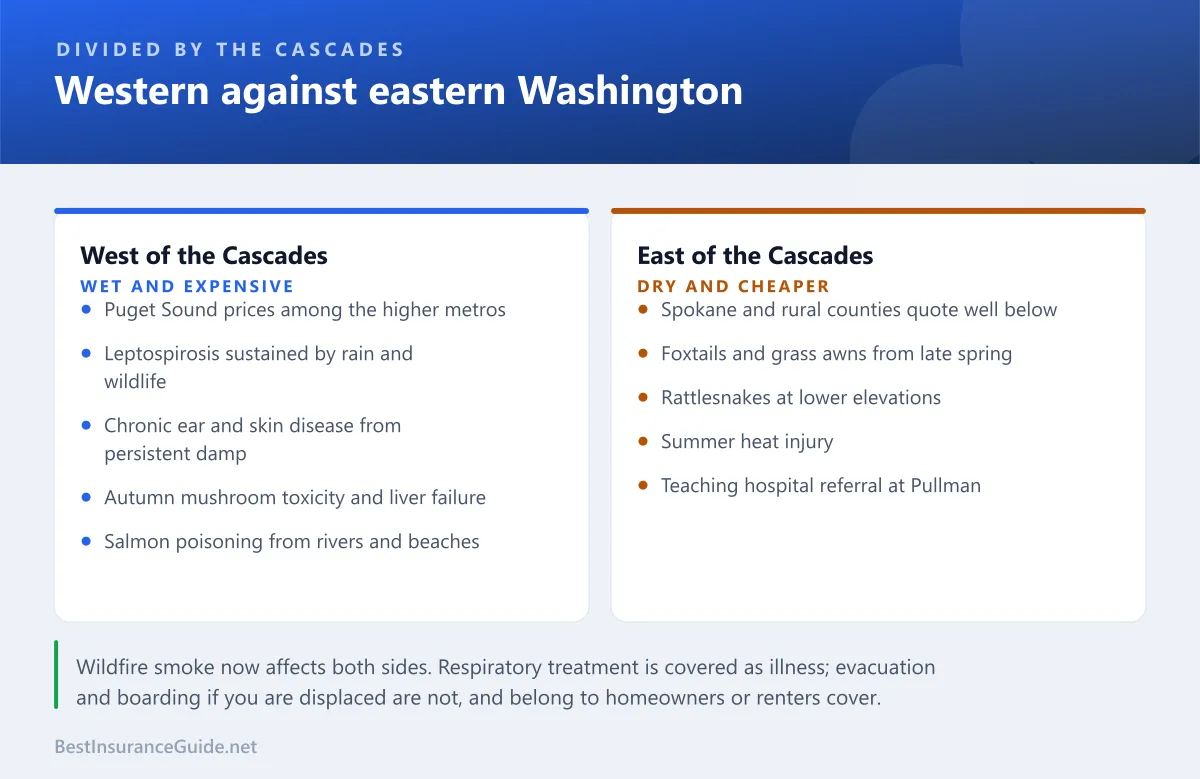
The Puget Sound corridor is the expensive end. Seattle, Bellevue and Tacoma carry high clinic overheads, a competitive veterinary labour market and dense referral and 24-hour emergency capacity. Where specialist care is available, more cases use it.
Eastern Washington quotes substantially lower. Spokane, the Tri-Cities and rural counties track local practice pricing, with Washington State University’s veterinary teaching hospital at Pullman providing genuine referral access outside the metro cost structure.
Washington sits toward the higher end nationally overall, largely because most of the population lives on the expensive side of the mountains. Our pet insurance by state guide covers why the intra-state gap frequently exceeds the difference between two states.
Salmon poisoning disease
This is the Washington-specific risk, and it is a genuinely serious one that owners moving here have usually never heard of.
Dogs that eat raw salmon, trout or other freshwater fish can ingest a fluke carrying a rickettsial organism. The resulting illness, universally called salmon poisoning disease, is largely confined to the Pacific Northwest because the fluke’s life cycle depends on a snail species found here.
Three things make it matter.
It is frequently fatal if untreated. Mortality in untreated dogs is high, and the course can be quick.
It responds very well to prompt treatment. Antibiotics and supportive care are effective when started early, which makes recognition the critical variable rather than availability of treatment.
Exposure is easy. A dog that scavenges a dead fish on a riverbank, takes a salmon carcass on a beach walk, or is fed raw fish is exposed. It does not require anything exotic.
Symptoms typically appear within about a week: lethargy, fever, vomiting, diarrhoea, swollen lymph nodes and loss of appetite. If your dog has been anywhere near a river or beach and presents like that, tell the vet about the fish exposure explicitly. It changes the diagnostic path immediately.
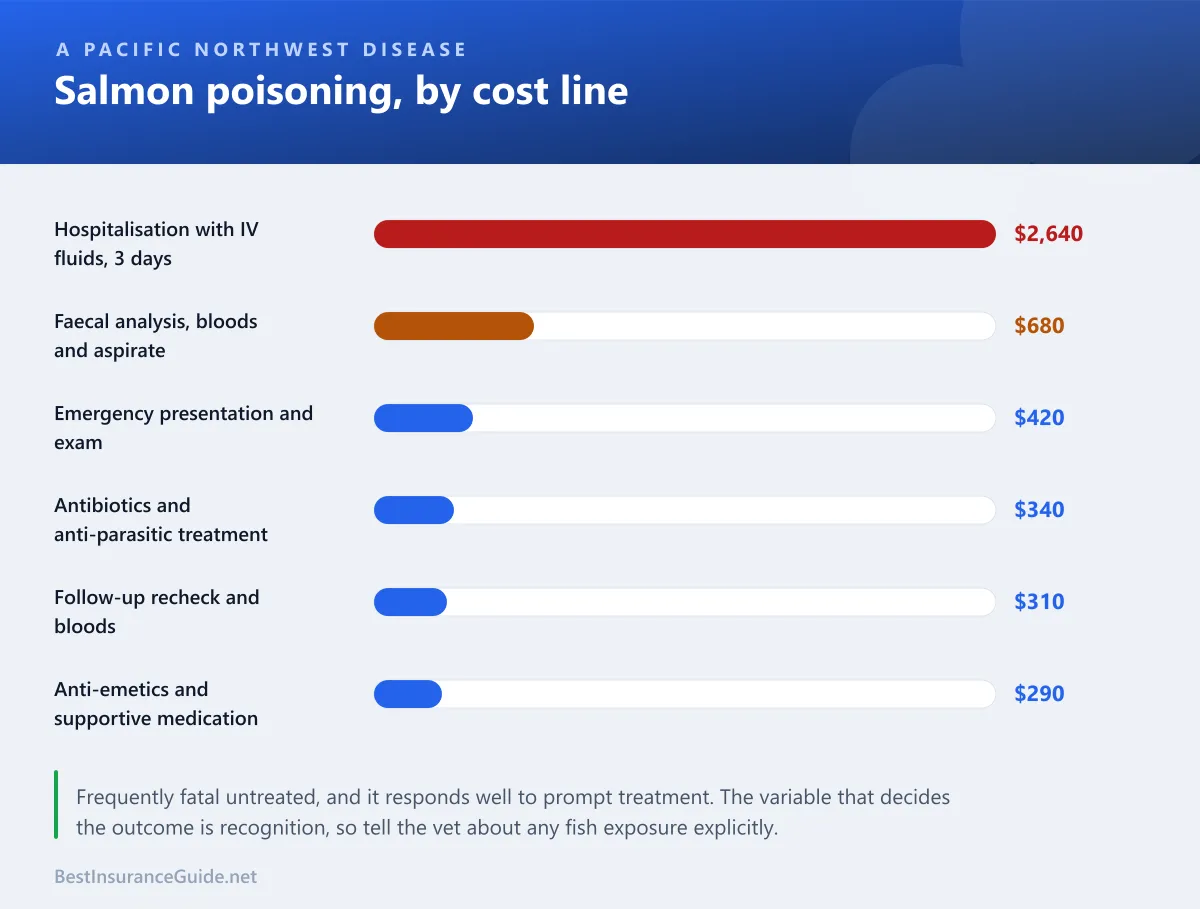
Worked example: salmon poisoning caught mid-course
Policy: $500 annual deductible, 80% reimbursement, $10,000 annual limit.
| Item | Cost |
|---|---|
| Emergency presentation and examination | $420 |
| Faecal analysis, bloodwork and lymph node aspirate | $680 |
| Hospitalisation with IV fluids, three days | $2,640 |
| Antibiotics and anti-parasitic treatment | $340 |
| Anti-emetics and supportive medication | $290 |
| Follow-up recheck and bloods | $310 |
| Total | $4,680 |
| Less deductible | $500 |
| Reimbursed at 80% | $3,344 |
| Owner pays | $1,336 |
Covered in full as an illness. The reason to know about the disease is not insurance; it is that recognising it a day earlier materially changes the outcome.
The prevention is behavioural and free: do not feed raw Pacific salmon or trout, and keep dogs off fish carcasses on riverbanks and beaches.
West of the Cascades
Leptospirosis. Standing water, heavy rainfall and wildlife exposure make lepto a genuine risk in western Washington, and urban Seattle sustains it as well. It attacks kidneys and liver, and severe cases mean hospitalisation, aggressive fluid therapy and sometimes dialysis referral. Treatment is covered; the vaccine is preventive and is not.
Chronic skin and ear disease. Persistent damp drives recurring otitis and dermatological problems. These are frequently chronic, which is the single strongest argument for an annual deductible rather than a per-condition one.
Blue-green algae on lakes and slow water in summer, rapidly dangerous and covered as toxin ingestion.
Mushroom toxicity. Notable in western Washington in autumn. Amanita ingestion causes liver failure and is an intensive, expensive emergency.
Foreign body ingestion, the most common expensive emergency nationally.
East of the Cascades
Foxtails and grass awns from late spring, lodging in paws, ears and noses and occasionally migrating internally. Removal ranges from a sedated procedure to invasive surgery.
Rattlesnake bites at lower elevations in the south and east. Covered as accidents; the vaccine is not.
Heat injury through the eastern Washington summer, covered as illness.
Wildfire smoke. Increasingly a routine seasonal factor on both sides of the mountains. Respiratory irritation and aggravated existing conditions are covered as illness. Evacuation and boarding costs are not, and sit under homeowners or renters loss-of-use instead.
Orthopaedic injuries throughout, because Washington dogs are active year-round. That brings the orthopaedic waiting period into play, commonly six or twelve months on cruciate and hip conditions rather than the few days covering ordinary accidents. Ask whether a clean exam can shorten it.
How to buy in Washington
Match four fields before comparing any premium: the annual limit, the deductible and whether it is annual or per condition, the reimbursement percentage, and the waiting periods.
Four Washington leanings.
Prefer an annual deductible. Chronic ear and skin disease west of the Cascades is the most likely recurring claim in the state.
Take the higher reimbursement percentage in Puget Sound. The percentage applies to larger numbers there.
Buy a high annual limit in the metro. Seattle specialist pricing finds the top of a $5,000 cap quickly.
Check the orthopaedic waiting period before an active season.
Vaccines, prevention and wellness riders
Core pet insurance covers neither vaccines nor neutering. Both are preventive or elective.
Washington’s preventive load is moderate rather than heavy. Heartworm prevalence is lower here than in the South and Midwest, and the tick burden is lighter than the Northeast, so the recurring preventive cost is smaller than in many states. The leptospirosis vaccine is the one most western Washington owners should be buying regardless.
Whether a wellness rider pays is arithmetic: total the published allowances, subtract the rider premium, and buy only if the result is positive for care you would purchase anyway. With a lighter preventive load, the rider is worth less here than in Alabama or Virginia, and that money is better spent on a higher annual limit.
Regulation
Pet insurance in Washington is regulated by the Office of the Insurance Commissioner as a property and casualty line rather than as health insurance. That is why it reimburses you after the fact and why there is no provider network: any licensed vet works, including Pullman.
A growing number of states have adopted rules based on the NAIC Pet Insurance Model Act, standardising how waiting periods, pre-existing condition definitions and exam requirements are disclosed. Adoption has been moving quickly, so check the office’s current position rather than assuming a protection applies.
Read the pre-existing condition definition yourself in any case. It varies more between insurers than any other term and it decides most declined claims.
The mistakes that cost Washington owners money
Not knowing about salmon poisoning. It is covered, but recognising it early is what changes the outcome, and owners new to the region routinely have never heard of it.
Skipping the leptospirosis vaccine because insurance covers lepto. It covers a multi-day hospitalisation. Prevention costs a fraction of that and is not covered at all.
Choosing a per-condition deductible. Chronic dermatology west of the Cascades is exactly what that design punishes.
Assuming an eastern Washington quote applies in Seattle. Rating is by ZIP code, and the gap across the mountains is large.
Buying a low annual limit in Puget Sound. Specialist pricing here is among the higher in the country.
Cancelling as premiums rise with age. Raise the deductible or lower the reimbursement percentage instead; both keep the enrolment date, which is the asset you have been paying to build.
A note on the figures
Premiums and treatment costs here are illustrative, drawn from typical ranges rather than any single insurer’s rates. Actual pricing depends on your ZIP code, the species, breed and age of the animal, and the limits chosen, and veterinary charges differ substantially between Puget Sound and eastern Washington. Quote your own circumstances and read the policy wording rather than the summary.
Raw feeding, and why it matters here
Raw feeding is popular in the Pacific Northwest, and Washington is the one state where it carries a specific and serious risk beyond the usual arguments.
Never feed raw Pacific salmon, trout, steelhead or other anadromous fish. This is the direct route to salmon poisoning disease described above, and freezing at domestic freezer temperatures is not reliably sufficient to kill the fluke. Commercially prepared raw diets using these species are processed to address it; home-prepared fish is where the risk sits.
Insurance covers the consequences either way. Salmon poisoning, bacterial gastroenteritis and bone-related foreign body or perforation injuries are all covered as illness or accident. No insurer excludes claims because you feed raw, though they will ask about diet during a claim workup because it is diagnostically relevant.
The practical position: if you feed raw in Washington, avoid local fish entirely and keep dogs away from carcasses on riverbanks and beaches during and after salmon runs. That single habit removes the state’s most distinctive pet health risk.
Cats in Washington
Cats cost substantially less to insure and their claim profile differs: urinary blockage, chronic kidney disease in older cats, hyperthyroidism, dental disease and foreign body ingestion.
Two Washington notes. Outdoor cats west of the Cascades develop abscesses from fight wounds readily in the damp, and they can contract salmon poisoning as well, though it is far less commonly recognised in cats than dogs. Indoor cats avoid most of it and still justify cover, because urinary blockage in a male cat is a sudden four-figure emergency.
Multi-pet discounts of roughly five to ten per cent per additional animal are widely available. Worth asking for, not worth choosing an insurer over.
Questions worth asking a Washington insurer
Five questions worth more than the premium gap between two quotes.
Is the deductible annual or per condition? Chronic ear and skin disease west of the Cascades makes this decisive.
Are exam fees reimbursed? Chronic dermatology generates a long run of consultations.
Do you cover a chronic condition across renewals?
What is the orthopaedic waiting period, and can an exam shorten it?
How are bilateral conditions handled?
A note on the figures
Premiums and treatment costs here are illustrative, drawn from typical ranges rather than any single insurer’s rate filing. Actual pricing depends on your ZIP code, the species, breed and age of the animal, and the limits chosen, and Puget Sound charges differ substantially from eastern Washington. Quote your own circumstances and read the policy wording rather than the summary.
Comparable states
Washington’s salmon poisoning exposure is shared only with Oregon, which also matches it on the wet western climate and the metro vet market. Colorado is the closest comparison on price structure without the disease.
The short version
Washington is two markets divided by the Cascades. Puget Sound prices among the higher metros in the country and holds most of the specialist capacity; eastern Washington costs considerably less and has Pullman for referrals.
Salmon poisoning disease is the genuinely regional risk. It is covered by any standard policy, it is frequently fatal untreated, and it responds well to prompt treatment, which makes recognising it the thing that matters. Do not feed raw Pacific salmon or trout, and keep dogs off fish carcasses.
Beyond that: leptospirosis and chronic skin disease in the west, foxtails and heat in the east, orthopaedic injuries throughout. Buy an annual deductible, take a high limit in the metro, and check the orthopaedic waiting period.
For lifetime costs and how premiums climb with age, see the pet insurance cost guide.