Pet Insurance That Covers Neutering: Only Through a Wellness Rider
Spay and neuter surgery is never covered by core pet insurance. What wellness riders pay, whether complications are covered, and low-cost alternatives.

Table of contents

People search for pet insurance that covers neutering expecting to find an insurer that includes it. None do, in the way the question implies, and understanding why saves you from buying the wrong product.
Why neutering is not in a core policy
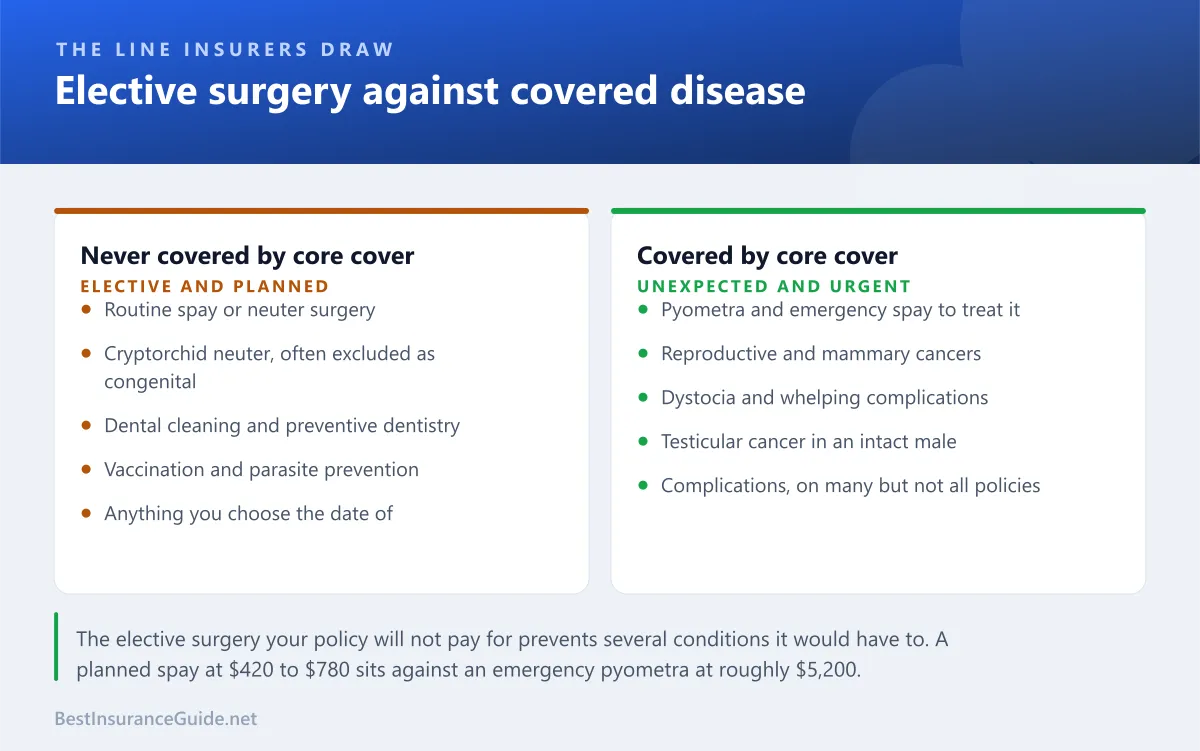
Core pet insurance is accident and illness cover. It pays for things that were not planned: the swallowed sock, the torn ligament, the cancer diagnosis.
Spaying and neutering are elective. You choose when they happen, they are scheduled, and the cost is known in advance. Insurance does not cover certainties; it prices them, adds a margin, and hands the money back, which benefits nobody.
That is the same reason vaccines, flea prevention, dental cleaning and nail trims sit outside a core policy. Our companion article on whether pet insurance covers vaccines sets out the same logic in more detail.
What a wellness rider actually pays
Most major insurers sell an optional wellness or routine care rider, and spay or neuter is nearly always on its schedule.
It works differently from the core policy. The core policy reimburses a percentage after a deductible. The rider pays a fixed allowance, with no deductible and an overall annual cap.
Typical spay and neuter allowances run around $100 to $200, depending on the insurer and the rider tier.
That is what you receive, not what the surgery costs.
| Amount | |
|---|---|
| Neuter, male dog, private practice | $320 to $520 |
| Spay, female dog, private practice | $420 to $780 |
| Neuter, male cat | $120 to $260 |
| Spay, female cat | $220 to $420 |
| Typical rider allowance | $100 to $200 |
Female spays cost more than male neuters because the surgery is abdominal rather than superficial, and larger animals cost more than smaller ones.
Does the rider pay for itself?
The honest test is arithmetic, and it takes five minutes.
Worked example: a puppy’s first year
| Routine item | Typical cost | Allowance paid |
|---|---|---|
| Core vaccination series | $180 | $130 |
| Neuter surgery | $420 | $150 |
| Wellness exams | $110 | $60 |
| Flea, tick and heartworm prevention | $260 | $110 |
| Microchip | $50 | $30 |
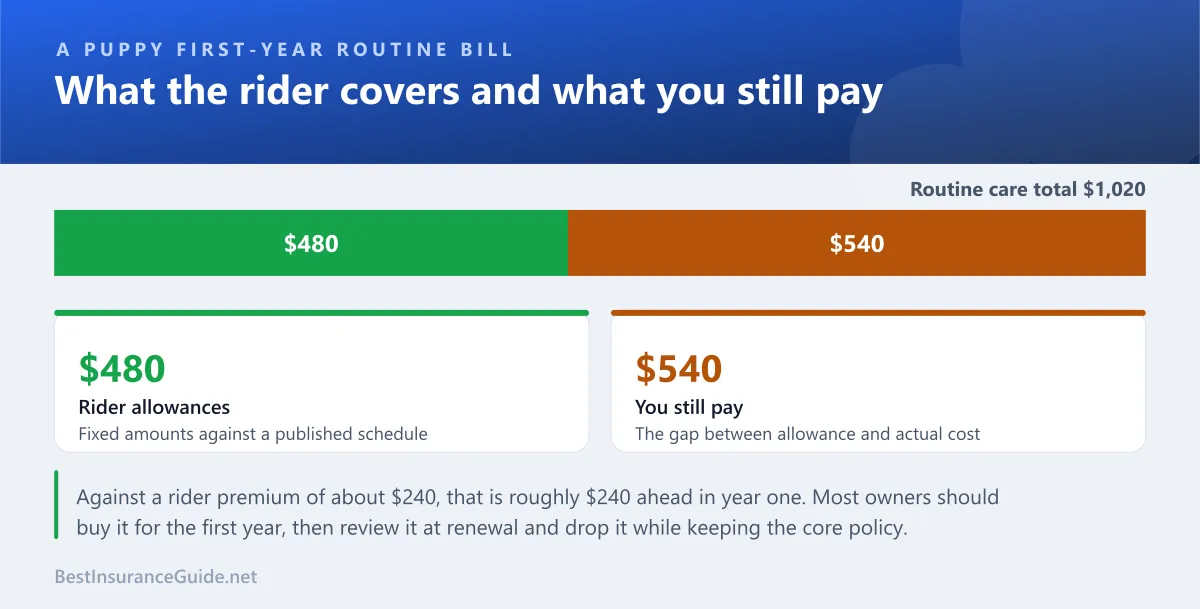
| Total | $1,020 | $480 |
| Rider premium for the year | $240 | |
| Net benefit | $240 |
In a puppy’s first year, when the vaccination series and the neuter both land, the rider generally comes out ahead. In year four, when the same animal needs one exam and a booster, it generally does not.
That is the whole shape of it. A wellness rider is a budgeting tool rather than insurance, and the year it earns its keep is almost always the first one.
Two practical consequences. Buy the rider for the first year if you want the neuter subsidised, then review whether to keep it at renewal. And note that most insurers let you drop the rider while keeping the core policy, which is exactly the right move for most owners after year one.
Complications: the part worth asking about
This is where policies genuinely differ, and it is the question almost nobody asks before booking surgery.
Some insurers cover complications arising from an elective procedure as a new illness or accident. A post-operative infection, a wound dehiscence, a reaction to anaesthesia or an internal bleed would then be claimable under the core policy.
Some exclude anything connected to an elective surgery, on the basis that the underlying procedure was not covered.
The difference is not trivial. A routine neuter that goes well costs a few hundred dollars. One that develops a serious post-operative infection requiring re-operation and hospitalisation can run into four figures.
Ask the question directly before you book: if there is a complication from this elective surgery, is treatment covered under my core policy? Get the answer in writing.
Pyometra, and the argument that actually matters
Here is the financial case for spaying that has nothing to do with wellness riders.
Pyometra is an infection of the uterus that occurs in unspayed females, typically some weeks after a season. It is genuinely serious, it can become life-threatening quickly, and the treatment is usually emergency spay surgery on a sick animal.
It is covered by a standard accident and illness policy, as an illness, provided it was not pre-existing.
Worked example: emergency pyometra surgery
Policy: $500 annual deductible, 80% reimbursement.
| Item | Cost |
|---|---|
| Emergency presentation, bloods and imaging | $740 |
| Stabilisation and IV fluids | $560 |
| Emergency ovariohysterectomy | $2,400 |
| Hospitalisation, three days | $1,180 |
| Medication and recheck | $320 |
| Total | $5,200 |
| Less deductible | $500 |
| Reimbursed at 80% | $3,760 |
| Owner pays | $1,440 |
Compare that to a planned spay at $420 to $780, done on a healthy animal, at a time you chose.
Spaying also removes the risk of ovarian and uterine cancers and substantially reduces mammary tumour risk when done before or shortly after the first seasons. Neutering males removes testicular cancer risk and reduces certain prostate problems.
None of that is an insurance argument. It is a better one: the elective surgery your policy will not pay for prevents several conditions your policy would have to.
Cryptorchid and other complications of the question
Cryptorchidism, where one or both testicles fail to descend, is a congenital condition. Retained testicles carry a materially higher cancer risk, so removal is recommended rather than optional.
Insurance treatment varies. Some insurers exclude it as congenital, some as elective, and some that cover congenital conditions will cover it provided no signs were recorded before enrolment. Since it is usually identified at an early puppy check, this is another argument for insuring at the point of collection rather than after the first veterinary visit.
Retained deciduous teeth, hernias and other conditions frequently found at the neuter appointment sit in the same grey area. If they are noted before your policy starts, they are pre-existing.
Low-cost alternatives worth knowing about
If the surgery cost is the actual problem, a wellness rider is a poor solution to it. These are better.
Humane societies, SPCA and ASPCA clinics run low-cost spay and neuter programmes in most parts of the country, frequently at a fraction of private practice pricing.
Municipal animal services often subsidise or fully fund it, sometimes tied to licensing.
Veterinary teaching hospitals run reduced-cost surgical programmes, performed by students under close supervision.
Mobile and high-volume spay-neuter clinics operate across most states.
Some are income-qualified; plenty are open to anyone. The saving against private practice is frequently larger than any wellness rider would have reimbursed, which makes this the more efficient route for most people asking the original question.
Timing the surgery, and what insurers expect
There is no universal right age, and the veterinary consensus has moved considerably in recent years.
Traditional advice was around six months for both sexes. That is still common practice for cats and small dogs.
Current thinking for larger dogs frequently favours waiting until skeletal maturity, sometimes twelve to eighteen months or later, because growth plate closure is influenced by sex hormones and early neutering has been associated with higher rates of certain orthopaedic conditions in some large breeds.
That is a clinical conversation with your own vet rather than an insurance one. But it has two insurance consequences worth knowing.
A wellness rider’s allowance does not expire on a schedule, so waiting does not forfeit it, though the rider has to be in force in the year the surgery happens.
Waiting means an intact animal for longer, which means a longer window for pyometra in females and for roaming-related accidents in males. Both are covered by the core policy, so this is not an insurance risk so much as a real one.
Does neutering affect your premium?
Modestly, and less than people expect.
Some insurers apply a small discount for neutered animals, on the basis that neutered pets have somewhat lower rates of certain conditions and roaming behaviour. Others do not rate on it at all.
Where a discount exists it is usually a few per cent, which across a year is a fraction of the surgery cost. It is not a reason to neuter, and it is not a reason to choose one insurer over another.
The genuine financial case remains the one set out above: pyometra, reproductive cancers and roaming accidents are all covered conditions the surgery reduces or removes, and the emergency version costs several times the planned one.
What to ask before booking
Is the wellness rider in force now, and what is the exact spay or neuter allowance?
Are complications from this elective surgery covered under my core policy? The single most valuable question here, and the least commonly asked.
Is pre-anaesthetic bloodwork included in the allowance or separate? Frequently a separate line and frequently not covered.
If my pet is cryptorchid, how is the additional surgery treated? Ask before the appointment, because the answer varies between insurers.
A note on scope
Allowances, exclusions and the treatment of complications all vary between insurers and change over time, and the figures used here are illustrative ranges rather than any particular company’s schedule. Confirm your own rider’s published allowance and your core policy’s position on elective-surgery complications directly with the insurer, in writing, before booking.
Surgical pricing also varies enormously by region and by practice type, and a low-cost clinic and a private specialty practice can differ by several hundred dollars for the same procedure. This site is independent and not affiliated with any insurer or clinic.
The clinical questions here, particularly the right age to neuter a given breed, are for your veterinarian rather than an article. The insurance point is narrower: the surgery is elective and therefore never covered by core cover, and the conditions it prevents are covered and expensive.
The short version
There is no pet insurance that covers neutering under a core policy. Spay and neuter are elective, and core insurance covers the unexpected.
A wellness rider reimburses a fixed allowance, usually $100 to $200, and typically pays for itself in a puppy or kitten’s first year when the vaccination series lands alongside it. After that it generally does not, and you can usually drop it while keeping the core policy.
Two things matter more than the rider. Ask whether complications from an elective surgery are covered under your core policy, and get the answer in writing. And remember that pyometra, which spaying prevents, is a covered emergency costing several thousand dollars, which is the real financial argument for the surgery.
If cost is the barrier, low-cost clinics through humane societies, municipal services and veterinary schools will save you more than any rider.
For the wider picture on what core cover does and does not include, see the pet insurance cost guide and does pet insurance cover vaccines.