Does Renters Insurance Pay for a Hotel? Loss of Use, Explained
Renters insurance loss of use pays hotel costs after a covered loss. What counts as an additional living expense, the limits, and civil authority coverage.

Table of contents
Loss of use is the least understood coverage on a renters policy and the one tenants most consistently under-claim. It is also the coverage that matters most in the days immediately after something goes wrong.
What triggers it
Two conditions have to be met.
A covered peril caused the damage. Fire, smoke, a burst pipe, storm damage, vandalism. The full list is in our guide to what renters insurance covers.
Your home is uninhabitable as a result. Not merely inconvenient. Uninhabitable generally means you cannot reasonably live there, and it is usually established by the building manager, a contractor or a building official rather than by your own judgement.
Things that do not trigger it:
Landlord renovation or repairs that were not caused by a covered loss.
A boiler that stopped working, since mechanical failure is not a covered peril.
Infestation, which is excluded as a maintenance issue. Our guide to whether renters insurance covers fleas and pests covers that in detail.
A utility failure originating off your property, in most policies, unless you have added off-premises power failure coverage.
Flood or earthquake damage, both excluded unless you carry separate cover.
What “additional” actually means
This is where people misread the coverage, and it is the whole mechanism.
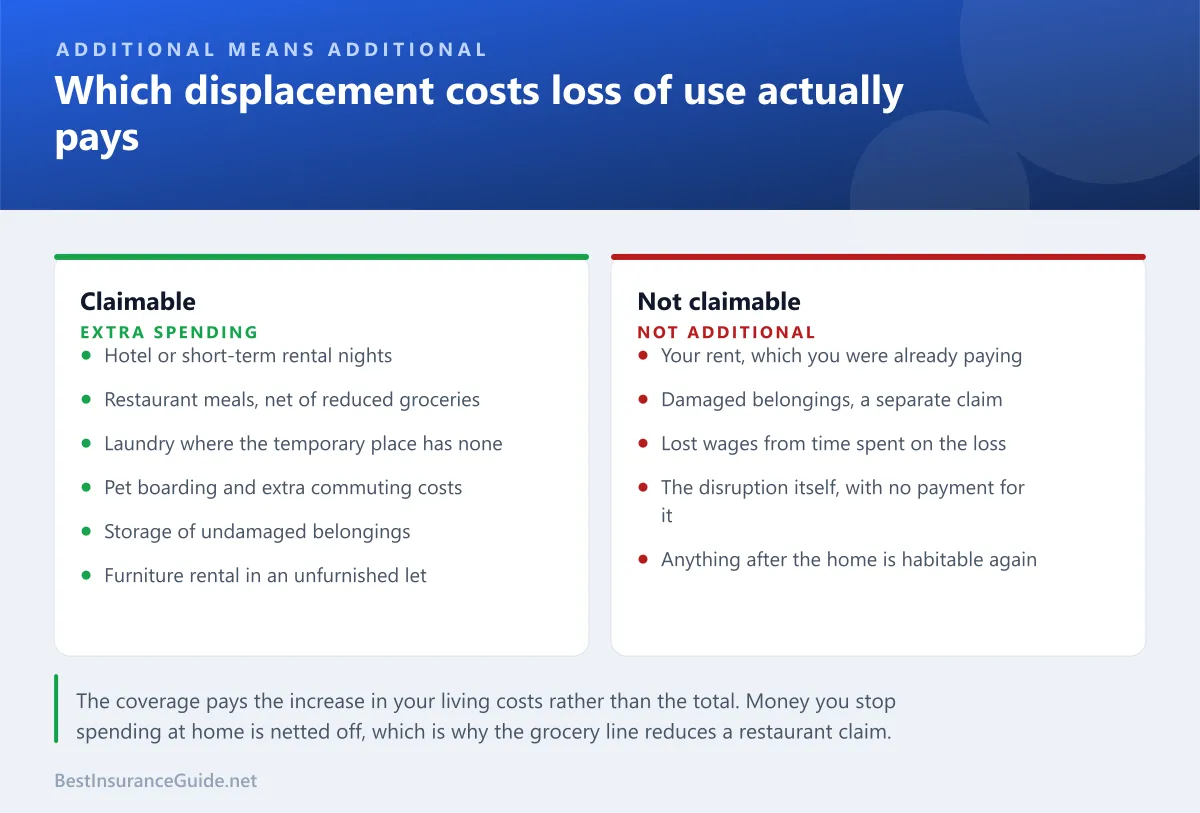
Loss of use pays the increase in your living costs, not the total. Money you no longer spend at home offsets money you spend away.
Worked example: three weeks in a hotel
| Normal month | Displaced month | Additional | |
|---|---|---|---|
| Rent, still owed | $1,650 | $1,650 | $0 |
| Hotel, 21 nights | $0 | $2,730 | $2,730 |
| Groceries | $420 | $180 | -$240 |
| Restaurant meals | $140 | $760 | $620 |
| Laundry, having no machine | $30 | $180 | $150 |
| Parking at the hotel | $0 | $210 | $210 |
| Extra commuting | $0 | $135 | $135 |
| Pet boarding | $0 | $390 | $390 |
| Storage of undamaged belongings | $0 | $190 | $190 |
| Additional living expense claimed | $4,185 |
Two things to notice.
Rent contributes nothing, because you were already paying it. That surprises people who expect the insurer to fund the hotel outright. If your lease abates rent while the unit is uninhabitable, the calculation changes in your favour and the insurer may fund more of the substitute housing.
The grocery line goes down, and that reduction is netted off. You cannot claim restaurant costs without accounting for the food you are no longer buying.
The items nobody claims
Loss of use is under-claimed not because tenants are honest but because most of the eligible costs do not feel like insurance claims.
Laundry, when the flat you are in has no machine.
Parking, at a hotel or a temporary rental where you previously parked free.
Extra commuting, if the temporary accommodation is further from work.
Pet boarding, when the hotel will not take animals. This is frequently claimable and almost never claimed.
Storage of undamaged belongings while repairs run.
Furniture rental, if you are in an unfurnished temporary let.
Higher utility costs at the temporary property, where you pay them.
Restaurant meals, netted against reduced grocery spend.
Additional childcare, where displacement has changed the arrangements.
Keep every receipt from the first night, including the small ones. A shoebox of receipts is worth several hundred dollars on a typical displacement.
The limits
Loss of use is capped, and the cap takes one of two forms.
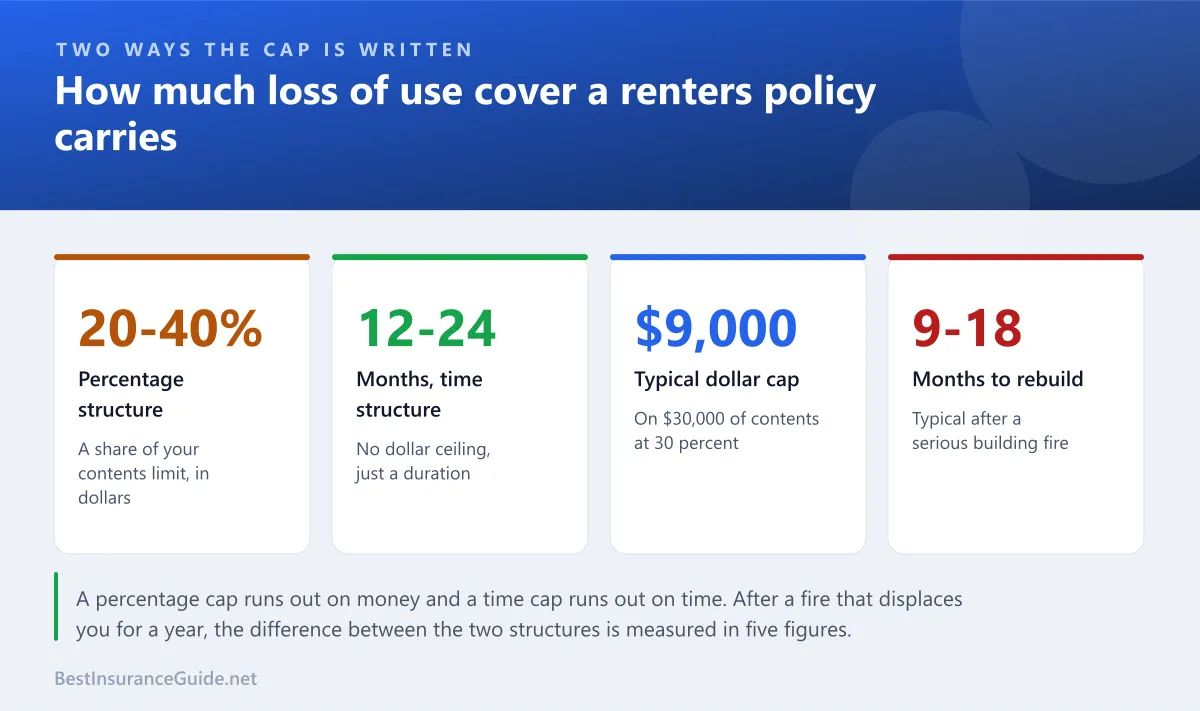
A percentage of your contents limit, commonly 20% to 40%. On $30,000 of contents at 30%, that is $9,000 of loss of use cover.
A time cap, commonly 12 to 24 months, with no dollar limit.
Both, on some policies, in which case whichever is reached first applies.
The time-capped version is generally better after a serious loss, because a fire that destroys a building can leave you displaced for a year or more and a dollar cap runs out well before the repairs finish.
Check which yours is. It is on the declarations page and it is the sort of thing nobody looks at until the week they need it.
Civil authority coverage
This is the piece almost nobody knows about and it is genuinely valuable.
Where a government order prevents you accessing your home, loss of use frequently applies even though your unit itself is undamaged.
That covers a wildfire evacuation of a neighbourhood that did not burn, a building evacuated after a gas leak, an area closed after a nearby structural failure, or a mandatory evacuation ahead of a storm.
It is usually time-limited, commonly around two weeks, and the trigger is normally that the order arose from a peril the policy covers.
If you are evacuated by order, start keeping receipts on day one and ask your insurer specifically about civil authority coverage. Most tenants in that situation assume they are on their own and never ask.
Getting paid
Loss of use is reimbursement-based on most policies, which creates a cash flow problem exactly when you have the least capacity for one.
Ask for an advance. Most insurers will release funds quickly after a significant loss, and many will pay a hotel directly. You do not have to fund three weeks of accommodation and wait for settlement.
Report immediately, before you book anything expensive, so the insurer can agree the arrangement. Booking a suite at a resort and claiming afterwards invites an argument about reasonableness.
Reasonable and comparable is the standard. A temporary home of broadly similar standard to what you lost, not an upgrade and not a downgrade.
Keep a log alongside the receipts: dates, what each cost was for, and why it was necessary.
Ask what happens if repairs run long, and track your spend against the limit so you are not surprised when it runs out.
What it does not cover
Your rent, as above, because it is not additional.
Damaged belongings, which are a personal property claim rather than loss of use.
Lost wages from time off dealing with the loss.
The inconvenience itself. There is no payment for disruption; the coverage is strictly for costs incurred.
Costs after the home is habitable again, even if you would rather not return yet.
The short version
Loss of use pays the additional cost of living elsewhere when a covered peril makes your home uninhabitable. It pays the increase in your costs rather than the total, which is why your rent contributes nothing and reduced grocery spend is netted off.
It is capped either as a percentage of your contents limit, commonly 20% to 40%, or as a time cap of 12 to 24 months. Check which yours is now rather than during a displacement.
The under-claimed items are laundry, parking, pet boarding, storage, extra commuting and furniture rental. Keep every receipt from the first night.
And ask about civil authority coverage if you are ever evacuated by order, because it frequently applies even when your own home is undamaged.
For the full list of perils that trigger it, see what renters insurance covers, and for the most common trigger, does renters insurance cover fire damage.
How long it actually lasts
The duration question matters more than the headline limit, and the two policy structures behave very differently under a serious loss.
A percentage-of-contents limit runs out on money. On $30,000 of contents at 30%, you have $9,000. In an expensive market at $150 a night plus additional food and transport, that is roughly two months.
A time cap runs out on time. Twelve or twenty-four months, with no dollar ceiling.
After a fire that destroys a building, repairs routinely take nine to eighteen months. A dollar-capped policy leaves you funding the back half of that yourself; a time-capped one does not.
Worked example: a twelve-month displacement
| Percentage limit, $9,000 | Time cap, 12 months | |
|---|---|---|
| Monthly additional cost | $1,900 | $1,900 |
| Months funded | About 4.7 | 12 |
| Total paid | $9,000 | $22,800 |
| You fund | $13,800 | $0 |
If you have a choice, the time-capped structure is materially better for the scenario the coverage exists for. If you are stuck with a percentage, consider raising the contents limit, since the loss of use figure moves with it.
Practical arrangements while displaced
Ask the insurer to pay the hotel directly where possible. Many will, which removes the cash flow problem entirely.
Agree the standard of accommodation up front. Reasonable and comparable is the test, and getting the insurer’s agreement before booking avoids an argument afterwards.
Consider a short-term rental over a hotel for anything beyond a couple of weeks. It is frequently cheaper, which preserves your limit, and having a kitchen substantially reduces the food differential you are claiming.
Keep the receipts organised as you go, with a simple log of date, amount and purpose. Reconstructing three months of receipts at the end is miserable.
Track your spend against the limit so you know where you stand rather than discovering it has run out.
Tell the insurer if repairs are running long, because some policies allow an extension and none of them offer one you did not ask for.
Talking to the adjuster about loss of use
Most of what determines your loss of use settlement happens in the first week, in conversations rather than in the policy wording.
Raise loss of use explicitly at first notification. Adjusters handle the property damage as the main event and will not always volunteer the displacement coverage. Ask what your limit is, whether it is a percentage or a time cap, and whether an advance is available.
Get the accommodation agreed before you book anything substantial. Reasonable and comparable is a judgement, and it is far easier to agree in advance than to defend afterwards. A tenant moving from a one-bedroom flat into a one-bedroom serviced apartment is on solid ground; the same tenant booking a suite is inviting a deduction.
Ask for direct billing. Many insurers will pay a hotel or a short-term let directly, which removes the cash flow problem entirely and is rarely offered unprompted.
Confirm what counts before you spend. If you are unsure whether pet boarding, storage or a furniture rental will be accepted, ask and note the answer with a date. That converts a later dispute into a record.
Put the running total in writing weekly. A short email listing what you have spent keeps the adjuster informed, prevents an unpleasant surprise as the limit approaches, and creates the paper trail that supports an extension request if repairs run long.
Worked example: a claim handled well against one handled badly
| Handled well | Handled badly | |
|---|---|---|
| Accommodation agreed in advance | Yes, paid direct | Booked first, partly disputed |
| Receipts kept from day one | Yes | Reconstructed later |
| Under-claimed categories | Claimed | Missed |
| Extension requested before limit hit | Yes | Requested after |
| Recovered on a $12,000 exposure | $11,400 | $7,200 |
The coverage was identical in both columns. The difference is entirely process, which is why loss of use rewards organisation more than any other part of a renters policy.
A note on scope
Loss of use limits, civil authority provisions and the treatment of individual expense categories vary between insurers and change over time. The figures here are illustrative rather than any particular policy’s terms.
Your declarations page states your limit and whether it is a percentage or a time cap, and that single line determines how the coverage behaves under a serious loss. This site is independent and not affiliated with any insurer.