Are COBRA Payments Tax Deductible? Sometimes, and Rarely Usefully
Whether COBRA premiums are tax deductible, the itemised medical expense threshold, HSA reimbursement, self-employed deductions, and what actually saves money.

Table of contents
The honest answer disappoints most people who ask, and there is one route that is genuinely valuable and almost unknown.
The general position
COBRA premiums are a qualifying medical expense.
That sentence is true and it is doing less work than it appears to. To convert a qualifying medical expense into an actual tax reduction, you have to clear two hurdles.
You must itemise deductions rather than taking the standard deduction. Most households take the standard deduction because it is larger than their itemised total.
Your total qualifying medical expenses must exceed a percentage of adjusted gross income, and only the excess is deductible.
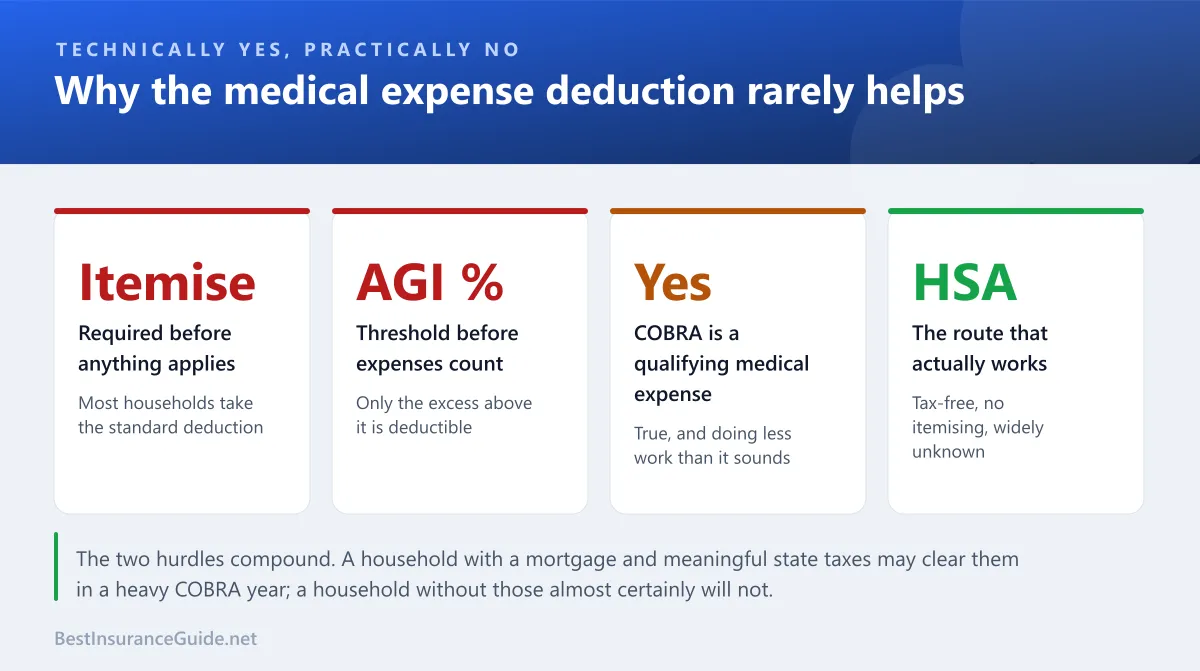
The combined effect is that for most households, the answer is technically yes and practically no.
Worked example: the itemising problem
A household with adjusted gross income of $70,000 paying $1,600 a month for family COBRA cover for seven months.
| Amount | |
|---|---|
| COBRA premiums paid | $11,200 |
| Other qualifying medical expenses | $2,300 |
| Total medical expenses | $13,500 |
| Less the AGI threshold percentage | Reduces the deductible portion substantially |
| Deductible medical expenses | The excess only |
| Other itemised deductions | Mortgage interest, state taxes, charity |
| Benefit | Only if the itemised total beats the standard deduction |
For a household with a mortgage and meaningful state taxes, a large COBRA year can genuinely tip them into itemising. For a household without those, it usually does not.
The route that actually works
A health savings account can pay COBRA premiums, tax-free.
This is the exception worth knowing, and it is widely unknown because the general rule is the opposite.
Health savings accounts normally cannot be used for insurance premiums. COBRA is one of a small number of specific exceptions, alongside coverage while receiving unemployment compensation, certain Medicare premiums, and long-term care premiums within limits.
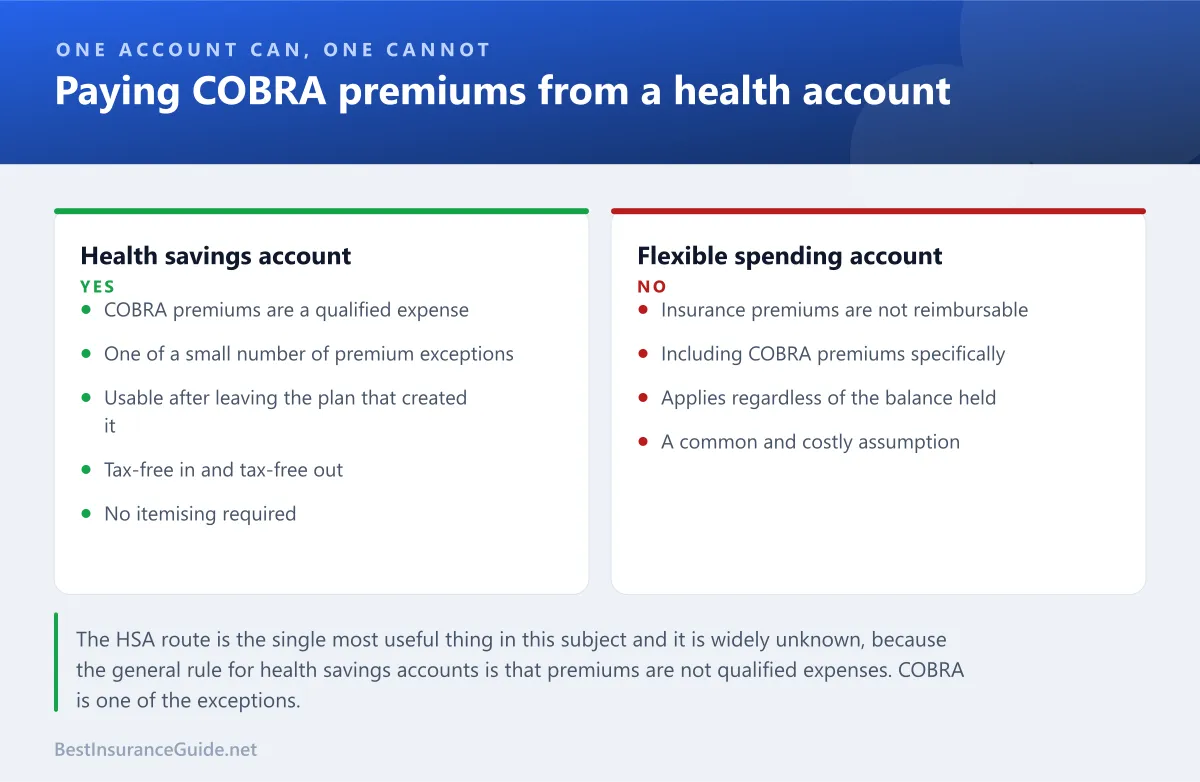
Four things make this genuinely valuable.
You can use an HSA even after leaving the plan that created it. The account is yours. You do not need to still be enrolled in a high-deductible plan to spend from it; that requirement applies only to contributing.
It is tax-free at both ends for contributions already made: no tax going in, no tax coming out for a qualified expense.
It applies to the whole premium, not to an excess above a threshold.
It requires no itemising, which removes the hurdle that defeats the deduction route for most people.
The corresponding limitation is that a health flexible spending account cannot do this. FSAs do not permit reimbursement of insurance premiums. That distinction between HSA and FSA is the single most useful piece of information in this article.
The self-employed route
A third possibility applies to a narrower group.
The self-employed health insurance deduction allows eligible self-employed people to deduct health insurance premiums as an adjustment to income, which does not require itemising.
The complication is a specific exclusion: the deduction is generally not available for any month in which you were eligible to participate in a subsidised health plan through an employer, including a spouse’s employer.
Whether COBRA continuation from a former employer counts as such a plan for these purposes depends on the specific facts, and it is genuinely a question for a tax professional rather than an article. Somebody who left employment, started a business, and elected COBRA is in exactly the fact pattern where the answer is not obvious.
What to do instead
Since the tax routes are narrow, the more productive question is usually whether COBRA is the right purchase at all.
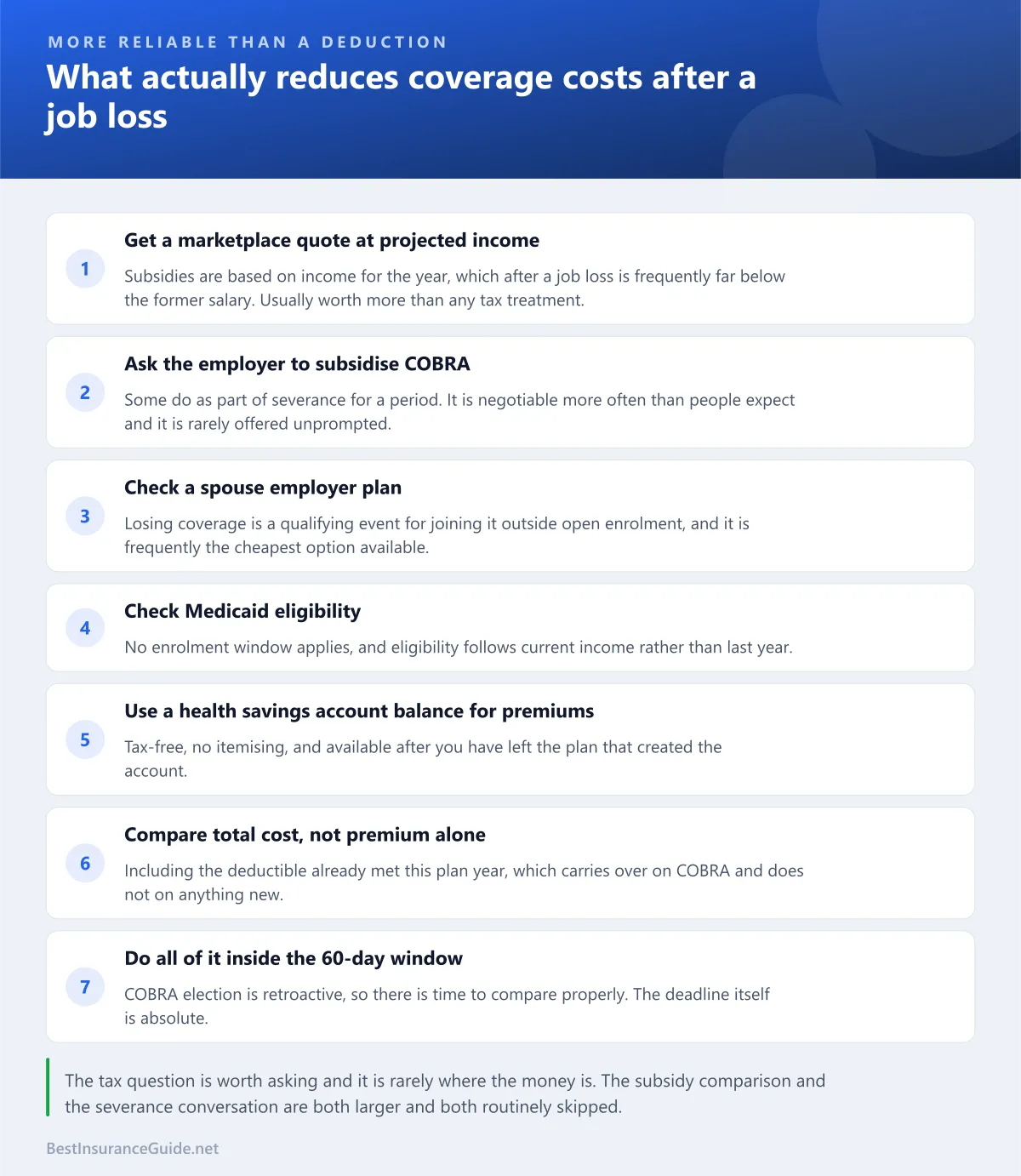
Get an actual marketplace quote at your projected income. Subsidies are based on income for the year, and somebody who has just lost a job frequently has a much lower projected income than their former salary suggests. The subsidy is usually worth more than any tax treatment of COBRA premiums.
Ask the employer whether they will subsidise COBRA. Some do as part of severance, for a period. It is negotiable more often than people expect and it is rarely offered unprompted.
Check a spouse’s employer plan. Losing coverage is a qualifying event for joining it outside open enrolment, and it is frequently the cheapest option available.
Check Medicaid eligibility if income has dropped substantially, since it has no enrolment window.
Compare on total cost, not premium alone, including the deductible you have already met on the current plan, which carries over on COBRA and does not on a new one.
Remember the election window is 60 days and coverage is retroactive, so there is time to do all of this properly. Our guide to how long COBRA coverage lasts sets out the deadlines.
Record keeping
If you are going to pursue any of the tax routes, three habits matter.
Keep every premium notice and payment record, with dates and amounts.
Keep the COBRA election notice, which evidences what the coverage was and when it started.
Keep records of HSA distributions and what they paid for. HSA reimbursements are self-certified, and the substantiation is your responsibility if questioned.
Do not reimburse the same expense twice, for example claiming an itemised deduction for a premium already paid from an HSA. That is a straightforward error and it is easy to make across a messy year.
The short version
COBRA premiums are a qualifying medical expense, which produces an actual deduction only if you itemise and your total medical expenses exceed a percentage of adjusted gross income. For most households that means no benefit.
The route that genuinely works is a health savings account, which can pay COBRA premiums tax-free as one of a small number of premium exceptions, does not require itemising, and remains available after you have left the plan that created it. A flexible spending account cannot do this.
Self-employed people may have a route through the self-employed health insurance deduction, subject to a specific exclusion that makes it a question for a tax professional.
And the more reliable saving is usually not tax at all. Get a marketplace quote at your actual projected income, ask the employer about subsidised COBRA, and check a spouse’s plan, all within the 60-day election window.
For the duration and deadlines, see how long COBRA coverage lasts, and for the arithmetic, COBRA insurance cost.
The comparison that usually matters more
Because the tax routes are narrow, the decision that actually saves money is which coverage to buy rather than how to treat its cost.
Worked example: COBRA against a subsidised marketplace plan
A household whose income has dropped after a job loss, comparing seven months of coverage.
| COBRA | Marketplace with subsidy | |
|---|---|---|
| Monthly premium | $1,600 | Varies with income, frequently far less |
| Deductible already met this year | Carries over | Starts at zero |
| Provider network | Unchanged | May differ |
| Ongoing treatment authorisations | Continue | Need re-authorisation |
| Tax treatment | Rarely deductible | Subsidy is not taxable income |
Two of those rows favour COBRA and three favour the marketplace, which is why the honest answer depends on where you are in the plan year and whether treatment is ongoing.
The general pattern: COBRA wins mid-year with a partly met deductible or active treatment; a subsidised marketplace plan wins early in the year with a substantial income drop.
Two things worth asking
Ask the employer whether they will pay some COBRA premiums. It is negotiable more often than people assume, particularly as part of a severance discussion, and it is almost never volunteered.
Ask your tax professional specifically about the health savings account route if you hold an HSA, because it is the one mechanism here that is straightforward, does not require itemising, and is widely unknown. Most people with an HSA balance and a COBRA premium do not realise the two connect.
Keeping the records that matter
Whichever route applies, the substantiation is your responsibility and it is easier to keep than to reconstruct.
Every premium notice and payment confirmation, with dates and amounts.
The COBRA election notice, which evidences the coverage period.
A record of every health savings account distribution and the expense it paid, since HSA reimbursements are self-certified.
A note of anything the employer contributed, since employer-paid COBRA has different tax treatment from premiums you paid yourself.
A clear separation between expenses claimed once and expenses claimed twice. Claiming an itemised deduction for a premium already reimbursed from an HSA is a straightforward error and an easy one to make across a disrupted year.
Two questions for a tax professional
Does the self-employed health insurance deduction apply to my COBRA months? The answer depends on the specific exclusion for months in which employer coverage was available, and on how COBRA continuation is treated in your circumstances. It is genuinely fact-specific.
Will this year’s medical expenses tip me into itemising? Somebody with a mortgage, meaningful state taxes and a large COBRA year is closer to that threshold than they assume, and the answer determines whether the premiums are worth tracking for a deduction at all.
The one-line answer for each situation
You hold a health savings account. Use it for COBRA premiums. It is tax-free, requires no itemising, and remains available after you leave the plan that created it. This is the best answer available and it applies to more people than realise it.
You itemise deductions already. Track the premiums. A large COBRA year alongside other medical expenses may clear the threshold and produce a genuine deduction.
You take the standard deduction. The medical expense route will almost certainly produce nothing. Spend the effort on the marketplace subsidy comparison instead.
You are newly self-employed. Ask a tax professional about the self-employed health insurance deduction and the employer-plan exclusion, because the answer is fact-specific and the amounts are meaningful.
You are negotiating severance. Ask for COBRA premiums to be covered for a period. It is a common concession and it is worth more than the tax treatment of paying them yourself.
Two things to check on your own position
Whether you hold a health savings account with a balance. If you do, the premiums can be paid from it tax-free, which is the cleanest answer in this whole article and one that many people with both an HSA balance and a COBRA bill never connect.
Whether your total medical expenses this year are unusually high. A large COBRA year alongside other qualifying costs is the one scenario in which the itemised medical expense deduction becomes worth calculating rather than dismissing.
Related reading
Two related decisions sit alongside the tax question. How long COBRA coverage lasts covers the duration and the election deadline, which is the more consequential of the two. Can I cancel my health insurance at any time covers what happens if the premiums become unaffordable partway through.
A note on scope
Nothing here is tax, legal or financial advice. Medical expense deduction thresholds, health savings account rules, the self-employed health insurance deduction and their interactions change over time and depend on individual circumstances.
The Internal Revenue Service publishes the authoritative guidance on medical expense deductions and health savings account qualified expenses, and the Department of Labor publishes COBRA guidance. A qualified tax professional is the appropriate source for a personal situation, particularly for the self-employed deduction question. This site is independent and not affiliated with any insurer.