Can You Get Medicare at 62? Almost Certainly Not, and Here Is What To Do
Why Medicare starts at 65, the narrow exceptions before that age, and how to cover the gap if you retire at 62 through marketplace plans, COBRA or a spouse.

Table of contents

The short answer is no, and the useful part of the question is what to do about the three years in between.
Why 65
Medicare eligibility begins at 65 for almost everyone, and that has not changed even as the Social Security full retirement age has risen.
The confusion arises because Social Security can be claimed from 62, and the two are frequently discussed together. They are separate programmes with separate eligibility ages, and claiming one early does not affect the other.
Claiming Social Security at 62 also permanently reduces the monthly benefit, which is a separate decision worth taking on its own merits rather than as part of a health cover plan.
The narrow exceptions
Medicare is available before 65 in three specific circumstances.
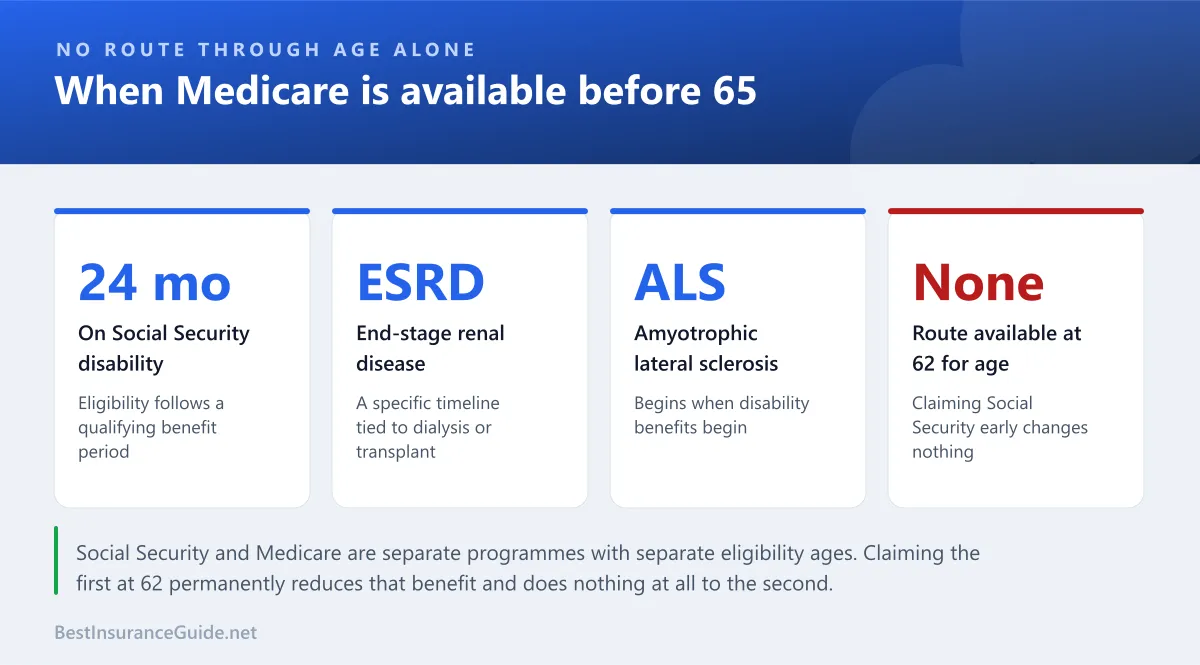
Disability. Someone who has received Social Security Disability Insurance benefits for a qualifying period, commonly 24 months, becomes eligible for Medicare regardless of age.
End-stage renal disease. Eligibility can begin on a specific timeline connected to the start of dialysis or a transplant.
Amyotrophic lateral sclerosis. Eligibility begins when disability benefits begin, without the usual waiting period.
Those are the exceptions. There is no early enrolment for age alone, no buy-in at 62, and no route through claiming Social Security early.
Bridging 62 to 65
This is the practical question, and there are five routes.
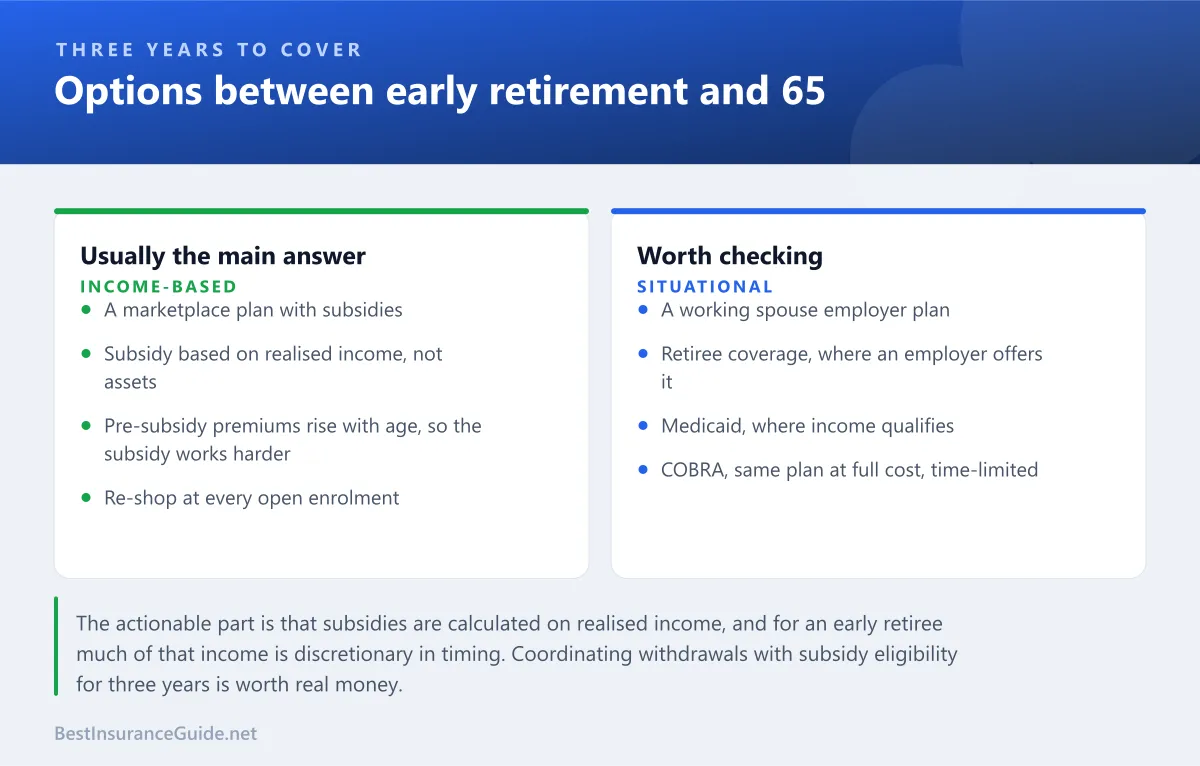
A marketplace plan. For most early retirees this is the main answer, and it is frequently better than expected. Subsidies are based on household income, not on assets and not on age. An early retiree living partly on savings may have a modest realised income, which produces a substantial subsidy. Premiums before subsidy rise with age, which means the subsidy at 62 is doing more work than it would at 40.
A spouse’s employer plan. If a partner is still working, joining their plan is usually the simplest and cheapest option. Retirement is a qualifying life event, so you can join outside their normal enrolment window.
COBRA continuation from the former employer. Keeps the same plan, the same network and the same providers, which matters a great deal during ongoing treatment. You pay the full unsubsidised cost plus an administrative charge, and it is time-limited, commonly to 18 months, so it rarely bridges three years alone.
Retiree health coverage, where a former employer offers it. Increasingly rare and worth asking about specifically.
Medicaid, where income qualifies. In expansion states this covers adults up to a defined income threshold, and it has no enrolment window.
The income planning point
This is the part that is genuinely actionable and it is frequently missed.
Marketplace subsidies are calculated on modified adjusted gross income for the year. For an early retiree, a great deal of that income is discretionary in timing: which accounts to draw from, when to realise capital gains, whether to convert retirement accounts, and when to claim Social Security.
Worked example: the same household, two withdrawal strategies
A couple aged 62 and 61, retiring, with savings across taxable and tax-deferred accounts.
| Drawing mostly from tax-deferred | Drawing mostly from taxable savings | |
|---|---|---|
| Realised income for the year | Higher | Lower |
| Marketplace subsidy | Reduced or lost | Substantial |
| Net annual premium cost | Considerably higher | Considerably lower |
| Long-run tax position | Different, and worth modelling | Different, and worth modelling |
The point is not that one column is right. It is that the health insurance cost is a function of a decision most people make for unrelated reasons, and coordinating the two for the three years before Medicare is worth real money.
This is genuinely a case for professional advice, because the interaction between withdrawal strategy, tax and subsidy eligibility is complex and the amounts involved over three years are substantial.
Preparing for 65
Two things matter and both have deadlines.
The initial enrolment period runs for seven months around your 65th birthday, starting three months before the month you turn 65 and ending three months after. Enrolling in the three months before means coverage begins the month you turn 65.
Late enrolment penalties are permanent. Part B carries a penalty that increases the premium for as long as you have Part B, and Part D carries a similar lifelong penalty. These are avoidable and they are not forgiven.
Two situations where the timing differs.
Still working at 65 with employer coverage. Where the employer is large enough, you may delay Part B without penalty and enrol later through a special enrolment period. The rules depend on employer size and on the type of coverage, and getting this wrong is expensive, so confirm it rather than assuming.
Health savings account contributions must stop before Medicare enrolment, and enrolment can be applied retroactively in some circumstances, which creates a tax problem if contributions continued. Anyone contributing to an HSA approaching 65 should take specific advice on the timing.
What to do at 62
Work out what a marketplace plan would actually cost you, using your projected income rather than your former salary. This is the single most useful thing to do, and most people are surprised by the answer.
Check whether a spouse’s plan is available, and what adding you costs.
Ask your former employer about retiree coverage and about the COBRA cost, in writing.
Model the withdrawal strategy against subsidy eligibility for the three years, ideally with an adviser.
Check that your providers are in the network of whatever plan you choose, since continuity of care matters more at this age than at any earlier one.
Diarise the Medicare initial enrolment period three months before your 65th birthday, now, while you are thinking about it.
The short version
Medicare begins at 65 and there is no route to it at 62 on the basis of age. Claiming Social Security early does not change that.
The narrow exceptions are long-term disability benefits, end-stage renal disease and ALS.
For an early retiree, a marketplace plan is usually the main answer, and the subsidy is based on realised income rather than assets, which makes the withdrawal strategy for those three years genuinely consequential. A spouse’s plan, COBRA, retiree cover and Medicaid fill the remaining cases.
And whatever bridges the gap, diarise the Medicare initial enrolment period now, because the late enrolment penalties on Part B and Part D are permanent.
For the programme comparison, see Medicare versus Medicaid, and for cover after leaving a job, health insurance without a job.
The parts of Medicare, for planning purposes
Since the point of this article is preparing for 65, a brief orientation helps.
Part A covers inpatient hospital care and is premium-free for most people based on work history.
Part B covers outpatient care, physician services and durable medical equipment, and carries a monthly premium that rises with income.
Part C, Medicare Advantage, is a private plan alternative bundling A and B and usually D, with networks and its own rules.
Part D covers prescription drugs, through a private plan, and carries its own premium and late enrolment penalty.
Medigap, or Medicare Supplement, covers cost sharing left by A and B, and is sold separately.
The decision that matters most at 65 is Advantage against Original Medicare plus Medigap, and the reason it matters is that the Medigap purchase has a one-time guaranteed issue window in most states. Outside it, insurers can medically underwrite, which means a person who chooses Advantage at 65 and wants to switch later may not be able to buy the Medigap policy they want.
That is a genuinely consequential decision made once, and it is worth understanding before the birthday rather than during the enrolment window.
Free help that most people do not use
Every state operates a State Health Insurance Assistance Program, providing free, unbiased counselling on Medicare decisions. It is funded to advise rather than to sell, and it is the single best resource available for this decision.
Two other sources worth knowing.
Medicare.gov’s plan finder, which compares Part D and Advantage plans against your actual prescription list. This matters because Part D plans differ enormously in what they cover and at what tier, and the cheapest premium is frequently not the cheapest total cost.
Your state insurance department, which publishes Medigap rate comparisons in many states.
A three-year plan, year by year
At 62, or at retirement. Model what a marketplace plan costs at your projected realised income. Check whether a spouse’s plan is available. Ask the former employer about retiree coverage and the COBRA cost in writing.
Each year to 65. Reassess the withdrawal strategy against subsidy eligibility before the year begins rather than after, because income is far easier to shape prospectively. Re-shop the marketplace plan at open enrolment, since plans and networks change annually and auto-renewal frequently costs money.
At 64 and nine months. The Medicare initial enrolment period opens. Enrol in the three months before your birthday month so coverage begins the month you turn 65.
Before enrolling. Stop health savings account contributions in good time, decide between Original Medicare with Medigap and Medicare Advantage, and use the free State Health Insurance Assistance Program counselling rather than a salesperson.
At 65. Confirm Part B and Part D are in place, and confirm the marketplace plan is ending cleanly so there is no overlap or gap.
The mistake that costs the most
Delaying Part B without qualifying employer coverage.
The penalty is a permanent increase in the Part B premium for as long as you hold it, and Part D carries a similar lifelong penalty. Neither is forgiven, and both are entirely avoidable by knowing the date.
If you are still working at 65 with employer coverage, whether you may delay depends on employer size and coverage type. That determination is worth confirming with Medicare or a State Health Insurance Assistance Program counsellor rather than assuming, because getting it wrong is expensive for the rest of your life.
Two things to do this month
Get an actual marketplace quote at your projected income, rather than assuming it is unaffordable. Subsidies are calculated on realised income and the result frequently surprises early retirees, particularly those drawing partly from taxable savings.
Ask your former or current employer, in writing, what happens to coverage at retirement, including whether retiree cover exists, what COBRA would cost, and the exact date active coverage ends.
Both are free and both inform every other decision in the three-year plan.
The health savings account detail
Anyone contributing to a health savings account approaching 65 needs to know one specific rule, because getting it wrong creates a tax problem.
HSA contributions must stop before Medicare coverage begins. Medicare enrolment disqualifies you from contributing, and enrolment can be applied retroactively for up to six months in some circumstances where Social Security has been claimed.
The practical consequence is that contributions made in the months immediately before enrolment can become excess contributions after the fact, with tax and penalty consequences.
The usual guidance is to stop contributing several months before Medicare begins, and to take specific advice on the exact timing given how you are claiming Social Security. The amounts involved are modest and the administrative unpleasantness is not.
Related reading
Two of the bridging options have their own detail. How long COBRA coverage lasts covers the continuation route and why eighteen months rarely bridges a three-year gap alone. How long Medicaid approval takes covers the option worth checking where income has dropped substantially at retirement.
A note on scope
Nothing here is financial, tax or legal advice. Medicare eligibility rules, enrolment periods, penalty calculations, marketplace subsidy formulas and Medicaid eligibility are set by federal and state authorities and change over time.
Medicare.gov publishes the authoritative eligibility and enrolment rules, HealthCare.gov and your state marketplace publish subsidy and enrolment information, and your State Health Insurance Assistance Program offers free counselling on Medicare decisions. A qualified tax or financial adviser is the appropriate source on coordinating withdrawals with subsidy eligibility. This site is independent and not affiliated with any insurer.