Medicare vs Medicaid: Two Programmes, One Confusing Letter Apart
Is Medicare and Medicaid the same? No. One is age-based and federal, one is income-based and state-run. Eligibility, costs, and whether you can have both.

Table of contents
Medicare and Medicaid are separate programmes that sound almost identical, were created at the same time, and do genuinely different jobs. The confusion is entirely understandable and it causes real problems, because people assume they are covered by one when they qualify for the other.
The one-line difference
Medicare is about age. Federal, uniform across the country, for people 65 and over plus certain younger people with disabilities. Your income is irrelevant.
Medicaid is about income. Jointly funded by federal and state government, administered by your state, with rules and names that vary. Your income and circumstances determine everything.
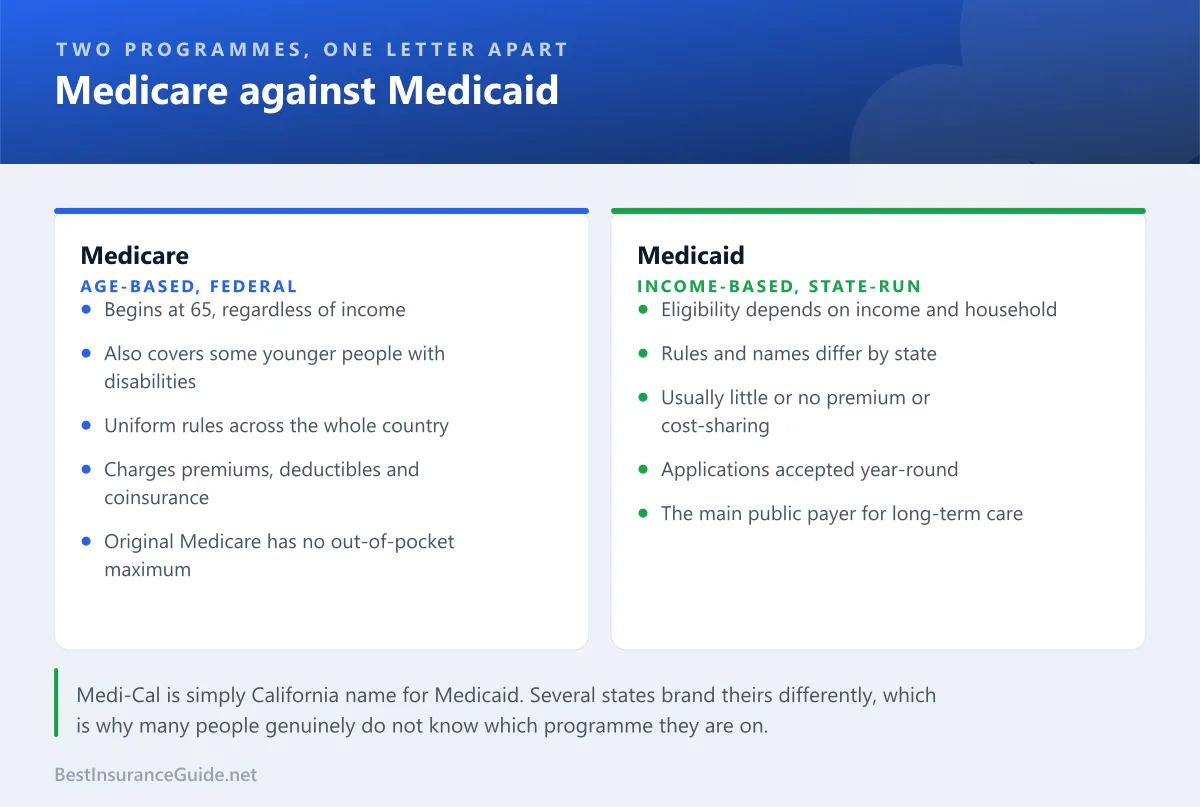
That is the whole distinction. Everything else follows from it.
Medicare in practice
Medicare comes in parts, and the alphabet is the confusing bit.
Part A, hospital insurance. Inpatient stays, limited skilled nursing, hospice, some home health. Usually premium-free if you or a spouse paid Medicare taxes for about ten years. It has a deductible per benefit period, not per year, which trips people up.
Part B, medical insurance. Doctor visits, outpatient care, preventive services, durable medical equipment. Charges a monthly premium, which is higher for higher incomes, plus an annual deductible and generally 20% coinsurance with no out-of-pocket maximum.
Part C, Medicare Advantage. A private plan that replaces Parts A and B, usually bundling Part D and often extras like dental or vision. It works like an HMO or PPO with a network, and unlike original Medicare it does have an out-of-pocket maximum.
Part D, prescription drugs. A separate private plan, or included in Advantage.
Medigap. Supplemental private policies that cover the gaps in original Medicare’s cost-sharing. You cannot hold Medigap alongside Medicare Advantage; it is one route or the other.
The critical thing people underestimate: original Medicare has no cap on your out-of-pocket costs. That 20% coinsurance on Part B applies to everything, including expensive ongoing treatment. This is why most beneficiaries add either Medigap or Medicare Advantage rather than relying on original Medicare alone.
Can you get Medicare at 62?
No, not on age. This is one of the most persistent misunderstandings in the whole system.
You can claim Social Security retirement benefits from 62 at a reduced rate. Medicare eligibility still begins at 65. Claiming Social Security early does not accelerate Medicare, and the three-year gap between the two catches people who retire at 62 assuming health coverage comes with it.
If you retire before 65, you need coverage for the gap: a marketplace plan, COBRA, a spouse’s plan or retiree coverage. Our guide to health insurance without a job covers those routes, and marketplace subsidies are often generous for someone living on early Social Security.
Three exceptions grant Medicare before 65:
Social Security Disability Insurance for 24 months. Coverage begins in month 25.
End-stage renal disease. Eligibility regardless of age, with its own timing rules.
ALS. Eligibility begins with SSDI benefits, without the 24-month wait.
Enrolment timing matters more than almost anything
Your initial enrolment period runs seven months: three before the month you turn 65, the birthday month, and three after.
Miss it without qualifying coverage and you can face lifelong late enrolment penalties on Part B and Part D. The Part B penalty in particular is permanent and increases with each year of delay.
The main exception is having creditable coverage through active employment, yours or a spouse’s, which lets you delay without penalty and gives you a special enrolment period when that employment ends. Note the word active: retiree coverage and COBRA generally do not count for this purpose, which is a genuinely expensive trap.
Medicaid in practice
Medicaid covers a much broader population than most people realise: children, pregnant women, parents, adults under an income threshold in expansion states, people with disabilities, and older adults needing long-term care.
Cost. Usually no premium or a very small one, and minimal cost-sharing. For those who qualify, it is the most comprehensive coverage available at the lowest cost.
Scope. Federally required benefits plus optional ones each state may add. Coverage of dental, vision and some therapies varies considerably by state.
Long-term care. This is the part Medicare does not do, and it is why Medicaid matters to families who never expected to encounter it. Medicaid is the largest public payer for nursing home care in the country.
Applications run year-round. There is no open enrolment. Apply whenever your circumstances change, and coverage can typically be backdated up to three months for bills already incurred.
Approval times. States are generally required to decide within about 45 days, or around 90 days where a disability determination is involved. Incomplete documentation is the usual cause of delay.
The naming problem
Medi-Cal is California’s Medicaid programme. Same thing, different name.
Several states brand theirs distinctly, which is why people genuinely do not know whether they have Medicaid. If you are on a state health programme for low-income residents, it is almost certainly Medicaid under a local name.
This also explains a persistent search confusion: people asking whether “medical” and Medicaid are the same are usually asking about Medi-Cal, and the answer is yes.
Having both: dual eligibility
Around one in ten Medicare beneficiaries also qualifies for Medicaid. These are described as dual eligible, and the combination is powerful.
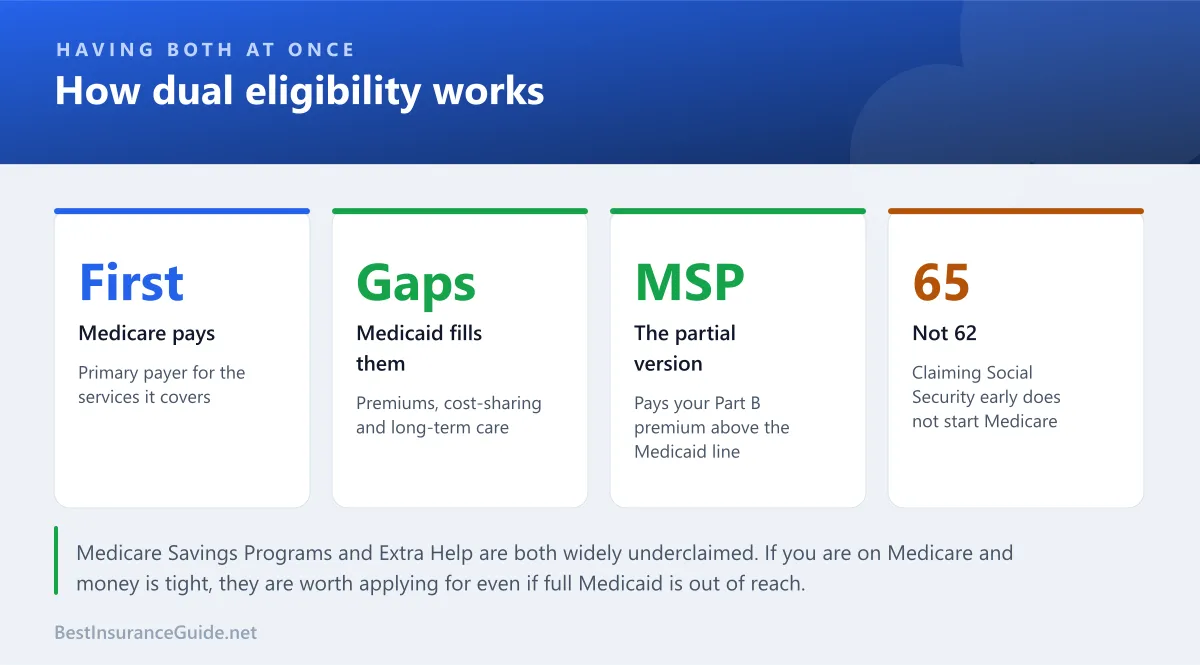
Medicare pays first as the primary payer for services it covers.
Medicaid fills the gaps: Part B premiums, deductibles, coinsurance, and services Medicare does not cover at all, most importantly long-term custodial care.
Medicare Savings Programs are the partial version, and they are widely underclaimed. Even where full Medicaid is out of reach, these programmes can pay your Part B premium and sometimes your cost-sharing, for people whose income sits modestly above the Medicaid line. If you are on Medicare and money is tight, this is worth applying for.
Extra Help, the low-income subsidy for Part D, similarly reduces prescription costs and is separately worth checking.
Which one applies to you
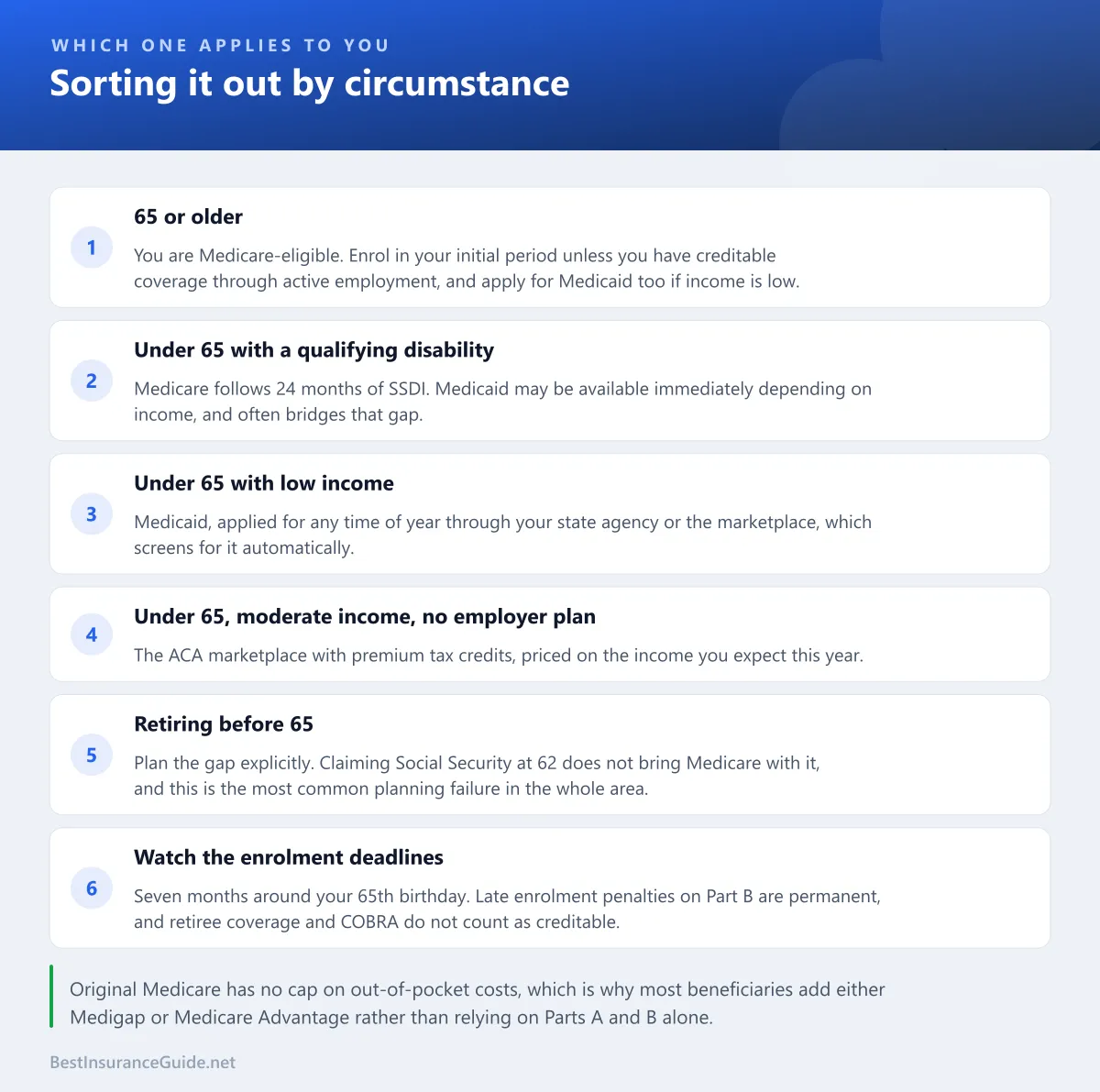
The practical sorting:
65 or older, you are Medicare-eligible. Enrol during your initial enrolment period unless you have creditable coverage through active employment. If your income is low, apply for Medicaid or a Medicare Savings Program as well.
Under 65 with a qualifying disability, Medicare follows 24 months of SSDI. Medicaid may be available immediately depending on income and state, and often bridges that 24-month gap.
Under 65, low income, Medicaid is the route, applied for at any time of year through your state agency or the marketplace, which screens for it automatically.
Under 65, moderate income, no employer plan, the ACA marketplace with premium tax credits is usually the answer.
Retiring before 65, plan for the gap explicitly. It is the single most common planning failure in this area.
The short version
Medicare is federal and age-based, starting at 65 regardless of income, with parts covering hospital, medical, drugs and private alternatives. It has no out-of-pocket cap in its original form, which is why most people add Medigap or Medicare Advantage.
Medicaid is state-administered and income-based, accepts applications year-round, usually costs little or nothing, and is the main public payer for long-term care. Medi-Cal is simply California’s version.
You cannot get Medicare at 62 by claiming Social Security early. You can have both programmes at once, and if your income is modest you should check Medicare Savings Programs and Extra Help, both of which are widely underclaimed.
For the terminology that applies once you are choosing between plan designs, HMO vs PPO and your insurance card and health insurance terms explained cover the mechanics.