Deductible vs Out-of-Pocket Maximum: What Happens After You Meet It
Deductible vs max out of pocket, what happens when you meet your deductible, and whether prescriptions count. With a full worked year of medical bills.

Table of contents

Two numbers on a health plan do most of the work, and people routinely confuse them.
The deductible is where the plan starts helping. The out-of-pocket maximum is where the plan takes over entirely. Everything meaningful about a health plan happens in the space between them.
The three stages of a plan year
Every plan year moves through the same three phases.
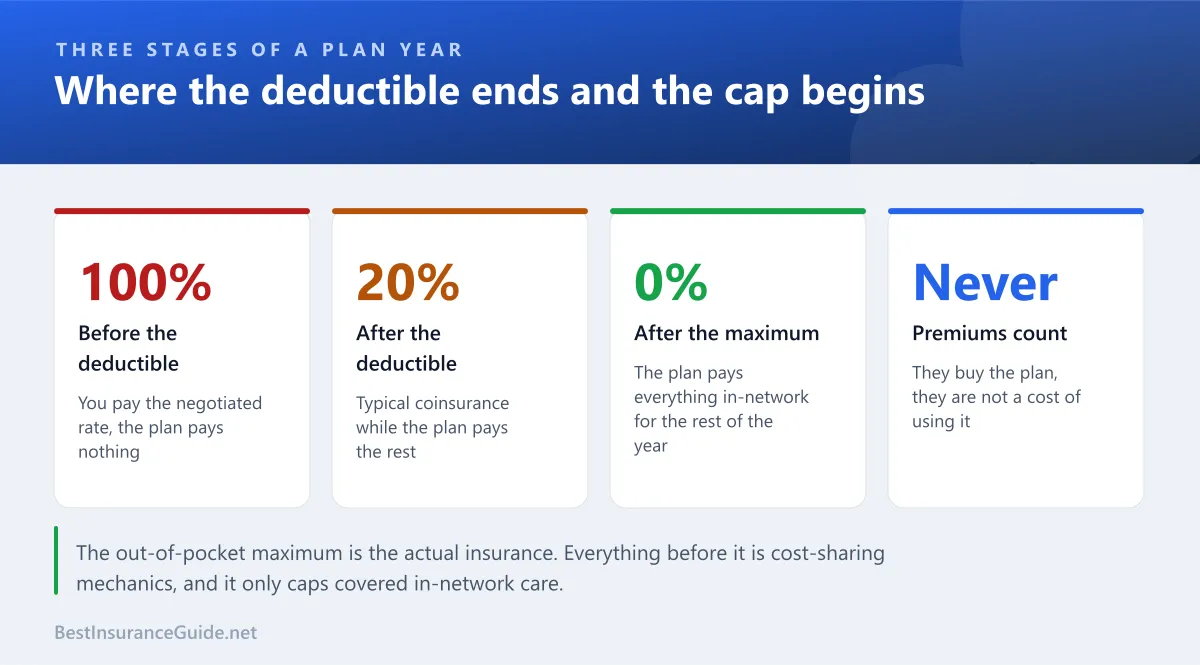
Stage one, before the deductible. You pay the full negotiated cost of covered care. The insurer pays nothing toward it, though you still benefit from their negotiated rates, which are typically far below list price. Preventive care is the exception and is covered from day one on ACA-compliant plans.
Stage two, after the deductible, before the out-of-pocket maximum. You and the plan share. You pay coinsurance, commonly 20%, and the plan pays the remaining 80%. This is the stage people mean when they say “insurance kicked in.”
Stage three, after the out-of-pocket maximum. The plan pays 100% of covered in-network care for the rest of the year. You pay nothing more, no matter how large the bills get.
That third stage is the whole product. Everything else is cost-sharing mechanics; the out-of-pocket maximum is the actual insurance.
What happens when you meet your deductible
The common misunderstanding is that meeting the deductible means care becomes free. It does not. It means you stop paying everything and start paying a share.
Worked example: a full plan year, start to finish
A plan with a $2,500 deductible, 20% coinsurance, a $7,000 out-of-pocket maximum and $30 primary care copays.
| Event | Billed | You pay | Plan pays | Running total you have paid |
|---|---|---|---|---|
| Annual physical | $310 | $0 | $310 | $0 |
| GP visit, chest pain | $30 copay | $30 | Rest | $30 |
| Imaging and cardiology | $2,640 | $2,470 | $170 | $2,500 deductible met |
| Same visit, remaining balance | ||||
| Hospital admission, 3 nights | $21,800 | $4,360 | $17,440 | $6,860 |
| Follow-up specialist | $420 | $84 | $336 | $6,944 |
| Physiotherapy, 6 sessions | $960 | $56 | $904 | $7,000 max reached |
| Everything else that year | $9,400 | $0 | $9,400 | $7,000 |
| Totals | $35,560 | $7,000 | $28,560 |
Three things worth pulling out of that table.
The imaging visit is where the deductible finished. The patient paid $2,470 of a $2,640 bill, and the plan picked up the last $170 because the deductible was satisfied part way through.
The hospital admission is where the plan earned its keep. A $21,800 bill cost the patient $4,360.
The physiotherapy capped out mid-course. The patient paid $56 of a $960 bill and then paid nothing for the rest of the year, including $9,400 of further care.
Total exposure: $7,000, exactly as the plan promised, regardless of the $35,560 billed.
What counts toward each
This is where plans differ and where people get caught out.
Counts toward the out-of-pocket maximum: your deductible, your coinsurance, and copays for covered in-network services.
Never counts: your monthly premium. Premiums are the price of having the plan, not a cost of using it, and they sit entirely outside both numbers.
Usually does not count: out-of-network care, anything the plan does not cover at all, and balance billing where a provider charges above the allowed amount.
That last category matters more than the rest combined. The out-of-pocket maximum only caps in-network covered care. Go out of network and the ceiling either rises to a separate, much higher out-of-network maximum or disappears altogether. This is how people with good insurance still receive catastrophic bills, and it is why checking network status before non-emergency care is worth the phone call.
Do prescriptions count towards the deductible?
The most-asked detail, and the answer is genuinely plan-specific.
Toward the out-of-pocket maximum: almost always yes. Prescription costs count.
Toward the medical deductible: it varies, and there are three common designs.
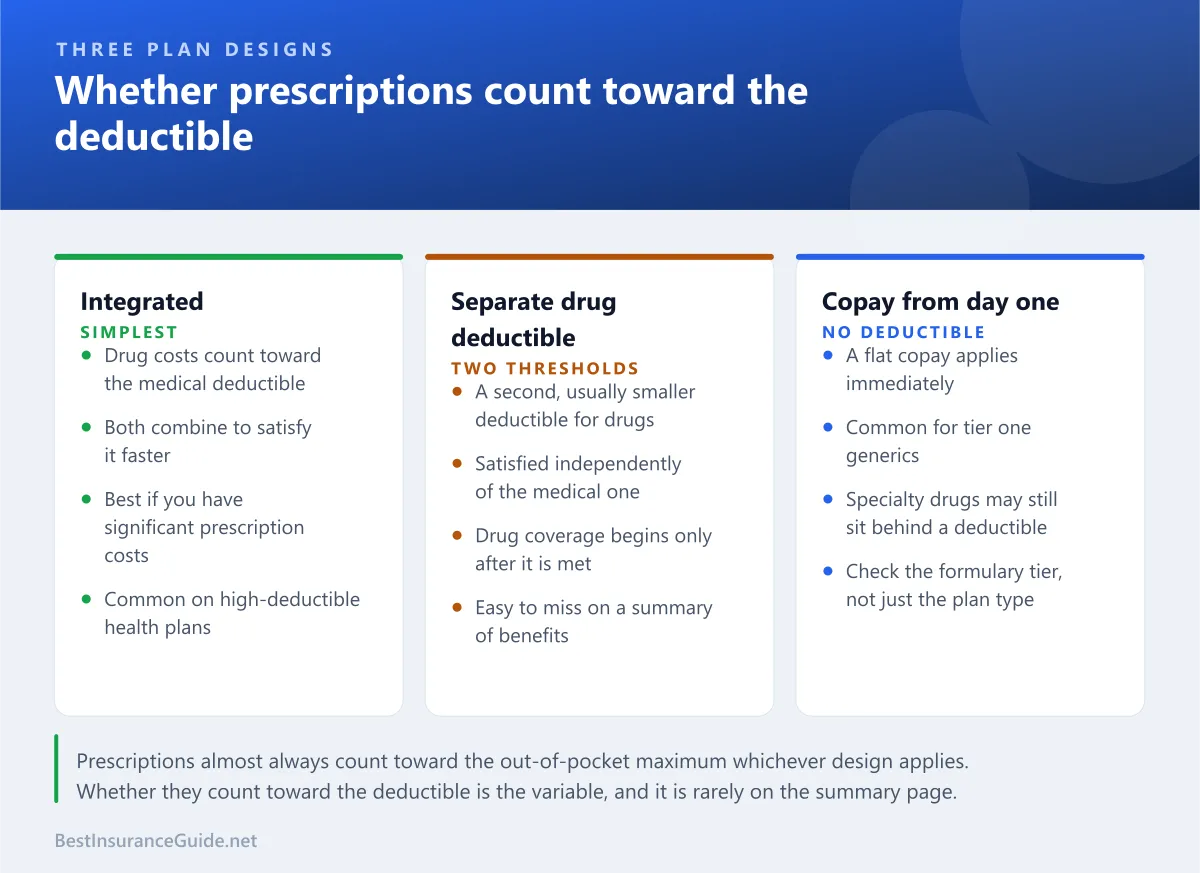
Integrated. Drug costs count toward the same deductible as medical care. Simplest, and best for anyone with significant prescription costs, because the two combine to satisfy the deductible faster.
Separate prescription deductible. The plan runs a second, usually smaller deductible for drugs. You satisfy it independently before drug coverage begins.
Copays from day one. Many plans, particularly for generics, apply a flat copay immediately without touching the deductible. Common on tiered formularies where tier one generics are copay-only and specialty drugs sit behind the deductible.
If you take anything regularly, this is the single most important thing to check when comparing plans, and it is rarely on the summary page. Look for the formulary and the prescription deductible line specifically.
Two related notes. Manufacturer copay assistance may not count toward your deductible or maximum under copay accumulator programmes, which surprises people using expensive specialty drugs. And high-deductible health plans are legally required to apply the deductible to most care including prescriptions, which is what makes them HSA-eligible.
Family plans: embedded or aggregate
Family coverage adds a wrinkle worth understanding before anyone gets ill.
Embedded deductibles give each family member an individual deductible inside the family one. Once a person meets their individual deductible, the plan starts sharing for that person even if the family total is unmet. Most ACA-compliant plans work this way.
Aggregate deductibles require the whole family deductible to be met before the plan pays for anyone. Common on high-deductible plans. If one family member has a serious year, the entire family deductible must be satisfied from that one person’s care before cost-sharing begins.
The practical difference is large. On a $6,000 family deductible with a $3,000 embedded individual limit, one person’s surgery triggers cost-sharing at $3,000. On an aggregate design, it does not trigger until $6,000.
Why a higher deductible lowers your premium
This is not specific to health insurance. It is the mechanism behind every deductible on every policy you own.
A deductible is the portion of risk you keep. The higher it is, the less the insurer expects to pay across small and mid-sized claims, and the less they charge you for the policy.
The effect is strongest at the low end because small claims are common and large claims are rare. Moving a deductible from $500 to $1,000 removes a large number of potential claims from the insurer’s expected costs. Moving it from $5,000 to $5,500 removes almost none, because few claims land in that band. That is why the premium saving per dollar of deductible shrinks as the deductible rises.
The same logic drives home and auto pricing. Raising a homeowners insurance deductible from $1,000 to $2,500 produces a meaningful premium reduction, and raising a comprehensive deductible on a car does the same. Our guide to what drives your insurance premiums works through where each lever sits.
The honest test for any deductible, in any line, is the same: could you pay it, today, without borrowing? If yes, take the higher deductible and pocket the premium saving. If no, you have bought a policy you cannot afford to use, which is the worst of both outcomes.
Choosing between a low and high deductible plan
Worked example: two plans, three different years
| Low-deductible plan | High-deductible plan | |
|---|---|---|
| Monthly premium | $520 | $290 |
| Annual premium | $6,240 | $3,480 |
| Deductible | $1,000 | $5,000 |
| Out-of-pocket maximum | $4,500 | $7,500 |
A healthy year, $600 of care
| Low | High | |
|---|---|---|
| Premium | $6,240 | $3,480 |
| Care | $600 | $600 |
| Total | $6,840 | $4,080 |
A moderate year, $9,000 of care
| Low | High | |
|---|---|---|
| Premium | $6,240 | $3,480 |
| Care | $2,600 | $5,800 |
| Total | $8,840 | $9,280 |
A severe year, $80,000 of care
| Low | High | |
|---|---|---|
| Premium | $6,240 | $3,480 |
| Care (capped at maximum) | $4,500 | $7,500 |
| Total | $10,740 | $10,980 |
The high-deductible plan wins clearly in the healthy year, loses modestly in the moderate year, and is roughly a wash in the catastrophic year because the premium saving offsets the higher ceiling.
That last row is the important one. People avoid high-deductible plans fearing the worst case, but the worst case is where the two plans converge. The real risk is the middle year, and the real question is whether you could produce $5,000 in a difficult month.
Add a health savings account and the arithmetic shifts further toward the high-deductible plan. Contributions are pre-tax, growth is untaxed, and withdrawals for medical costs are untaxed. It is the only account with all three, and it can also pay COBRA premiums, as our guide to COBRA costs covers.
The short version
The deductible is where the plan starts sharing. The out-of-pocket maximum is where the plan pays everything. Deductible, coinsurance and copays all count toward the maximum; premiums never do, and out-of-network care usually does not.
Prescriptions almost always count toward the maximum, but whether they count toward the deductible depends on whether your plan is integrated, runs a separate drug deductible, or applies copays from day one. Check that before anything else if you take medication regularly.
A higher deductible lowers the premium because you are keeping more of the risk. Take the higher one only if you could pay it today without borrowing.
For the rest of the vocabulary, health insurance terms explained covers premiums, copays, coinsurance and networks with the same worked-example approach.