How Much Does COBRA Insurance Cost? The 102% Nobody Warns You About
COBRA costs 102% of the full group premium, not the payroll deduction you are used to. What COBRA actually costs, how long it lasts, and cheaper alternatives.

Table of contents
The number on the COBRA election notice is the part that stops people mid-sentence.
You were paying $180 a month. The notice says $742. Nothing about the plan changed, the network is identical, the deductible is identical. What changed is who is paying, and you had probably never seen what the coverage actually cost.
Why the number is so much bigger
Employer health coverage is heavily subsidised, and the subsidy is invisible because it never touches your paycheck.
Your employer pays most of the premium. Your payroll deduction is the remainder. When employment ends, the subsidy ends with it and you become responsible for the whole thing, plus a 2% administration fee the law permits the plan to charge.
That is the entire mechanism. COBRA costs 102% of the full group premium.
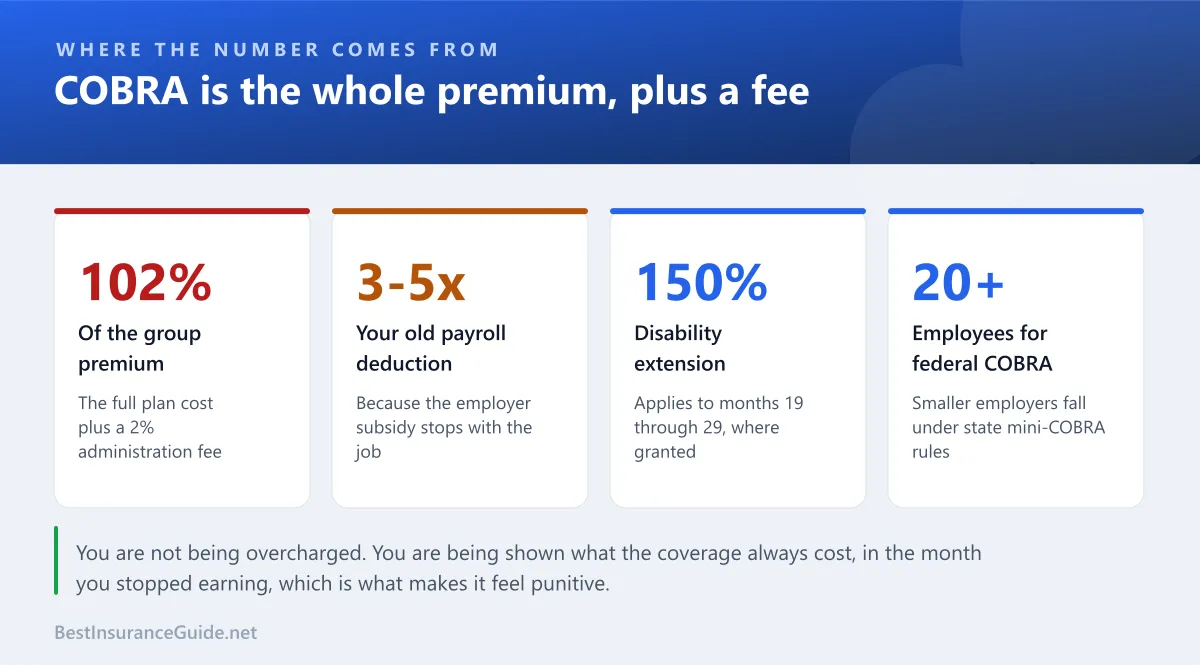
Employers typically cover a large majority of single-coverage premiums and a somewhat smaller share of family premiums. That is why the jump feels so violent: you are not being charged more than the plan is worth, you are being charged what it always cost.
Worked example: what the payslip was hiding
A single employee on a mid-range PPO.
| Monthly | |
|---|---|
| Total plan premium | $728 |
| Employer paid | $557 |
| Payroll deduction you saw | $171 |
| COBRA: full premium | $728 |
| Plus 2% administration fee | $15 |
| COBRA premium | $743 |
The same coverage, at 4.3 times the price, in the month you lost your income. That timing is what makes COBRA feel punitive even though it is functioning exactly as designed.
Worked example: a family, which is where it really hurts
| Monthly | |
|---|---|
| Total family premium | $2,090 |
| Employer paid | $1,466 |
| Payroll deduction you saw | $624 |
| COBRA premium (102%) | $2,132 |
Over an 18-month COBRA term, that family would pay roughly $38,000 to keep a plan that had been costing them $11,200 over the same period.
How long COBRA lasts
The duration depends on why coverage ended, not on what you want.
| Qualifying event | Maximum coverage |
|---|---|
| Job loss, voluntary or involuntary | 18 months |
| Reduction in hours below eligibility | 18 months |
| Disability determined within 60 days of the event | Extends to 29 months |
| Divorce or legal separation from the covered employee | 36 months |
| Death of the covered employee | 36 months |
| Dependent child aging off the plan | 36 months |
| Covered employee becoming entitled to Medicare | 36 months for dependents |
Two things about that table.
The disability extension months 19 through 29 can be charged at 150% of the group premium rather than 102%. It is still usually worth having, but the price steps up.
COBRA only exists where a group plan exists. If your former employer terminates the plan entirely, there is no coverage to continue and COBRA ends with it. Employers with fewer than 20 employees are outside federal COBRA altogether, though many states run their own continuation rules for small groups, often called mini-COBRA. Check your state insurance department rather than assuming you have no options.
The deadlines, which are the part that goes wrong
COBRA is unusually forgiving on timing and unusually unforgiving if you miss a window.
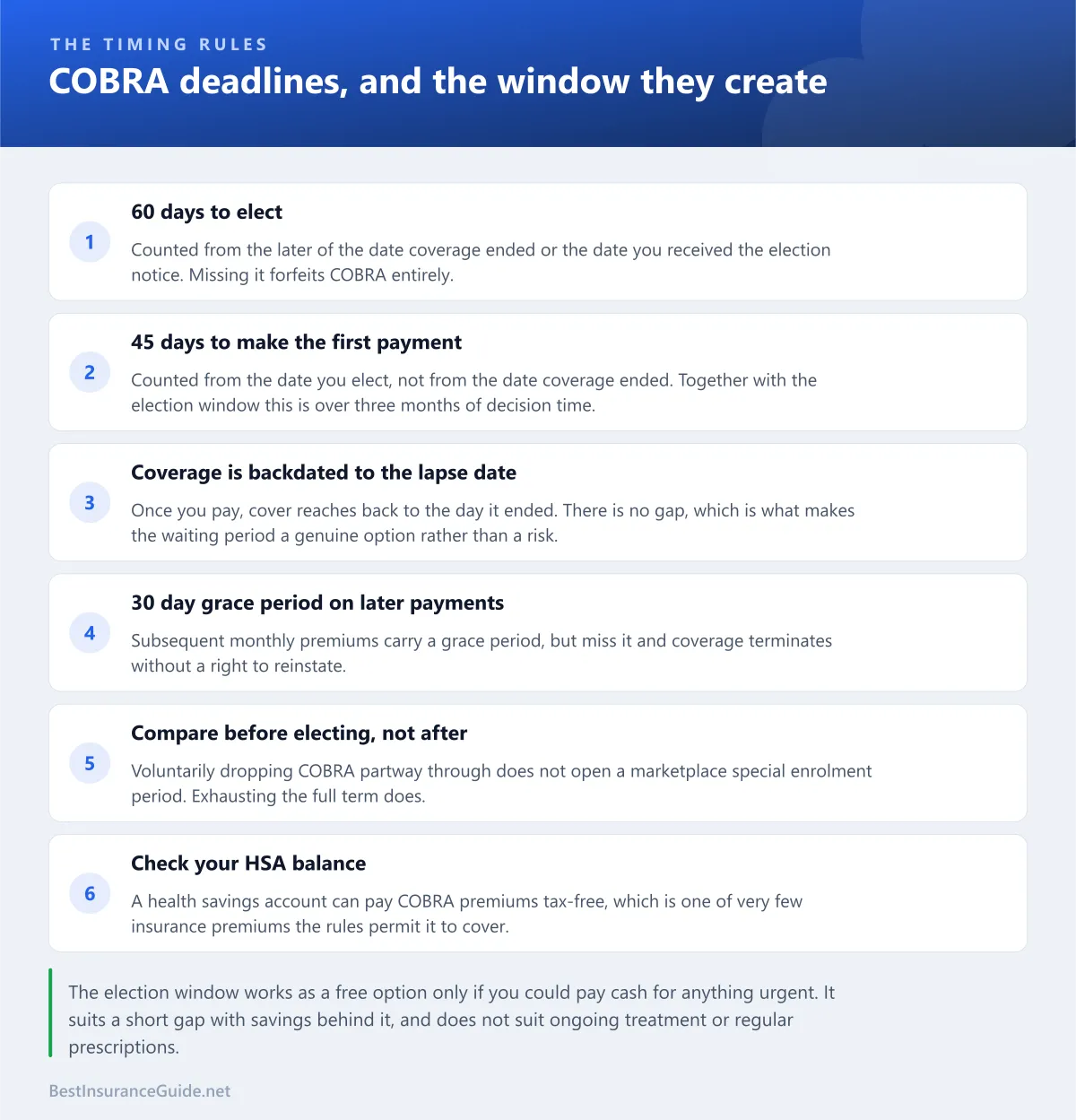
The retroactivity is the genuinely useful feature and almost nobody uses it deliberately.
You have 60 days to elect, and then 45 more days to pay. Coverage, once you pay, is backdated to the day it lapsed. So there is a window of roughly three and a half months where you can decide not to pay, stay uninsured, and then elect retroactively if something serious happens.
Worked example: using the election window as a free option
Someone laid off on 1 March, with coverage ending 31 March.
| Date | What happens |
|---|---|
| 31 March | Employer coverage ends |
| 1 April to 30 May | Election window open, nothing paid, technically uninsured |
| 12 May | Emergency appendectomy, $19,400 billed |
| 15 May | Elects COBRA, pays April and May premiums |
| Result | Both months backdated, surgery processed as covered |
If nothing had happened by 30 May, they would have let the window close, paid nothing, and moved to a marketplace plan.
This is a real strategy, and it carries a real risk: a claim on day 61 is uninsured and uninsurable. It suits someone with savings who is confident of a short gap. It does not suit someone managing an ongoing condition, because you also cannot fill prescriptions or see specialists during the unpaid window without paying cash.
The alternative most people should price first
Losing job-based coverage is a qualifying life event, which opens a 60-day special enrolment period on the ACA marketplace.
That matters because marketplace subsidies are calculated on the income you expect this year, not the salary you have just stopped earning. Someone whose income has dropped sharply often qualifies for a substantial premium tax credit, and the resulting number can be dramatically below COBRA.
Worked example: the same person, two routes
Single, laid off in March, expecting roughly $34,000 of income for the year.
| COBRA | Marketplace silver plan | |
|---|---|---|
| Monthly premium before help | $743 | $498 |
| Estimated premium tax credit | Not eligible | Applied |
| Monthly cost | $743 | About $160 |
| Deductible already met this year | $1,900 of $2,500 | Resets to $0 |
| Network | Unchanged | May differ |
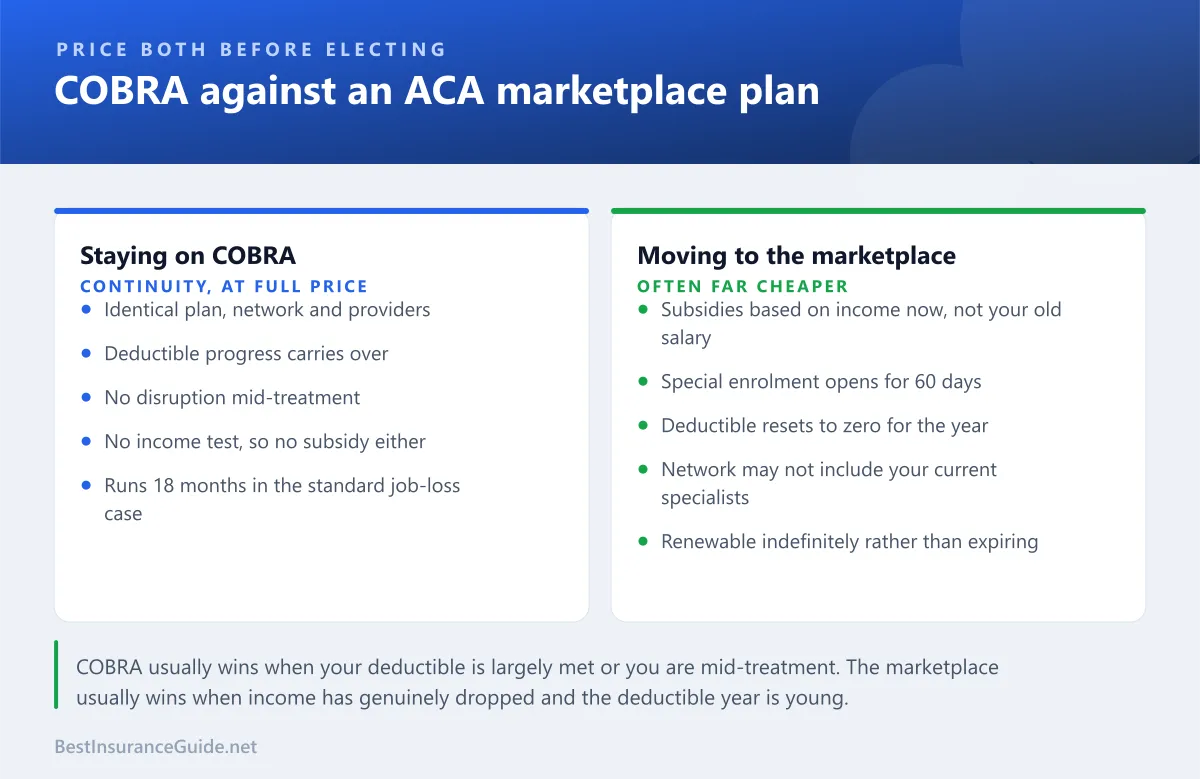
The marketplace plan is far cheaper. It is not automatically the right answer, because that $1,900 of met deductible has real value and switching mid-treatment can break continuity with a specialist.
The honest decision rule looks like this.
COBRA usually wins when you have already met most of your deductible or out-of-pocket maximum, when you are mid-treatment with a provider you cannot easily change, when a family member’s specialist is not in any marketplace network, or when the gap is short and you expect employer coverage again within a couple of months.
The marketplace usually wins when your income has genuinely dropped, when the deductible year is young, when the gap will be long, or when the COBRA number is simply unaffordable and the alternative is going uninsured.
Run both numbers before electing. Once you voluntarily drop COBRA partway through, that alone does not reopen a marketplace special enrolment period, so the flexibility you have on day one is worth more than the flexibility you have in month seven.
Are COBRA payments tax deductible?
Technically yes, practically rarely.
COBRA premiums are qualifying medical expenses, so they can be included in the itemised medical deduction. That deduction only counts costs above 7.5% of adjusted gross income, and it only helps if you itemise rather than take the standard deduction. Most households clear neither bar.
Two better routes exist.
A health savings account can pay COBRA premiums. This is one of a very short list of insurance premiums the rules permit an HSA to cover, and it works even if the COBRA plan itself is not HSA-qualified. If you built an HSA balance while employed, this is the most tax-efficient money available to you for exactly this situation.
The self-employed health insurance deduction generally does not apply to COBRA, because the plan is established through your former employer rather than your own business. If you have started working for yourself, buying your own plan may unlock a deduction that COBRA will not.
None of this is individual tax advice, and the interaction with a premium tax credit is genuinely fiddly. If the amounts are large, it is worth an hour with a tax professional.
What to do in the first week
Read the election notice properly, including the premium, the coverage end date and the exact election deadline. Then, before doing anything else, get a marketplace quote using your expected income for this year rather than last year’s.
Check how much of your deductible and out-of-pocket maximum you have already met, because that figure is the single biggest argument for staying on COBRA. Check whether your current specialists appear in the marketplace networks you are considering. And if you have an HSA balance, remember it can pay the premium either way.
Then decide with the numbers in front of you rather than reacting to the size of the COBRA figure, which is designed to look alarming and usually succeeds.
The short version
COBRA costs 102% of the full group premium, typically three to five times your old payroll deduction, and lasts 18 months in the standard job-loss case or up to 36 for other qualifying events. You have 60 days to elect and 45 more to pay, with coverage backdated, which quietly gives you a decision window rather than a deadline.
Price an ACA marketplace plan against it before electing, because a drop in income usually unlocks subsidies that COBRA cannot match. Keep COBRA when your deductible is largely met or your care is mid-flight. Otherwise the marketplace usually wins on cost by a wide margin.
For the vocabulary underneath all of this, health insurance terms explained covers premiums, deductibles, copays and the out-of-pocket maximum with worked examples of how a year of bills actually settles.