HMO vs PPO, and What Every Number on Your Insurance Card Means
What's the difference between an HMO and a PPO, what out-of-network means, and whether your policy number is the same as your member ID on your card.

Table of contents
Two questions come up constantly at the point of actually using health insurance: which plan type should I pick, and what do all these numbers on my card mean?
They are related. Nearly every expensive surprise in health insurance comes from a network problem, and the card is where the network is written down.
HMO vs PPO: the actual difference
Both are networks of providers who have agreed rates with your insurer. The difference is what happens at the edges of that network, and how you move within it.
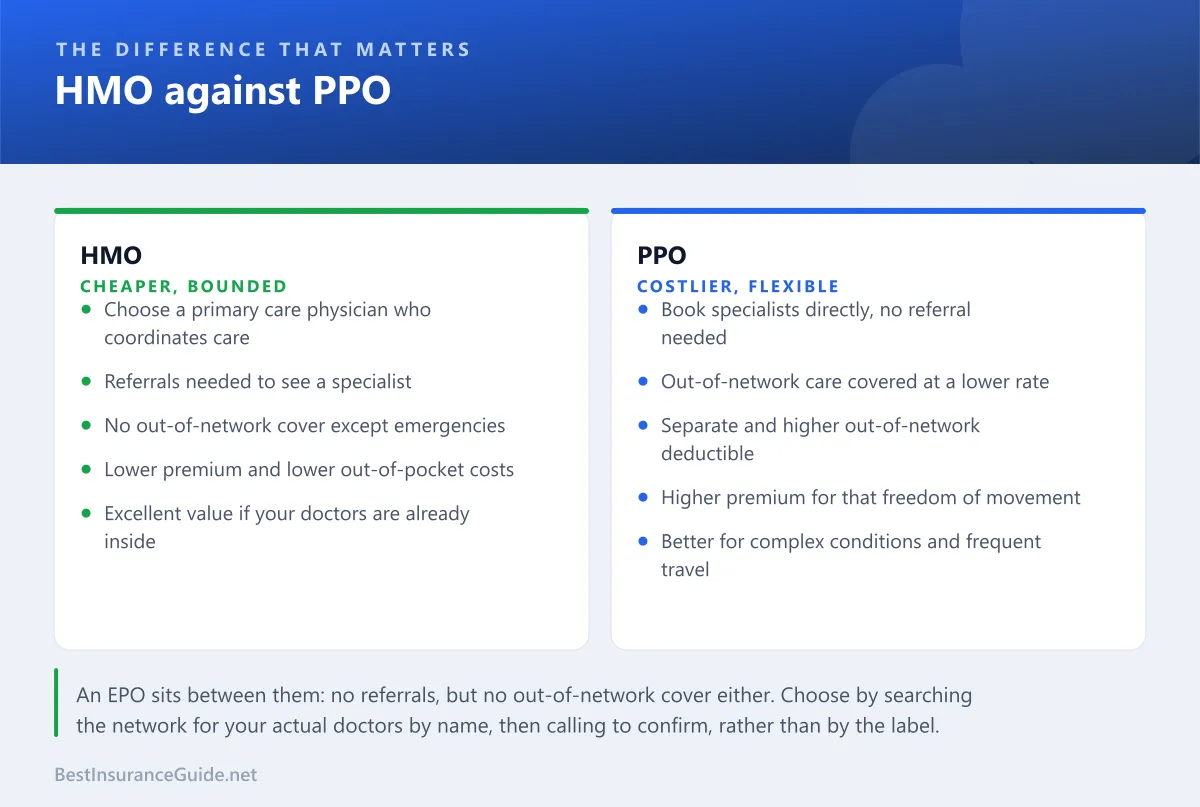
HMO. You choose a primary care physician who coordinates your care. To see a specialist you generally need a referral from them. Outside the network there is essentially no coverage at all, except for genuine emergencies. In exchange, premiums and out-of-pocket costs are typically lower.
PPO. No referral needed; you can book a specialist directly. Out-of-network care is covered, at a lower reimbursement rate and against a separate, higher deductible and out-of-pocket maximum. You pay more in premium for that.
Two more types fill the middle.
EPO. No referrals required, but no out-of-network coverage. A PPO’s freedom of movement inside an HMO’s network boundary. Often the best value if the network genuinely contains your doctors.
POS. Referrals required like an HMO, but some out-of-network coverage like a PPO. Less common.
Worked example: the same knee, two plans
A torn meniscus needing an orthopaedic consult, an MRI and arthroscopic surgery.
| HMO | PPO | |
|---|---|---|
| Monthly premium | $340 | $505 |
| Annual premium | $4,080 | $6,060 |
| GP visit for referral | $25 | Not needed |
| Orthopaedic consult | $40 | $60 |
| MRI, in-network | $410 | $520 |
| Surgery, in-network, after deductible | $2,100 | $2,400 |
| Total for the year | $6,655 | $9,040 |
On in-network care, the HMO wins comfortably. The premium difference alone was $1,980.
Now change one fact: the surgeon you want is not in the HMO network.
| HMO | PPO | |
|---|---|---|
| Surgery with that surgeon | Not covered, $18,400 | $4,900 after out-of-network cost-sharing |
That is the trade in a single line. The HMO is cheaper right up until you need something outside it, at which point it is not insurance at all for that service.
Which to choose
An HMO suits you if your doctors are already in the network, you are happy with a coordinated primary care model, you do not travel much, and you want the lowest predictable cost.
A PPO suits you if you have established relationships with specific specialists, you have a complex or rare condition where you may need a particular centre, you travel or split time between locations, or you simply want to skip referrals.
Before choosing either, search the actual network directory for your actual doctors, by name, and then call the office to confirm they take that specific plan. Directories are notoriously out of date, and “we take that insurer” is not the same as “we are in that plan’s network.” Insurers sell several networks under one brand.
What out-of-network really means
This is where the money is, and the mechanism is worth understanding properly.
An in-network provider has a contract with your insurer specifying what they may charge. That contracted rate is usually far below their list price, and it protects you as much as it protects the insurer.
An out-of-network provider has no such contract. Three consequences follow.
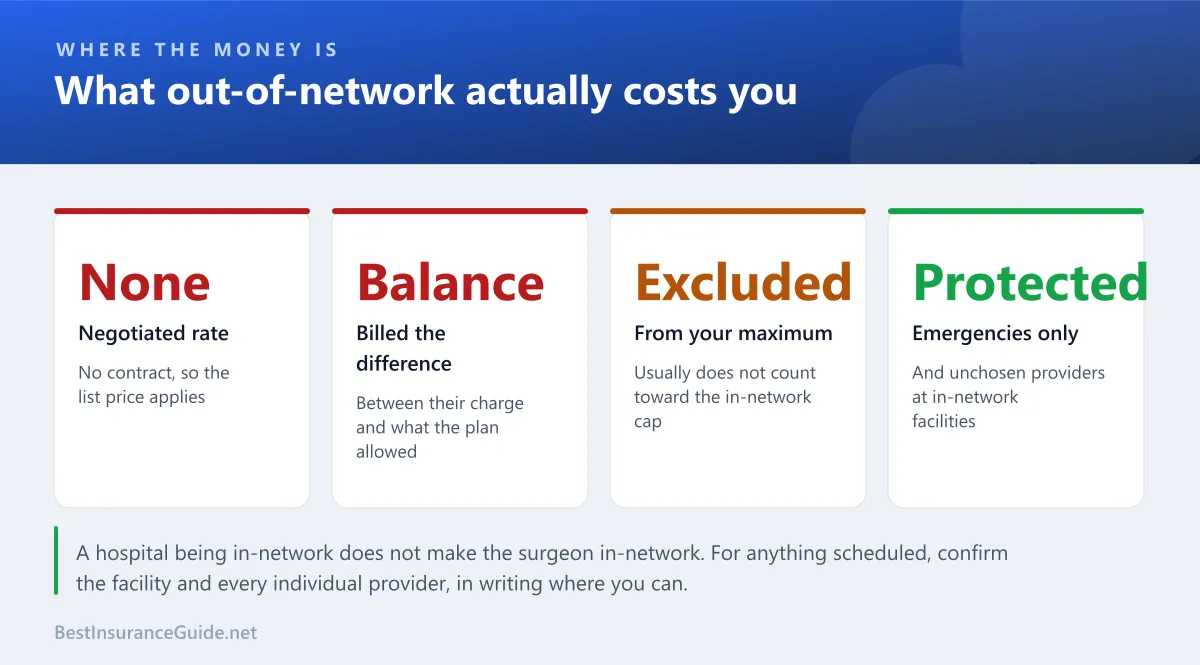
No negotiated rate. They charge their list price, which can be several times the contracted one.
Balance billing. Your plan pays what it considers a reasonable amount. The provider bills you the difference. This is the part that produces the shocking numbers.
It usually does not count. Out-of-network spending typically does not count toward your in-network out-of-pocket maximum, so the ceiling that made you feel safe does not apply.
Worked example: one out-of-network scan
| In-network | Out-of-network | |
|---|---|---|
| Provider’s list charge | $2,800 | $2,800 |
| Contracted rate | $640 | None |
| Plan’s allowed amount | $640 | $700 |
| Plan pays (80%) | $512 | $420 (60%) |
| You pay coinsurance | $128 | $280 |
| Balance billed to you | $0 | $2,100 |
| Your total | $128 | $2,380 |
Same scan, same machine, possibly the same radiologist. The difference is a contract.
The protections that do exist
Federal surprise billing rules changed this meaningfully for the worst cases. You are generally protected from balance billing for emergency services, and for certain out-of-network providers treating you at an in-network facility, such as anaesthetists, radiologists and pathologists you did not choose. In those situations you owe only in-network cost-sharing.
What remains unprotected is care you choose out-of-network, and follow-up care after an emergency once you are stable enough to be moved. Ground ambulances are also outside the main protections in many cases.
The practical habit: for anything scheduled, confirm the facility and every provider is in-network, in writing where you can. A hospital being in-network does not make the surgeon in-network.
Reading your insurance card
Now the second question, which sounds trivial until a receptionist asks for a number you cannot find.
Is the policy number the same as the member ID? Sometimes, and it depends on your plan type.
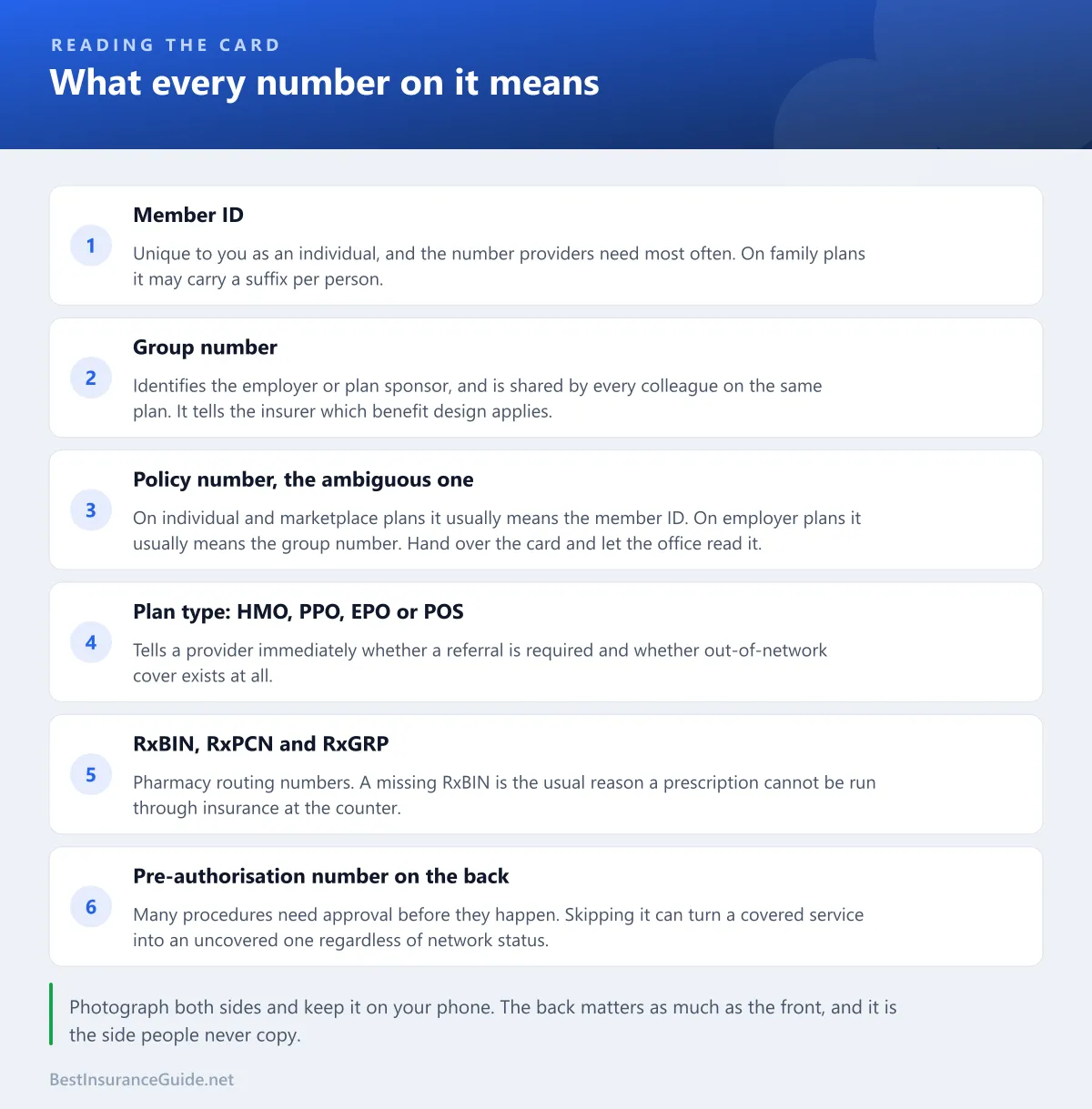
Member ID. Unique to you as an individual. This is the number providers need most often. On family plans, each member may have the same base number with a suffix, or entirely separate IDs.
Group number. Identifies the employer or plan sponsor. Everyone at your company on that plan shares it. It tells the insurer which benefit design applies.
Policy number. This is the ambiguous one. On many individual and marketplace plans, the policy number and member ID are the same thing, and insurers use the terms interchangeably. On many employer plans, “policy number” refers to the group policy the employer holds, which makes it the same as the group number.
So the honest answer to is the policy number the same as the member ID is: on an individual plan, usually yes; on an employer plan, usually no, it is the group number.
If in doubt, hand over the card and let the office read it. They do this hundreds of times a week and know the layouts.
The other fields worth knowing:
Plan type, printed as HMO, PPO, EPO or POS. This tells a provider immediately whether they need a referral.
RxBIN, RxPCN and RxGRP. Pharmacy routing numbers. A pharmacy needs these, not your medical member ID alone, and a missing RxBIN is the usual reason a prescription cannot be run through insurance.
Copay summary. Often printed on the front: office visit, specialist, urgent care, emergency. Useful, but it is a summary, not the policy, and it will not mention the deductible.
Customer service and pre-authorisation numbers, usually on the back. The pre-authorisation number matters: many procedures require approval before they happen, and skipping it can turn a covered service into an uncovered one regardless of network status.
The habits that prevent bills
Verify the network before every scheduled service, including each individual provider involved, not just the facility.
Ask whether pre-authorisation is required, and get the reference number.
Photograph both sides of your card and keep it on your phone. The back matters as much as the front.
Check your explanation of benefits against the bill. The EOB tells you what the plan allowed and what you owe; a provider bill that exceeds it is worth querying before paying.
If you get a surprise out-of-network bill, do not pay immediately. Check whether the federal protections apply, and appeal. A substantial share of these are reduced or removed on appeal, particularly where you had no realistic choice of provider.
The short version
An HMO restricts you to a network and requires referrals, and costs less. A PPO lets you go outside the network and skip referrals, and costs more. EPO sits between them. Choose by checking whether your actual doctors are in the actual network, not by the label.
Out-of-network means no contract, which means list prices, balance billing, and spending that does not count toward your out-of-pocket maximum. Federal rules now protect emergencies and unchosen providers at in-network facilities, but not care you elect to receive out-of-network.
Your member ID identifies you; your group number identifies your employer’s plan. “Policy number” usually means the member ID on an individual plan and the group number on an employer plan.
For what the deductible and out-of-pocket maximum actually do once you are inside the network, see deductible vs out-of-pocket maximum.