How Long Does Medicaid Approval Take? Usually 45 Days, Sometimes 90
Medicaid application timelines, the 45 and 90 day standards, retroactive coverage, what causes delays, and what to do while a decision is pending.

Table of contents
Federal rules set the outer limits and most applications finish well inside them. Understanding what actually consumes the time is what makes the difference between three weeks and three months.
The standards
45 days is the general federal standard for a decision on a Medicaid application.
90 days applies where eligibility depends on a disability determination, which takes longer because a medical assessment is involved.
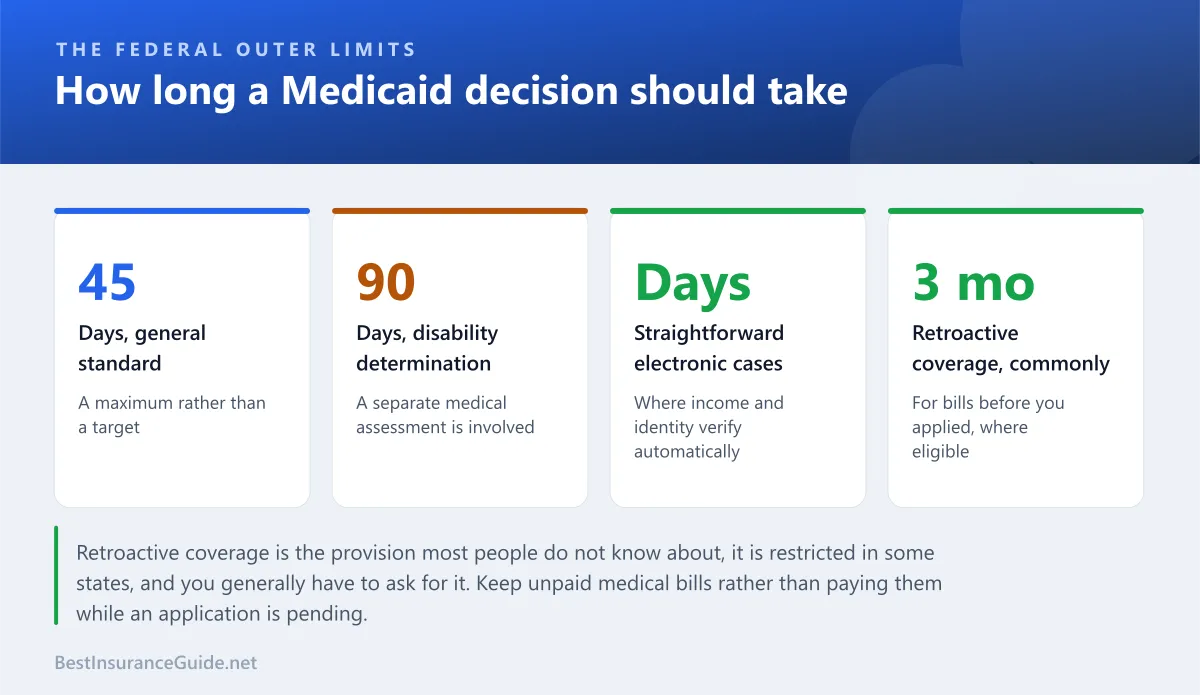
Those are maximums rather than targets. In practice:
Straightforward applications with electronic verification of income and identity are frequently decided in days rather than weeks. Several states verify income directly against federal and state data sources, and where everything matches the decision can be close to immediate.
Applications requiring documents from you take as long as it takes you to supply them, plus processing.
Disability-based applications routinely take the full period and sometimes longer, because the medical determination is a separate process.
Where the time actually goes
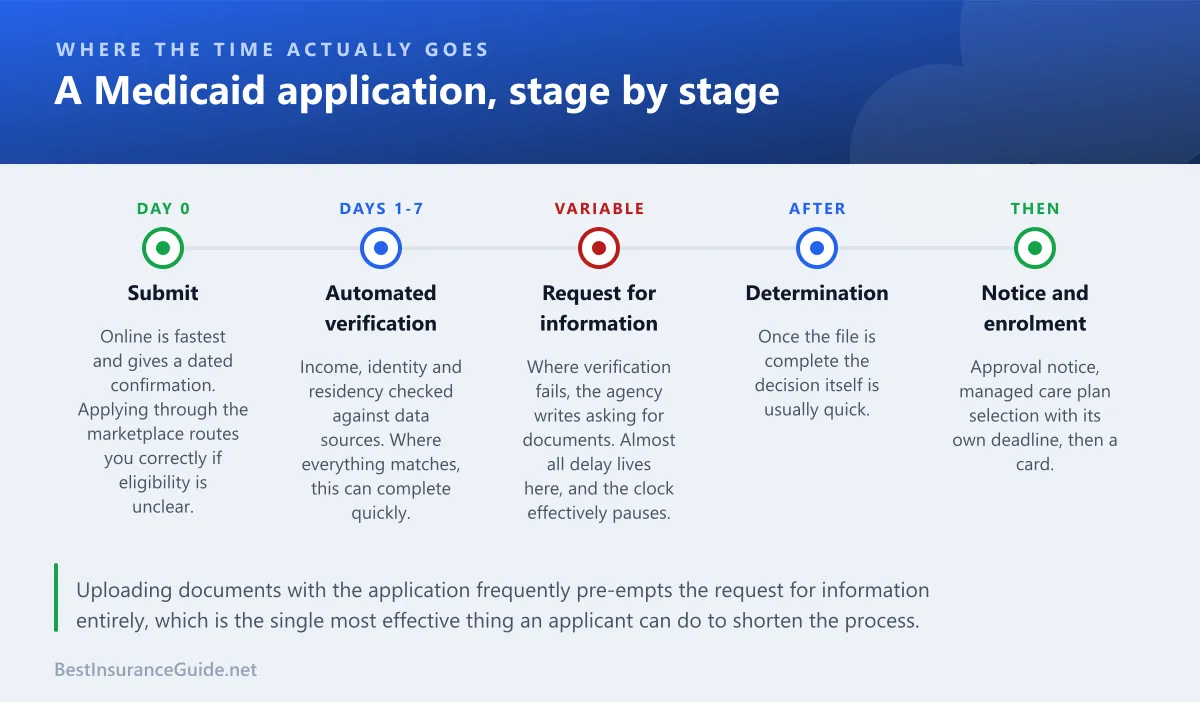
Submission. Online, by post, by phone or in person. Online is fastest and produces a dated confirmation you should keep.
Automated verification. The agency checks income, identity, residency and other criteria against data sources. Where everything matches, this stage can complete quickly.
A request for information. Where verification does not match or cannot be completed, the agency writes asking for documents. This is where almost all the delay lives. The clock effectively pauses while the agency waits.
Determination. Once the file is complete, the decision itself is usually quick.
Notice and enrolment. The approval notice, followed by selection of a managed care plan in most states, followed by an identification card.
The single biggest thing you control
Respond to a request for information immediately and completely.
That sentence is most of this article. The 45-day standard describes what the agency must do; it does not compensate for a fortnight spent finding a payslip.
Two related habits.
Send everything at once, rather than what is convenient now and the rest later. A partial response frequently produces a second request.
Keep copies of everything you send, with the date and the method. Documents are lost, and being able to demonstrate what was sent and when resolves that quickly.
What is usually requested
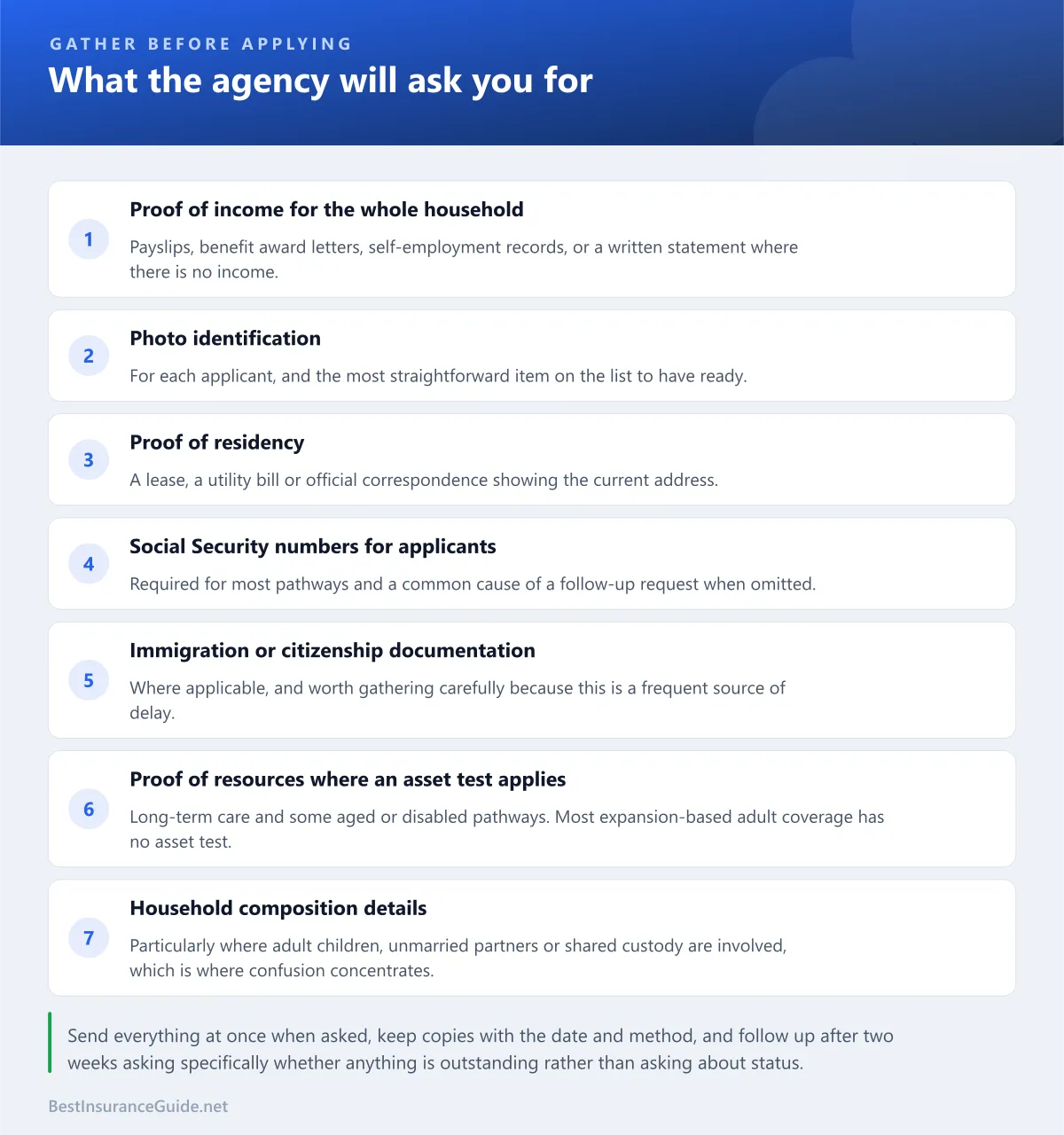
Proof of income for everyone in the household: payslips, a benefits award letter, self-employment records, or a written statement where there is no income.
Proof of identity, usually a photo identification document.
Proof of residency, such as a lease, a utility bill or official correspondence.
Social Security numbers for applicants.
Immigration or citizenship documentation, where applicable.
Proof of resources, in categories where an asset test applies, such as some long-term care and aged or disabled pathways. Most expansion-based adult coverage has no asset test.
Household composition information, particularly where a household structure is complicated.
Gathering these before applying rather than after is what turns a 45-day process into a two-week one.
Retroactive coverage
This is the provision most people do not know about and it can be worth a great deal.
Medicaid can cover medical bills incurred before the application was filed, commonly for up to three months, provided you would have been eligible during that period.
Two important caveats.
Some states have restricted or eliminated retroactive coverage through federal waivers, so it is not universal.
You generally have to ask. The application may include a question about it, and it may not. Raise it explicitly.
The practical consequence is significant. Somebody who was hospitalised in March and applies in May may have those bills covered, which is why you should keep unpaid medical bills rather than paying them while an application is pending.
Presumptive eligibility
A faster route that exists for specific situations.
Qualified providers — commonly hospitals, community health centres and some clinics — can grant temporary Medicaid coverage on the spot, allowing immediate care while the full application is processed.
It is most commonly available for pregnancy, children, and hospital-based applications, and availability varies by state.
If you are in a hospital or clinic and need coverage urgently, ask specifically whether presumptive eligibility is available. Staff frequently know and it is not always offered unprompted.
While you wait
Do not pay medical bills you cannot afford. Keep them, and tell providers a Medicaid application is pending. Billing is frequently held while a determination is outstanding.
Get emergency care if you need it. Emergency treatment is provided regardless of coverage status and hospitals cannot refuse it.
Ask hospitals about financial assistance. Non-profit hospitals are generally required to have a financial assistance policy, and eligibility for it is separate from Medicaid.
Keep a contact log: date, time, who you spoke to, what was said, and any reference number. This is what resolves a stalled application.
Follow up after two weeks if you have heard nothing, and ask specifically whether anything is outstanding.
Check whether a marketplace plan is a better fit, if income may be above the Medicaid threshold, since applying through the marketplace frequently routes an application to Medicaid automatically where eligible.
If it is denied
Read the notice for the reason and the deadline. Both are stated and the deadline is strict.
Distinguish missing verification from ineligibility. A denial for failure to provide documents is fixed by providing them and reapplying, and is much easier to resolve than a genuine income or category ineligibility.
Appeal within the deadline if you believe the decision is wrong. Medicaid appeals are free and you have a right to a fair hearing.
Ask about continued coverage during appeal if you are appealing a termination rather than an initial denial, since coverage can sometimes continue while the appeal runs.
Get help. Legal aid organisations, a state Medicaid ombudsman, and community health navigators assist with this at no cost and know the process well.
The short version
Federal standards require a decision within 45 days, or 90 where a disability determination is needed, and many straightforward applications are decided far faster through automated verification.
Almost all delay comes from outstanding documents. Gathering proof of income, identity and residency before applying, and responding to any request immediately and completely, is the single largest thing within your control.
Ask about retroactive coverage for bills in the months before you applied, and ask about presumptive eligibility if you need care now.
While waiting, keep the bills unpaid, tell providers an application is pending, and keep a log of every contact.
For the programme comparison, see Medicare versus Medicaid, and for cover options generally, health insurance without a job.
Applying in the way that goes fastest
Apply online where possible. Electronic applications route into automated verification directly, and produce a dated submission confirmation.
Apply through the marketplace if you are unsure of eligibility, because an application there is assessed for both marketplace subsidies and Medicaid and routed accordingly. That avoids applying in the wrong place and starting again.
Answer every question, including the ones that seem irrelevant. Blanks generate requests for information, which is the main source of delay.
Report household composition accurately, which is one of the more common sources of confusion, particularly where adult children, unmarried partners or shared custody are involved.
Upload documents at the time of application rather than waiting to be asked. Most portals allow it and it frequently pre-empts the request entirely.
Note the confirmation number and the date, and keep the confirmation.
Getting help, which is free
Several kinds of assistance exist and almost all of them are free.
Navigators and certified application counsellors, funded to help people apply, available through community organisations and health centres.
Hospital financial counsellors, who assist with applications for patients and who know the presumptive eligibility routes.
Legal aid organisations, which handle appeals and complex eligibility questions at no cost.
The state Medicaid ombudsman, where one exists, for stalled applications.
Federally qualified health centres, which have staff who do this daily.
The common thread is that these people know which document the agency actually wants and how to present a household correctly, which is worth more than any amount of persistence on a phone line.
Renewals, which catch people out later
Approval is not the end of the process, and a large share of coverage losses happen at renewal rather than at application.
Medicaid eligibility is redetermined periodically, commonly annually.
Many losses are procedural rather than substantive. People remain eligible and lose coverage because a renewal notice went to an old address, or a form was not returned by the deadline.
Four habits prevent that.
Keep your address current with the agency, and update it the week you move rather than eventually.
Open everything that arrives from the agency, promptly. Renewal notices have deadlines.
Return renewal paperwork immediately, in full.
Report changes when they happen — income, household composition, address — rather than at renewal, since a change reported late can create an overpayment to resolve.
If coverage is terminated at renewal and you believe you remain eligible, you can appeal, and in many states coverage continues during the appeal if you file within a short window of the notice.
Two things that shorten it most
Gather the documents before you apply. Proof of income for everybody in the household, photo identification, proof of residency and Social Security numbers. Uploading them with the application frequently pre-empts the request for information entirely, and that request is where nearly all the delay lives.
Respond to anything the agency sends within days, not weeks, and send it all at once. A partial response generates a second request and restarts the wait. Keep a copy of everything with the date and method of sending.
Those two habits are the difference between a decision in a fortnight and a decision at the outer edge of the statutory limit.
What the decision notice should tell you
When the decision arrives, four things on it are worth reading carefully.
The effective date of coverage, which may be earlier than the decision date if retroactive coverage was granted.
Whether retroactive coverage was applied, and for which months. If you had bills in the preceding months and it was not applied, raise it.
Which category you were approved under, because that determines the benefit package and any cost sharing.
Any next step, most commonly selecting a managed care plan, which frequently has its own deadline and a default assignment if you do not choose.
That last item matters more than it appears. The plan you are assigned to by default may not include your existing providers, and switching afterwards is possible but is easier to get right at the outset.
If nothing has happened after a month
Call and ask specifically whether anything is outstanding, rather than asking about status. Those produce different answers, and the first is the useful one.
Ask for the caseworker name and a reference number, and note the date.
Ask whether the application has been assigned, because unassigned applications sit.
Escalate to a supervisor if a second call produces nothing, and then to the state Medicaid ombudsman where one exists.
Ask a navigator or legal aid organisation to help, since they frequently have direct channels that are unavailable to applicants and they do this daily at no charge.
Keep the log. Dates, names, what was said. A stalled application resolves considerably faster when you can state precisely what happened and when.
Related reading
Two related questions come up during and after an application. Does Medicaid cover wisdom teeth removal covers how adult benefits vary by state and how medical necessity is assessed. Can I cancel my health insurance at any time covers the sequencing where Medicaid is replacing an existing plan.
A note on scope
Nothing here is legal or medical advice. Medicaid eligibility rules, processing standards, retroactive coverage provisions and appeal procedures are set federally and by each state and change over time, and several states have modified retroactive coverage through waivers.
Your state Medicaid agency publishes the current application requirements, timelines and appeal procedures, and the Centers for Medicare and Medicaid Services publishes the federal standards. Community health navigators and legal aid organisations assist with applications free of charge. This site is independent and not affiliated with any insurer.