Can I Cancel My Health Insurance at Any Time? Yes, and Usually Should Not
When you can cancel health insurance, why re-enrolling is restricted, the differences between marketplace and employer plans, and what to do instead.

Table of contents

You can usually cancel. The question worth asking is whether you can get back in, and the answer to that one is considerably less flexible.
The asymmetry
Cancelling is easy. Marketplace plans can generally be terminated at any time with modest notice.
Re-enrolling is restricted. You can only enrol during open enrolment, or during a special enrolment period triggered by a qualifying life event.
Voluntarily cancelling is not a qualifying life event.
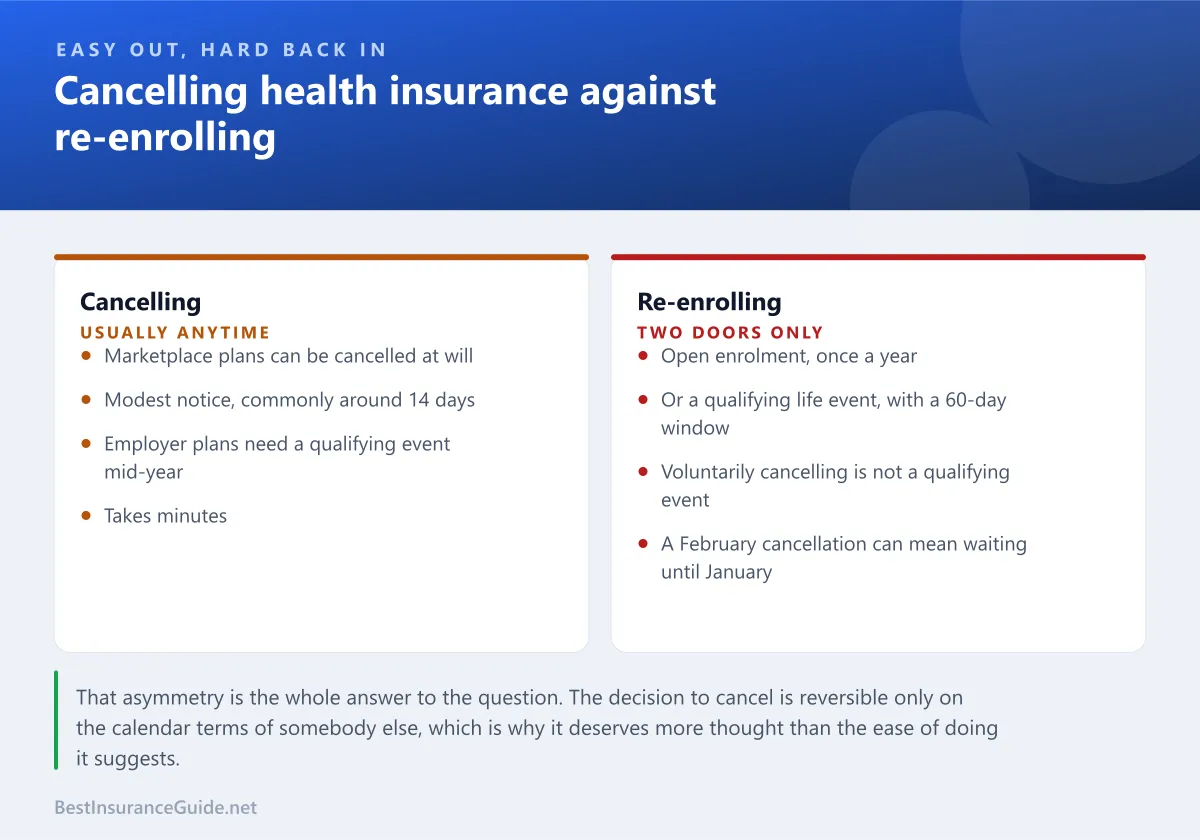
Read those three lines together and the practical position is clear. Somebody who cancels a marketplace plan in February, with no other coverage, is likely uninsured until the following January.
That asymmetry is the entire subject and it is the reason the honest answer to the headline question is “yes, and think very carefully”.
Marketplace plans
You can generally cancel at any time. Log in, choose an end date, confirm.
Three practical points.
Give notice properly. Marketplace plans generally want around 14 days for a chosen termination date, though it varies. Choose the date rather than letting it happen.
Do not simply stop paying. Non-payment produces a termination after a grace period, which is messier than a clean cancellation, may leave unpaid premiums owing, and can affect your ability to re-enrol with the same insurer.
Reconcile the subsidy. If you received advance premium tax credits, cancelling mid-year affects the reconciliation on your tax return. Report the change to the marketplace, because a subsidy paid for months you were not covered has to be repaid.
Removing one person is different from cancelling the plan. Where a household member gains other coverage, remove them specifically rather than terminating the policy.
Employer plans
The position here is different and it surprises people.
You generally cannot drop employer coverage mid-year without a qualifying life event.
The reason is the tax treatment. Employer premiums are usually deducted pre-tax under a cafeteria plan, and the rules governing those arrangements lock the election for the plan year unless a permitted change event occurs.
Permitted change events typically include marriage, divorce, birth or adoption, a change in employment status, a spouse’s open enrolment, and a dependent gaining or losing eligibility.
Open enrolment is the ordinary route. Once a year, you can change or drop coverage for the following plan year without needing a reason.
Qualifying life events
Since this is the mechanism that reopens enrolment, it is worth knowing the list.
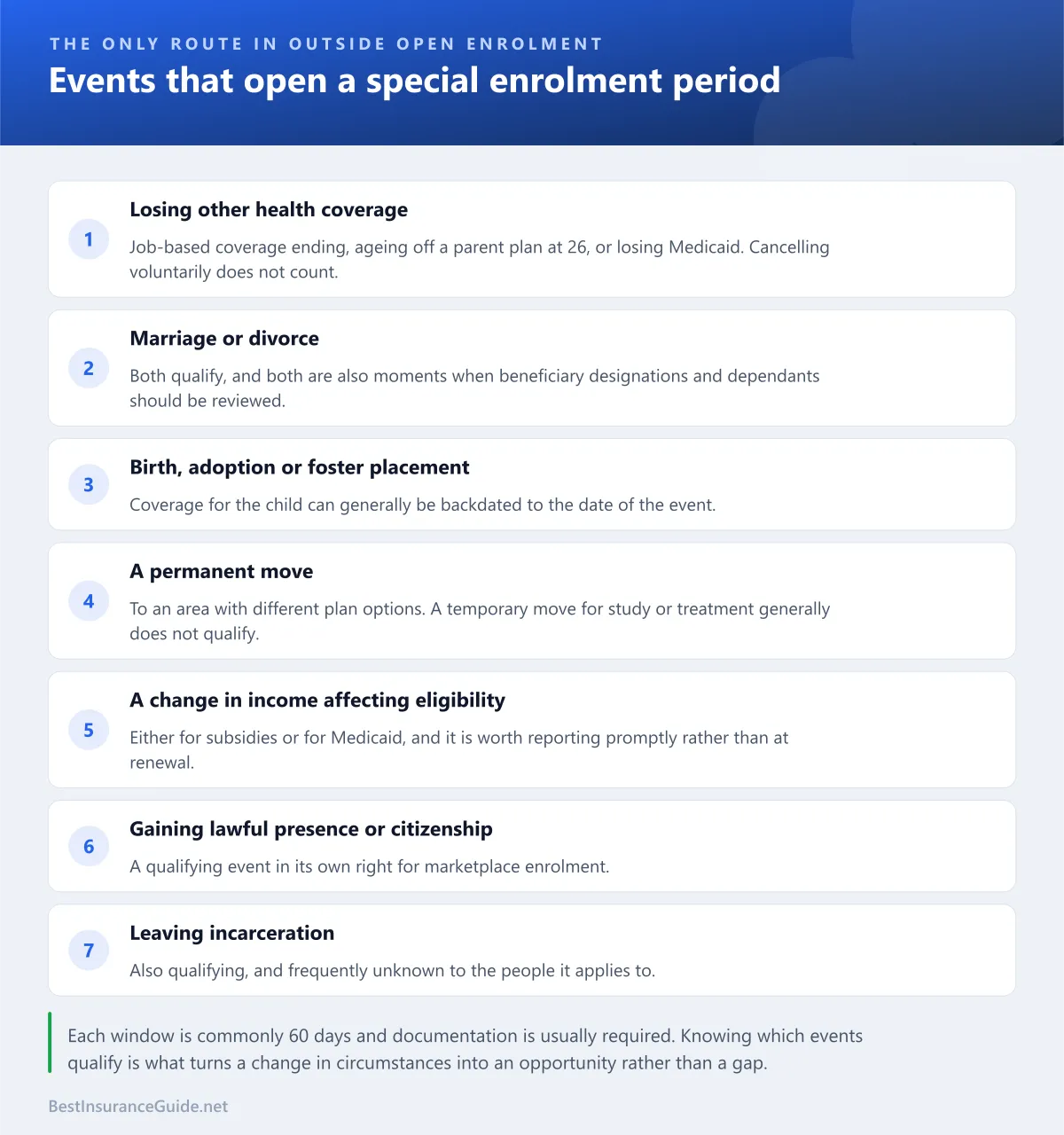
Losing other health coverage, including job-based coverage, ageing off a parent’s plan at 26, or losing Medicaid eligibility. Note that losing coverage because you cancelled it voluntarily does not count.
Marriage or divorce.
Birth, adoption or placement for foster care.
A permanent move to an area with different plan options.
A change in income affecting eligibility for subsidies or Medicaid.
Gaining lawful presence or citizenship.
Leaving incarceration.
Each opens a window, commonly 60 days, and documentation is usually required.
When cancelling is genuinely right
There are good reasons, and they share a feature: other coverage is starting.
A new employer’s plan begins, and you no longer need the marketplace plan.
A spouse’s plan is better or cheaper, and you are joining it.
Medicaid eligibility begins.
Medicare begins at 65.
You are moving abroad with coverage arranged there.
In every one of those, the sequence matters: confirm the new coverage is in force before terminating the old one. Overlapping by a few days costs a small amount of premium and prevents a gap. Doing it the other way round can leave a hole that cannot be filled until open enrolment.
When it is not
Two situations account for most regretted cancellations.
Cancelling because it is unaffordable. Understandable and usually the wrong response, because there are better options.
Cancelling because you are healthy and do not use it. The purpose of health insurance is not the routine care; it is the ceiling on a catastrophic event, and the events it protects against do not announce themselves in advance.
Worked example: what being uninsured actually costs
An uninsured person has an appendectomy with a two-night stay.
| Insured, mid-range plan | Uninsured | |
|---|---|---|
| Billed charges | $28,000 | $28,000 |
| Negotiated rate | $11,400 | None, list price applies |
| Your responsibility | Deductible plus coinsurance, capped at the maximum | Whatever is billed |
| Ceiling on your exposure | The out-of-pocket maximum | None |
| Typical outcome | A few thousand dollars | A five-figure debt |
The negotiated rate is the point. Insurance is not only a payment mechanism; it is access to a price that is not available to an individual.
What to do instead of cancelling
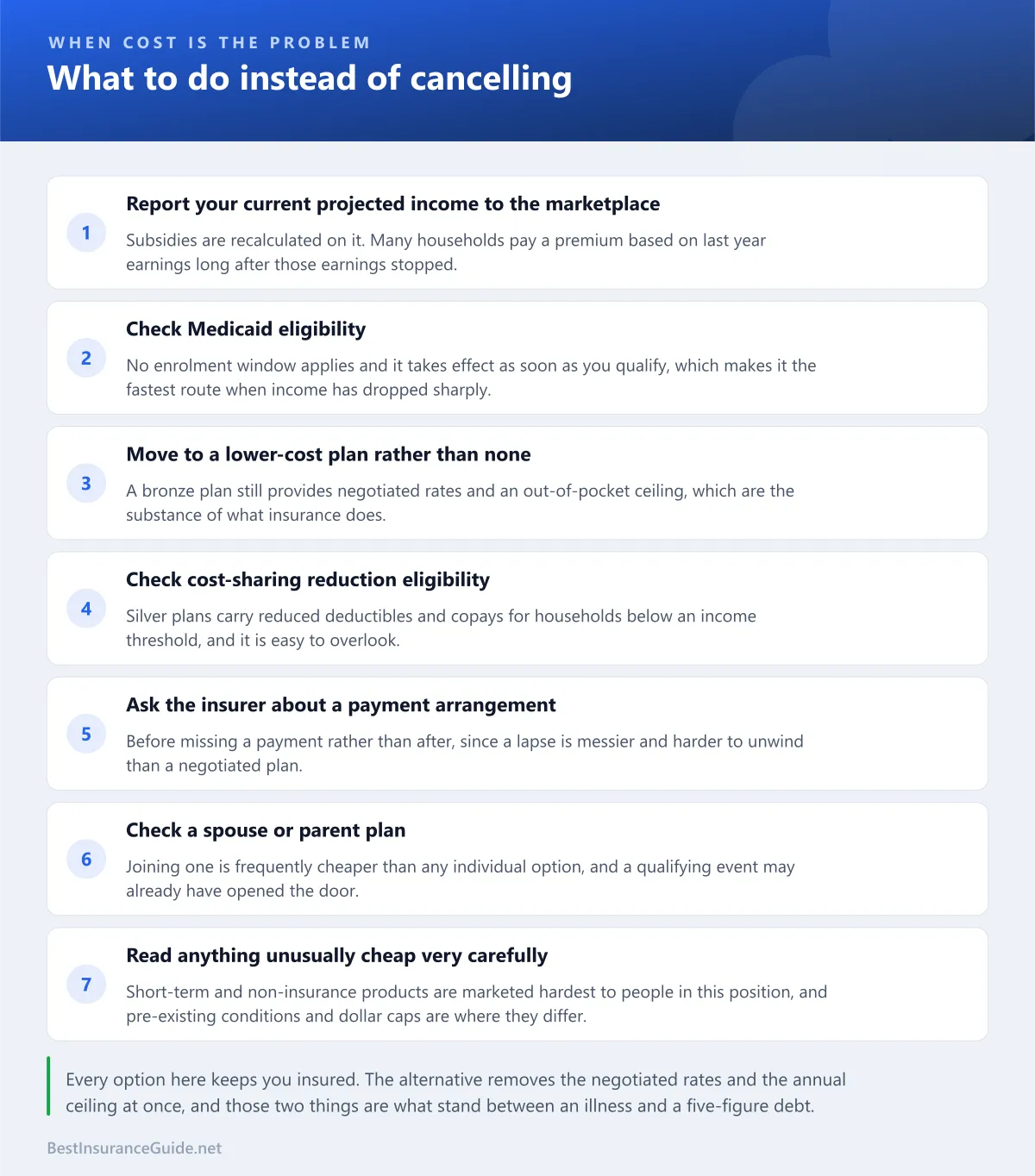
Report an income change to the marketplace. Subsidies are based on current projected income, and a drop increases the subsidy. Many people continue paying a premium calculated on last year’s earnings.
Check Medicaid eligibility, which has no enrolment window and applies as soon as you qualify.
Change to a lower-cost plan at open enrolment, or during a special enrolment period, rather than dropping coverage entirely. A bronze plan with a high deductible still provides the negotiated rates and the out-of-pocket ceiling.
Check whether you qualify for cost-sharing reductions, which reduce deductibles and copays on silver plans for households below an income threshold.
Ask about a payment arrangement with the insurer before missing a payment.
Check a spouse’s or parent’s plan, if either is available to you.
Every one of those keeps you insured, which the alternative does not.
The short version
You can generally cancel a marketplace plan at any time, and usually cannot drop an employer plan mid-year without a qualifying life event because of the pre-tax premium rules.
The constraint that matters is not cancelling but re-enrolling. Enrolment is limited to open enrolment and special enrolment periods, and voluntarily cancelling is not itself a qualifying event, so a cancellation early in the year can leave you uninsured for most of it.
Cancel when other coverage is starting, and confirm the new plan is in force first. Do not cancel because you are healthy, and do not cancel because it is expensive without first reporting an income change, checking Medicaid, and looking at a lower-cost plan.
For continuation after leaving a job, see how long COBRA coverage lasts, and for the options generally, health insurance without a job.
Cancelling properly, step by step
Where cancelling is the right decision, doing it cleanly avoids several avoidable problems.
Confirm the new coverage is in force first. Get written confirmation of the start date before terminating anything.
Overlap by a few days rather than trying to align the dates exactly. A short overlap costs a small amount of premium and prevents a gap that could otherwise be very expensive.
Choose a termination date rather than stopping payment. Non-payment produces a lapse, may leave premiums owing, and can affect re-enrolment with the same insurer.
Report the change to the marketplace if you had advance premium tax credits, because a subsidy paid for months you were not covered has to be repaid at tax time.
Keep the termination confirmation, which evidences the loss of coverage if you later need it for a special enrolment period.
Check whether dependants are affected, since terminating a policy removes everybody on it and removing one person is a different transaction.
Transfer prescriptions and confirm providers under the new plan in the first week rather than at the next appointment.
Two things to check before deciding
Report your current projected income to the marketplace. Subsidies are recalculated on it, and a household paying a premium based on last year’s earnings after an income drop is frequently paying far more than it needs to. This single step resolves a large share of affordability-driven cancellations.
Look at what a lower-cost plan would cost rather than at nothing. A high-deductible bronze plan still provides negotiated rates and an out-of-pocket ceiling, and those two things are the substance of what insurance does. Being underinsured is a different position from being uninsured, and the gap between them is much larger than the gap between a bronze plan and a gold one.
The short-term plan trap
One category deserves specific mention because it is marketed hardest to exactly the people considering cancelling.
Short-term limited duration plans and various non-insurance products are sold at low monthly cost with prominent premiums and much less prominent terms.
Four features to check on anything cheap that is not a marketplace plan.
Whether pre-existing conditions are covered, which on short-term products they frequently are not.
Whether there is an annual or lifetime dollar cap, which comprehensive plans cannot have and these frequently do.
Whether the essential benefit categories are covered, including prescription drugs, maternity care and mental health, which are guaranteed on marketplace plans and are commonly excluded here.
Whether it is insurance at all. Some products are cost-sharing arrangements rather than insurance, are not regulated as insurance, and carry no obligation to pay.
None of that means every such product is wrong for every situation. It means the comparison against a bronze marketplace plan should be made on coverage rather than on the monthly figure, and that a very low premium for something described as comprehensive cover warrants reading before buying.
Two things to do before cancelling anything
Report your current projected income to the marketplace and get a fresh subsidy calculation. This resolves a large share of affordability-driven cancellations on its own and takes twenty minutes.
Price the cheapest comprehensive plan available to you, so the comparison is between two real options rather than between an expensive plan and nothing.
The decision in one paragraph
If new coverage is starting, cancel cleanly: confirm the new plan is in force, overlap by a few days, choose a termination date rather than stopping payment, and report the change to the marketplace if you had subsidies.
If the problem is cost, do not cancel. Report your current income for a fresh subsidy calculation, check Medicaid, and price the cheapest comprehensive plan available to you. Being on a bronze plan with a high deductible still gives you negotiated rates and a ceiling on a catastrophic year, and those two things are the substance of what insurance does.
And if the reasoning is that you are healthy and do not use it, remember that re-entry is restricted to open enrolment and qualifying life events, and that a serious event does not wait for January.
Two dates that govern everything
Your plan’s open enrolment period, which is the annual window in which you can change or drop coverage without needing a reason.
The 60-day special enrolment window that follows a qualifying life event, which is the only other route in.
Knowing both means a cancellation is a decision rather than an accident, and it means that if circumstances change, you know exactly when the next door opens rather than discovering there is not one.
Related reading
Two situations frequently prompt the question. Staying on a parent’s health insurance covers the transition at 26, which is the most common moment coverage ends without anybody choosing it. How long Medicaid approval takes covers the route worth checking before cancelling anything on cost grounds.
A note on scope
Nothing here is legal, tax or medical advice. Enrolment rules, qualifying life events, cafeteria plan change rules, subsidy reconciliation and state-level coverage requirements vary and change over time, and a small number of states impose their own coverage requirements.
HealthCare.gov and your state marketplace publish the authoritative enrolment and special enrolment rules, your employer’s plan administrator is the authoritative source on mid-year changes, and your state Medicaid agency publishes eligibility criteria. This site is independent and not affiliated with any insurer.