Business Umbrella Insurance: Cheap Limits Above Everything Else
How commercial umbrella insurance works, what it sits above, the difference from excess liability, underlying limit requirements, and who needs it.

Table of contents

A commercial umbrella is the cheapest large limit in business insurance and the most commonly misunderstood. It is worth being precise about what it does, because the misunderstanding is expensive in both directions.
How it works
An umbrella sits above your existing liability policies. When a claim exhausts the underlying limit, the umbrella pays the excess up to its own limit.
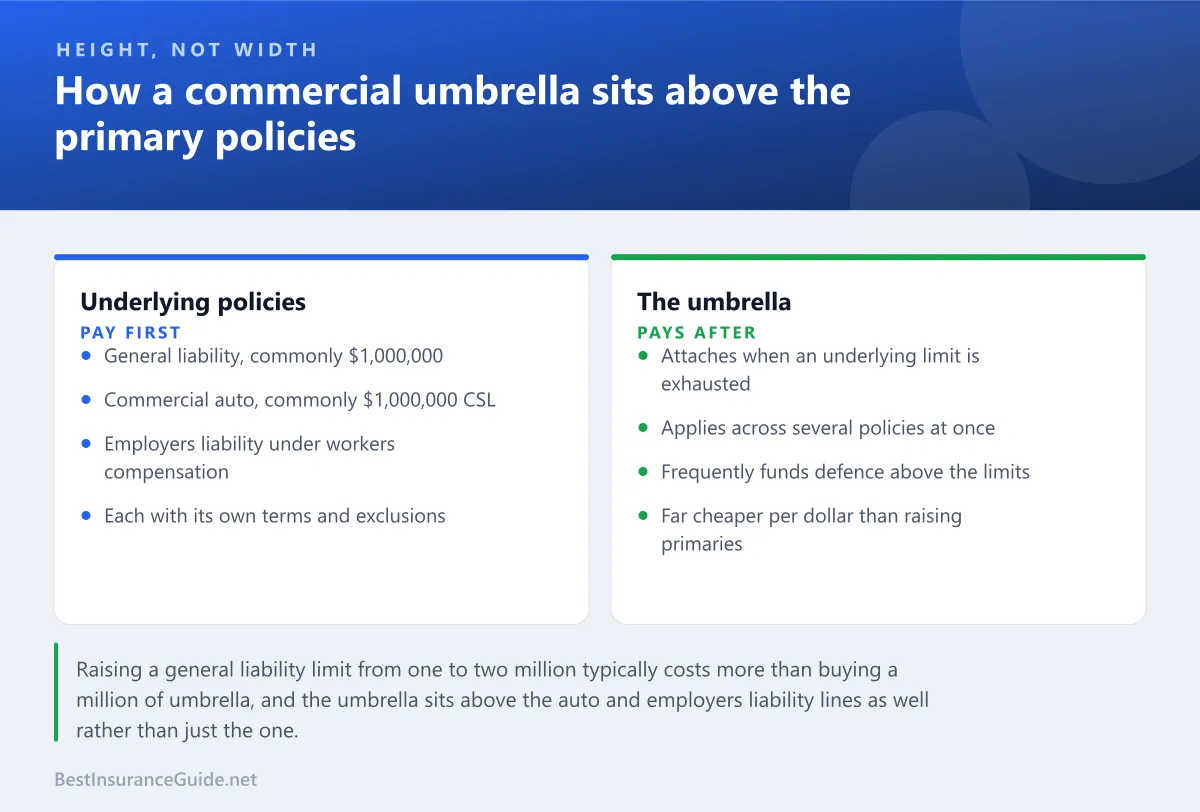
A typical structure:
General liability at $1,000,000 per occurrence.
Commercial auto liability at $1,000,000 combined single limit.
Employers liability, under the workers compensation policy, at specified limits.
An umbrella of $1,000,000 to $10,000,000 sitting above all three.
A $2,400,000 judgment against a business with $1,000,000 of general liability and a $2,000,000 umbrella is met in full: $1,000,000 from the primary policy, $1,400,000 from the umbrella.
Why it is so cheap
The reason the pricing looks too good is straightforward.
The umbrella only pays after the underlying limit is exhausted, and most claims never approach that point. The insurer is covering a low-frequency, high-severity tail, and that is inexpensive to insure.
The practical consequence: raising a general liability limit from $1,000,000 to $2,000,000 typically costs considerably more than buying $1,000,000 of umbrella, and the umbrella applies across several underlying policies at once rather than just one.
That is the whole argument for the product and it is a strong one.
Umbrella against excess liability
These terms are used interchangeably in the market and they are not the same thing.
Excess liability follows the underlying policy exactly. Same terms, same exclusions, more limit. Simpler and slightly cheaper.
A true umbrella can be broader than the underlying policies, covering some claims they exclude, subject to a self-insured retention you pay first on those drop-down claims.
Two practical points.
Many policies sold as umbrellas are effectively excess. The wording decides it, not the name on the cover.
Broader is not automatically better if you do not need it. For most small businesses, additional limit is the objective and an excess policy achieves it.
Ask specifically: is this following form, or is it broader, and if broader, in what respects?
Underlying limit requirements
This is the mechanism that goes wrong most often.
An umbrella attaches at a stated point, and it requires the underlying policies to carry at least the scheduled limits. If an underlying policy is written below the requirement, you fund the difference personally before the umbrella responds.
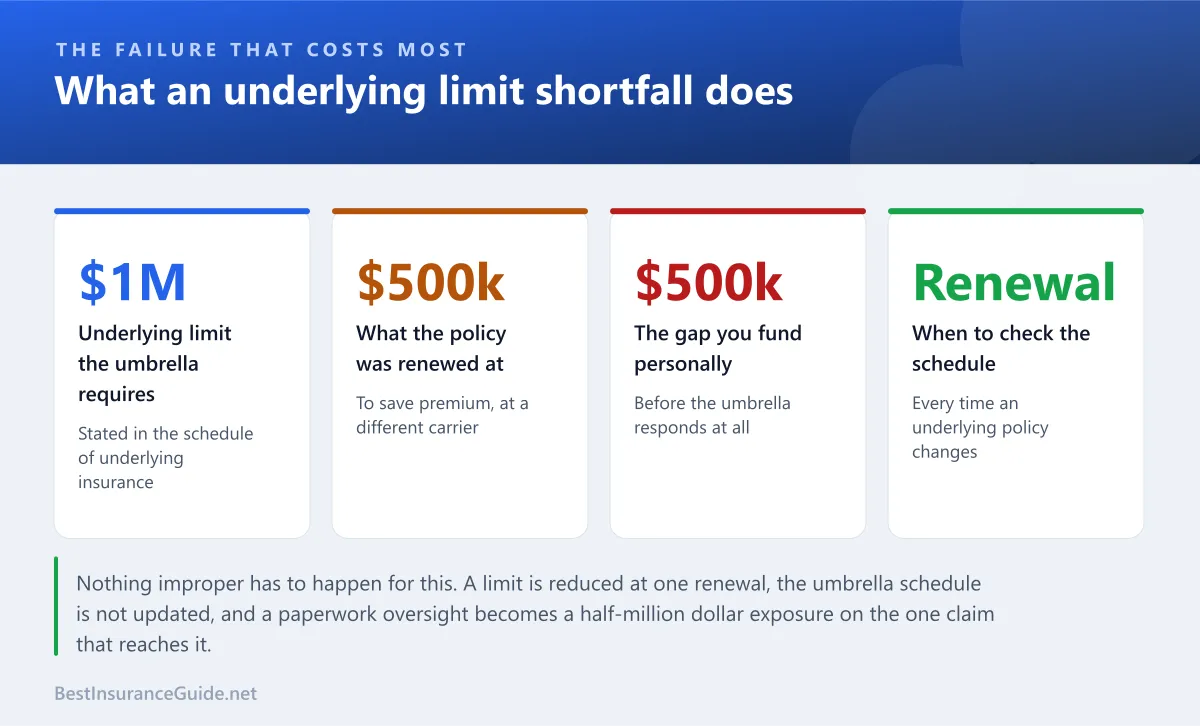
Worked example: an underlying gap
A business with a $2,000,000 umbrella requiring $1,000,000 underlying auto liability. The auto policy was renewed at $500,000 to save premium.
| Requirement met | Underlying reduced | |
|---|---|---|
| Claim | $1,800,000 | $1,800,000 |
| Auto policy pays | $1,000,000 | $500,000 |
| Gap funded by the business | $0 | $500,000 |
| Umbrella pays | $800,000 | $800,000 |
| Business pays | $0 | $500,000 |
Nothing improper happened. A limit was reduced at one renewal and the umbrella schedule was not updated, which is a paperwork failure with a half-million dollar consequence.
Check the umbrella schedule every time an underlying policy renews, particularly if it moved to a different carrier.
What it will not do
An umbrella adds height, not width. It does not cover exposures your underlying policies exclude.
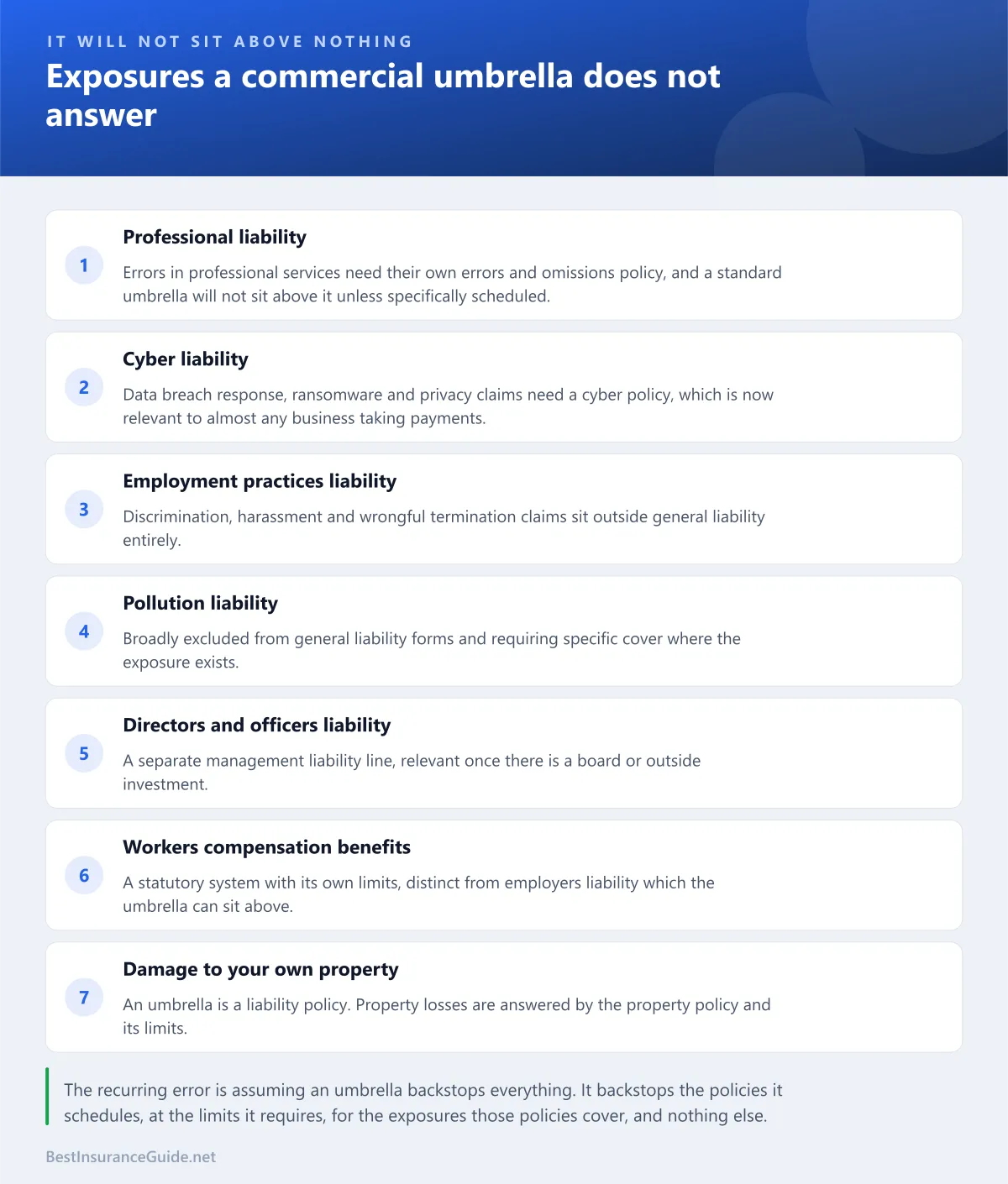
Professional liability, meaning errors in professional services, needs its own errors and omissions policy. A standard umbrella will not sit above it unless it is specifically scheduled.
Cyber liability, including data breach response, ransomware and privacy claims.
Employment practices liability, covering discrimination, harassment and wrongful termination claims.
Pollution liability, which is broadly excluded from general liability forms.
Directors and officers liability.
Workers compensation benefits, as distinct from employers liability, which is a statutory system with its own limits.
Property damage to your own property, since an umbrella is a liability policy.
Contractual liability beyond what the underlying policy assumes.
The recurring error is assuming an umbrella backstops everything. It backstops the policies it schedules, at the limits it requires, for the exposures those policies cover.
Who should carry one
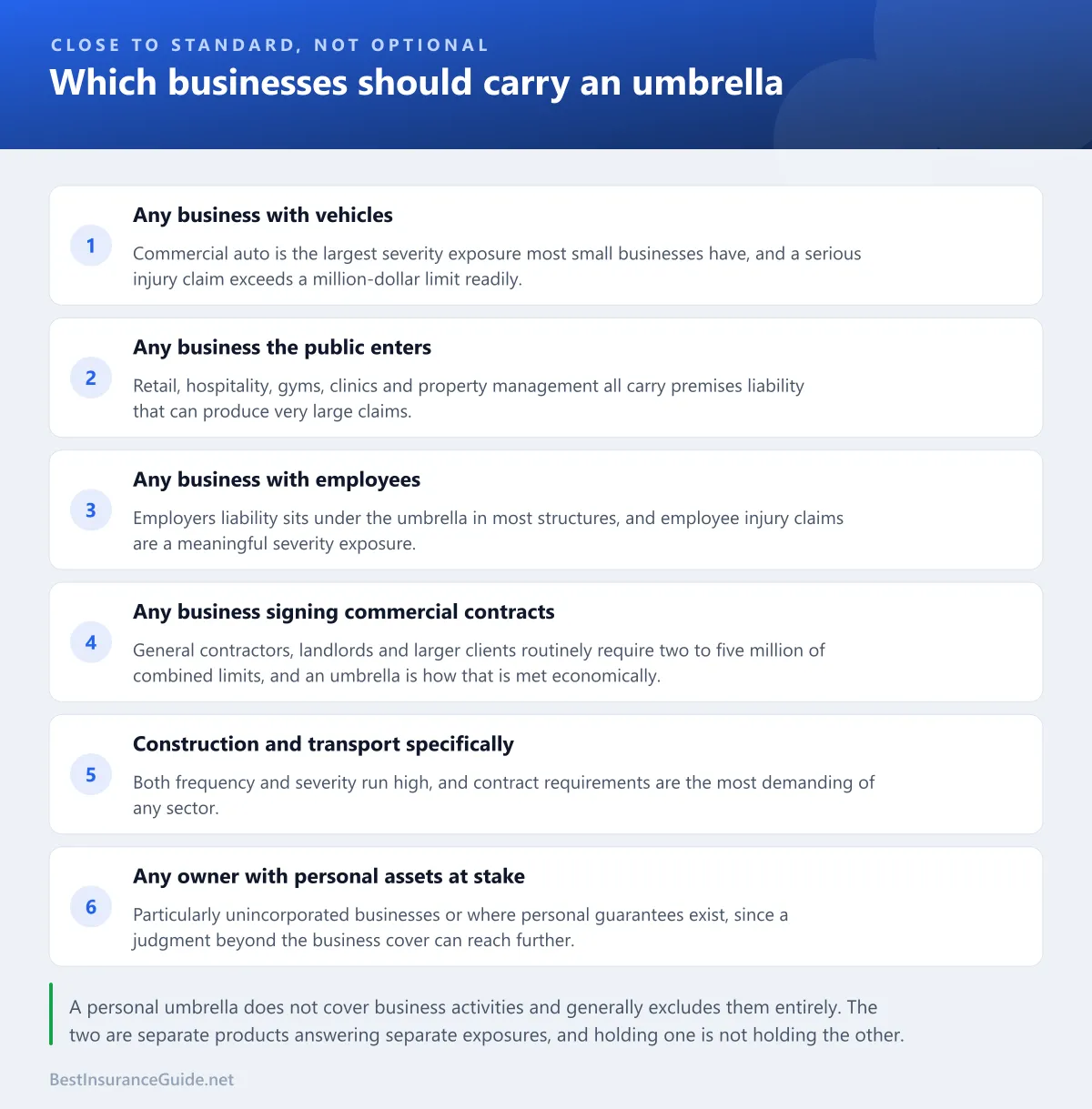
Any business with meaningful assets to protect, which is most businesses with premises, equipment or receivables.
Any business with vehicles. Commercial auto is the largest severity exposure most small businesses have, and a serious injury claim exceeds a $1,000,000 limit readily.
Any business the public enters. Retail, hospitality, gyms, clinics, property management.
Any business with employees, because employers liability claims sit under the umbrella in most structures.
Any business signing commercial contracts. General contractors, landlords, municipalities and larger clients routinely require $2,000,000 to $5,000,000 of combined limits, and an umbrella is how that is met economically.
Construction and transport specifically, where both frequency and severity are high and contract requirements are highest.
Buying it properly
Decide the limit from your exposure, not from a round number. Consider assets, revenue, the worst realistic claim in your industry, and the highest limit any contract requires.
Schedule every underlying policy, and check the required limits against what each policy actually carries.
Re-check at every underlying renewal, especially after changing carrier, since limits move and schedules do not update themselves.
Ask whether it is following form or broader, and if broader, what the self-insured retention is.
Ask what is excluded, specifically professional services, pollution, cyber and employment practices, and whether any of those can be added.
Place it with a broker who sees the whole programme. An umbrella bought in isolation from the underlying policies is exactly how attachment gaps happen.
Review the limit as the business grows. A limit set at founding is frequently inadequate three years later, and the incremental cost of raising it is small.
The short version
A commercial umbrella sits above your general liability, commercial auto and employers liability policies and pays when their limits are exhausted. It is the cheapest large limit available, because it only responds to the rare claims that get that far.
It adds height and not width. Professional liability, cyber, employment practices and pollution all need their own policies, and an umbrella will not sit above a coverage you do not have.
The failure mode that matters is an underlying policy falling below the umbrella’s attachment requirement, which leaves the business funding the gap personally. Check the schedule at every renewal.
And size the limit against your actual exposure and your contract requirements rather than against a round number, because the incremental cost of more limit is unusually low.
For the auto exposure underneath it, see commercial auto insurance cost, and for the programme overall, the business insurance checklist.
Sizing the limit
The most common question is how much umbrella to buy, and there is a defensible way to reach a figure rather than picking a round number.
Start with contract requirements. If any contract you have signed or expect to sign requires $5,000,000 combined, that is a floor rather than a consideration.
Consider the worst realistic claim in your industry. A single serious injury claim involving a commercial vehicle, a customer injured on premises, or a fire spreading from your operation to neighbouring property. Those are the events umbrellas exist for and each can exceed several million dollars.
Consider what is at risk. Business assets, receivables, and for an unincorporated business or one where the veil could be pierced, personal assets too.
Consider the incremental cost. The price per million falls as the limit rises, because each additional layer is less likely to be reached. Going from $1,000,000 to $2,000,000 usually costs far less than the first million did.
Worked example: the cost curve
Illustrative pricing for a small contracting business.
| Umbrella limit | Indicative annual premium | Cost per million |
|---|---|---|
| $1,000,000 | $1,400 | $1,400 |
| $2,000,000 | $2,100 | $1,050 |
| $5,000,000 | $3,600 | $720 |
| $10,000,000 | $5,400 | $540 |
The second million costs half what the first did. That curve is why businesses that buy an umbrella at all should generally buy more of it than they initially intend.
Two checks worth doing annually
Reconcile the schedule of underlying insurance against the actual policies, particularly after any underlying policy changed carrier or limit. This is where attachment gaps come from and it is entirely a paperwork problem.
Compare the limit against the highest requirement in any contract signed during the year. Contract requirements ratchet upward and businesses frequently discover at renewal that they have been non-compliant with a clause for months.
What an umbrella does for a small business owner personally
One aspect worth stating because it is frequently the actual motivation.
For a small business, particularly an unincorporated one or one where the owner has personally guaranteed obligations, a liability judgment that exceeds the business insurance can reach personal assets.
A commercial umbrella is the cheapest defence against that outcome, because it puts several million dollars of limit between a serious claim and everything the owner owns.
Three related points.
A personal umbrella does not cover business activities. The two are separate products and a personal umbrella will generally exclude business exposures entirely.
Corporate structure is a partial answer, not a complete one. Limited liability protects against many claims and not against personal negligence, personal guarantees, or situations where the structure is disregarded.
Defence costs matter as well as judgments. Umbrella policies typically fund defence above the underlying limits, and defence costs on a serious claim are substantial in their own right.
Two questions before binding
What are the scheduled underlying limits, and do my current policies meet every one? This is where attachment gaps come from, and the check takes minutes against the declarations pages.
Is the policy following form or genuinely broader, and if broader, what is the self-insured retention? The answer determines whether you have bought additional limit or additional scope, and both are legitimate purchases as long as you know which one you made.
The decision, summarised
Buy one if you have assets, vehicles, employees, premises the public enters, or contracts requiring high limits. That describes most businesses beyond a sole trader working from home.
Buy more limit than you initially intend, because the cost per million falls sharply as the limit rises.
Schedule every underlying policy and check the required limits, at inception and at every underlying renewal.
Remember it adds height and not width. Professional liability, cyber, employment practices and pollution need their own policies, and no amount of umbrella limit substitutes for a coverage you do not hold.
A note on scope
Coverage forms, attachment requirements, self-insured retentions, exclusions and pricing vary considerably between insurers and states and change over time, and commercial pricing depends heavily on industry, size and loss history. Figures here are illustrative rather than quotes.
Your state insurance department publishes commercial insurance guidance, and your policy wording, schedule of underlying insurance and endorsement schedule are the authoritative statement of what you hold. A commercial broker who sees the whole programme is the appropriate source for structuring it. This site is independent and not affiliated with any insurer.