Business Insurance for Sole Proprietors: You Are the Business
Why sole proprietors need business insurance more than incorporated businesses, what a homeowners policy excludes, and the coverages that actually matter.

Table of contents
The defining feature of a sole proprietorship is that there is no legal separation between you and the business. That single fact drives every insurance decision that follows.
Why the structure matters
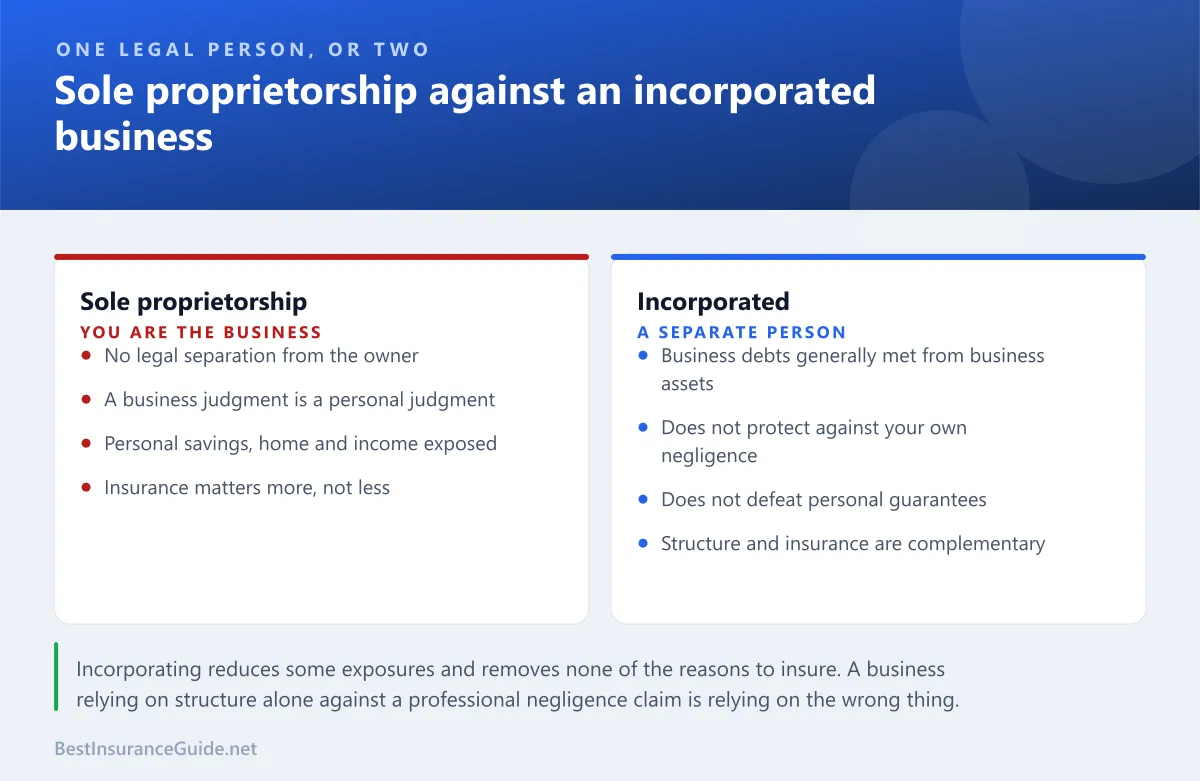
A corporation or limited liability company creates a legal person separate from its owner. A judgment against the business is generally satisfied from business assets.
A sole proprietorship does not. The business and the owner are the same legal entity. A judgment arising from the business is a judgment against you, and it can reach personal savings, a home, a vehicle and future income.
Two things follow, and they point in the same direction.
Insurance matters more, not less. Sole proprietors frequently treat business insurance as something for larger operations, and the exposure runs the other way.
Incorporating does not remove the need for it. Limited liability protects against many business debts and does not protect against your own negligence, personal guarantees you have given, or situations where a court disregards the structure. Structure and insurance address overlapping but different risks, and neither substitutes for the other.
The homeowners policy gap
Most sole proprietors start at home, and most assume the home policy covers something. It covers almost nothing relevant.
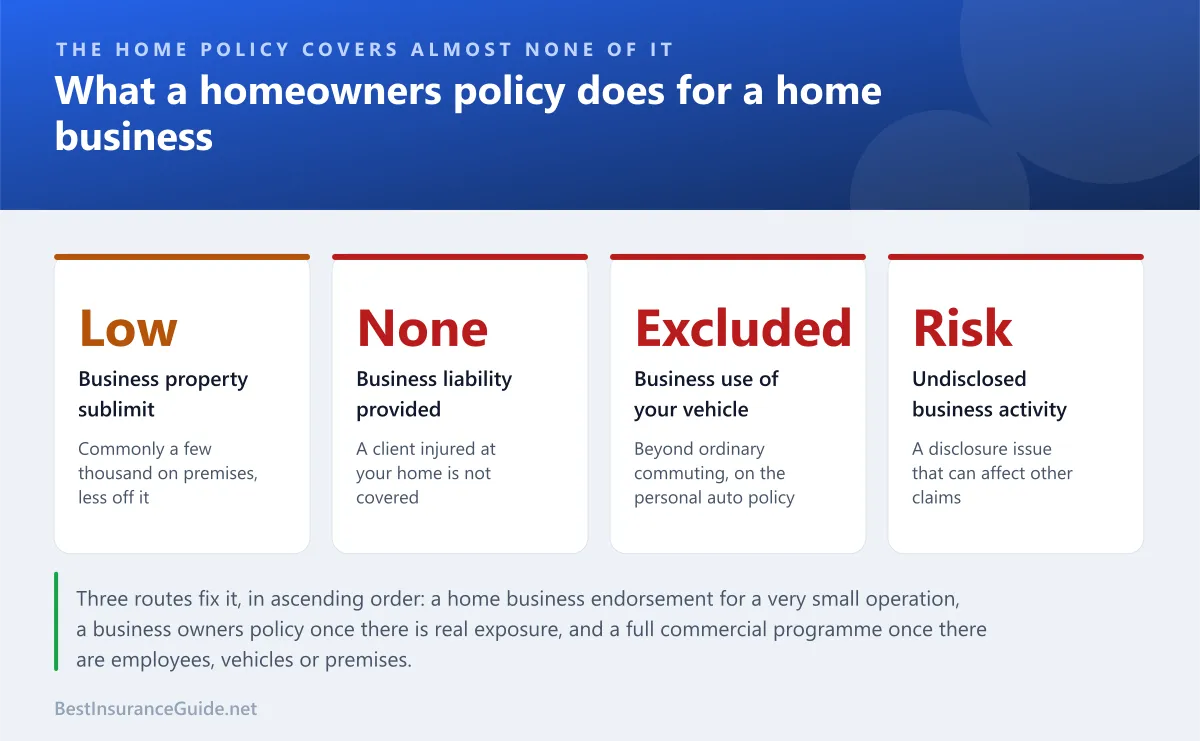
Business property is capped at a low sublimit, commonly a few thousand dollars on premises and less off premises. A home office with a computer, cameras, tools or stock exceeds that quickly.
Business liability is generally excluded entirely. A client injured visiting your home office is not covered. A claim arising from your work is not covered.
Business use can affect the policy itself. Undisclosed business activity at a home is a disclosure issue that can affect an unrelated claim.
Vehicles used for business are outside the personal auto policy, which excludes business use beyond ordinary commuting.
Three routes to fixing it, in ascending order.
A home business endorsement on the homeowners policy, which raises the property sublimit and adds limited liability. Suitable for a very small operation with no client visits.
A business owners policy, packaging general liability with business property and business income. The usual answer once there is any real exposure.
A standalone commercial programme, once there are employees, vehicles or premises.
What a sole proprietor actually needs
The mix depends heavily on the trade, and four questions determine it.
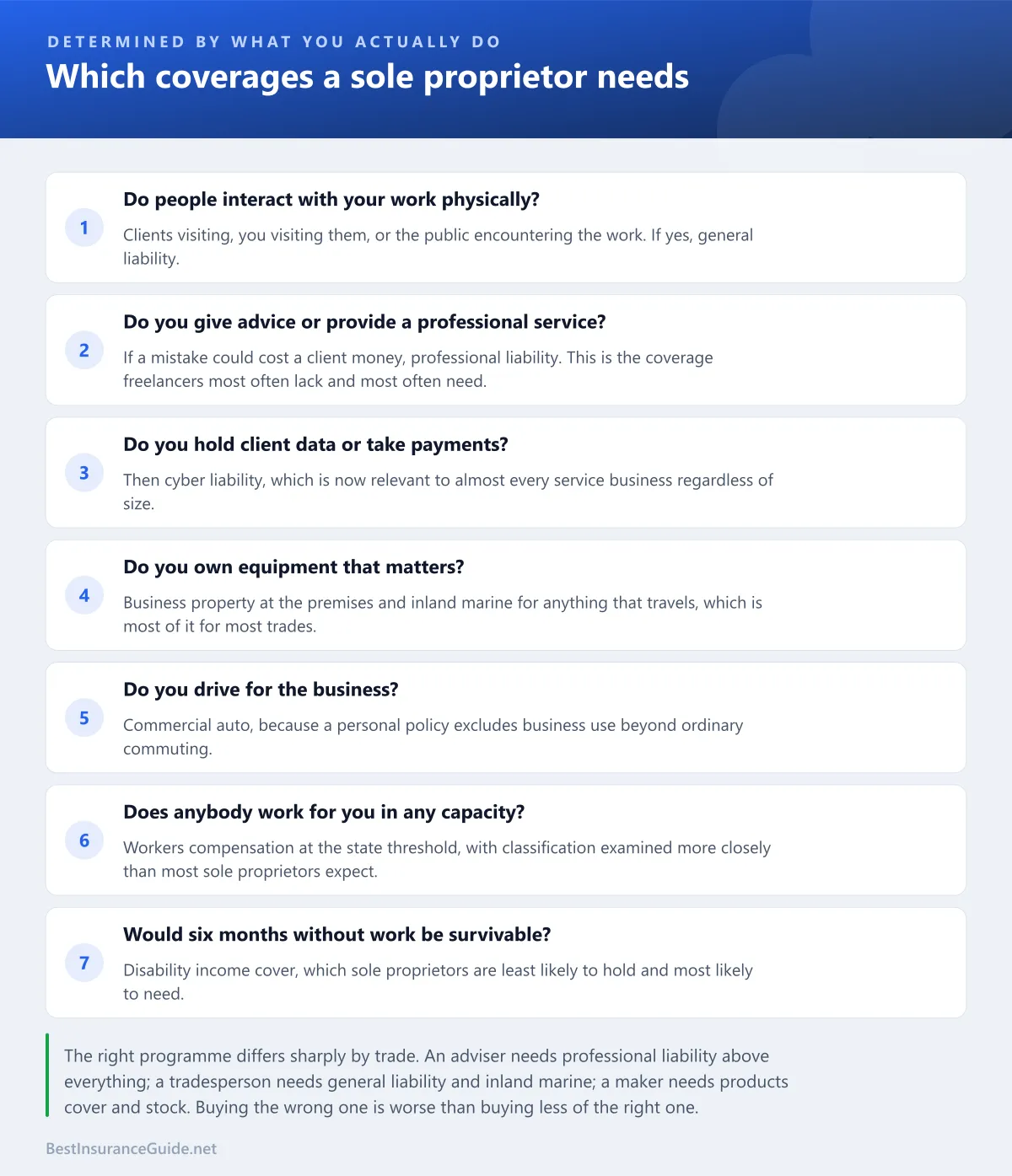
Do people interact with your work physically? If clients visit, if you visit them, or if the public encounters your work, you need general liability.
Do you give advice or provide a professional service? If a mistake in your work could cost a client money, you need professional liability, sometimes called errors and omissions. This is the coverage freelancers most often lack and most often need.
Do you hold client data or take payments? Then cyber liability, which is now relevant to almost every service business.
Do you own equipment that matters? Then business property at the premises and inland marine for anything that travels.
Do you drive for the business? Then commercial auto, because the personal policy excludes business use.
Do you have anybody working for you, in any capacity? Then workers compensation, subject to the state threshold, and worker classification is examined more closely than most sole proprietors expect.
Health, disability and the personal side
For a sole proprietor the boundary between business and personal insurance is artificial, and two personal coverages matter more here than for an employee.
Health insurance, since there is no employer plan. Marketplace coverage with income-based subsidies is the usual route, and the self-employed health insurance deduction may apply.
Disability income insurance, which is the coverage sole proprietors most consistently lack and most need. There is no sick pay, no employer plan and no colleague to cover the work. An inability to work for six months is a total loss of income, and the probability of that during working years exceeds the probability of dying.
For a household depending on one self-employed income, disability cover is arguably a higher priority than any business policy on this page.
Life insurance, where anybody depends on that income, as our guide to whether life insurance is worth it works through.
What clients will require
Even where nothing is legally required, clients frequently are.
General liability at $1,000,000, near universally for any work at a client’s premises.
Additional insured status, naming the client.
Professional liability, for consultancy, design, technology and healthcare-adjacent work, frequently at $1,000,000 or more.
Cyber liability, increasingly, for anybody touching client data.
Workers compensation, which some clients require even from a sole proprietor with no employees, in which case a policy covering the proprietor personally or a ghost policy providing a certificate may be needed.
A certificate of insurance, which is what actually gets you onto the site or the contract.
Two practical points. Read the insurance clause before agreeing the work, since meeting a requirement you did not price for erodes the margin. And build the cost into your rates, because for a sole proprietor there is nobody else to absorb it.
Building it economically
Start with the exposure that would end you. For most sole proprietors that is professional liability or general liability depending on the trade, not property.
Use a business owners policy where one is available, since packaging is cheaper than components.
Set limits against client requirements rather than guessing, and revisit as clients get larger.
Do not insure trivial property at commercial rates when the exposure is small.
Buy disability cover, which is the one most likely to be needed and least likely to be held.
Review annually, since a sole proprietorship changes shape faster than a larger business and the programme drifts out of alignment quickly.
The short version
A sole proprietorship has no legal separation between the owner and the business, which means a business liability reaches personal assets directly. That makes insurance more important than for an incorporated business, not less.
A homeowners policy provides a low property sublimit and generally excludes business liability entirely, so a home-based business is largely uninsured by default.
Which coverages you need depends on the trade: general liability where people interact physically with the work, professional liability where you give advice, cyber where you hold data, inland marine where equipment travels, and commercial auto if you drive for the business.
And the coverage sole proprietors most consistently lack is disability income insurance, because there is no sick pay and no colleague to cover the work.
For the excess layer, see business umbrella insurance, and for what to hold generally, the business insurance checklist.
Where the exposure actually sits, by trade
The right programme differs sharply by what you do, and four shapes cover most sole proprietors.
The adviser. Consultant, bookkeeper, designer, coach, therapist. The dominant exposure is professional liability, because the claim is that your advice or work cost the client money. General liability is largely a contractual requirement, and cyber matters wherever client data is held.
The tradesperson. Electrician, plumber, decorator, gardener. The dominant exposures are general liability and inland marine, because you work on other people’s property with tools that travel. Commercial auto follows immediately.
The maker or seller. Craft, food, retail. Products liability within general liability is the exposure, plus property and stock, plus business income.
The service provider seeing clients at home. Tutor, therapist, hairdresser, instructor. This is where the homeowners policy gap bites hardest, because a client injured on the premises is a business liability the home policy excludes.
Worked example: the same premium, different products
Four sole proprietors each spending a similar amount annually.
| What it buys | |
|---|---|
| The adviser | Professional liability, modest general liability, cyber |
| The tradesperson | General liability, inland marine, commercial auto contribution |
| The maker | General liability with products, property and stock, business income |
| The home-based service | Business owners policy with premises liability and property |
The same budget, four different programmes, and buying the wrong one is worse than buying less of the right one.
Two things to sort out first
Separate the finances. A dedicated business account is not an insurance requirement and it is what makes a business income claim, a revenue-rated liability policy and a tax position all provable rather than argued.
Buy disability income cover. It is the coverage sole proprietors are least likely to hold and most likely to need, because there is no sick pay and no colleague to cover the work.
The contract requirements you will meet
Even without employees or premises, a sole proprietor working with commercial clients meets the same requirements a larger business does.
General liability at $1,000,000 per occurrence, near universally, for any work at a client’s site.
Professional liability, frequently at $1,000,000 or more, for advisory, design, technology and healthcare-adjacent work.
Cyber liability, increasingly, for anybody touching client data.
Workers compensation, which some clients require even from a sole proprietor with no employees. Where that happens, either a policy covering the proprietor personally or a policy issued for certificate purposes may be needed.
Additional insured status, naming the client.
Two practical points. Read the insurance clause before agreeing the work, since a requirement discovered afterwards is absorbed from your own margin. And build the cost into your rates, because for a sole proprietor there is no overhead line to hide it in.
Two things to do this month
Check whether your homeowners policy knows about the business. Undisclosed business activity at a home is a disclosure issue that can affect an unrelated claim, and correcting it is a phone call.
Get a disability income quote. It is the coverage sole proprietors are least likely to hold and most likely to need, and most people are surprised by what it costs relative to what it protects.
The programme, summarised
The coverage that answers the fatal claim first, which is professional liability for advisers and general liability for trades.
A business owners policy once there is any premises or equipment exposure, since packaging beats components.
Inland marine for anything that travels, which for most sole proprietors is most of what matters.
Commercial auto if you drive for the business, because the personal policy excludes business use.
Cyber liability if you hold client data or take payments.
Workers compensation the moment anybody works for you in any capacity.
Disability income cover, which is the personal coverage most likely to be needed and least likely to be held.
Health cover through the marketplace, with the subsidy calculated on realised rather than assumed income.
When to incorporate, from an insurance perspective
This is a legal and tax question first and it has an insurance dimension worth stating.
Incorporating separates the business from the owner for many purposes, which limits the reach of business debts and many business liabilities into personal assets.
It does not protect against your own negligence. If you personally did the work that caused the loss, you can generally be sued personally regardless of the structure.
It does not protect against personal guarantees, which lenders and landlords routinely require from small business owners.
It does not protect where the structure is disregarded, which courts may do where the business and personal finances are not genuinely separate.
So the honest position is that structure and insurance address overlapping but different risks. Incorporating reduces some exposures and removes none of the reasons to insure, and a business relying on structure alone against a professional negligence claim is relying on the wrong thing.
The practical sequence for most sole proprietors: insure the exposure that would end you first, then take advice on structure as the business grows, and treat the two decisions as complementary rather than alternative.
Related reading
Start-up business insurance costs covers what a new venture pays and why, which for a sole proprietor is usually the same conversation. Business umbrella insurance covers the excess layer, which matters more where there is no legal separation between the owner and the business.
A note on scope
Nothing here is legal, tax or financial advice, and questions about business structure and personal liability warrant qualified advice. Workers compensation thresholds, worker classification tests and licensing requirements are set by state law and vary considerably.
Your state insurance department publishes commercial guidance, your state workers compensation authority publishes coverage requirements, and your policy documents and client contracts are the authoritative statement of what you hold and what you must hold. This site is independent and not affiliated with any insurer.