Start-Up Business Insurance Costs: What to Budget and When
What business insurance costs a new venture, why start-ups pay more, which coverage to buy first, and what triggers each additional policy as you grow.

Table of contents

New ventures pay more for insurance than established ones doing identical work, and understanding why makes the budgeting easier and the reduction predictable.
Why start-ups pay more
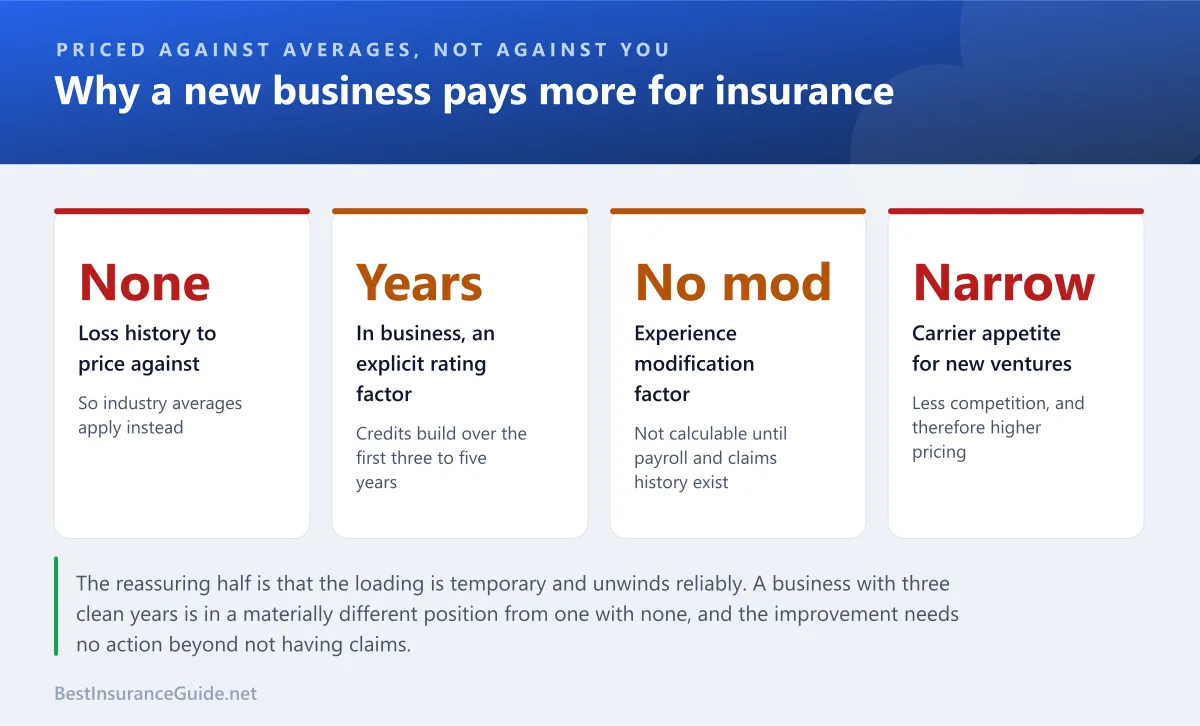
Underwriters price against loss history, and a new business has none.
That means a start-up is priced against industry averages rather than against its own record, and industry averages include every badly run business in the class.
Three factors compound it.
Years in business is an explicit rating factor with most carriers, and the credit builds over the first three to five years.
No experience modification factor exists for workers compensation until there is enough payroll and claims history to calculate one, so a new employer starts at the industry baseline.
Underwriting appetite is narrower. Some carriers will not write new ventures in certain classes at all, which reduces competition and therefore price.
The reassuring half of that is that it is temporary and it improves reliably. A business with three clean years is in a materially different position from one with none, and the improvement arrives without any action beyond not having claims.
What to budget, by shape of business
There is no useful single figure, and the range across business types is many multiples. What is useful is the relative shape.
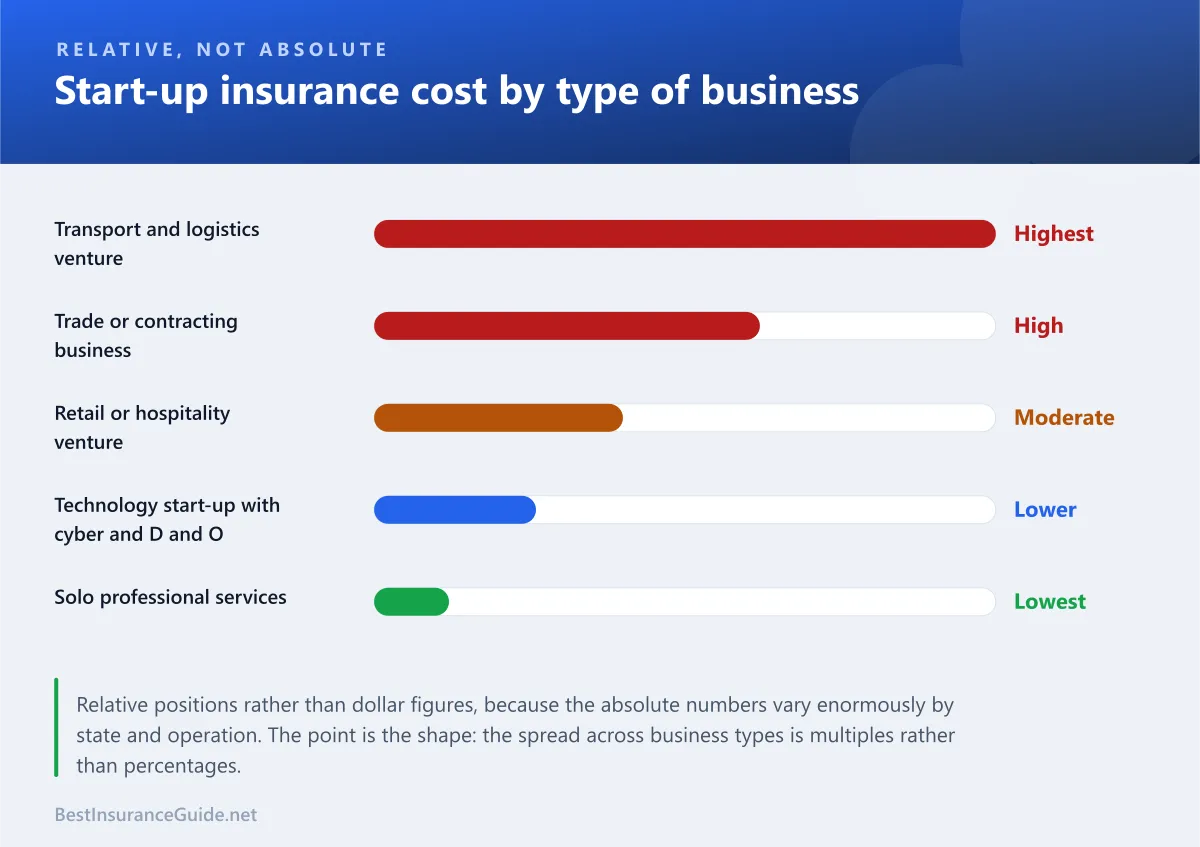
A solo professional services venture — consultancy, design, coaching, bookkeeping — sits at the bottom. General liability is largely a contractual requirement, professional liability is the real coverage, and there is little property.
A technology start-up adds cyber liability as a primary rather than secondary coverage, and directors and officers cover once there is outside investment.
A retail or hospitality venture adds commercial property, business income, higher premises liability, and liquor liability where applicable.
A trade or contracting business adds workers compensation at a construction classification, commercial auto, inland marine for tools, and contract-driven umbrella limits.
A transport or logistics venture sits at the top, with commercial auto severity, cargo cover, filings and regulatory requirements. Our guide to commercial auto insurance costs covers that end.
What to buy first
The sensible order is by consequence rather than by cost.
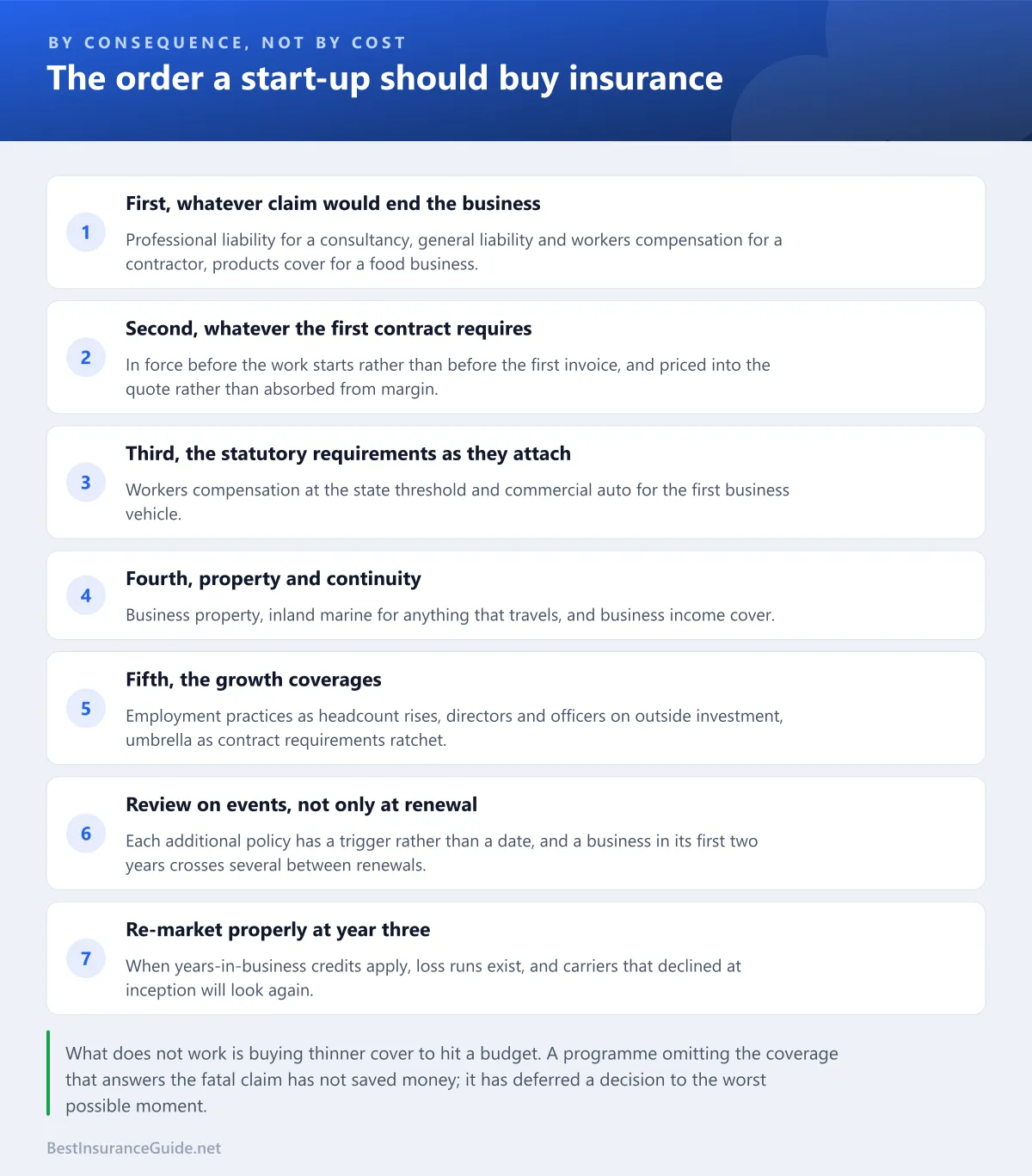
First, whatever would end the business. For a consultant that is professional liability. For a contractor it is general liability and workers compensation. For a food business it is products liability. Identify the single claim that would be unsurvivable and cover it before anything else.
Second, whatever a contract requires. The first client contract usually specifies limits and endorsements, and it needs to be in place before the work starts rather than before the invoice.
Third, statutory requirements as they attach. Workers compensation at the state threshold, commercial auto for the first business vehicle.
Fourth, the property and continuity coverages. Business property, inland marine, business income.
Fifth, the growth coverages. Employment practices liability as headcount rises, directors and officers on outside investment, cyber as data accumulates, umbrella as contract requirements ratchet.
What triggers each policy
A more useful framing than a shopping list is knowing what event makes each coverage necessary.
| Trigger | Coverage it makes necessary |
|---|---|
| First client contract | General liability, frequently professional liability |
| First person visiting your premises | General liability and premises exposure |
| First advice given for a fee | Professional liability |
| First customer data held | Cyber liability |
| First employee, at the state threshold | Workers compensation |
| First employee driving on business | Hired and non-owned auto |
| First business vehicle | Commercial auto |
| First equipment leaving the premises | Inland marine |
| First outside investment or board | Directors and officers |
| Around ten to fifteen employees | Employment practices liability |
| First contract requiring high limits | Commercial umbrella |
Every row is an event rather than a date, which is why an annual review misses several of them in a fast-moving first two years.
Keeping the cost down honestly
Six things genuinely reduce a start-up programme’s cost without reducing what it does.
Classify the business accurately. A misclassified business pays the wrong rate in both directions, and the correction at audit is unpleasant.
Package where possible. A business owners policy is cheaper than general liability plus property bought separately.
Set limits from contracts rather than from anxiety, then raise them as requirements ratchet.
Pay annually if cash flow allows, which usually attracts a discount and avoids instalment fees.
Use a broker who works with your industry, because commercial markets are not reachable through comparison sites and placement quality matters more than shopping.
Build the record deliberately. Document safety procedures, hiring standards and maintenance from the start. Underwriters ask, and a new business that can answer well is priced better than one that cannot.
What does not work is buying thinner cover to hit a budget. A programme that omits the coverage answering the claim that would end the business has not saved money; it has deferred a decision.
The three-year improvement
Because the start-up loading is temporary, it is worth knowing when to expect it to unwind.
Year one. Priced against industry averages, narrower market, highest relative cost.
Year two. A year of clean loss runs, which is the single most useful document in any renewal submission.
Year three. Years-in-business credits begin applying with most carriers, and the market broadens.
Years three to five. The workers compensation experience modification factor becomes calculable and, on a clean record, starts reducing premium directly.
The practical instruction: re-market the programme at year three, properly, through a broker with a full submission. That is the point at which the market that declined you at inception will look again, and the difference is frequently substantial.
The short version
Start-ups pay more because there is no loss history to price against, and the loading unwinds over three to five years without any action beyond not having claims.
Buy in order of consequence rather than cost: first whatever claim would end the business, then whatever the first contract requires, then the statutory requirements as they attach.
Every additional policy has an event that triggers it rather than a date, which is why a business in its first two years should review when things change rather than only at renewal.
And re-market properly at year three, when the years-in-business credits apply, the loss runs exist and the market that would not look at you at inception will.
For the excess layer, see business umbrella insurance, and for the full list of what a business should hold, the business insurance checklist.
The first-contract problem
The single most common timing error in a new business is discovering the insurance requirement after signing.
Client contracts specify insurance, frequently at limits and with endorsements a start-up does not hold.
Coverage has to be in force before the work starts, not before the first invoice.
Some endorsements take time. Additional insured status with a specific form, primary and non-contributory wording, and a waiver of subrogation are all straightforward and none of them is instant.
Certificates are issued against the policy, so a certificate cannot show a coverage that has not been bound.
The practical sequence: read the insurance clause during negotiation, price it into the quote, and arrange the cover before signature rather than in the week before mobilisation.
Worked example: the cost of a clause
A start-up wins its first commercial contract requiring $1,000,000 general liability, $1,000,000 commercial auto, workers compensation, a $2,000,000 umbrella, additional insured with completed operations, and a waiver of subrogation.
| Priced in advance | Discovered after signing | |
|---|---|---|
| Cost included in the quote | Yes | No, absorbed from margin |
| Endorsements arranged in time | Yes | Rushed, sometimes unavailable |
| Ability to negotiate the clause | Yes | None |
| Start date | On schedule | Delayed pending certificates |
The insurance cost was the same in both columns. Only one of them charged for it.
Two habits for the first two years
Review when things change, not only at renewal. The triggers in the table above are events, and a business in its first two years crosses several of them between renewals.
Keep the loss runs and the safety documentation from day one, because at year three the quality of the submission is what unlocks the improved pricing that years in business make available.
Where founders underspend and overspend
Two patterns recur and they are opposite errors.
Underspending on the coverage that answers the fatal claim. A consultancy with general liability and no professional liability, a food business without products cover confirmed, a contractor without workers compensation at the state threshold. In each case the business is insured against the claim it will not face and uninsured against the one that would end it.
Overspending on property and low-severity coverages. A start-up insuring modest office contents at commercial rates, or buying a comprehensive package where a narrow professional liability policy was the actual need.
The corrective question is the same one in both cases: what single claim would this business not survive, and is it covered?
Worked example: the same budget, two allocations
A consultancy with a modest first-year insurance budget.
| Allocation A | Allocation B | |
|---|---|---|
| General liability | $1M, as contracts require | $1M |
| Professional liability | Not purchased | $1M |
| Cyber liability | Not purchased | Included |
| Office contents | Comprehensively insured | Modest cover |
| Exposure to a claim that a client lost money on your advice | Entirely uninsured | Covered |
The spend was similar. Only one of them addressed the exposure the business actually has.
Two things to do in the first month
Read the insurance clause of every contract before signing, and price it into the quote.
Ask a broker what would end this business, and buy that first. It is a better question than asking what insurance a business like yours usually buys.
The three-year plan, summarised
Year one. Buy the coverage answering the claim that would end the business, plus whatever the first contract requires. Accept that the pricing is loaded and that the loading is temporary.
Year two. Maintain clean loss runs, document safety and hiring standards, and add coverages as the triggering events occur rather than waiting for renewal.
Year three. Re-market the whole programme properly through a broker with a full submission. Years-in-business credits apply, loss runs exist, and carriers that declined at inception will look again.
Years three to five. The workers compensation experience modification factor becomes calculable and, on a clean record, begins reducing premium directly.
The cost of a start-up programme is highest exactly when a business can least afford it, and it improves reliably without any action beyond running the business well and keeping the records that prove it.
Related reading
Business insurance for sole proprietors covers the most common structure a new venture starts in, and why a homeowners policy answers almost none of it. Business umbrella insurance covers the coverage most commonly required by a first substantial client contract.
A note on scope
Commercial pricing varies enormously by industry, geography, size and structure, and the comparisons here are relative and illustrative rather than quotes. Workers compensation thresholds, experience rating mechanics and regulatory requirements are set by state and change over time.
Your state insurance department publishes commercial guidance, your state workers compensation authority publishes coverage thresholds and rating mechanics, and your policy documents and client contracts are the authoritative statement of what you hold and what you must hold. This site is independent and not affiliated with any insurer.