Small Business Insurance in Pennsylvania: What the State Actually Requires
What Pennsylvania requires of small businesses, workers compensation rules, the coverages contracts demand, and how to build a programme that fits.

Table of contents
Pennsylvania requires less of a small business than owners expect and enforces one requirement more seriously than most states. Getting that one right is the priority.
What the state actually requires
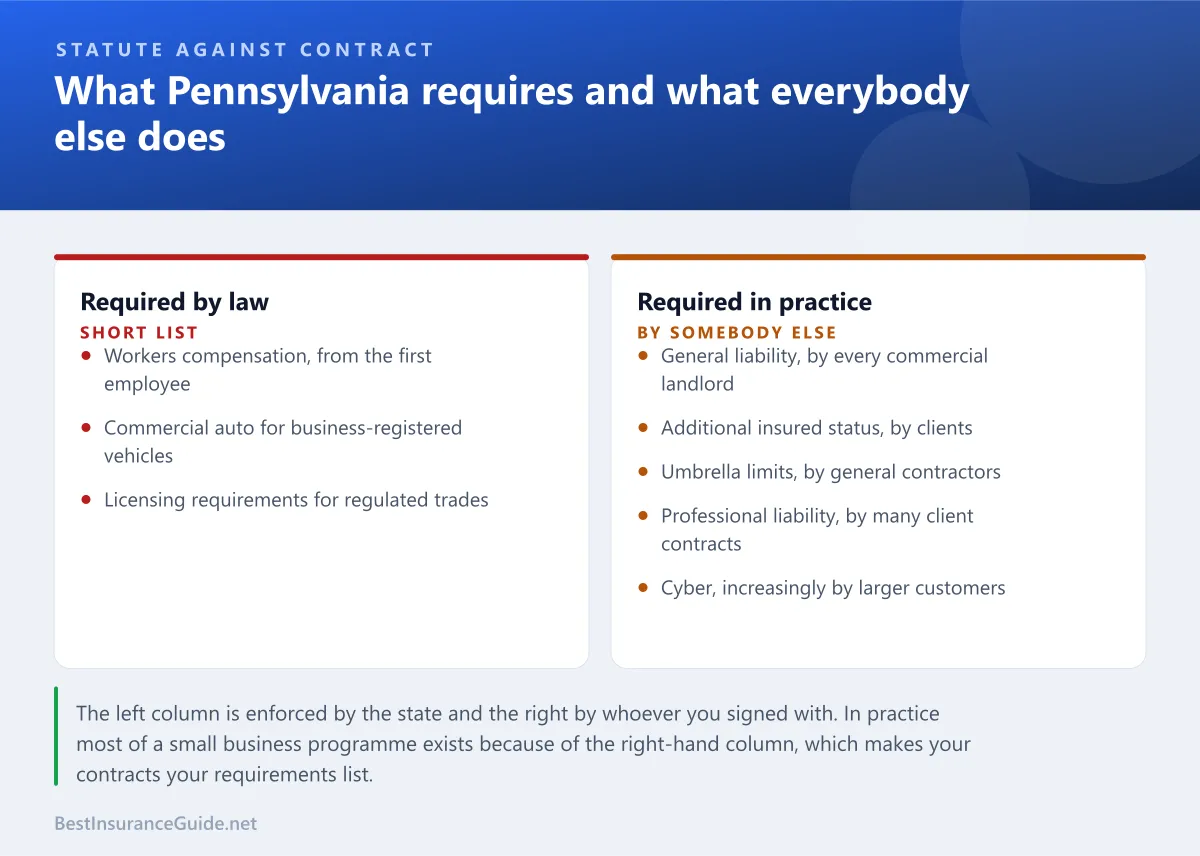
Workers compensation, for employers with employees. This is the significant one and it applies broadly.
Commercial auto liability, for vehicles registered to the business, at Pennsylvania’s statutory minimums, which as covered in our guide to car insurance in PA are among the lowest in the country and are wholly inadequate for a business.
Specific licensing requirements for certain regulated professions and trades, which vary by activity and are set by the relevant board.
Everything else is not required by statute and is required in practice by somebody else: a landlord, a client, a lender, a franchisor or a contract.
Workers compensation, taken seriously
Pennsylvania treats this as more than an administrative obligation, and it is worth being plain about it.
The requirement starts with the first employee, and the definition of employee is applied broadly. Part-time, seasonal and casual workers generally count.
The penalties are severe. Failing to carry required coverage in Pennsylvania can carry financial penalties and criminal liability, and it removes the protection that workers compensation otherwise gives an employer against direct injury suits.
Independent contractor classification is scrutinised. Calling somebody a contractor does not make them one, and the tests applied look at control, integration and the economic reality of the relationship rather than at what the paperwork says. In construction specifically, Pennsylvania applies particular statutory criteria.
An uninsured subcontractor’s injured worker can become your responsibility. This is the exposure that catches small contractors, and the protection against it is straightforward: collect a current certificate of insurance from every subcontractor before they start, and keep it on file.
Sole proprietors and certain officers may be exempt or may elect coverage. The rules are specific and worth confirming rather than assuming.
What contracts require
Since the statutory list is short, most of a small business programme exists because somebody demanded it.
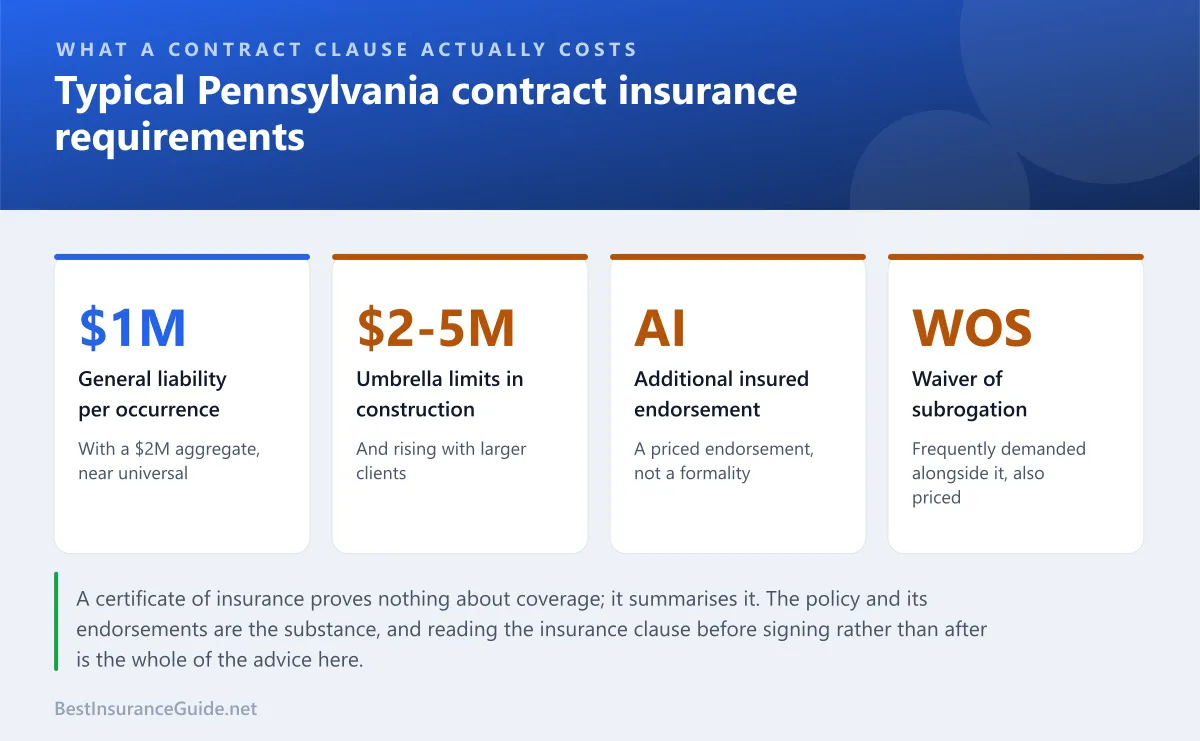
Commercial general liability, commonly at $1,000,000 per occurrence and $2,000,000 aggregate. Required by essentially every commercial landlord and most clients.
Additional insured status, naming the landlord or client on your policy, which is an endorsement with real cost implications rather than a formality.
Waiver of subrogation, frequently demanded alongside it, preventing your insurer from pursuing the other party.
Certificates of insurance, which prove nothing about coverage and merely summarise it. The policy and its endorsements are the substance.
Umbrella limits, commonly $2,000,000 to $5,000,000 in construction and for larger clients. Our guide to business umbrella insurance covers how those are met economically.
Professional liability, for consultants, designers, technology and healthcare-adjacent businesses.
The practical instruction: read the insurance clause before signing, not after. Discovering a requirement you cannot meet after signature is expensive, and meeting one you did not price for is worse.
The coverages a Pennsylvania small business usually needs
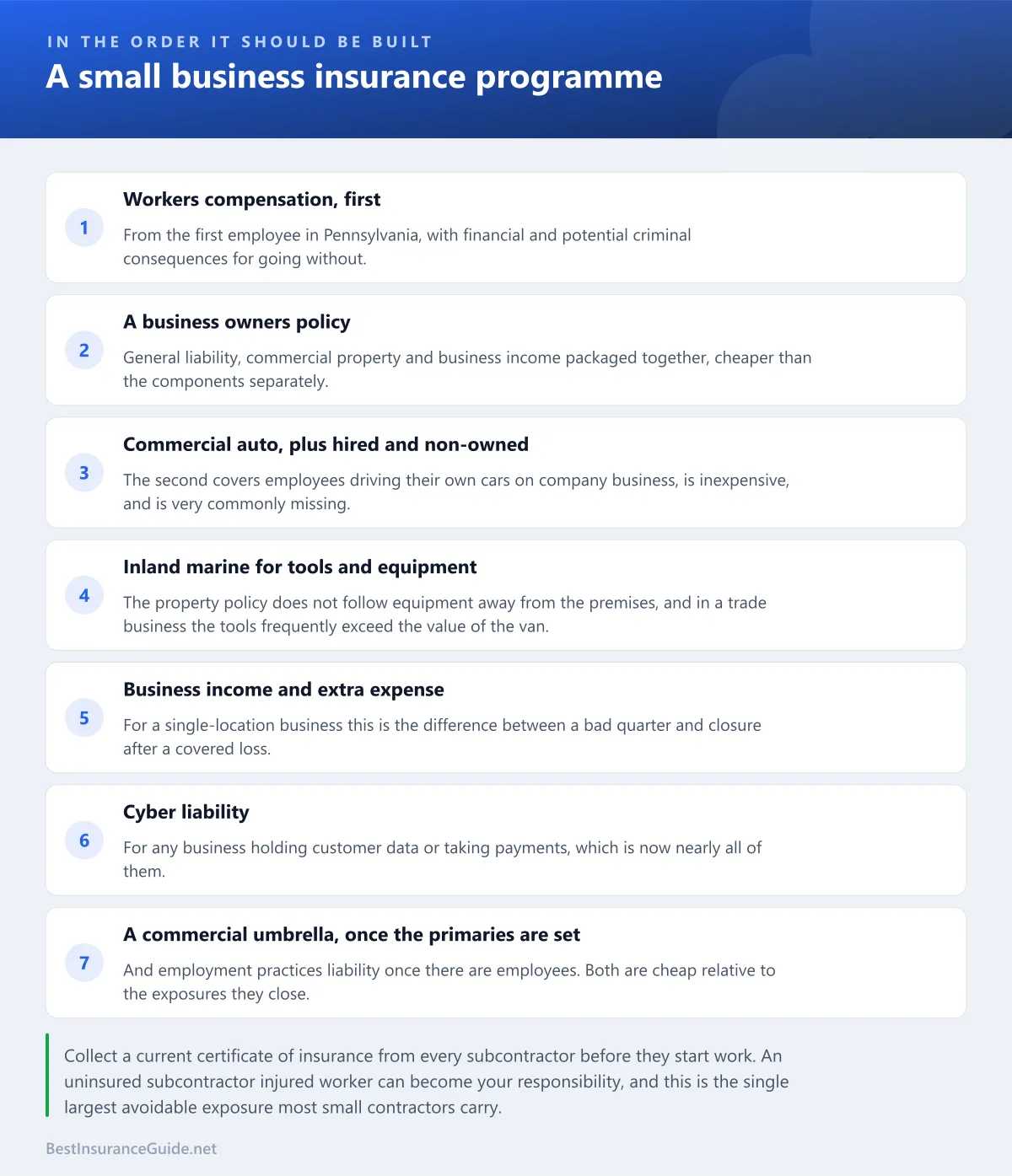
A business owners policy, packaging general liability with commercial property and business income cover. The usual starting point for a small business and cheaper than the components separately.
Workers compensation, as above.
Commercial auto, for owned vehicles, plus hired and non-owned auto for employees driving their own cars on company business, which is inexpensive and very commonly missing.
Business income and extra expense, which pays while operations are interrupted after a covered loss. For a single-location business this is frequently the difference between a bad quarter and closure.
Inland marine or contractors equipment, for tools and equipment away from the premises, which the property policy does not cover in transit.
Cyber liability, for any business holding customer data or taking payments, which is now most of them.
Employment practices liability, once there are employees.
Professional liability, where advice or professional services are provided.
A commercial umbrella, above the liability lines.
What drives the cost
Industry classification, above everything else. A professional services firm and a roofing contractor are different worlds.
Payroll, for workers compensation, by job classification.
Revenue, for general liability.
Property values and location, for the property side.
Claims history, and for workers compensation the experience modification factor, which compares your loss record against your industry and multiplies the premium directly.
Contract-driven limits, since higher limits and additional insured endorsements both cost.
The experience modification factor deserves emphasis. It is a multiplier applied to workers compensation premium, it is calculated from your own claims against industry expectation, and it is one of the few insurance costs a business can genuinely manage over time through safety performance and claims handling.
Pennsylvania specifics worth knowing
The State Workers Insurance Fund operates as a competitive state fund and as a market of last resort for employers who cannot obtain coverage in the voluntary market.
Certified safety committees can attract a workers compensation premium credit where the committee is properly constituted and certified. This is a genuine and underused saving.
Regional variation is significant. Philadelphia rates above Pittsburgh, which rates above the rural counties, on both liability and auto lines, for the same reasons that apply to personal insurance.
Winter weather exposure matters for premises liability. Slip and fall claims concentrate in winter, and documented snow and ice procedures are both a defence and an underwriting positive.
Building the programme
Start with the statutory requirements, which is workers compensation and commercial auto.
Add a business owners policy for liability and property.
Read every contract you have signed and list the insurance requirements in each.
Identify the exposures specific to your work, particularly tools away from premises, employee driving, professional advice and customer data.
Add an umbrella once the liability lines are in place.
Use a broker who knows your industry. Commercial placement quality matters more than price shopping, and the good markets are not reachable through comparison sites.
Review annually against payroll, revenue, vehicles, employees and contracts, all of which drift.
The short version
Pennsylvania requires workers compensation from the first employee and commercial auto for business vehicles. It takes the first of those unusually seriously, with financial and potential criminal consequences for going without.
Everything else in a small business programme exists because a landlord, a client or a contract demanded it, which means the insurance clause in your contracts is effectively your requirements list.
The coverages most often missing are hired and non-owned auto for employees driving their own cars, inland marine for tools away from premises, business income cover, and cyber liability.
And on workers compensation specifically, collect a certificate of insurance from every subcontractor before they start, because an uninsured subcontractor’s injured worker can become your responsibility.
For the umbrella layer, see business umbrella insurance, and for what to hold generally, the business insurance checklist.
Regional differences within the state
Pennsylvania’s internal variation is large enough to affect a business programme.
Philadelphia carries the highest liability and auto rates in the state, driven by claim frequency, litigation costs and theft. Premises liability exposure is higher and property crime affects both the property and inland marine lines.
Pittsburgh and Allegheny County rate above the state average and well below Philadelphia, with winter weather and hillside water exposure affecting property.
The Lehigh Valley and the I-81 corridor carry substantial warehousing and logistics activity, which means commercial auto and workers compensation classifications dominate those programmes.
Rural Pennsylvania rates lowest on liability and carries longer emergency response times, which affects property loss severity, and higher commercial auto severity from higher speeds and deer collisions.
Two things worth doing this year
Ask about the certified safety committee credit. Pennsylvania offers a workers compensation premium credit for employers operating a properly constituted and certified safety committee. It requires meeting specific criteria and filing, and for a business of any size with payroll it is a meaningful and underused saving.
Audit your subcontractor certificates. Pull the file, check every certificate is current, and check the limits meet what your own contracts require you to pass down. This is a half-day exercise that removes the single largest uninsured exposure most small contractors carry.
Building the programme in order
For a business starting from nothing, the sequence matters because each layer depends on the one below.
First, the statutory requirements. Workers compensation if there are employees, and commercial auto for any vehicle registered to the business.
Second, a business owners policy. General liability, commercial property and business income together, which is cheaper than the components separately and covers the exposures every business has.
Third, the exposures specific to your work. Tools and equipment away from premises on inland marine, employees driving their own cars on hired and non-owned auto, professional advice on errors and omissions, and customer data on cyber.
Fourth, the contract requirements. Read every signed agreement, list the limits and endorsements each demands, and reconcile them against what you hold.
Fifth, the umbrella, once the underlying liability lines are in place at the limits the umbrella requires.
Sixth, employment practices liability, once there are employees and particularly once there are several.
Each step is cheap relative to the exposure it closes, and the sequence prevents the common error of buying an umbrella before the underlying policies are correctly specified.
Worked example: what a contract clause actually demands
A typical general contractor requirement on a subcontractor.
| Requirement | What it means |
|---|---|
| $1,000,000 general liability per occurrence | The primary limit, and an umbrella cannot substitute |
| $2,000,000 general aggregate | The annual ceiling across all claims |
| $1,000,000 commercial auto CSL | Including hired and non-owned |
| Workers compensation, statutory | Plus employers liability at stated limits |
| $2,000,000 umbrella | Sitting above the above |
| Additional insured, primary and non-contributory | An endorsement with real cost |
| Waiver of subrogation | Another endorsement, also priced |
Six lines of a contract, and a programme that has to be built to match before the first day on site.
Two things worth doing this quarter
Verify every subcontractor certificate is current and adequate. This is the single largest uninsured exposure most small Pennsylvania contractors carry, and the remedy is a folder and an afternoon.
Ask your broker about the certified safety committee credit. It requires a properly constituted committee meeting specified criteria and a filing, and for any employer with meaningful payroll it is a genuine and persistent reduction in workers compensation premium rather than a one-off discount.
The decision, summarised
Workers compensation first, without exception, from the first employee. Pennsylvania enforces this seriously and the consequences of going without extend beyond financial penalties.
A business owners policy next, for liability, property and business income together.
Then the exposures your work creates, particularly tools away from premises, employees driving their own cars, professional advice and customer data.
Then whatever your contracts demand, which in practice is where most of the programme comes from.
And subcontractor certificates on file for every one of them, current, before they start work.
How other states set the threshold
Pennsylvania requires workers compensation from the first employee, which is at the strict end. The states we cover elsewhere sit at various points.
New Jersey matches it with no small-employer exemption and adds a stricter contractor classification test. Illinois also attaches from the first employee. Georgia and North Carolina wait until three, and Michigan applies thresholds on both headcount and hours. Florida varies its threshold by industry.
A note on scope
Nothing here is legal advice. Pennsylvania statutory requirements, worker classification tests, penalties, exemptions and safety committee credit rules are set by state law and regulation and change over time.
The Pennsylvania Department of Labor and Industry publishes the authoritative workers compensation requirements, the Pennsylvania Insurance Department publishes commercial insurance guidance, and your contracts and policy documents are the authoritative statement of what you are required to hold and what you actually hold. This site is independent and not affiliated with any insurer.