Small Business Insurance in Florida: Wind, Water and Workers Comp Thresholds
Florida workers compensation thresholds by industry, hurricane and flood exposure for commercial property, and what a small business programme should include.

Table of contents
Florida differs from most states in two specific ways that matter to a small business, and both are worth understanding before shopping.
The workers compensation thresholds
Florida does not apply a single employee threshold. It varies by industry, and the distinction is unusually consequential.
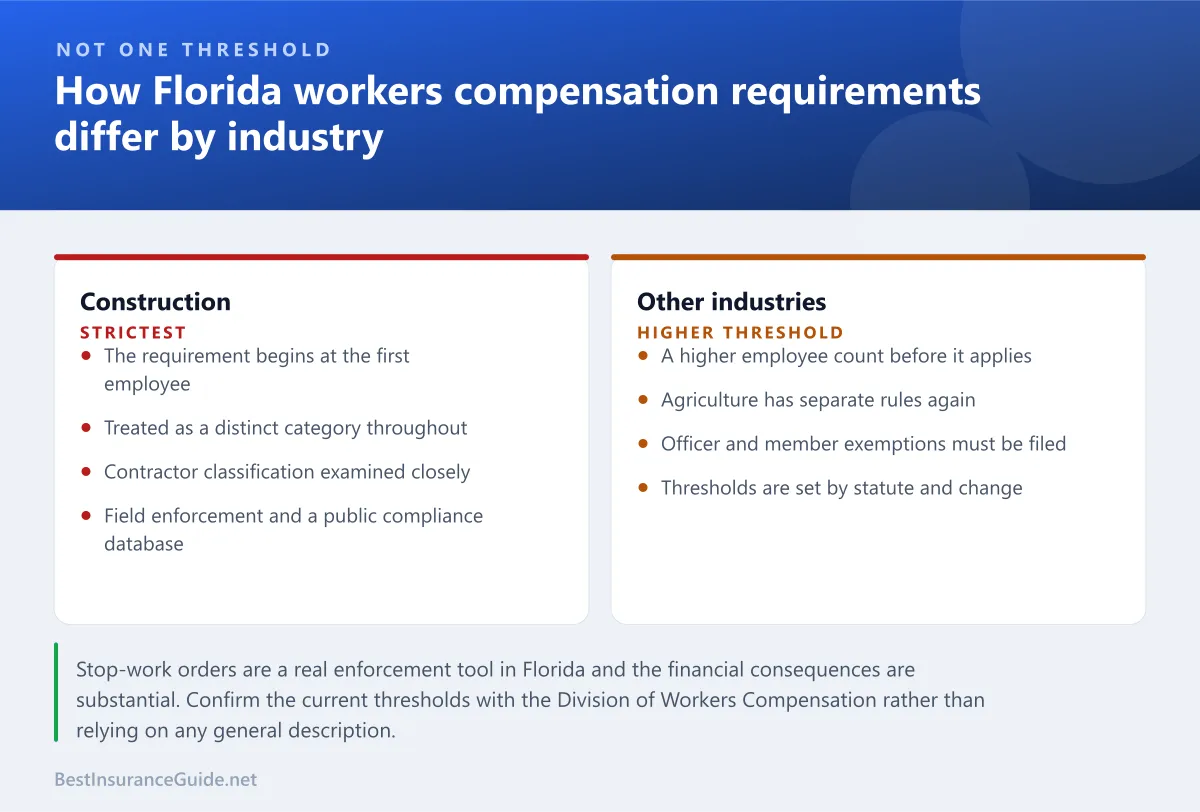
Construction is treated most strictly, with the requirement applying from the first employee. Florida treats construction as a distinct category throughout its workers compensation framework.
Non-construction employers have a higher employee threshold before the requirement applies.
Agriculture has its own separate rules based on regular and seasonal employee counts.
Thresholds and definitions are set by state law and are adjusted, so confirm the current position with the Florida Division of Workers’ Compensation rather than relying on any general description.
Three points that catch small businesses regardless of threshold.
Contractor classification is examined closely, and in construction particularly. Florida operates a public compliance database and conducts field enforcement.
An uninsured subcontractor’s injured worker can become your responsibility. Collect a current certificate of insurance from every subcontractor before they start work, and keep it.
Exemptions for officers and members exist and must be filed rather than assumed. An exemption that was never properly filed provides nothing.
Stop-work orders are a real enforcement tool in Florida, and the financial consequences of one are substantial.
The property problem
The second Florida-specific issue is commercial property, and it is unlike any other state.
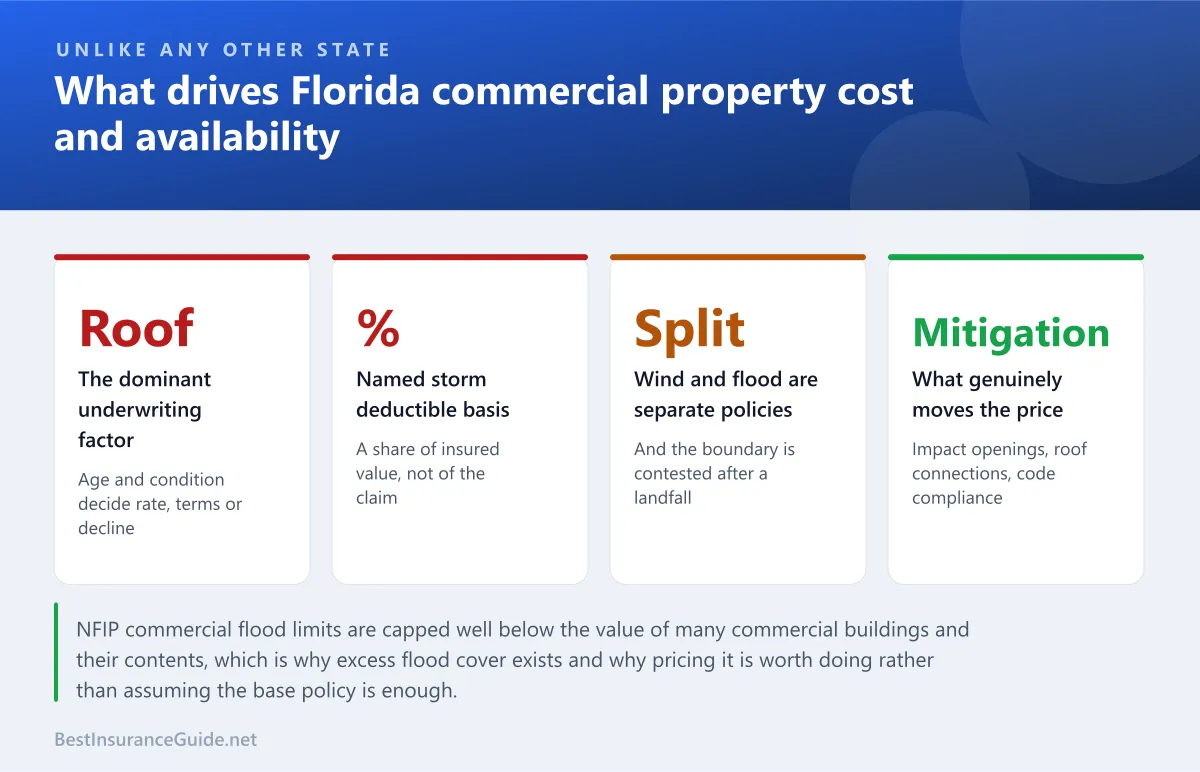
Named storm deductibles are percentages of the insured value, not of the claim, and on commercial property those percentages are frequently higher than on residential.
Wind and flood are separate. The property policy covers wind. Storm surge and rising water are flood, excluded entirely, and requiring a separate policy. After a landfall the allocation between the two is the most contested issue in the claim.
Flood limits under the NFIP commercial programme are capped, at levels well below the value of many commercial buildings and their contents, which is why excess flood cover exists and is worth pricing.
Roof age and condition dominate underwriting. An older roof produces higher rates, restricted terms, or a decline.
Mitigation features matter materially. Impact-rated openings, roof-to-wall connections, secondary water resistance and building code compliance all affect both availability and price, and documentation of them is worth obtaining.
Citizens Property Insurance Corporation is the market of last resort. It writes certain commercial risks that cannot be placed privately, with narrower coverage, and it should be a fallback rather than a destination.
Business income, which matters most here
For a Florida small business this is arguably the most important coverage on the programme, and it is the one most commonly bought too thin.
Business income cover pays lost income and continuing expenses while operations are interrupted by a covered loss.
Four Florida-specific reasons it matters more here.
Regional events close everything at once. After a hurricane, contractors, suppliers, staff and customers are all affected simultaneously, and the interruption is far longer than the physical repair suggests.
The waiting period matters. Most policies have a 48 or 72 hour waiting period before cover begins, and some have longer.
The indemnity period must be realistic. Twelve months is a common default and can be inadequate after a widespread event where reconstruction capacity is exhausted.
Civil authority coverage responds where a government order prevents access to your premises even without physical damage to them, which after an evacuation order is exactly the situation many businesses face. It is usually time-limited and it is frequently overlooked in a claim.
Worked example: a modest wind loss with a long closure
A restaurant with $60,000 of building damage and a four-month closure.
| Property cover only | With business income | |
|---|---|---|
| Building repair | Paid, less the named storm deductible | Same |
| Lost revenue over four months | $0 | Covered |
| Continuing payroll and rent | $0 | Covered |
| Extra expense to reopen sooner | $0 | Covered if the endorsement is present |
| Outcome | Repaired and possibly closed permanently | Repaired and trading |
The building damage was the smaller problem in that table, which is the pattern after nearly every Florida windstorm.
The rest of the programme
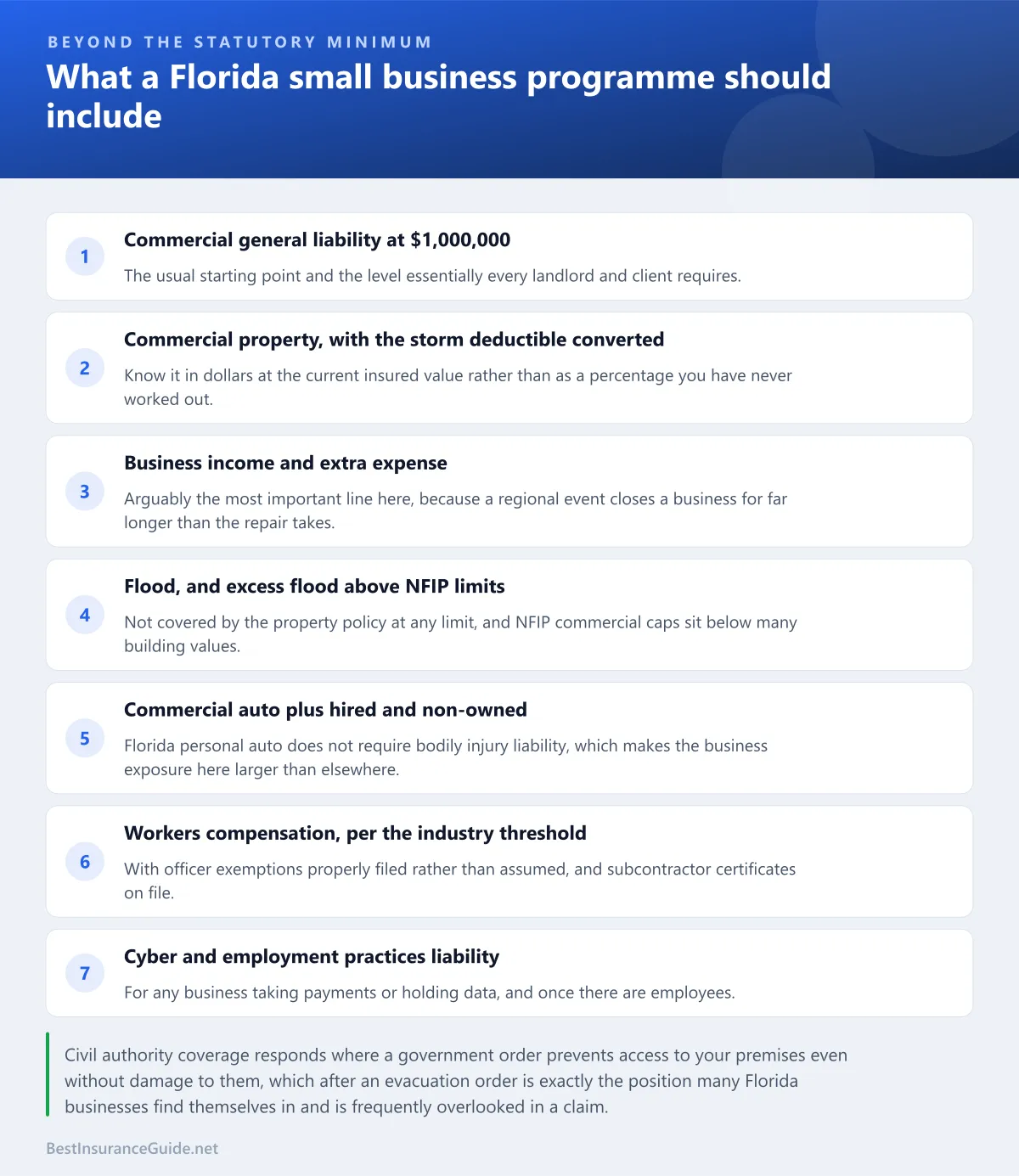
Commercial general liability, at $1,000,000 per occurrence as the usual starting point and as required by essentially every landlord and client.
Commercial property, with attention to the named storm deductible and to whether contents and improvements are adequately valued.
Business income and extra expense, as above.
Flood, both for the building and contents, and excess flood where NFIP limits are inadequate.
Commercial auto, plus hired and non-owned auto for employees driving their own vehicles on business. Note that Florida’s personal auto requirements do not include bodily injury liability, as our guide to Florida automobile insurance sets out, which makes the business exposure here larger than in other states.
Workers compensation, per the thresholds.
Cyber liability, for any business taking payments or holding customer data.
Employment practices liability, once there are employees.
A commercial umbrella above the liability lines, which is how contract limit requirements are met economically.
Managing the cost
Document mitigation features. Wind mitigation inspections and code compliance documentation directly affect property pricing and availability.
Address roof age proactively, since it is the single largest property underwriting factor.
Manage the workers compensation experience modification factor, which multiplies premium directly and responds to safety performance and claims handling over time.
Collect subcontractor certificates, without exception, which protects both the workers compensation position and the liability one.
Use a broker with Florida commercial experience, because the market has been through significant change and carrier appetite shifts.
Review limits annually against replacement cost, revenue and contract requirements, all of which move.
The short version
Florida requires workers compensation above thresholds that differ by industry, with construction treated most strictly and enforced actively through compliance checks and stop-work orders. Confirm the current thresholds rather than assuming.
The property side is the Florida problem. Named storm deductibles are percentages of insured value, wind and flood are separate policies with a contested boundary, NFIP commercial limits are capped, and roof age dominates underwriting.
Business income cover is arguably the most important line on a Florida programme, because a regional event closes a business for far longer than the repair takes, and civil authority cover responds even where the premises are undamaged.
And collect a certificate of insurance from every subcontractor before they start, because an uninsured subcontractor’s injured worker can become your responsibility.
For the umbrella layer, see business umbrella insurance, and for the programme generally, the business insurance checklist.
Preparing for the season, practically
A Florida business programme is only half the answer. The other half is what happens in the week before a storm and the week after.
Before the season. Photograph the premises inside and out, document the inventory and equipment with serial numbers, store the records off-site or in the cloud, confirm the named storm deductible in dollars rather than as a percentage, and confirm the business income limit and indemnity period.
Before a storm. Secure or move equipment and stock, relocate vehicles to higher ground away from trees, back up systems off-site, and confirm staff contact arrangements.
Immediately after. Photograph everything before any cleanup, report the claim promptly before the regional queue forms, mitigate further damage and keep receipts for doing so, and note the timing of wind against water because that allocation decides which policy pays.
Through the closure. Keep records of lost revenue and continuing expenses, ask specifically about civil authority coverage if an order kept you closed, and document extra expenses incurred to reopen sooner.
Worked example: what documentation is worth
Two identical businesses, both flooded and wind-damaged.
| Documented | Not documented | |
|---|---|---|
| Pre-loss condition evidence | Photographs and inventory | Memory |
| Wind and water allocation | Supported by timing evidence | Contested |
| Business income claim | Records of revenue and expenses | Reconstructed and disputed |
| Extra expense claim | Receipted | Largely lost |
| Recovery on a $400,000 exposure | Substantially higher | Substantially lower |
The coverage was identical. Documentation created before the storm and in the first week after it is what separates the columns.
Two things to confirm on your policy
The named storm deductible in dollars, calculated on the current insured value, rather than as a percentage. Business owners routinely know the percentage and have never converted it, and it is frequently a five-figure number.
The business income indemnity period and waiting period. Twelve months and 72 hours are common defaults, and after a regional event twelve months is frequently not enough. Extending it is inexpensive relative to what it protects.
The market conditions, and shopping in them
Florida commercial property has been through a period of contraction, and that changes how a business should approach placement.
Start earlier than you think. Renewal quotes take longer to obtain than they used to, and leaving it to the final fortnight limits your options.
Use a broker with genuine Florida commercial experience, because carrier appetite shifts and knowing who is writing what this quarter is the value they add.
Expect to be asked for documentation you would not previously have needed: roof age and condition, wind mitigation features, building code compliance, and updates to electrical and plumbing systems. Having it ready improves both the price and the availability.
Consider layering. Where a single carrier will not write the full property limit, brokers place layers with several, which is normal in this market rather than a sign of a problem.
Do not chase the cheapest number. A quote with a much higher named storm deductible, a lower business income limit or a shorter indemnity period is not the same product, and after a landfall the difference is what determines whether the business reopens.
Confirm the claims service. In a catastrophe-exposed state, how quickly an insurer responds and pays after a regional event matters more than a few hundred dollars of premium, and the Florida Office of Insurance Regulation publishes complaint information worth checking.
Two things to do before June
Convert the named storm deductible into a dollar figure and confirm you could produce it, because after a landfall contractors want deposits and lending is slow.
Photograph and inventory everything, stored off-site. It is a two-hour task that materially changes what a claim recovers, and it is the single highest-value preparation a Florida business can make.
Two questions for your broker
What is my named storm deductible in dollars at the current insured value, and what triggers it? Both parts matter. The dollar figure determines whether you could actually fund a claim, and the trigger wording determines whether a marginal event falls inside or outside it.
Is my business income indemnity period realistic for a regional event? Twelve months is a common default and after a widespread hurricane, reconstruction capacity across a region is exhausted for considerably longer than that. Extending it is one of the cheaper improvements available on a Florida programme.
How other states set the threshold
Florida varies its threshold by industry, with construction treated most strictly, which no other state we cover does in quite the same way.
Georgia is the closest comparison overall, sharing both a coastal property market and a three-employee count for most industries. Pennsylvania, New Jersey and Illinois all attach from the first employee, and Michigan applies a dual headcount and hours test.
A note on scope
Nothing here is legal advice. Florida workers compensation thresholds, exemption procedures, enforcement powers, property market conditions and Citizens eligibility are set by state law and regulation and change over time.
The Florida Division of Workers’ Compensation publishes the authoritative coverage requirements and exemption procedures, the Florida Office of Insurance Regulation publishes market and consumer information, and FEMA publishes flood zone determinations and NFIP commercial limits. Your policy documents and contracts are the authoritative statement of what you hold and what you must hold. This site is independent and not affiliated with any insurer.