Florida Automobile Insurance: The State That Does Not Require Injury Liability
Florida car insurance requirements, why bodily injury liability is not mandatory, how PIP works, hurricane comprehensive risk and how to compare quotes.

Table of contents

Florida is the clearest example in the country of a state whose minimum requirements do not describe the risk. Understanding one specific gap explains most of what goes wrong here.
What the state requires
| Coverage | Florida requirement |
|---|---|
| Personal injury protection | $10,000 |
| Property damage liability | $10,000 |
| Bodily injury liability | Not required for most drivers |
Read that last row again. Florida does not require most drivers to carry any bodily injury liability cover at all.
The design logic was that PIP would handle routine injury costs, so injury liability could be left optional. The practical result is that a large share of Florida drivers carry nothing that would pay for injuries they cause to somebody else.
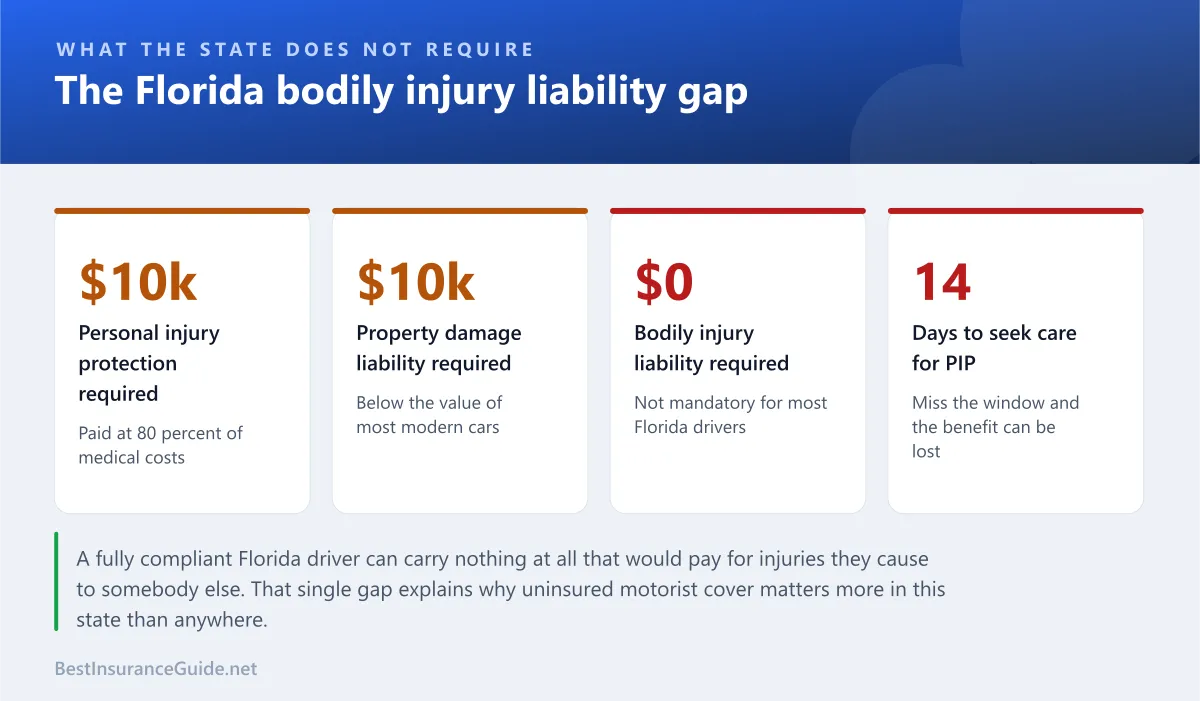
That single fact drives almost every piece of advice that follows.
How PIP works, and the 14-day rule
Florida PIP pays 80% of medical expenses and 60% of lost wages, up to a $10,000 limit, regardless of who caused the crash.
Three features catch people out.
The 14-day rule. You generally have to receive initial medical care within 14 days of the crash for PIP to respond at all. Miss that window and the benefit can be forfeited entirely. This is the single most common way a valid Florida PIP claim is lost, and it costs nothing to avoid.
The emergency medical condition distinction. Where no emergency medical condition is diagnosed, the available PIP benefit is substantially lower than the headline $10,000. That determination is made by a qualified provider and it materially changes what you receive.
It is a low limit. $10,000 at 80% is $8,000 of medical cover. A single ambulance ride, an emergency department visit and imaging can consume most of it.
Above the threshold, you may claim against the at-fault driver for pain and suffering, but only for a permanent injury as defined by Florida law. Below that threshold the claim is barred, which means PIP plus your own coverages is the whole of your recovery.
Why uninsured motorist cover matters more here
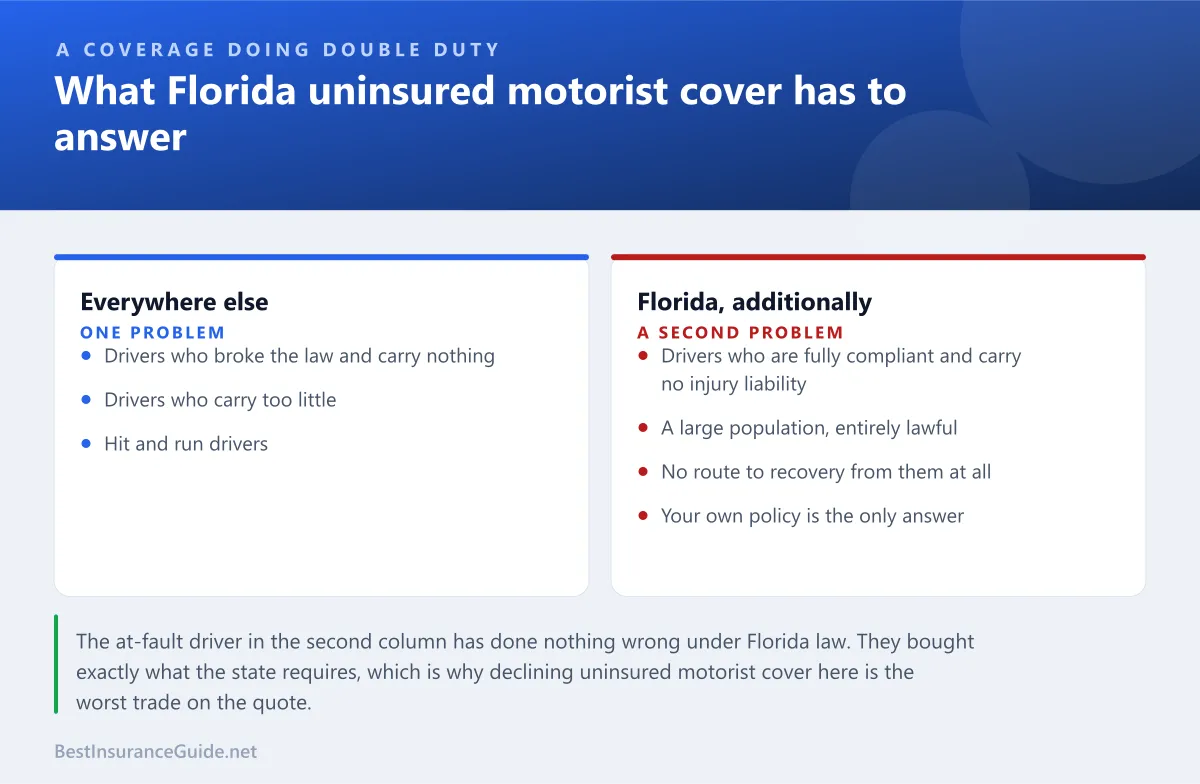
In most states, uninsured motorist cover answers the driver who broke the law by carrying nothing.
In Florida it also answers the far larger group of drivers who are fully compliant and carry no injury liability at all, because the state does not require it.
Worked example: hit by a compliant driver
Injuries and lost income of $95,000. The at-fault driver carries exactly the Florida minimum: PIP and $10,000 of property damage, no bodily injury liability.
| With $100,000 UM | Without UM | |
|---|---|---|
| Their bodily injury liability | $0, none carried | $0, none carried |
| Your PIP | Up to $10,000, at 80% | Up to $10,000, at 80% |
| Your uninsured motorist cover | Up to $100,000 | $0 |
| Recovered | Around $108,000 | Around $8,000 |
The at-fault driver in that example did nothing wrong under Florida law. They simply bought what the state requires, and there is no route to recovery from them beyond whatever personal assets a judgment could reach, which for most people is nothing.
Uninsured motorist cover is the answer, it is optional, and it is rejected on the form by a great many Florida drivers.
The hurricane and water problem
Florida’s comprehensive exposure is the largest in the country and it is entirely outside collision cover.
Hurricane wind and wind-borne debris.
Storm surge and flooding, which write off vehicles rather than damaging them. A flooded vehicle is almost always a total loss, and flood-damaged vehicles that reappear on the used market are a separate problem worth knowing about when buying.
Hail and falling trees.
Theft and vandalism, at rates well above the national average in parts of the south Florida metros.
All of those are comprehensive claims. A liability-only Florida policy pays nothing toward any of them.
Two practical points. Move the vehicle before a storm, to higher ground and away from trees, which is the cheapest claim avoidance available. And never drive through standing water, because a flooded engine is a write-off and the circumstances may be argued.
What moves a Florida quote
Your record, dominating for three to five years.
Where you park it. Miami-Dade, Broward and Hillsborough rate well above the state average, and the ZIP code spread inside those metros is itself large.
Continuous coverage, where a lapse is particularly expensive in Florida because the state suspends registration promptly on a reported gap.
The vehicle, specifically repair cost, theft rate and safety record.
Annual mileage and commute distance.
Coverage choices, including the bodily injury liability you are not required to carry, uninsured motorist limits and deductibles.
What to carry in Florida
Bodily injury liability at 100/300 or higher, despite it being optional. Not carrying it does not remove your liability; it removes your defence and your indemnity.
Uninsured and underinsured motorist at matching limits, which is the single most important optional coverage in the state.
Property damage liability well above $10,000.
Comprehensive, without hesitation, on any vehicle worth keeping.
Collision, on any vehicle you could not comfortably replace.
Rental reimbursement, because after a hurricane every body shop in the region is booked for months.
An umbrella policy above the auto liability if you have assets, which requires meaningful underlying liability limits to sit above.
The short version
Florida requires PIP and property damage liability and does not require bodily injury liability. That gap means a large share of fully compliant Florida drivers carry nothing that would pay for injuries they cause.
The response is to buy the coverage the state left out, on both sides. Carry real bodily injury liability so you are protected when you cause harm, and carry uninsured motorist cover so you are protected when somebody else does and has nothing.
Then remember the 14-day rule, because it is the cheapest thing on this page and it is how valid PIP claims are most commonly lost.
For what happens after a crash that was not your fault, see car accident not your fault, and for the full discount list, auto insurance discounts.
After a crash in Florida, in order
The Florida sequence differs from most states because of the 14-day rule and the PIP structure, and getting the first week right decides a great deal.
Call the police and get a report number, on anything beyond the most trivial contact.
Photograph before the vehicles move: positions, damage on both vehicles, road markings, signals, skid marks, debris, weather and light.
Photograph the other driver’s licence, insurance card and registration.
Collect witness contact details.
Report to your own insurer immediately, because your PIP is the first payer regardless of fault and delay delays it.
Get medical attention within 14 days, and preferably the same day. This is the single most consequential item on the list. Florida PIP generally requires initial care within 14 days of the crash, and missing the window can forfeit the benefit entirely.
Ask whether an emergency medical condition has been diagnosed, because that determination governs how much of the $10,000 is actually available.
Keep every record: treatment notes, bills, mileage to appointments, and employer confirmation of any lost work.
Florida regions, and what changes between them
Miami-Dade and Broward rate highest in the state, driven by frequency, litigation costs, theft and a large uninsured population. The ZIP code spread inside those counties is itself substantial.
Tampa, Orlando and Jacksonville rate above the state average while sitting below south Florida.
The Gulf coast counties carry the heaviest hurricane comprehensive exposure.
Inland central and north Florida rates lowest on frequency and carries meaningful deer collision and flooding exposure.
Two Florida checks worth doing this month
Look at whether your policy carries bodily injury liability at all, and at what limit. A substantial number of Florida policies carry none, because none is required, and the owner has no idea. Adding it is the single most important change most Florida drivers could make.
Look at whether uninsured motorist cover is present, and whether it is stacked where your policy permits it. In a state where compliant drivers routinely carry no injury liability, this is the coverage that answers the most common serious scenario, and it is optional.
Both of those are lines on the declarations page and both are a phone call to change.
Buying a used car in Florida
This belongs on an insurance page because it is an insurance problem as much as a purchase one.
Florida produces a large number of flood-damaged vehicles, and after a major storm those vehicles enter the used market across the country. Some are properly branded as salvage or flood; some have been moved through states with weaker titling rules and reappear with a clean title.
Four checks before buying.
Run the vehicle identification number through a history service and check for a salvage, flood or total loss brand, and for a title that has moved between states shortly after a storm.
Look and smell for water. Silt under the carpet and in the boot well, corrosion on unpainted metal under the seats, water lines in the engine bay, damp or mildew smell, and moisture inside light housings.
Check the electrics thoroughly. Every window, every seat motor, the infotainment, the lights and the climate control. Flood damage shows up as intermittent electrical faults months later.
Have it inspected independently, which costs little relative to the risk.
The insurance consequence is direct: a vehicle with a flood or salvage brand is harder to insure, frequently cannot be written with comprehensive and collision, and settles for substantially less if it is written at all.
When to re-quote in Florida
Every two years as a baseline, and immediately after a move, a household change, a vehicle change, a violation ageing off the record, or any renewal that arrived materially higher without an obvious cause.
Each time, write the package down first: the bodily injury liability limits you have chosen to carry despite them being optional, the uninsured motorist limits and whether they are stacked, the property damage limit, and the deductibles. Then quote that exact specification across three carriers including an independent agent. In Florida more than anywhere, comparing quotes without checking whether bodily injury liability is present at all is comparing two different products.
Where Florida drivers overpay, and where they underinsure
The overpaying is ordinary: a lapse in the record, which Florida punishes quickly through registration suspension, plus a stale mileage figure and no bundling.
The underinsuring is structural and it is the whole story of this state.
No bodily injury liability at all, which the state permits and a large number of drivers rely on. It removes your indemnity and your legal defence, and it leaves you personally liable for injuries you cause.
Uninsured motorist cover rejected, which is the coverage that answers the very population the state has created by not requiring injury liability.
PIP treated as sufficient, when $10,000 at 80% is $8,000 of medical cover and an ambulance ride plus an emergency department visit can consume most of it.
Comprehensive dropped in the state with the largest hurricane and flood exposure in the country.
Every one of those is a line on the declarations page, and every one is a phone call to change.
How other no-fault states compare
Florida requires personal injury protection and does not require bodily injury liability, which is unusual even among no-fault states.
Kansas requires both, and mandates uninsured and underinsured motorist cover at matching limits on top. Kentucky lets drivers reject the no-fault system entirely in writing. Pennsylvania offers a choice through its tort election while still requiring liability cover.
Florida is the only one of the four where a fully compliant driver can carry nothing at all that would pay for injuries they cause.
Related reading
Does insurance cover a stolen car covers the comprehensive claim that matters most in a state with Florida’s theft and flood exposure. Zero down car insurance covers the payment structures marketed hardest in states where minimum-limit policies are common.
A note on scope
Premium figures here are illustrative rather than quotes, and Florida pricing varies substantially by county and ZIP code, driving record, vehicle, coverage selected and individual insurer. Statutory requirements, PIP rules and the injury threshold are set by Florida law and change over time, and Florida’s no-fault framework has been the subject of repeated legislative attention.
The Florida Office of Insurance Regulation and the Florida Department of Highway Safety and Motor Vehicles publish the current requirements and consumer guidance, and the NAIC publishes comparative data by state. Nothing here is legal advice. This site is independent and not affiliated with any insurer.