Does Insurance Cover a Stolen Car? Only If You Bought Comprehensive
How a stolen car claim works, why comprehensive is the only coverage that pays, how the settlement is calculated, and what happens if the car is recovered.

Table of contents
A stolen vehicle is one of the clearest coverage questions in insurance and one of the most commonly misjudged, because the answer depends entirely on a coverage many drivers dropped to save money.
Comprehensive is the only answer
Theft is a comprehensive claim. Not collision, not liability.
That single fact decides everything.
Liability-only policies pay nothing. No exceptions, no partial payment, nothing.
Collision does not apply, because there was no impact.
Comprehensive pays, subject to its deductible.
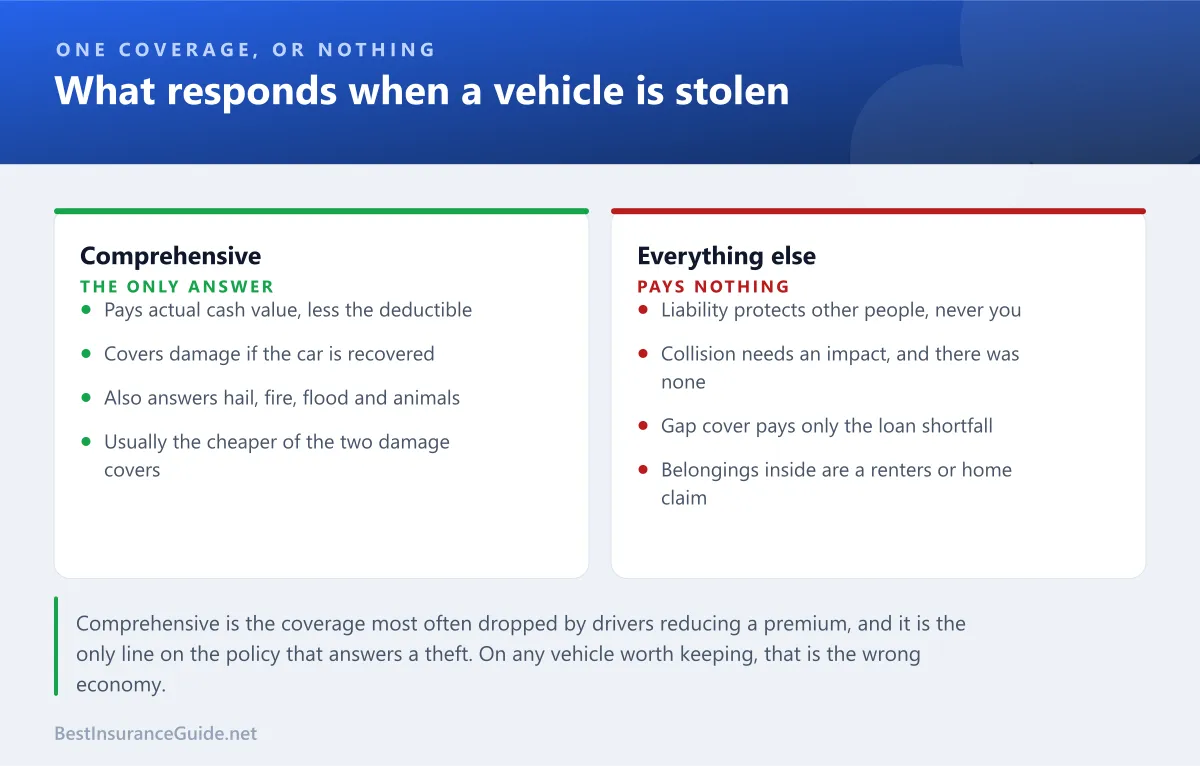
Comprehensive is typically the cheaper of the two physical damage coverages, and it is the one most commonly dropped by drivers reducing a premium. On any vehicle worth keeping, that is the wrong economy: comprehensive answers theft, weather, animals, fire, flooding and falling objects all at once.
What it actually pays
The actual cash value of the vehicle at the time of the theft, less your deductible.
Three things people expect it to be, which it is not:
Not what you paid. Depreciation applies.
Not what you owe. The loan is irrelevant to the settlement calculation.
Not the cost of a replacement you would like. It is what your specific vehicle, at its mileage and condition, was worth.
Actual cash value is established from market data for comparable vehicles in your area, adjusted for mileage, condition, options and history. It is negotiable, and the negotiation is evidence-based rather than a matter of opinion.
Worked example: a financed vehicle stolen
A three-year-old vehicle, $500 comprehensive deductible.
| Amount | |
|---|---|
| Actual cash value at theft | $19,400 |
| Less comprehensive deductible | $500 |
| Insurer pays | $18,900 |
| Outstanding loan balance | $23,100 |
| Shortfall owed by you | $4,200 |
That last row is why gap insurance exists, and why it matters most on newer financed vehicles with small deposits. Our guide to gap insurance sets out when it is worth carrying.
The belongings inside are a different policy
This surprises people every time, and the logic is consistent.
The auto policy covers the vehicle. The laptop on the seat, the tools in the boot, the pushchair, the sports equipment and the shopping are personal property, and they belong to your renters or homeowners policy under off-premises coverage.
That means:
A separate claim, with a separate deductible, on a different policy.
Category sublimits still apply. Cash is capped at a few hundred dollars, and jewellery, firearms and electronics may be limited.
Permanently installed equipment is different. A factory or professionally fitted stereo, built-in navigation and mounted speakers are part of the vehicle and fall under the auto policy, sometimes subject to a custom equipment limit.
Our guide to whether renters insurance covers car break-ins works through the split in detail, and the same division applies to a full theft.
The waiting period
Insurers do not settle a theft claim immediately, and it is worth knowing why before it happens to you.
Most apply a waiting period, commonly around 14 to 30 days, before paying out, because a meaningful proportion of stolen vehicles are recovered within that window. Settling immediately and then recovering the car creates a mess for everybody.
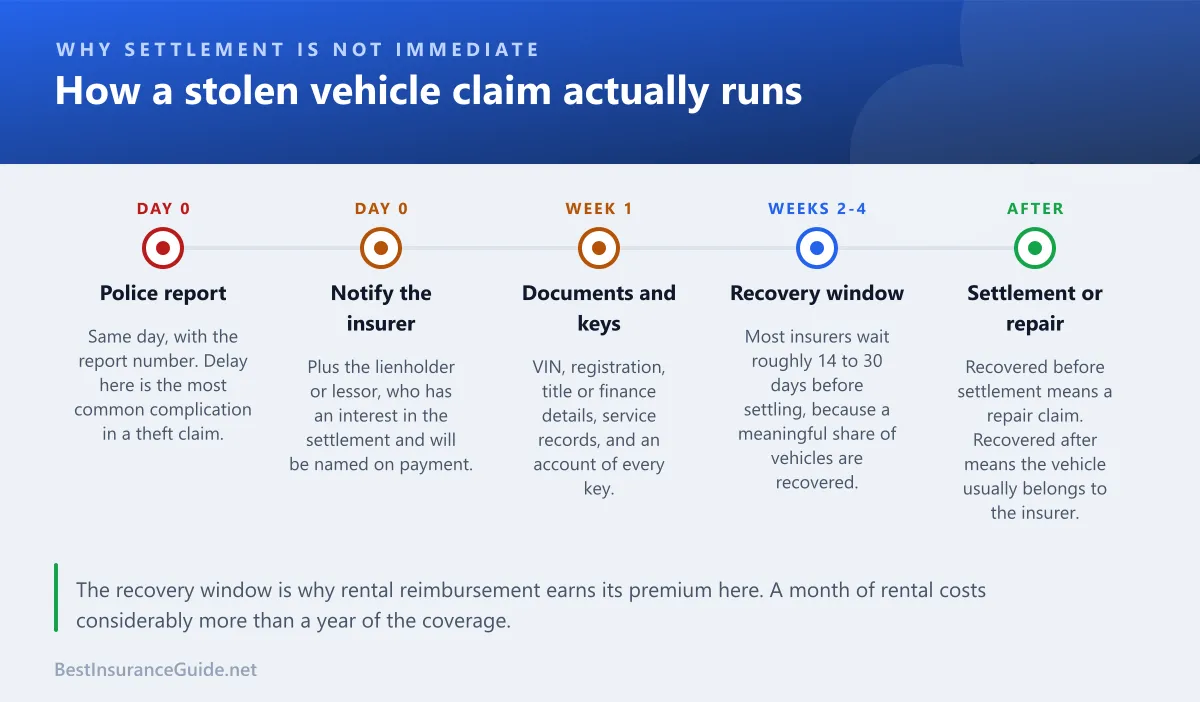
During that period you are without a vehicle, which is where rental reimbursement earns its premium. It is inexpensive, and a month of rental costs considerably more than a year of the coverage.
If the car is recovered
Two scenarios, and the timing decides which.
Recovered before settlement. The claim becomes a damage claim rather than a total loss. The insurer repairs whatever was done to it under the same comprehensive claim and the same deductible. Recovered vehicles are frequently damaged, stripped of parts, or have had ignition and lock damage.
Recovered after settlement. The vehicle generally belongs to the insurer at that point, because they have paid you its value. Many insurers will allow you to buy it back if you want it, and whether that is sensible depends entirely on its condition.
Either way, a recovered vehicle should be inspected properly before you drive it again. Ignition damage, cut wiring and missing safety components are common and are not always obvious.
What to do when it happens
Call the police immediately and get the report number. Every insurer will require it, and delay is the most common complication in a theft claim.
Call your insurer the same day.
Gather what they will ask for: the vehicle identification number, the registration, the title or lienholder details, service records, and photographs if you have them.
Account for all the keys. Insurers ask, and being unable to produce them invites questions. This is one of the more common friction points in a theft claim.
List what was inside, with model and serial numbers where you have them, and open a separate claim on your renters or homeowners policy.
Tell the lienholder or lessor, because they have an interest in the settlement and will be named on the payment.
Cancel anything connected to the vehicle, including toll transponders and parking permits, and change any garage or gate codes if a remote was in the car.
Check for tracking data. Many modern vehicles have connected services that can assist recovery, and telling the police early matters more than telling them well.
Reducing the odds
Theft is highly concentrated by model, area and opportunity.
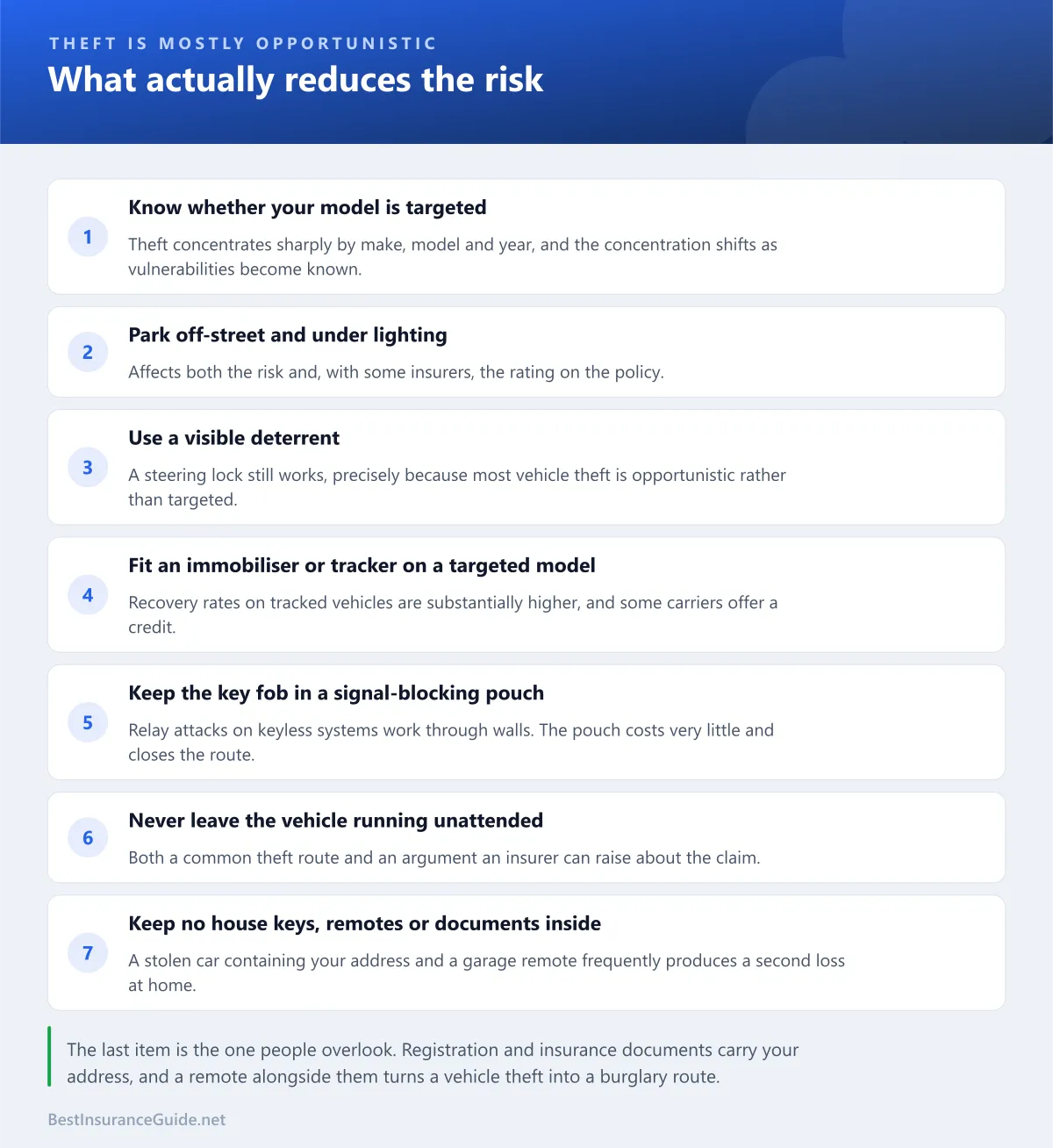
Know whether your model is targeted, since concentration shifts as vulnerabilities become known and some carriers restrict cover on affected models.
Park off-street and under lighting, which affects both risk and, in some cases, rating.
Use a visible deterrent, including a steering lock, which remains effective precisely because theft is largely opportunistic.
Fit an immobiliser or tracker on a targeted model, which raises recovery rates substantially and sometimes earns a discount.
Never leave the vehicle running unattended, which is both a theft route and an argument an insurer can raise.
Keep keys away from the front door, since relay attacks on keyless systems work through walls. A signal-blocking pouch costs very little.
Leave nothing visible, because a large share of vehicle crime is opportunistic and starts with something on a seat.
The short version
A stolen car is covered by comprehensive coverage and by nothing else. A liability-only policy pays nothing.
The settlement is the vehicle’s actual cash value less your deductible, which is neither what you paid nor what you owe. If the loan exceeds the value, gap insurance is what closes the difference and nothing else will.
Your belongings inside the car are a separate claim on your renters or homeowners policy, with a separate deductible and its own sublimits.
Expect a waiting period of two to four weeks before settlement in case the car is recovered, which is exactly what rental reimbursement is for.
For the loan shortfall, see gap insurance explained, and for the contents side, does renters insurance cover car break-ins.
Negotiating the settlement
An actual cash value settlement is an opinion supported by data, and it is negotiable. Most people accept the first figure and a meaningful proportion of those figures are low.
Ask for the valuation report. The insurer used comparable vehicles to reach the number, and you are entitled to see which ones.
Check the comparables are genuinely comparable. Same trim, similar mileage, similar condition, and from your actual market rather than a cheaper region.
Supply your own evidence. Listings for the same year, trim and mileage in your area, dated. Three or four good ones are worth more than a general argument.
Document the condition and history. Service records, recent tyres, a recent timing belt or clutch, new brakes. Recent significant work supports a higher figure and is routinely ignored unless you raise it.
List the options. Trim level, factory options and packages are frequently missed in an initial valuation, particularly on a vehicle the insurer never saw.
Check what the settlement includes. Sales tax and registration or title fees are payable in many states as part of a total loss settlement, and are sometimes omitted from an initial offer.
Worked example: a documented rebuttal
| Initial offer | After evidence | |
|---|---|---|
| Base valuation | $17,600 | $17,600 |
| Trim and options correction | — | +$900 |
| Mileage adjustment, below average | — | +$650 |
| Recent tyres and brakes | — | +$400 |
| Sales tax and fees, where payable | Omitted | Added |
| Settlement | $17,600 | $19,550 plus taxes and fees |
None of that is confrontational. It is supplying information the insurer did not have about a vehicle they never inspected.
Preventing the second loss
A stolen vehicle frequently produces a second problem that has nothing to do with the car.
Anything in the vehicle that identifies your home. Registration documents, insurance documents and post all carry your address, and a garage remote or a house key alongside them is a burglary route. This is a genuine pattern rather than a theoretical risk.
The practical response is simple. Keep registration and insurance documents on your phone rather than in the glovebox where your state permits it, keep no house keys or garage remotes in the vehicle, and if a car is stolen with a remote in it, change the code the same day.
Gap insurance, and when it matters
Because the settlement is the vehicle’s value rather than the loan balance, the shortfall question deserves a direct answer.
You are exposed to a shortfall when the loan exceeds the value. That is most common in the first two or three years of a new vehicle purchase, on a long loan term, with a small deposit, or where negative equity from a previous vehicle was rolled into the new loan.
Gap insurance covers exactly that difference, and it responds to a total loss from any covered cause, theft included.
It is available from several places and the price varies enormously between them: the dealer at the point of sale, your own auto insurer as an endorsement, and some credit unions. The insurer endorsement is frequently the cheapest by a wide margin.
It stops being useful once the loan balance falls below the vehicle value, and continuing to pay for it after that point is a common small waste.
Our guide to gap insurance sets out the arithmetic in full.
Keys, and the question insurers ask
Nearly every theft claim includes a question about the keys, and the reason is that key-enabled thefts are a large share of the total.
You will be asked to account for all of them, including any held by a garage, a valet service or a previous owner.
Leaving keys in the vehicle is excluded or restricted under some policies, and leaving a vehicle running unattended gives an insurer grounds to argue on most.
Keyless entry relay attacks are a genuine and growing route, and they work through walls. A signal-blocking pouch for the fob costs very little and removes the exposure.
A missing key is not automatically a denial, but it lengthens the investigation, which matters when a settlement is already several weeks away.
Related reading
Two adjacent questions decide what a theft claim actually leaves you with. Comprehensive deductible explained covers the coverage that answers theft and why its deductible deserves different treatment from collision. Does car insurance cover repairs covers what happens when a stolen vehicle is recovered damaged rather than written off.
A note on scope
Waiting periods, key-related exclusions, custom equipment limits and settlement practices vary between insurers and between states, and change over time. Figures here are illustrative rather than quotes.
Your own declarations page states whether you carry comprehensive coverage and at what deductible, and your policy wording is the authoritative statement of how a theft claim is handled. Your state insurance department publishes consumer guidance on total loss settlements. This site is independent and not affiliated with any insurer.